Summary
- AI hallucinations about brands are systematic failures, not rare glitches -- models confidently state wrong headquarters, discontinued products, or fabricated details
- The fix isn't waiting for AI companies to improve their models -- it's taking control of the sources these systems reference
- A 5-step process works: identify hallucinations with brand-specific prompts, audit where misinformation originates, repair inaccurate sources, create authoritative content, and monitor continuously
- Tools like Promptwatch automate tracking across 10+ AI models and surface the exact content gaps causing hallucinations
- Most hallucinations stem from outdated Wikipedia entries, incorrect business directory listings, and third-party mentions that AI models weight heavily
What you're up against
Your potential customers are asking ChatGPT about your brand right now. The AI might be confidently stating you're headquartered in the wrong city, offering products you discontinued years ago, or attributing your company's founding to someone who never worked there. A recent comparison of 29 Large Language Models found hallucination rates ranging from 15-52%, even in top systems like GPT-5, Gemini, and Claude. These aren't edge cases -- they're costing businesses real money.
The problem compounds because AI-generated responses often become a user's first exposure to your brand. When that information conflicts with what appears on your website, it confuses readers and erodes trust in both sources. The solution isn't waiting for AI companies to fix their models. It's taking control of the sources these systems reference.
Step 1: Identify hallucinations with systematic prompts
Start by querying each major AI platform with brand-specific prompts. Don't just search for your company name -- that's too broad. Test prompts that reveal specific factual claims:
- "Who founded [Your Company] and when?"
- "What products does [Your Company] offer?"
- "Where is [Your Company] headquartered?"
- "What is [Your Company]'s main business model?"
- "Tell me about [Your Company]'s history and key milestones"
Run these prompts across ChatGPT, Claude, Perplexity, Gemini, and Google AI Overviews. Document every response. Look for inconsistencies between what the AI states and what's actually true. Pay attention to:
- Factual errors (wrong dates, locations, people)
- Outdated information (discontinued products presented as current)
- Conflated details (mixing your brand with a competitor)
- Fabricated claims (features or achievements you never had)
Manual testing works for initial discovery, but it doesn't scale. If you're serious about tracking hallucinations over time, you need automation. Promptwatch monitors 10 AI models daily and surfaces exactly what each model says about your brand, making it easy to spot hallucinations as they emerge.

The key is testing prompts your actual customers would use. Generic brand searches miss the nuanced ways people ask about specific products, features, or use cases. Build a prompt library that mirrors real customer questions.
Step 2: Audit where misinformation originates
Once you've identified hallucinations, trace them back to their source. AI models don't invent facts from nothing -- they synthesize information from the web. The most common culprits:
Wikipedia entries: Often outdated or edited by non-experts. AI models weight Wikipedia heavily because it's structured and authoritative-looking.
Business directory listings: Sites like Crunchbase, LinkedIn, and industry directories. If your profile hasn't been updated in years, AI models will cite that stale data.
Third-party mentions: Blog posts, news articles, and forum discussions. Even a single high-authority site stating incorrect information can propagate across AI responses.
Your own website: Ironically, outdated content on your site can confuse AI models. If your "About" page still lists a former CEO or your product pages reference discontinued features, models will cite that.
To audit sources, look at the citations AI models provide when they answer prompts. Perplexity and Google AI Overviews show sources directly. For ChatGPT and Claude, you can often infer sources by asking follow-up questions like "Where did you get that information?" or by searching for the exact phrasing the model used.
Use tools like Ahrefs or Semrush to find every mention of your brand across the web. Filter for high-authority domains -- those are the ones AI models trust most.
Step 3: Repair inaccurate sources
Now comes the work: fixing the sources causing hallucinations. Prioritize by authority and reach.
Fix Wikipedia first: If your brand has a Wikipedia page, update it with accurate, well-sourced information. Wikipedia requires citations from reliable sources, so you can't just edit it yourself -- you need to cite reputable publications that state the correct facts. If those publications don't exist, create them (more on that in Step 4).
Update business directories: Claim and update your profiles on Crunchbase, LinkedIn, AngelList, and industry-specific directories. Ensure every field -- founding date, headquarters, product descriptions, key people -- is accurate and current.
Contact third-party sites: For blog posts or articles stating incorrect information, reach out to the author or site owner. Most will update or remove inaccuracies if you provide proof. For high-authority sites, this is worth the effort.
Audit your own website: Run a content audit to find outdated information. Update your About page, product pages, and press releases. Remove or archive old content that no longer reflects reality.
Standardize naming and descriptions: AI models get confused by inconsistent terminology. If you call your product "Platform X" on your website but "X Platform" in press releases, models might think they're different products. Pick one name and use it everywhere.
This screenshot from a GEO audit tool shows how to identify which sources AI models are citing -- the first step in fixing hallucinations at the root.
Step 4: Create authoritative content AI models will cite
Repairing existing sources stops the bleeding. Creating new, authoritative content ensures AI models have accurate information to cite going forward.
Publish a comprehensive brand fact sheet: Create a single, definitive page on your website that states all key facts about your brand -- founding date, headquarters, products, leadership, milestones. Use structured data markup (Schema.org) so AI models can parse it easily.
Write detailed product documentation: AI models love documentation because it's factual and specific. Publish comprehensive guides for each product that explain what it does, how it works, and who it's for.
Get cited by authoritative publications: Pitch stories to reputable industry publications. When they write about your brand, they become citeable sources AI models trust. Focus on publications AI models already cite frequently.
Leverage structured data: Implement Schema.org markup for Organization, Product, and FAQPage. This helps AI models extract accurate information directly from your site.
Build a press page: Maintain an up-to-date press page with recent news, press releases, and media mentions. Link to authoritative sources that state correct facts about your brand.
Tools like Promptwatch include an AI writing agent that generates content grounded in real citation data -- articles, listicles, and comparisons engineered to get cited by ChatGPT, Claude, and Perplexity. This isn't generic SEO filler. It's content built from 880M+ citations analyzed across AI models, designed to close the exact content gaps causing hallucinations.
Step 5: Monitor continuously and catch new hallucinations early
Hallucinations aren't a one-time fix. AI models retrain, new sources appear, and old misinformation resurfaces. Continuous monitoring is the only way to stay ahead.
Set up automated tracking: Manual prompt testing doesn't scale. Use a monitoring platform that queries AI models daily and alerts you when responses change. Promptwatch tracks 10 AI models and surfaces exactly what each one says about your brand, making it easy to spot new hallucinations as they emerge.
Track prompt volumes and difficulty: Not all prompts matter equally. Focus on high-volume prompts where hallucinations cause the most damage. Promptwatch provides volume estimates and difficulty scores for each prompt, so you can prioritize fixes that move the needle.
Monitor AI crawler logs: AI models discover your content through crawlers like GPTBot (ChatGPT), ClaudeBot (Claude), and PerplexityBot. If these crawlers encounter errors or can't access key pages, they won't cite your content. Promptwatch's AI Crawler Logs show real-time logs of which pages AI crawlers read, errors they encounter, and how often they return.
Measure visibility over time: Track your visibility scores across AI models. As you fix hallucinations and publish authoritative content, your scores should improve. Page-level tracking shows exactly which pages are being cited, how often, and by which models.
Close the loop with traffic attribution: Visibility is meaningless if it doesn't drive traffic. Use Promptwatch's traffic attribution (code snippet, Google Search Console integration, or server log analysis) to connect AI visibility to actual website visits and revenue.
Comparison: tools for tracking AI hallucinations
| Tool | AI models tracked | Hallucination detection | Content gap analysis | AI crawler logs | Pricing |
|---|---|---|---|---|---|
| Promptwatch | 10 (ChatGPT, Claude, Perplexity, Gemini, etc.) | Yes | Yes | Yes | From $99/mo |
| Otterly.AI | 3 (ChatGPT, Perplexity, Google AI) | Basic | No | No | From $99/mo |
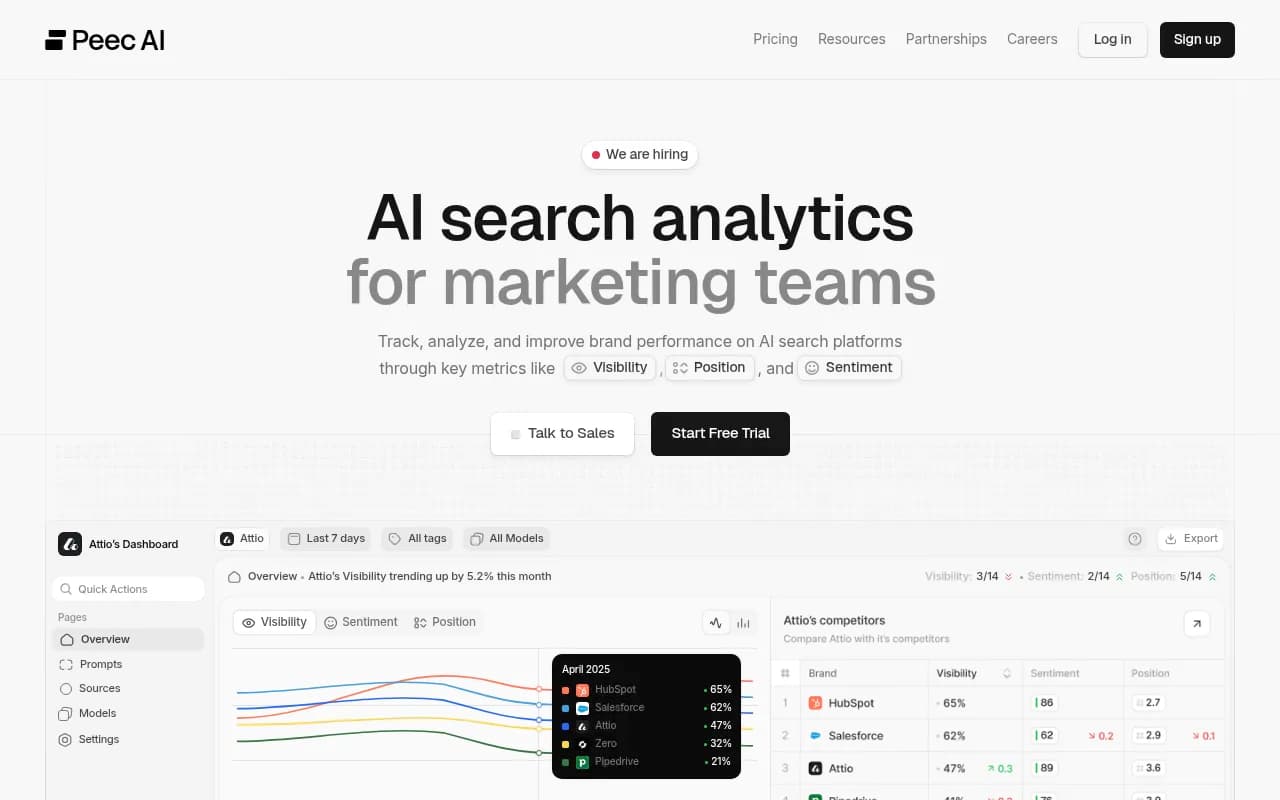
| Peec AI | 3 (ChatGPT, Perplexity, Claude) | Basic | No | No | From $99/mo |
| TrackMyBusiness | 3 (ChatGPT, Gemini, Perplexity) | Basic | No | No | From $49/mo |
| Semrush | Fixed prompts only | No | No | No | From $139.95/mo |
Otterly.AI

Most competitors stop at monitoring -- they show you what AI models say but leave you stuck figuring out how to fix it. Promptwatch is built around the action loop: find the gaps (Answer Gap Analysis shows exactly which prompts competitors are visible for but you're not), create content that ranks (built-in AI writing agent generates articles grounded in real citation data), and track the results (visibility scores improve as AI models start citing your new content).
Why hallucinations happen and how to prevent them
AI models hallucinate because they're trained to generate plausible-sounding text, not to verify facts. When a model encounters conflicting information about your brand, it doesn't know which source is correct -- it just synthesizes something that sounds coherent. The result: confident-sounding nonsense.
Prevention comes down to source control. The more authoritative, consistent, and up-to-date your brand information is across the web, the less room there is for hallucinations. This means:
- Claiming and updating every business directory listing
- Maintaining a single source of truth on your website with structured data
- Getting cited by authoritative publications that AI models trust
- Monitoring for new mentions and correcting inaccuracies quickly
- Ensuring AI crawlers can access and index your content without errors
The brands that win in AI search are the ones that treat it like a systematic optimization problem, not a one-time fix. They monitor continuously, fix sources as hallucinations emerge, and publish authoritative content that AI models can't ignore.
What to do right now
Start with a baseline audit. Query ChatGPT, Claude, and Perplexity with 10-15 brand-specific prompts. Document every hallucination you find. Then trace each one back to its source -- Wikipedia, business directories, third-party mentions, or your own website.
Fix the highest-authority sources first. Update Wikipedia if you have a page. Claim and correct your Crunchbase and LinkedIn profiles. Reach out to publications stating incorrect facts.
Then set up continuous monitoring. Manual testing doesn't scale and you'll miss new hallucinations as they emerge. Promptwatch offers a free trial -- it's the fastest way to see exactly what AI models say about your brand and where the gaps are.
Hallucinations aren't going away. AI models will keep retraining, new sources will appear, and old misinformation will resurface. The brands that stay ahead are the ones that treat AI visibility as an ongoing optimization process, not a one-time fix.