Summary
- AI search platforms like ChatGPT, Perplexity, and Gemini reveal which brands get recommended together -- exposing partnership patterns competitors miss
- Citation and source analysis shows which platforms, communities, and content types AI models trust -- revealing untapped distribution channels
- Competitor heatmaps and prompt tracking identify gaps where your brand could fill a recommendation slot alongside established players
- Reddit and YouTube insights surface grassroots partnerships and influencer opportunities before they hit mainstream radar
- Tools like Promptwatch turn AI search monitoring into actionable partnership intelligence with citation analysis, competitor tracking, and content gap identification

The partnership intelligence hiding in AI search responses
When someone asks ChatGPT "What's the best project management tool for remote teams?" the answer doesn't just list tools. It describes ecosystems. "Asana integrates well with Slack and Google Drive." "Monday.com works seamlessly with Zoom and Microsoft Teams." "Notion pairs nicely with Figma for design workflows."
These aren't random mentions. AI models learn partnership patterns from millions of pages, reviews, and discussions. They surface which tools get used together, which platforms complement each other, and which brands appear in the same buyer conversations.
Most companies track whether they're mentioned. The smarter play: track who they're mentioned with.
This is partnership intelligence at scale. Instead of guessing which integrations to build or which co-marketing deals to pursue, you're seeing the actual recommendation patterns that shape buyer decisions.
Why traditional partnership research misses the real opportunities
The old playbook for finding partners:
- Look at who your competitors integrate with
- Check industry reports for "ecosystem" diagrams
- Ask your sales team which tools customers mention
- Browse G2 and Capterra for related categories
This approach has three problems.
First, it's backward-looking. By the time a partnership shows up in a press release or integration directory, everyone's already seen it. You're chasing established plays, not discovering new ones.
Second, it's biased toward large players. Traditional research surfaces the Salesforces and HubSpots of the world because they have massive marketing budgets. It misses the emerging tools that are gaining traction in specific communities but haven't hit mainstream awareness yet.
Third, it's manual and slow. Analyzing competitor partnerships across dozens of tools, reading through integration docs, and tracking co-marketing campaigns takes weeks. By the time you've mapped the landscape, it's changed.
AI search data solves all three problems. It's real-time (updated as models retrain), unbiased (reflects actual usage patterns, not marketing spend), and automated (you're analyzing thousands of prompts, not reading press releases one by one).
The four types of partnership opportunities AI search reveals
Integration partnerships: who gets recommended together
AI models learn which tools work well together from documentation, reviews, and user discussions. When Perplexity recommends "Notion for documentation, Figma for design, and Linear for project tracking," it's surfacing a real workflow pattern.
Track these co-mentions systematically and you'll spot integration opportunities before your competitors do.
Example: A B2B analytics platform notices that ChatGPT frequently mentions their tool alongside a specific data warehouse they don't currently integrate with. Digging deeper, they find the co-mention appears in 40+ prompts about "real-time reporting for e-commerce." They reach out to the data warehouse, build the integration, and start getting cited in that specific use case.
Distribution partnerships: where AI models find your content
Citation analysis shows exactly which websites, YouTube channels, Reddit threads, and documentation sites AI models pull from when answering questions in your category.
If Claude consistently cites a specific SaaS review blog when comparing project management tools, that's a distribution partner worth knowing. If Gemini pulls heavily from a particular YouTube channel for "how to" queries, that's an influencer partnership opportunity.
Most brands focus on getting cited themselves. The smarter move: identify the sources AI models already trust, then get your content onto those platforms.

Co-marketing partnerships: shared audience signals
When AI models recommend your competitor alongside a specific tool in a different category, that's an audience overlap signal. If ChatGPT frequently mentions "Competitor A for email marketing and Tool B for landing pages," it means those brands share a buyer persona.
You can use this to identify co-marketing partners who reach the same audience but don't compete with you directly.
Example: A CRM platform notices that Perplexity often recommends a specific webinar platform when discussing "sales enablement workflows." They reach out to the webinar company, propose a joint content series on "Turning Webinar Attendees into Pipeline," and both brands start getting cited together in that prompt category.
Ecosystem partnerships: category adjacency patterns
Some partnership opportunities aren't obvious until you see the full picture of how AI models categorize your space.
A tool might think they're in "project management" but AI models consistently place them in "product development workflows" alongside design tools, roadmap platforms, and user research software. That's a signal to explore partnerships in adjacent categories you hadn't considered.
Prompt fan-outs (how one query branches into related sub-queries) reveal these category relationships. If "best project management tools" frequently leads to follow-up prompts about "design collaboration" and "product roadmapping," those are ecosystem partnership categories worth exploring.
How to extract partnership intelligence from AI search platforms
Step 1: Map your competitor's co-mention network
Start by tracking which brands appear alongside your competitors in AI responses. You need:
- The specific prompts where co-mentions occur
- How often each brand pair appears together
- Which AI models favor which partnerships
- Whether the co-mentions are positive, neutral, or comparative
Manual approach: Search for your competitor in ChatGPT, Perplexity, Claude, and Gemini using 20-30 relevant prompts. Note every other brand mentioned. Repeat weekly.
Automated approach: Use a platform like Promptwatch that tracks competitor mentions across models and surfaces co-citation patterns automatically.
The automated approach scales better. You're analyzing hundreds of prompts, not dozens, and you're tracking changes over time to spot emerging partnerships before they become obvious.
Step 2: Analyze citation sources for distribution channels
Every time an AI model cites a source, it's revealing a trusted distribution channel. Track:
- Which websites get cited most often in your category
- Which YouTube channels AI models pull from
- Which Reddit communities influence recommendations
- Which documentation sites and knowledge bases appear frequently
This tells you where to focus partnership outreach. If a specific blog gets cited 50 times across prompts in your category, that's a high-value partner. If a YouTube channel appears in 30 citations, that's an influencer worth reaching out to.
Tools like Promptwatch surface these citation patterns automatically. You see exactly which sources AI models trust, how often they're cited, and for which types of queries.
Step 3: Identify prompt gaps where partnerships could help
Answer Gap Analysis shows prompts where competitors appear but you don't. Some of these gaps exist because you're missing content. Others exist because you're missing partnerships.
Example: ChatGPT recommends Competitor A for "marketing automation with Salesforce integration" but doesn't mention your tool. You check -- you have a Salesforce integration. The problem: it's not documented anywhere AI models can find it, and you're not co-marketing with Salesforce.
That's a partnership gap. You need to either get featured in Salesforce's integration directory, co-create content with them, or get cited on third-party sites that discuss Salesforce ecosystems.
Prompt gap analysis reveals these opportunities systematically. You're not guessing which partnerships to pursue -- you're seeing exactly where a partnership would close a visibility gap.
Step 4: Track partnership momentum with visibility scoring
Once you identify potential partners, track whether pursuing them actually improves your AI visibility.
Set up tracking for:
- Prompts where you want to appear alongside the partner
- Citation rates before and after partnership activities
- Share of voice in co-mention scenarios
- Traffic attribution from AI search to partnership landing pages
This closes the loop. You're not just identifying partnerships -- you're measuring whether they deliver the visibility and traffic you expected.
Real-world partnership plays competitors are missing
The Reddit integration play
AI models pull heavily from Reddit when answering "what do real users think about X?" questions. But most brands treat Reddit as a place to lurk, not a partnership channel.
The opportunity: Identify subreddits where your category gets discussed frequently. Find the most active, helpful community members. Offer them early access to new features, exclusive content, or affiliate partnerships in exchange for authentic participation.
Example: A developer tool company notices that r/webdev discussions heavily influence ChatGPT's recommendations for "best API testing tools." They identify the top 10 contributors in that subreddit, offer them a free team plan and early beta access, and ask for honest feedback. Those contributors naturally mention the tool in future discussions. Six weeks later, the tool starts appearing in ChatGPT responses that cite r/webdev threads.
This isn't astroturfing -- it's strategic community partnership. You're giving value to influential community members who genuinely use and evaluate tools.
The documentation syndication play
AI models trust official documentation and knowledge bases. If your integration docs live only on your own site, you're missing citation opportunities.
The opportunity: Get your integration guides, API documentation, and use case examples syndicated to partner documentation sites, developer portals, and third-party knowledge bases.
Example: A payments API notices that Stripe's documentation gets cited 10x more often than theirs, even for queries where both are relevant. They reach out to e-commerce platforms, propose co-authored integration guides, and get those guides published in the partner's documentation. Within weeks, Claude and Perplexity start citing those partner-hosted docs when discussing payment integrations.
The YouTube collaboration play
YouTube is one of the top citation sources for "how to" queries. But most brands think of YouTube as a place to post their own content, not a partnership channel.
The opportunity: Identify YouTube channels that AI models cite frequently in your category. Propose collaboration videos where you provide expertise, data, or exclusive access in exchange for coverage.
Example: A project management tool sees that a specific productivity YouTuber gets cited in 20+ Perplexity responses about "remote team workflows." They reach out, offer exclusive early access to a new feature, and propose a collaboration video. The YouTuber creates a detailed walkthrough. Within days, that video starts getting cited by Gemini and Claude in related prompts.
The competitive displacement play
Sometimes the best partnership opportunity is displacing a competitor's existing partnership.
Track which integrations and co-marketing relationships drive your competitor's AI visibility. If you can offer a better integration, more comprehensive documentation, or a more attractive co-marketing deal, you can take their spot.
Example: A CRM platform notices that Competitor A appears frequently in prompts about "CRM with Slack integration." They dig into the citations and find that most reference a single blog post from 2023. They build a deeper Slack integration, create comprehensive documentation, publish a joint case study with Slack, and get featured in Slack's app directory. Three months later, they've displaced the competitor in 60% of those prompts.
The tools you need to turn AI search data into partnership intelligence
| Tool | Best for | Key partnership features | Pricing |
|---|---|---|---|
| Promptwatch | End-to-end AI visibility and partnership intelligence | Citation analysis, competitor co-mentions, Reddit/YouTube tracking, Answer Gap Analysis | From $99/mo |
| Ahrefs | Traditional SEO + basic AI tracking | Backlink analysis for partnership discovery, content gap analysis | From $129/mo |
| Semrush | All-in-one SEO with AI features | Competitor analysis, keyword gap analysis | From $139.95/mo |
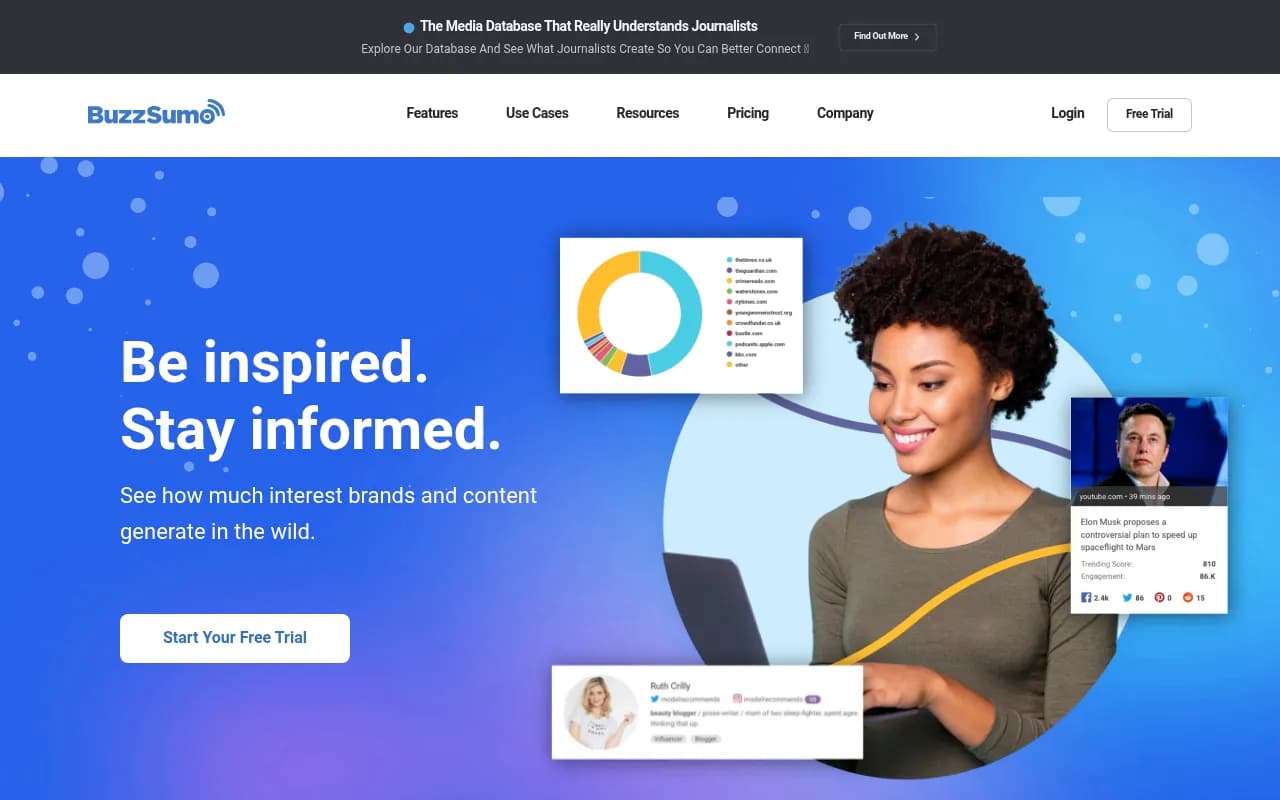
| BuzzSumo | Content and influencer discovery | Identify high-performing content and influencers for partnerships | From $199/mo |
For partnership intelligence specifically, Promptwatch is the most complete solution. It's built around the action loop: find gaps (Answer Gap Analysis), create content (AI writing agent), and track results (page-level citation tracking). The Reddit and YouTube insights are particularly valuable for partnership discovery -- most competitors don't track these channels at all.
How to pitch partnerships using AI search data
Once you've identified a partnership opportunity, AI search data makes your pitch significantly stronger.
Instead of: "We should partner because our audiences overlap."
Try: "ChatGPT mentions your tool alongside Competitor A in 40+ prompts about [specific use case]. We've analyzed the citation patterns and identified three content gaps where a co-authored guide would get us both cited. Here's the data."
You're not pitching a vague "let's work together" -- you're showing concrete evidence of audience overlap, specific content opportunities, and measurable outcomes.
Include:
- Screenshots of AI responses where both brands should appear but don't
- Citation data showing which sources AI models trust in your shared category
- Prompt volume estimates for the queries you want to target together
- A specific content or integration proposal with predicted visibility impact
This approach works because you're doing the research for them. Most partnership pitches require the recipient to evaluate whether the opportunity is real. You're removing that friction by presenting the data upfront.
Common mistakes that kill partnership opportunities
Chasing logo prestige over citation impact
The biggest brand in your category isn't always the best partnership target. If AI models rarely cite them, partnering won't improve your visibility.
Focus on brands that actually get cited frequently in the prompts you care about, even if they're smaller or less well-known.
Ignoring the content gap
A partnership announcement doesn't automatically improve AI visibility. You need content that AI models can cite -- integration docs, co-authored guides, case studies, video tutorials.
If you announce a partnership but don't create citation-worthy content around it, nothing changes.
Optimizing for the wrong prompts
Some prompts have high volume but low commercial intent. Others have lower volume but represent buyers actively evaluating tools.
Use prompt difficulty scores and commercial intent signals to prioritize partnerships that target high-value queries, not just high-volume ones.

Missing the follow-up loop
Most brands identify a partnership opportunity, execute once, and move on. The real value comes from iteration.
Track which partnership content gets cited, which doesn't, and why. Double down on what works. Adjust what doesn't. Treat partnership development as an ongoing optimization process, not a one-time deal.
The 30-day partnership intelligence sprint
Here's a practical roadmap for extracting partnership opportunities from AI search data in the next month.
Week 1: Baseline mapping
- Set up tracking for your brand and top 5 competitors across ChatGPT, Perplexity, Claude, Gemini
- Identify 20-30 high-value prompts in your category
- Document current co-mention patterns and citation sources
Week 2: Gap analysis
- Run Answer Gap Analysis to find prompts where competitors appear but you don't
- Analyze citation sources to identify trusted distribution channels
- Map competitor partnership networks (who gets mentioned together)
Week 3: Opportunity prioritization
- Score potential partners based on citation frequency, audience overlap, and commercial intent
- Identify 3-5 high-impact partnership opportunities
- Draft partnership pitches with supporting AI search data
Week 4: Outreach and execution
- Send partnership pitches to top targets
- Create initial partnership content (integration docs, co-authored guides, etc.)
- Set up tracking to measure visibility impact
This sprint gives you a repeatable process. Run it quarterly to stay ahead of emerging partnership trends.
The future of partnership intelligence
AI search is changing how partnerships get discovered and evaluated. The old model -- relationship-driven, based on gut feel and industry connections -- still matters. But it's being augmented by data-driven partnership intelligence.
In 2026, the brands winning at partnerships are the ones who:
- Track co-mention patterns across AI models to identify ecosystem opportunities
- Analyze citation sources to find high-value distribution partners
- Use prompt gap analysis to prioritize which partnerships will actually move the needle
- Measure partnership impact with visibility scoring and traffic attribution
This isn't replacing relationship-building. It's making it more strategic. Instead of networking broadly and hoping for the right connection, you're targeting specific partners with concrete data on why the partnership makes sense.
The opportunity is still wide open. Most brands are just starting to track their own AI visibility. Almost none are using that data to identify partnership opportunities. If you start now, you're 12-18 months ahead of your competitors.
Start finding partnership opportunities your competitors are missing
AI search data reveals partnership patterns that traditional research misses. Co-mention networks, citation sources, prompt gaps, and ecosystem signals -- all hiding in plain sight across ChatGPT, Perplexity, Claude, and Gemini.
The brands that figure this out first will build partnership networks that compound their AI visibility while competitors are still guessing which integrations to build.
If you want to start extracting partnership intelligence from AI search data, Promptwatch gives you the full toolkit: citation analysis, competitor tracking, Reddit and YouTube insights, Answer Gap Analysis, and page-level visibility scoring. It's the only platform that connects AI search monitoring to actual partnership opportunities.
Get the free trial and see which partnership opportunities you're missing.