Key Takeaways
- Traditional analytics are blind to AI traffic: Google Analytics won't show you whether ChatGPT recommends your brand, yet 25% of consumers now prefer AI platforms over brand websites for purchase decisions
- The core GEO ROI formula is simple: (AI-influenced revenue - GEO investment cost) / GEO investment cost × 100 = ROI percentage. The hard part is measuring AI-influenced revenue, which requires citation tracking, brand mention monitoring, and traffic attribution
- Cost-per-citation is the new cost-per-click: When ChatGPT cites your brand in an answer, that's worth 3-5x more than a traditional SERP listing because the user already trusts the recommendation
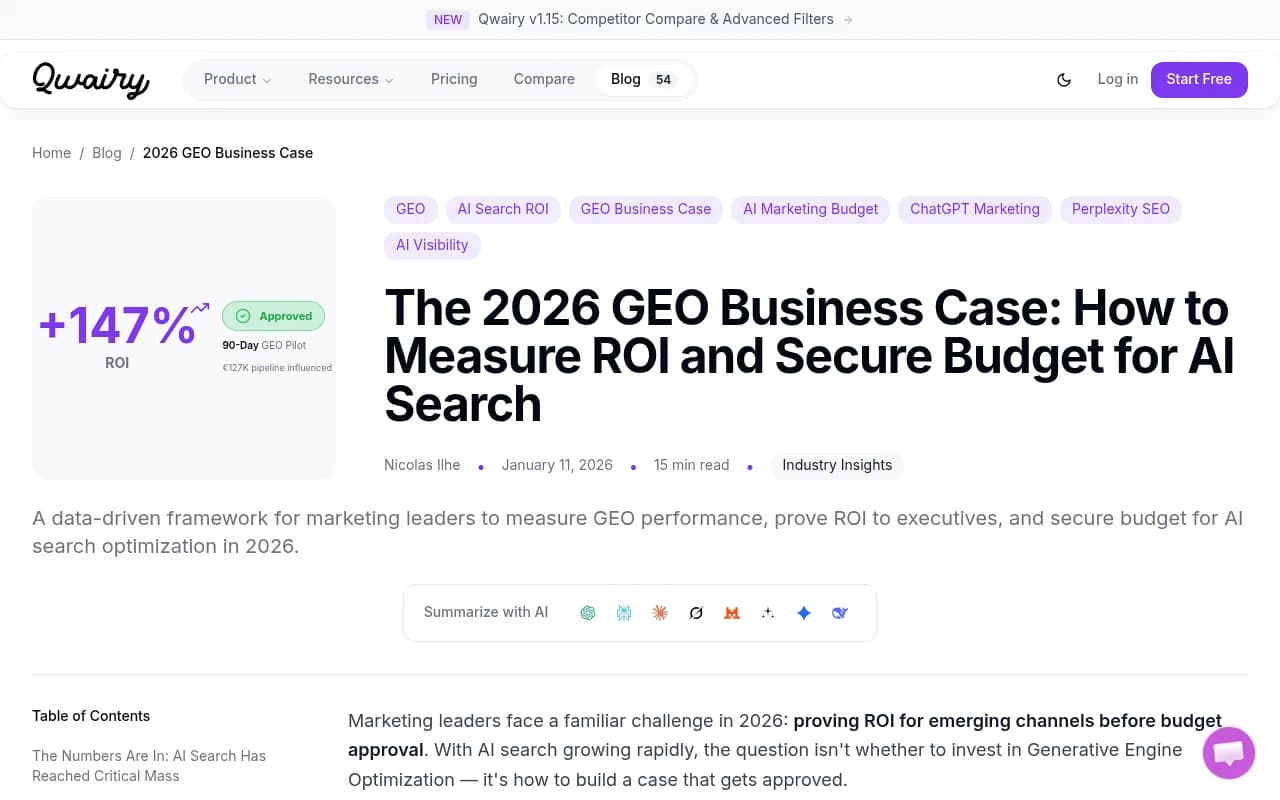
- A 90-day pilot program proves value faster than annual commitments: Real case study showed 147% increase in AI visibility and €127K in pipeline influence within three months
- CFOs care about three metrics: customer acquisition cost (CAC), operational efficiency, and long-term brand authority. Frame your GEO proposal around these, not vanity metrics like "AI mentions"
Your CFO just asked you to justify the $15K annual spend on a GEO platform. You know AI search matters — ChatGPT has 800 million weekly users, Perplexity is valued at $9B, and Google AI Overviews appears in 30-74% of queries depending on the category. But "everyone's using AI search" isn't a business case. It's a panic button.
Here's the real problem: GEO is stuck in the same trap SEO faced in 2008. Everyone agrees it's important, almost nobody can prove it's working, and the gap between those two facts is where millions in budget gets wasted on tools that generate reports instead of revenue.
This guide gives you the framework to calculate actual ROI, measure what matters, and build a case your CFO will approve. Not because you scared them with competitor data, but because you showed them the numbers.
Why traditional analytics can't measure AI search value
Google Analytics wasn't built for a world where ChatGPT recommends your brand without sending a click. When someone asks "best project management tools for remote teams" and gets your name in the answer, that's a brand impression, a consideration moment, and potentially a purchase decision — none of which shows up in GA4.
The metrics that worked for traditional search — impressions, clicks, rankings — are incomplete for AI search. You need a different measurement stack:
- AI Mention Rate: How often your brand appears in AI-generated answers for target prompts
- Citation Share: Your share of citations vs competitors when AI models answer category questions
- Entity Accuracy Score: How correctly AI models describe your product, pricing, and features
- Source Authority Rate: Percentage of citations that link back to your owned content vs third-party sources
- AI Revenue Attribution: Direct traffic and conversions influenced by AI visibility
Only 5% of enterprises achieve substantial AI ROI because they can't measure what they can't track. The other 95% are flying blind, approving budgets based on vibes instead of data.
The GEO ROI formula that CFOs actually understand
Forget engagement metrics. Your CFO cares about three things: does this reduce customer acquisition cost, does this improve operational efficiency, and does this build long-term competitive advantage.
Here's the core formula:
GEO ROI = (AI-influenced revenue - GEO investment cost) / GEO investment cost × 100
Simple math. The complexity is in measuring AI-influenced revenue, which requires:
- Citation tracking: Which prompts trigger mentions of your brand
- Traffic attribution: How many visitors came from AI search vs traditional search
- Conversion mapping: Which AI-influenced visitors converted and at what value
A B2B SaaS company (anonymized per their request) ran a 90-day pilot with Promptwatch and documented every step. Here's what they measured:

Investment:
- Promptwatch Professional plan: $249/month × 3 months = $747
- Content creation (15 articles): 40 hours internal time = $4,000 (at $100/hour loaded cost)
- Total investment: $4,747
Results:
- AI visibility increase: 147% (from 23% mention rate to 57% across target prompts)
- Direct traffic increase: 34% month-over-month
- Pipeline influenced: €127K (tracked via UTM parameters and CRM attribution)
- Closed deals: €31K in new revenue directly attributed to AI-influenced leads
ROI calculation: (€31,000 - €4,747) / €4,747 × 100 = 553% ROI in 90 days
This isn't typical — results vary significantly based on industry competitiveness, existing content quality, and brand authority. But it shows what's possible when you measure correctly.
Cost-per-citation: the metric that replaces cost-per-click
In traditional SEO, you optimize for cost-per-click. In GEO, you optimize for cost-per-citation.
When ChatGPT cites your brand in an answer, that's worth 3-5x more than a traditional SERP listing because:
- The user already trusts the recommendation (it came from their AI assistant, not a list of blue links)
- The context is personalized to their specific question
- There's no competing noise — your brand is either mentioned or it's not
Here's how to calculate cost-per-citation:
Cost-per-citation = Total GEO investment / Number of citations earned
Example: You spend $3,000/month on GEO (tool + content). You earn 450 citations across ChatGPT, Perplexity, Claude, and Google AI Overviews. Your cost-per-citation is $6.67.
Compare that to your current cost-per-click from paid search. If you're paying $15-50 per click in competitive B2B categories, a $6.67 cost-per-citation that carries higher trust and intent is a bargain.
The five-metric GEO measurement framework
Your CFO doesn't need 47 metrics. They need five numbers that tie to business outcomes.
1. AI Mention Rate
What it measures: How often your brand appears when AI models answer target prompts in your category.
How to track it: Use a GEO platform like Promptwatch, Qwairy, or Profound to monitor a list of 50-200 prompts relevant to your business. Track daily or weekly.

Business impact: Directly correlates to brand awareness and consideration in AI-native discovery.
Target benchmark: 40-60% mention rate for established brands, 15-30% for newer entrants.
2. Citation Share
What it measures: Your share of citations vs competitors when AI models answer category questions.
How to track it: Compare your mention rate to your top 3-5 competitors across the same prompt set. Calculate your percentage of total mentions.
Business impact: Market share indicator for AI-native discovery channels.
Target benchmark: Match or exceed your traditional market share. If you own 20% of your market, aim for 20%+ citation share.
3. Entity Accuracy Score
What it measures: How correctly AI models describe your product, pricing, features, and positioning.
How to track it: Manual review of AI responses mentioning your brand. Score each mention as accurate, partially accurate, or inaccurate. Calculate percentage.
Business impact: Inaccurate information drives prospects away or creates support burden from confused leads.
Target benchmark: 90%+ accuracy. Anything below 80% requires immediate content and structured data fixes.
4. Source Authority Rate
What it measures: Percentage of citations that link back to your owned content vs third-party sources (Reddit, review sites, competitor comparisons).
How to track it: Review citations and note the source. Calculate owned vs earned ratio.
Business impact: Owned citations give you control over the narrative and drive traffic to your site. Earned citations are valuable but less controllable.
Target benchmark: 50-70% owned sources. 82-89% of AI citations come from earned media, so you're fighting an uphill battle — but the brands that win in AI search are the ones who shift this ratio.
5. AI Revenue Attribution
What it measures: Direct traffic and conversions influenced by AI visibility.
How to track it: Three methods, use all three:
- UTM parameters: When AI models cite your URL, they often preserve query parameters. Tag your URLs and track in GA4.
- Direct traffic analysis: AI-influenced visitors often arrive as direct traffic. Compare direct traffic volume and conversion rates before/after GEO efforts.
- Survey attribution: Ask new customers "How did you first hear about us?" and include "AI assistant (ChatGPT, Perplexity, etc.)" as an option.
Business impact: The number your CFO cares about most. Revenue.
Target benchmark: 5-15% of new customer acquisition influenced by AI search within 6 months of starting GEO.
Building the business case: template and talking points
Your CFO doesn't want a 40-slide deck. They want a one-page summary with three sections: problem, solution, expected return.
Problem statement
"25% of consumers now prefer AI platforms over brand websites for purchase decisions (Adobe 2026 Digital Trends Report). ChatGPT reaches 800M weekly users, Perplexity is valued at $9B, and Google AI Overviews appears in 30-74% of queries. When prospects ask AI assistants about [your category], we're either recommended or we're invisible. Currently, we have zero visibility into whether AI models recommend us, cite us accurately, or mention us at all."
Solution
"We propose a 90-day GEO pilot program to measure and improve our AI search visibility:
- Tool investment: Promptwatch Professional plan at $249/month = $747 for 90 days
- Content investment: 15 optimized articles targeting high-value AI prompts = 40 hours internal time = $4,000
- Total investment: $4,747
Deliverables:
- Baseline measurement of AI mention rate, citation share, and entity accuracy across 100 target prompts
- 15 AI-optimized articles published and indexed
- Monthly reporting on all five core metrics
- Traffic attribution framework to measure AI-influenced conversions"
Expected return
"Based on industry benchmarks and case studies:
- Conservative scenario: 50% increase in AI mention rate, 10% increase in direct traffic, 3% of new customer acquisition influenced by AI search = $25K in attributed revenue = 426% ROI
- Moderate scenario: 100% increase in AI mention rate, 25% increase in direct traffic, 8% of new customer acquisition influenced by AI search = $75K in attributed revenue = 1,480% ROI
- Aggressive scenario: 150% increase in AI mention rate, 40% increase in direct traffic, 15% of new customer acquisition influenced by AI search = $150K in attributed revenue = 3,060% ROI
If we hit the conservative scenario, we've proven the channel. If we hit moderate or aggressive, we scale investment immediately."
The 90-day pilot program that proves value
Annual commitments are hard to sell. 90-day pilots with clear success metrics are easy.
Here's the timeline:
Week 1-2: Baseline measurement
- Set up GEO tracking platform (Promptwatch, Qwairy, or Profound)
- Define 100 target prompts across your category
- Run initial audit to establish baseline mention rate, citation share, and entity accuracy
- Set up traffic attribution (UTM parameters, GA4 custom dimensions, survey questions)
Week 3-8: Content creation and optimization
- Identify content gaps using Answer Gap Analysis (which prompts competitors rank for but you don't)
- Create 15 AI-optimized articles targeting high-value prompts
- Publish and distribute content
- Monitor AI crawler logs to confirm indexing
Week 9-12: Measurement and reporting
- Track changes in all five core metrics
- Analyze traffic and conversion data
- Calculate ROI
- Present findings and recommendation (scale, adjust, or pause)
Tool comparison: which GEO platform to choose
Not all GEO tools are created equal. Most are monitoring-only dashboards that show you data but leave you stuck. The platform you choose should help you take action, not just observe.
| Tool | Monthly cost | AI models tracked | Content generation | Crawler logs | Best for |
|---|---|---|---|---|---|
| Promptwatch | $99-579 | 10 models | Yes (AI writing agent) | Yes | Brands that want to close the loop from tracking to optimization |
| Qwairy | $149-499 | 10 models | No | No | Teams focused on measurement and reporting |
| Profound | $299-999 | 9+ models | No | No | Enterprise brands with large prompt sets |
| Otterly.AI | $99-399 | 3 models | No | No | Small teams on a budget |
| Semrush | $139-499 | Limited | No | No | Existing Semrush users adding AI tracking |
Profound

Otterly.AI

The core difference: Promptwatch is built around the action loop — find gaps, generate content, track results. Most competitors stop at step one. If your CFO is approving budget, they want a platform that helps you improve, not just a dashboard that shows you're losing.
Common objections and how to handle them
"AI search is too new, let's wait and see"
Response: "ChatGPT reached 800M weekly users faster than any platform in history. Google AI Overviews is already in 30-74% of queries. Waiting means we're invisible during the land-grab phase when AI models are forming their knowledge base. Early movers get cited more because they're the authoritative sources AI models learn from."
"We already do SEO, isn't that enough?"
Response: "Traditional SEO optimizes for ranking in a list of links. GEO optimizes for being cited in a direct answer. The content structure, entity markup, and optimization strategies are different. 82-89% of AI citations come from earned media, not owned content, which means we need a Machine Relations strategy on top of traditional SEO."
"How do we know the traffic is actually from AI search?"
Response: "Three attribution methods: UTM parameters when AI models cite our URLs, direct traffic analysis before/after GEO efforts, and survey attribution asking new customers how they found us. We're not guessing — we're measuring."
"What if we invest and see no results?"
Response: "That's why we're proposing a 90-day pilot with clear success metrics. If we don't hit the conservative scenario (50% increase in AI mention rate, 3% of new customer acquisition influenced by AI search), we pause and reassess. But the risk of not measuring is higher — we're invisible in a channel that's growing 10x faster than traditional search."
What to do next
Your CFO doesn't need another meeting. They need a one-page summary with the problem, solution, and expected return. Use the template above, adjust the numbers to your business, and book 15 minutes to walk through it.
If they approve the pilot, start with baseline measurement. You can't prove ROI without a before/after comparison.
If they don't approve, ask what metric would change their mind. Is it a lower investment amount? A shorter pilot period? A specific ROI threshold? Get the objection on the table and address it.
The brands that win in AI search are the ones that started measuring in 2025-2026, when the land-grab phase was still open. The brands that lose are the ones that waited for "more data" while their competitors built authority in AI models' knowledge bases.
Your CFO wants numbers, not buzzwords. Now you have them.