Key takeaways
- Bear AI starts at $199/month and is built as a full marketing stack -- tracking, content generation, lead conversion, and AI traffic analytics in one place. AI Rank Checker starts at $5 with no subscription, and does one thing: tell you where your brand ranks in AI search engines.
- AI Rank Checker covers 7 AI engines on every plan. Bear AI's Basic plan only covers 2 models; you need Enterprise to get 6+.
- If you want to convert AI-driven traffic into leads, Bear AI has dedicated tools for that. AI Rank Checker stops at the reporting layer.
- For agencies running client reports, AI Rank Checker's PDF/CSV exports and multi-domain dashboards are genuinely useful at a low cost. Bear AI's agency story is less clear below Enterprise pricing.
- Bear AI is backed by Y Combinator and is building toward a broader "marketing stack" vision. AI Rank Checker is a leaner, more focused tool -- no frills, no lock-in.
- Neither tool is a full GEO optimization platform. If you need content gap analysis, AI crawler logs, or prompt volume data on top of rank tracking, you'll want to look beyond both.
Overview
Bear AI
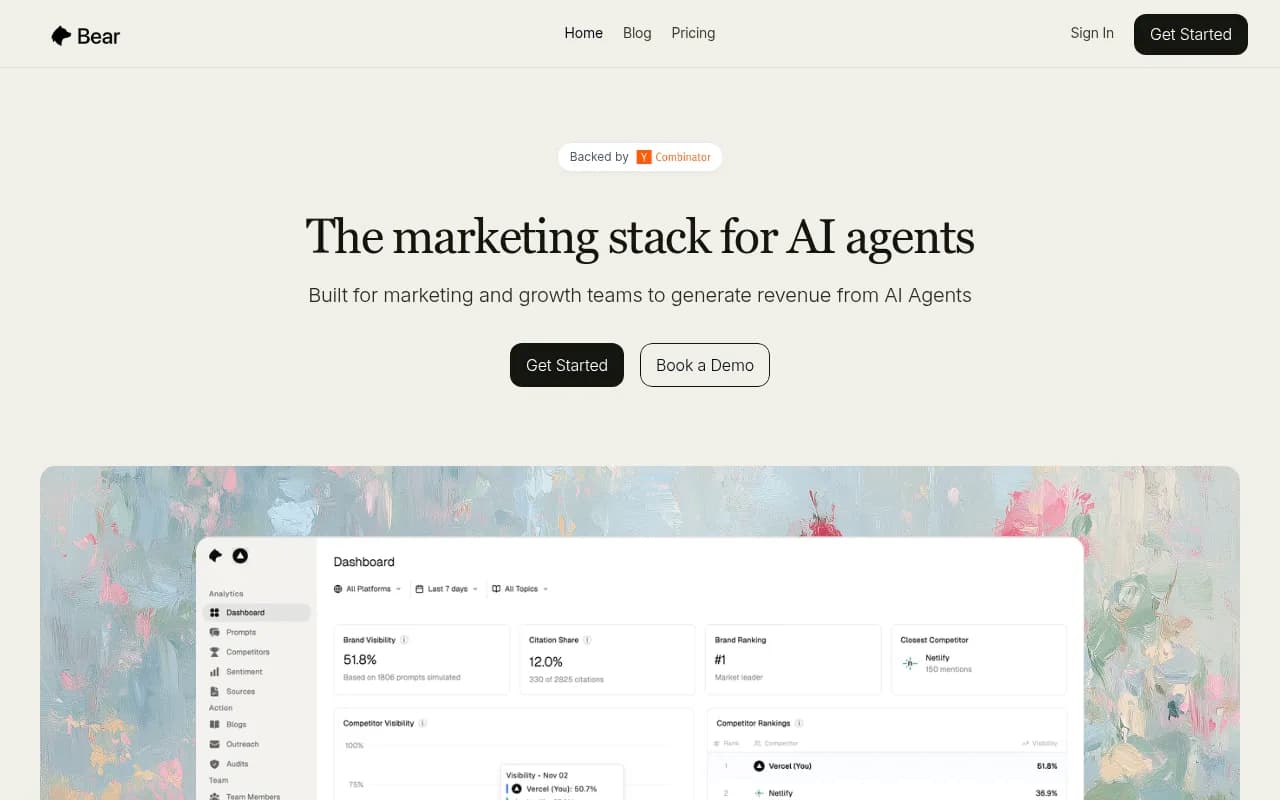
Bear AI describes itself as "the marketing stack for AI agents" -- which is a big claim, but it's not entirely wrong. The platform tracks how AI models like ChatGPT, Claude, and Google AI Overviews discover and recommend your brand, then goes a step further by identifying high-intent visitors arriving from those AI sources and giving you tools to convert them. It's built for marketing and growth teams who want to treat AI search as a revenue channel, not just a curiosity. YC-backed, with customers including Peerspace, Groww, and Wispr Flow.
AI Rank Checker
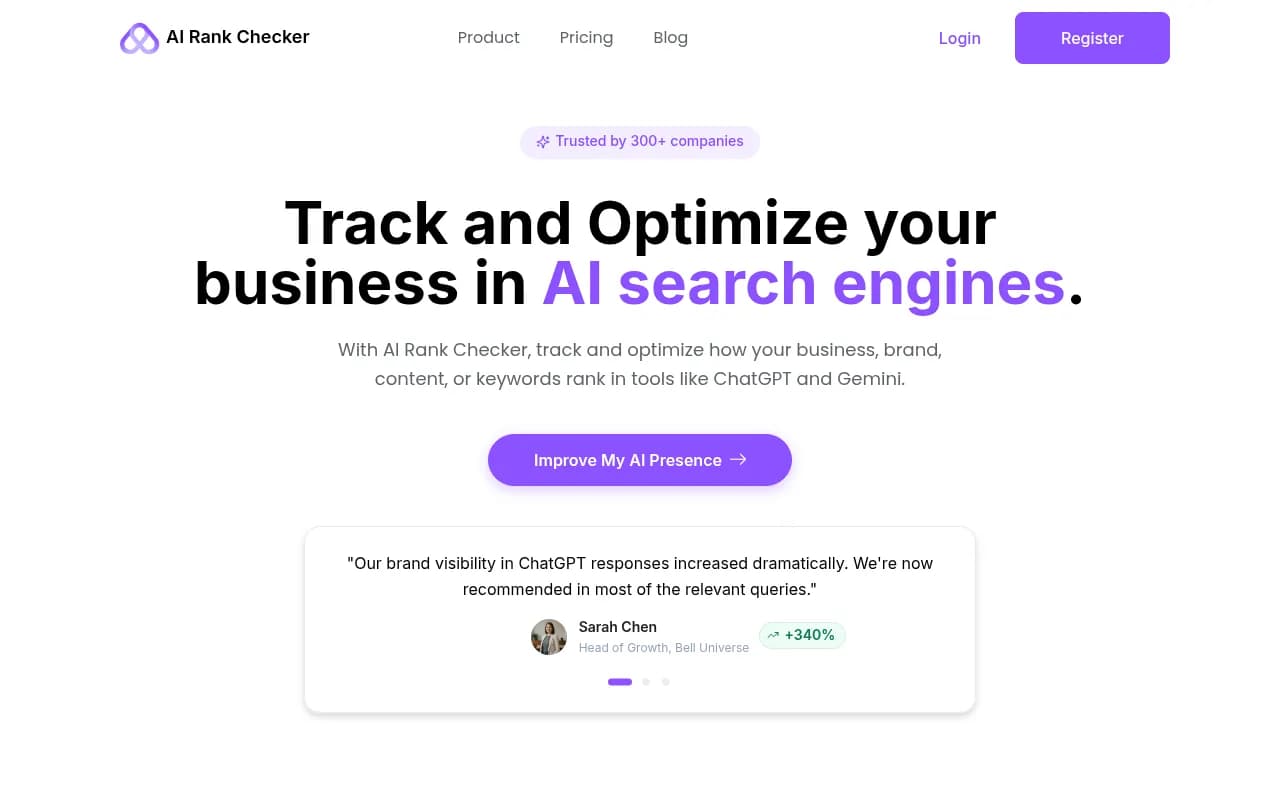
AI Rank Checker is a much simpler proposition: check how your brand or keywords rank across 7 AI engines, export the results, and pay only for what you use. No monthly subscription, no onboarding call, no platform to learn. It's trusted by 700+ companies according to the site, and the testimonials point to real visibility improvements -- though the tool itself is the tracker, not the optimizer. Think of it as the AI search equivalent of a classic rank checker tool.
Side-by-side comparison
| Feature | Bear AI | AI Rank Checker |
|---|---|---|
| Pricing model | Monthly subscription from $199 | Pay-as-you-go from $5 |
| Free tier | No | No (but $5 entry is low) |
| AI engines covered | 2 (Basic), 6+ (Enterprise) | 7 on all plans |
| Prompt/keyword tracking | 75 prompts (Basic) | Unlimited (pay per query) |
| Competitor tracking | Yes | Yes |
| Content generation | Yes (2 blogs/month on Basic) | No |
| Lead conversion tools | Yes | No |
| AI traffic analytics | Yes | No |
| Export reports | Not specified | PDF and CSV |
| Multi-domain support | Enterprise | Yes (all plans) |
| API access | Not specified | Not specified |
| Target user | Marketing/growth teams | Marketers, SEOs, agencies |
| Backed by | Y Combinator | Independent |
Head-to-head feature deep-dive
Pricing
This is where the two tools diverge most sharply.
Bear AI charges a flat monthly fee. The Basic plan at $199/month gets you 75 prompts, 2 blogs, and monitoring across 2 AI models. That's a meaningful commitment -- you're paying $2,388/year before you've seen whether the platform delivers ROI. Enterprise pricing is custom and presumably higher.
AI Rank Checker flips the model entirely. Top up a wallet starting at $5, pay per keyword check, choose which AI engines you query, and stop whenever you want. There's no annual contract, no seat pricing, no "contact sales" for basic features. For a team that wants to run occasional audits or test the concept before committing, this is a much lower-risk entry point.
| Plan | Bear AI | AI Rank Checker |
|---|---|---|
| Entry price | $199/month | $5 top-up |
| Commitment | Monthly subscription | None |
| Enterprise | Custom | N/A |
| Free trial | No | No (but $5 is close) |
Verdict: AI Rank Checker wins on pricing flexibility. Bear AI's pricing is only justified if you're actively using the content generation and conversion features -- the monitoring alone doesn't warrant $199/month.
AI engine coverage
Bear AI's Basic plan covers just 2 AI models. The website lists ChatGPT, Claude, Google AI Overviews, Perplexity, and Gemini as supported, but you don't get all of them unless you're on a higher tier. That's a real limitation when the whole point is understanding your cross-platform AI visibility.
AI Rank Checker covers ChatGPT, Perplexity, Claude, Gemini, Copilot, Grok, and Meta AI -- 7 engines -- and you can pick and choose which ones you query. You only pay for the engines you actually use, which is a smart design choice.
Verdict: AI Rank Checker covers more engines at every price point. Bear AI catches up at Enterprise, but that's a very different budget conversation.
Monitoring and tracking depth
Bear AI goes deeper on the analytics side. It doesn't just tell you whether you appear in AI responses -- it tracks trends over time, surfaces which prompts are gaining traction, and identifies traffic coming to your site from AI sources. The "trending prompts" feature (visible in their dashboard screenshot) suggests some level of prompt discovery, not just tracking prompts you've already defined.
AI Rank Checker is more straightforward: you define keywords, it checks your ranking across the selected AI engines, and you get results. The ranking history feature lets you track changes over time. It's clean and functional, but there's no traffic attribution, no prompt discovery, and no behavioral data about visitors.
Verdict: Bear AI has significantly more depth here. If you want to understand the full picture of AI-driven traffic -- not just rankings -- Bear AI is the more capable tool.
Content generation
Bear AI includes blog content generation as part of the platform. Basic gets you 2 blogs/month, which is modest but at least gives you a starting point for creating content that AI models are more likely to cite. This is a meaningful differentiator -- most monitoring tools leave you to figure out the "what do I do now?" question on your own.
AI Rank Checker has no content generation features. It tells you where you stand; what you do about it is entirely up to you.
Verdict: Bear AI wins this category outright. Though 2 blogs/month on Basic is a thin offering, it's more than zero.
Lead conversion and revenue attribution
This is Bear AI's most distinctive angle. The platform claims to identify high-intent visitors arriving from AI sources and provides tools to convert them into leads. This goes well beyond what any pure rank tracker does -- it's connecting AI visibility to actual business outcomes.
AI Rank Checker doesn't touch this at all. It's a visibility measurement tool, not a conversion tool.
Verdict: Bear AI wins, and it's not close. If revenue attribution from AI traffic is your goal, AI Rank Checker can't help you there.
Reporting and exports
AI Rank Checker has clean PDF and CSV exports, which makes it practical for agency use -- you can pull a report, drop it in a client deck, and move on. The multi-domain support with separate dashboards per brand is also well-suited to agencies managing multiple accounts.
Bear AI's reporting capabilities aren't as clearly documented on the public site. The dashboard looks polished, but whether you can export data in formats suitable for client reporting isn't obvious from the available information.
Verdict: AI Rank Checker is more transparent about its export capabilities and better suited to agencies that need clean deliverables.
Pricing comparison
| Plan | Bear AI | AI Rank Checker |
|---|---|---|
| Entry / Basic | $199/month (75 prompts, 2 blogs, 2 models) | $5 top-up (pay per query) |
| Mid-tier | Not publicly listed | Scales with usage |
| Enterprise | Custom (unlimited prompts, 6+ models, lead gen) | N/A |
| Annual discount | Not specified | N/A (no subscription) |
| Free tier | No | No |
Pros and cons
Bear AI
Pros:
- Full marketing stack approach -- monitoring, content, and conversion in one place
- AI traffic attribution connects visibility to actual revenue
- Lead conversion tools are genuinely unique in this category
- YC-backed with a clear product roadmap vision
- Prompt discovery features go beyond simple rank checking
Cons:
- $199/month is a steep entry point for what Basic actually includes
- Only 2 AI models on Basic -- you're paying a premium for limited coverage
- 2 blogs/month is a thin content generation offering at the base tier
- Less transparent about export and reporting capabilities
- No free trial makes it harder to evaluate before committing
AI Rank Checker
Pros:
- Pay-as-you-go model with no subscription lock-in
- Covers 7 AI engines on every plan
- Multi-domain support with separate dashboards -- good for agencies
- Clean PDF/CSV exports for client reporting
- Very low barrier to entry ($5 to start)
- Simple, focused tool that does what it says
Cons:
- No content generation or optimization features
- No traffic attribution or conversion tools
- No prompt discovery -- you define what to track, it doesn't surface new opportunities
- Monitoring-only: tells you where you stand but not what to do about it
- Less depth on analytics compared to Bear AI
Who should pick which tool
Pick Bear AI if:
- You're a marketing or growth team treating AI search as a revenue channel, not just a metric
- You want traffic attribution -- knowing that AI-driven visitors are converting, not just arriving
- You need content generation built into the same workflow as your monitoring
- You're at a company with budget to invest in a proper AI marketing stack
- Lead generation from AI traffic is a specific goal
Pick AI Rank Checker if:
- You want to check AI rankings without committing to a monthly subscription
- You're an agency managing multiple client domains and need clean, exportable reports
- You're early in your AI visibility journey and want to understand the landscape before investing in a full platform
- You need coverage across 7 AI engines without paying Enterprise pricing
- You run occasional audits rather than continuous monitoring
A note on what both tools don't cover
Worth mentioning: both Bear AI and AI Rank Checker are primarily monitoring and tracking tools. Neither gives you the kind of deep content gap analysis, AI crawler logs, or prompt volume intelligence that a full GEO optimization platform provides. If you want to understand not just where you rank but why -- which pages AI models are crawling, which competitor content is getting cited, what topics you're missing entirely -- tools like Promptwatch cover that layer with features like Answer Gap Analysis, citation tracking across 880M+ data points, and an AI writing agent built specifically to generate content that gets cited by LLMs.

Final verdict
These two tools are solving different problems at different price points, so the "which is better" question really depends on what you need.
Bear AI is the more ambitious product. It wants to be your entire AI marketing stack -- tracking, content, conversion, attribution. If you're a growth team that's serious about AI search as a revenue channel and has the budget to match, it's worth evaluating. The $199/month entry price is steep for what Basic delivers, but the platform's direction is clear.
AI Rank Checker is the pragmatic choice. It covers more AI engines at a lower cost, has no subscription lock-in, and is genuinely useful for agencies and teams that need clean reports without a lot of overhead. It won't tell you what to do with the data, but it will tell you where you stand -- accurately, across 7 engines, for as little as $5.
If you're choosing between the two: start with AI Rank Checker to understand your baseline, then graduate to Bear AI (or a more comprehensive platform) once you're ready to act on the data.