Key Takeaways
- Price difference is massive: GeoGen starts at €20/mo vs Cognizo's $300/mo -- a 15x gap at entry level. GeoGen wins on affordability for small brands.
- Both are monitoring-first platforms: Despite marketing language about "optimization," both tools primarily track brand mentions and citations. Neither offers the action loop (find gaps → generate content → track results) that platforms like Promptwatch provide.
- Cognizo includes content tools, GeoGen doesn't: Cognizo bundles content creation features; GeoGen gives you recommendations but no built-in writing agent.
- AI model coverage is similar: Both cover ChatGPT, Perplexity, Gemini, and Copilot. Neither matches the 10+ model coverage of more comprehensive platforms.
- Traffic attribution is unclear on both: Cognizo mentions "AI-driven traffic" but implementation details are vague. GeoGen doesn't emphasize this at all.
- Target audience differs: GeoGen is built for small-to-mid brands watching their budget. Cognizo targets marketing teams with bigger budgets who want an all-in-one dashboard.
Overview: Two monitoring platforms at very different price points
GeoGen: Budget-friendly AI visibility tracking
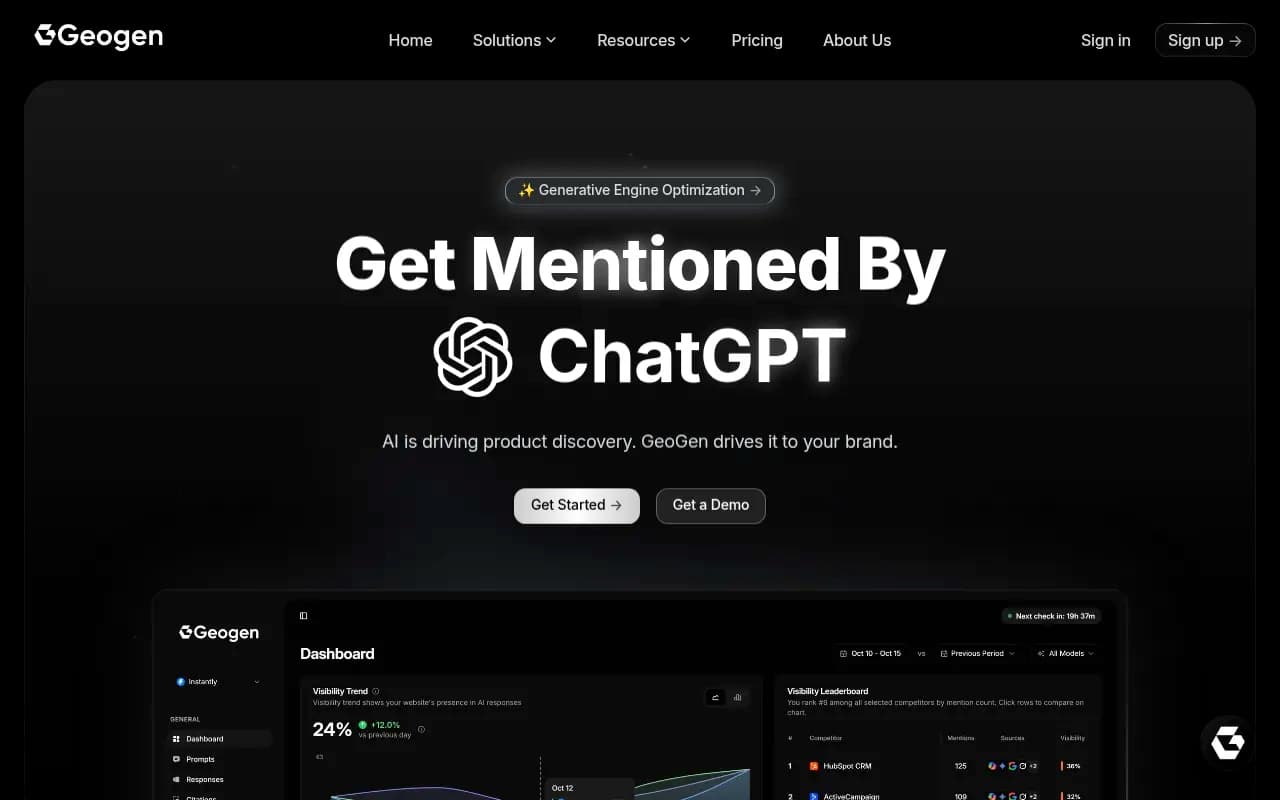
GeoGen positions itself as a Generative Engine Optimization (GEO) platform for brands that want to track how they show up in AI search engines. The pitch is straightforward: monitor your mentions across ChatGPT, Perplexity, Gemini, Grok, and Microsoft Copilot, see how you stack up against competitors, and get recommendations to improve your AI search presence.
The platform is aimed at small to mid-sized brands. Pricing starts at €20/mo for the Micro plan and goes up to €399/mo for Pro, with 20% off annual billing. That entry price is one of the lowest in the AI visibility space.
What you get is a monitoring dashboard. Track brand mentions, analyze competitor rankings, get some recommendations. The website doesn't show deep feature breakdowns, but the focus is clearly on visibility tracking rather than content creation or optimization.
Cognizo: Marketing-focused answer engine optimization
Cognizo
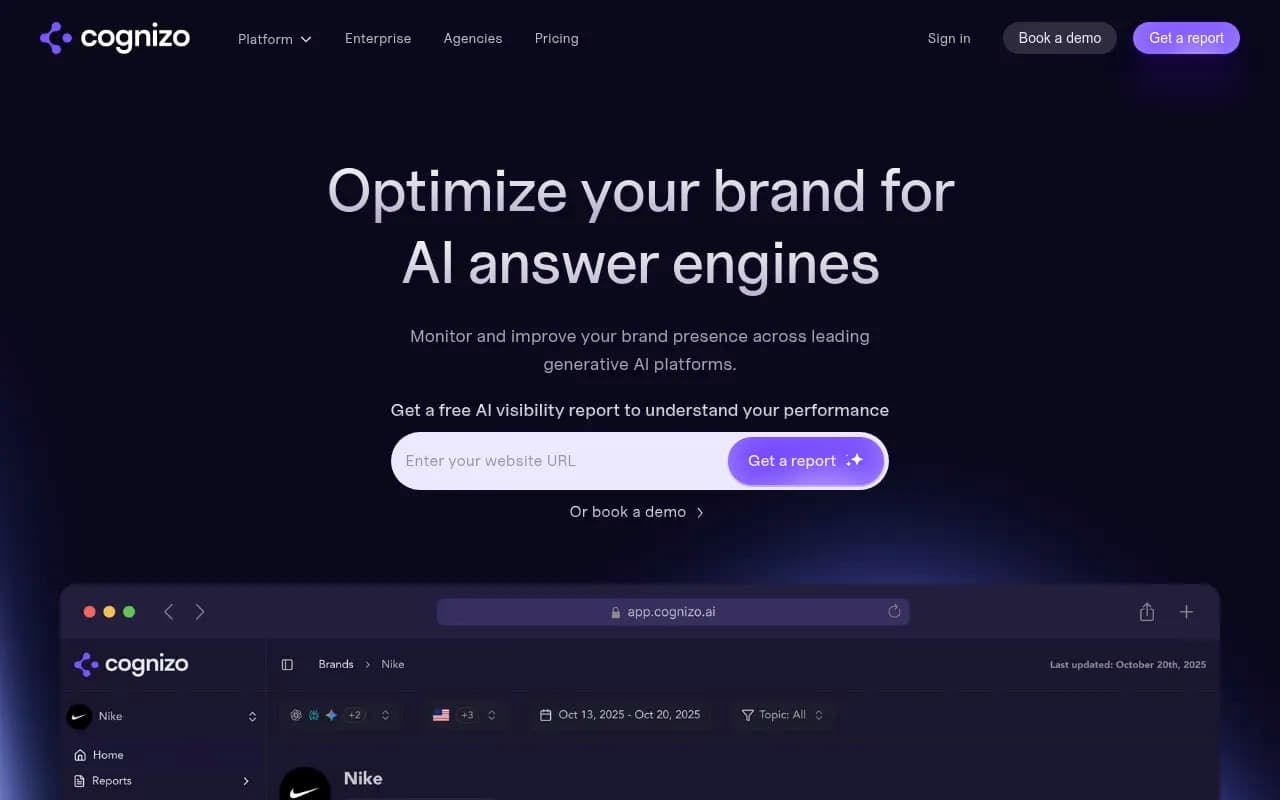
Cognizo calls itself an Answer Engine Optimization (AEO) platform -- same concept as GEO, different branding. The target audience is marketing teams at companies with real budgets. Pricing starts at $300/mo for the Starter plan with 350 prompts.
Cognizo's pitch is more ambitious: not just monitoring, but a "complete platform to win in AI search." The feature set includes visibility tracking, sentiment analysis, content creation tools, and AI-driven traffic measurement. The dashboard shows prompt discovery ("what billions of customers are asking AI"), real-time citation tracking, and automated content generation.
The marketing emphasizes turning insights into action -- identifying buyer questions, understanding visibility gaps, creating optimized content, measuring traffic. It's positioned as an all-in-one solution for marketers who want to own their AI search presence.
Side-by-side comparison
| Feature | GeoGen | Cognizo |
|---|---|---|
| Starting price | €20/mo (~$22) | $300/mo |
| Entry-level prompts | Not specified | 350 prompts |
| Free trial | Not mentioned | Yes |
| AI models covered | ChatGPT, Perplexity, Gemini, Grok, Copilot | ChatGPT, Perplexity, Gemini, Google AI Overviews, others |
| Content creation tools | No | Yes (AI-optimized content generation) |
| Traffic attribution | Not mentioned | Yes ("AI-driven traffic" measurement) |
| Competitor analysis | Yes | Yes |
| Sentiment tracking | Not specified | Yes |
| Citation tracking | Yes | Yes |
| Target audience | Small-to-mid brands | Marketing teams with budgets |
| Annual discount | 20% | Not specified |
| Enterprise pricing | Custom | Not specified |
Pricing: A 15x difference at the entry level
This is where the two platforms diverge most dramatically.
GeoGen pricing:
- Micro: €20/mo
- (Mid-tier plans not publicly listed)
- Pro: €399/mo
- Enterprise: Custom pricing
- 20% discount on annual billing
Cognizo pricing:
- Starter: $300/mo (350 prompts, basic monitoring)
- Higher tiers: Not publicly listed
- Free trial available
GeoGen's €20/mo entry point is one of the cheapest in the AI visibility space. That's about $22/mo at current exchange rates. Cognizo starts at $300/mo -- more than 13x higher.
For a small brand or solopreneur just dipping their toes into AI search monitoring, GeoGen's pricing is accessible. For a marketing team at a funded company, $300/mo is a rounding error.
Neither platform publishes full pricing details for mid-tier plans, which makes it hard to compare feature-for-feature. GeoGen's Pro plan at €399/mo (~$440) is still cheaper than Cognizo's entry tier, but we don't know what Cognizo's equivalent tier costs.
Verdict: GeoGen wins on price accessibility. Cognizo is priced for teams with real budgets.
AI model coverage: Similar but not comprehensive
Both platforms cover the major AI search engines:
GeoGen monitors:
- ChatGPT
- Perplexity
- Gemini
- Grok
- Microsoft Copilot
Cognizo monitors:
- ChatGPT
- Perplexity
- Gemini
- Google AI Overviews
- Others (not specified)
GeoGen explicitly lists Grok, which is a nice touch -- Grok is growing fast and most platforms ignore it. Cognizo mentions Google AI Overviews specifically, which is important for SEO-focused teams.
Neither platform appears to cover the full breadth of AI models. Missing from both: DeepSeek, Mistral, Meta AI/Llama, Claude (not explicitly mentioned). For comparison, Promptwatch monitors 10 AI models including all of the above.

Verdict: Tie. Both cover the big players but miss some emerging models.
Feature depth: Monitoring vs optimization
This is where the platforms start to differentiate.
GeoGen features
Based on the website:
- Brand mention tracking across AI engines
- Competitor ranking analysis
- Recommendations to improve AI search presence
- Dashboard for monitoring visibility
What's missing:
- No mention of content creation tools
- No traffic attribution details
- No prompt discovery or volume data
- No sentiment analysis mentioned
- No API or integrations listed
GeoGen is a monitoring dashboard. You see where you're mentioned, where competitors are mentioned, and you get some recommendations. What you do with that information is up to you.
Cognizo features
Based on the website:
- Real-time mention and citation tracking
- Sentiment analysis
- Prompt discovery ("what billions of customers are asking AI")
- Competitor visibility comparison
- AI-optimized content creation (automated)
- AI-driven traffic measurement
- Content opportunity identification
- Workflow management for content creation
Cognizo bundles more features into the platform. The content creation tools are the big differentiator -- Cognizo shows screenshots of content briefs, drafting workflows, and optimization scores.
But here's the thing: both platforms are still fundamentally monitoring tools. Cognizo adds a content layer on top, but it's not clear how deep that goes. The screenshots show content briefs and drafts, but there's no detail on how the AI writing agent works, what data it's trained on, or how it compares to dedicated content platforms.
For true content gap analysis and optimization, you'd want a platform that shows you exactly which prompts competitors rank for but you don't, then helps you create content grounded in real citation data. That's the action loop that separates monitoring from optimization.
Verdict: Cognizo has more features on paper. GeoGen is simpler and more focused.
Content creation: Cognizo's main edge
This is Cognizo's clearest advantage.
GeoGen doesn't include content creation tools. You get recommendations, but you're on your own to create the content.
Cognizo includes:
- Content opportunity identification
- Automated content brief generation
- AI-optimized content drafting
- Content workflow management
- Optimization scores
The platform shows a content editor with sections, key advantages, and SEO overview including word count and content scores. There's a workflow status tracker showing stages like "Researching," "Generating brief," "Drafting content," "Review brief."
This is useful if you want an all-in-one platform. Instead of exporting data to a separate content tool, you can draft and optimize inside Cognizo.
The question is: how good is the content? Cognizo doesn't publish details on what data the AI writing agent uses, how it handles citations, or how it compares to standalone content platforms. The screenshots look polished, but there's no transparency on the underlying engine.
For comparison, platforms like Promptwatch ground their AI writing agent in 880M+ citations analyzed, prompt volumes, persona targeting, and competitor analysis. That level of specificity matters when you're trying to rank in AI search results.
Verdict: Cognizo wins if you want built-in content tools. Quality and depth are unclear.
Traffic attribution: Vague on both platforms
Both platforms mention tracking AI-driven traffic, but details are sparse.
GeoGen: No mention of traffic attribution on the website. The focus is purely on visibility tracking.
Cognizo: Lists "Measure AI-driven traffic" as a feature with the tagline "See how AI interacts with your site and drives human traffic." But there's no detail on how this works -- code snippet, server logs, GSC integration, or something else.
This is a critical feature for closing the loop between visibility and revenue. If you can't connect AI mentions to actual traffic and conversions, you're flying blind.
Platforms like Promptwatch offer multiple attribution methods: code snippet, Google Search Console integration, or server log analysis. That transparency matters.
Verdict: Cognizo mentions it, GeoGen doesn't. Neither provides implementation details.
Competitor analysis: Similar capabilities
Both platforms include competitor tracking.
GeoGen: "Analyze competitor rankings" is listed as a core feature. The dashboard presumably shows where competitors are mentioned vs your brand.
Cognizo: "Understand how you stack up against competitors" is part of the Answer Engine Insights feature. The platform tracks competitor mentions, citations, and visibility.
Neither platform shows detailed competitor heatmaps or prompt-level breakdowns in their marketing materials. For deep competitive intelligence -- seeing exactly which prompts competitors rank for, which pages they're citing, and how to close the gap -- you'd want a platform with more granular data.
Verdict: Tie. Both offer basic competitor tracking.
Ease of use: Hard to judge without trials
Both platforms show clean, modern dashboards in their screenshots. GeoGen's interface looks simpler and more focused. Cognizo's interface has more tabs, workflows, and features -- which could mean more powerful or more cluttered, depending on your perspective.
Cognizo offers a free trial, which is a plus. GeoGen doesn't mention a trial on the website.
Without hands-on testing, it's hard to judge which platform is easier to use day-to-day.
Verdict: Cognizo gets a slight edge for offering a free trial.
Support and documentation: Not enough info
Neither platform publishes detailed documentation, API docs, or support details on their public websites.
GeoGen has a "Contact" page for demos. Cognizo has a "Book a demo" CTA throughout the site.
Both appear to be sales-led rather than self-serve. You're expected to talk to someone before you start using the platform.
Verdict: Tie. Both are opaque about support.
Who should choose GeoGen
GeoGen makes sense if:
- You're a small brand or solopreneur with a tight budget
- You want basic AI visibility tracking without the complexity
- €20-€399/mo is your price range
- You're comfortable creating content yourself based on recommendations
- You don't need traffic attribution or deep analytics
GeoGen is the budget option. It won't give you the full optimization stack, but it'll tell you where you stand in AI search results without breaking the bank.
Who should choose Cognizo
Cognizo makes sense if:
- You're a marketing team with a real budget ($300+/mo is fine)
- You want an all-in-one platform with content creation built in
- You value sentiment tracking and prompt discovery
- You want to manage content workflows inside the platform
- You're willing to pay more for a fuller feature set
Cognizo is the premium option. It bundles more features, but you're paying for it.
Pros and cons
GeoGen pros
- Extremely affordable entry price (€20/mo)
- Clean, focused monitoring dashboard
- Covers major AI engines including Grok
- 20% annual discount
- Good for small brands on a budget
GeoGen cons
- No content creation tools
- No traffic attribution mentioned
- Limited feature transparency on website
- No free trial mentioned
- Missing some AI models (DeepSeek, Mistral, Claude)
Cognizo pros
- Built-in content creation and optimization
- Sentiment analysis included
- Prompt discovery and volume data
- Free trial available
- More comprehensive feature set
- Workflow management for content
Cognizo cons
- Expensive entry point ($300/mo)
- Vague on traffic attribution implementation
- No pricing transparency for higher tiers
- Content quality and depth unclear
- Missing some AI models
The bigger picture: Monitoring vs optimization
Here's the uncomfortable truth: both GeoGen and Cognizo are primarily monitoring platforms, not optimization platforms.
Monitoring tells you where you stand. Optimization helps you improve.
GeoGen is honest about this -- it's a visibility tracker. Cognizo markets itself as a "complete platform to win in AI search," but the core is still monitoring with some content tools bolted on.
True optimization requires:
- Gap analysis: See exactly which prompts competitors rank for but you don't
- Content generation: Create articles grounded in citation data, prompt volumes, and persona targeting
- Traffic attribution: Connect visibility to actual revenue
- Iteration: Track what works, double down, repeat
Neither GeoGen nor Cognizo appears to offer this full loop. For that, you'd want a platform like Promptwatch, which is built around the action cycle: find gaps, generate content, track results.
That said, if you just want to monitor where you stand in AI search -- which is a valid use case -- both platforms can do that. GeoGen does it cheaply, Cognizo does it with more bells and whistles.
Final verdict
Choose GeoGen if: You're a small brand on a budget and you just want basic AI visibility tracking. The €20/mo entry point is hard to beat.
Choose Cognizo if: You're a marketing team with budget to spare and you want content creation tools bundled into your monitoring platform.
Choose neither if: You want true optimization -- content gap analysis, AI writing agents grounded in citation data, and traffic attribution that actually closes the loop. In that case, look at platforms built for action, not just monitoring.
The bottom line: GeoGen is the budget tracker. Cognizo is the premium all-in-one. Both will show you where you stand in AI search. Neither will do the heavy lifting to get you there.