Key takeaways
- Model Context Protocol (MCP) lets AI assistants connect directly to live data sources, so agencies can pull client AI visibility data into a conversation instead of building a separate dashboard for every account
- The main agency benefit is speed: instead of exporting CSVs and building Looker slides, an account manager can ask a question and get an answer in seconds
- MCP servers for AI visibility are still early-stage, but several platforms (including Promptwatch) are moving toward API and integration layers that support this workflow
- Security and data governance matter more than most agencies realize -- connecting client data to AI agents requires careful permission scoping
- The practical agency stack in 2026 combines an AI visibility platform, a workflow automation layer, and a reporting interface -- MCP is the connective tissue between them
What MCP actually is (and why agencies care)
Model Context Protocol is a standard introduced by Anthropic that lets AI assistants connect to external data sources in real time. Instead of copy-pasting data into a chat window, you give the AI a live connection to your tools -- and it can read, analyze, and act on that data during the conversation.
The analogy that keeps coming up: AI interfaces are becoming the new dashboard. Tyler Denk, CEO of Beehiiv, put it plainly when his team launched their own MCP integration -- "instead of pasting data into a chat window, your AI connects live to your account and can access, analyze, and act on everything." That's the shift.
For agencies, this matters because the old workflow is genuinely painful. You have 15 clients. Each one wants to know how they're appearing in ChatGPT, Perplexity, and Google AI Overviews. You're running prompts manually, screenshotting responses, building slides, and doing it all over again next month. It doesn't scale.
MCP changes that by letting an AI agent pull the data directly. Ask "how did Client A's AI visibility change this week?" and the agent queries the platform, compares it to last week, and writes the summary. No export. No pivot table. No custom dashboard.
The problem with custom dashboards for AI visibility
Before getting into the MCP workflow, it's worth being honest about why agencies keep trying to build dashboards and why it keeps going wrong.
The appeal is obvious: one place, all clients, branded reports. But AI visibility data is messier than traditional SEO data. You're not tracking a rank position that updates once a day. You're tracking whether a specific AI model mentions your client's brand in response to a specific prompt -- and that can change based on the model version, the phrasing, the day, even the region.
Building a custom dashboard that accurately represents this requires:
- A reliable data source with consistent prompt tracking
- Normalization across different AI models (ChatGPT behaves differently than Perplexity)
- Handling prompt variability (the same question phrased differently can produce different results)
- Keeping up with model updates that change citation behavior
Most agencies that have tried to build this in-house have ended up with something that looks good in a demo but breaks in production. The smarter move in 2026 is to use a platform that already handles this complexity and connect to it programmatically.
How the MCP workflow actually works for agencies
Here's the practical version of what an MCP-enabled agency workflow looks like today.
Step 1: The AI visibility platform does the heavy lifting
You need a platform that's actually tracking AI responses at scale -- running prompts across multiple models, storing citation data, and surfacing changes over time. This is not something you build yourself.
Promptwatch is the platform most agencies are gravitating toward for this because it goes beyond monitoring. It tracks brand visibility across 10 AI models (ChatGPT, Perplexity, Claude, Gemini, Google AI Overviews, Grok, DeepSeek, Copilot, Meta AI, Mistral), stores citation data from over 1.1 billion processed prompts, and -- critically -- has an API that lets you pull this data programmatically.

The API and Looker Studio integration are what make the MCP workflow possible. Without a data layer you can query, you're back to manual exports.
Step 2: An automation layer connects the data to the AI agent
This is where MCP comes in. You configure an MCP server that knows how to talk to your visibility platform's API. When an AI assistant (Claude, ChatGPT, or a custom agent) needs visibility data, it calls the MCP server, which fetches the live data and returns it.
Tools like Zapier and n8n are commonly used as the automation layer here, though more technical agencies are building lightweight MCP servers directly.
The key is that the MCP server handles authentication and data scoping. Client A's data only comes back when the agent is working on Client A. This is where most agencies underinvest -- the permission model matters.
Step 3: The AI agent answers questions in natural language
Once the connection is live, the workflow becomes conversational. An account manager can ask:
- "Which prompts is Client B missing from compared to their top competitor?"
- "Did Client C's mention rate in Perplexity improve after we published that new comparison page?"
- "Which AI models are citing Client D's content most often this month?"
The agent queries the MCP server, gets the data, and writes a response. It can also generate a summary for a client email or pull the numbers into a report template.
This is the part that actually saves time. Not the technology itself, but the fact that you no longer need a data analyst to answer a straightforward question about a client account.
What agencies are tracking through this workflow
The specific data points that matter most for agency clients in 2026:
Brand mention rate: How often does the client's brand appear in AI responses to relevant prompts? This is the top-line metric most clients want to see.
Citation sources: Which pages on the client's site are being cited by AI models? This tells you what's working and where to invest content effort.
Competitor visibility: Who's showing up instead of the client? Seeing a competitor's name in AI responses is more motivating for a client than any abstract metric.
Prompt-level breakdown: Not all prompts are equal. A client might be invisible for high-volume category queries but well-cited for branded queries. The breakdown matters.
Model-by-model performance: A client might appear in Perplexity but not in ChatGPT. Understanding which models are and aren't citing them helps prioritize content strategy.
Trend over time: Month-over-month changes are what clients actually care about in a report. Did the work you did last month move the needle?
The agency stack in 2026
Here's how the pieces fit together for a well-run agency doing AI visibility work at scale:
| Layer | Purpose | Example tools |
|---|---|---|
| AI visibility platform | Track prompts, citations, competitor data across AI models | Promptwatch, Profound, Otterly.AI |
| SEO/content platform | Keyword research, content briefs, traditional rank tracking | Semrush, Ahrefs, Surfer SEO |
| Automation/MCP layer | Connect data sources to AI agents, trigger workflows | Zapier, n8n, custom MCP servers |
| Reporting interface | Client-facing summaries, trend charts | Looker Studio, Raven Tools, custom |
| AI assistant | Natural language queries, report drafting | Claude, ChatGPT |
The MCP layer is what makes this feel like a real-time system rather than a monthly reporting exercise. Without it, you're still doing manual work between each layer.

Security: the thing most agencies skip
This is worth spending real time on because it's where things go wrong.
When you connect client data to an AI agent via MCP, you're creating a pathway from sensitive business data to an AI model that may log queries, use them for training, or expose them through prompt injection attacks. The MCP security landscape is still maturing -- research from Bitsight found over 1,000 exposed MCP servers in early 2026, and Endor Labs flagged that a meaningful share of MCP server code uses patterns associated with command-injection risk.
For agencies, the practical implications:
- Scope permissions tightly. The MCP server for Client A should not be able to access Client B's data, even accidentally.
- Use read-only API keys where possible. The agent needs to read data, not modify it.
- Audit what the AI agent is doing with the data. If it's summarizing client metrics and sending them somewhere, you need to know where.
- Check your client contracts. Some clients have data residency requirements that affect whether their data can flow through a US-based AI service.
The EU AI Act's major enforcement requirements roll out from August 2026, and agencies handling client data through AI pipelines will need to be able to demonstrate governance. This isn't theoretical -- it's coming.
What this looks like in practice: a real agency scenario
Say you're running AI visibility for a mid-size SaaS client. They want to know if their investment in GEO content over the last quarter is paying off.
Old workflow: You log into the visibility platform, filter by the client, export the data for the last 90 days, open a spreadsheet, build a chart, copy it into a slide deck, write a narrative, send it.
MCP workflow: You open your AI assistant, which has a live connection to the visibility platform via MCP. You ask: "Summarize how [Client Name]'s AI visibility changed over the last 90 days, broken down by model and compared to their main competitor." The agent pulls the data, writes a summary, and flags the two prompts where the client gained the most ground and the three where they're still losing to the competitor.
You review it, adjust the framing for the client's context, and send. Total time: 10 minutes instead of 90.
The content gap analysis is where this gets really useful. Promptwatch's Answer Gap Analysis shows which prompts competitors are visible for that the client isn't -- and the MCP workflow means you can surface those gaps in a conversation rather than hunting through a dashboard. That output goes directly into a content brief for the next month's work.
Tools worth knowing for this workflow
Beyond Promptwatch, a few other tools are relevant depending on what part of the stack you're building:
Otterly.AI

Otterly.AI is a solid monitoring option for agencies that want simpler prompt tracking without the full optimization layer. It covers ChatGPT, Perplexity, and Google AI Overviews and is easier to onboard clients onto.
Profound

Profound has strong enterprise features and covers 9+ AI search engines. It's a good fit for larger agency clients with complex monitoring needs, though it sits more on the monitoring side than the optimization side.
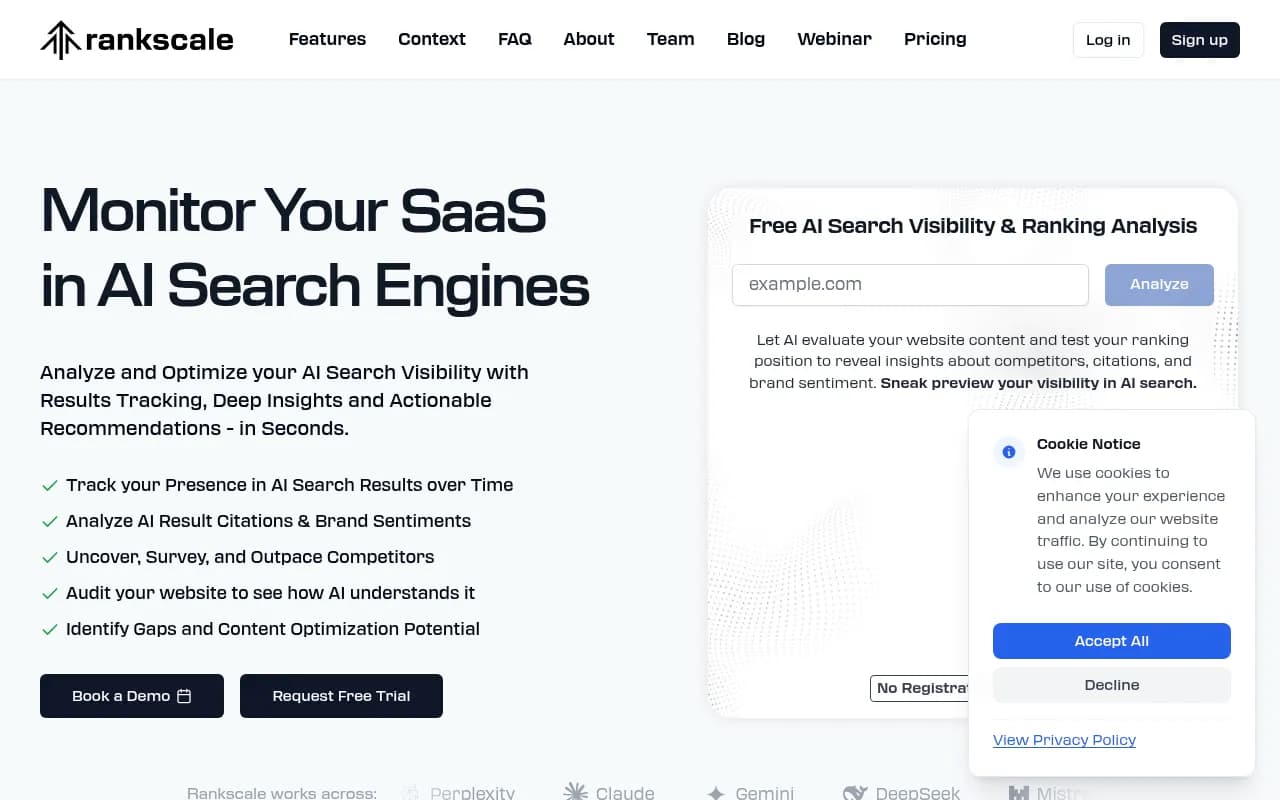
Rankscale is built specifically for agencies, with multi-client management and white-label reporting. If the MCP workflow isn't your priority and you just need a clean agency interface, it's worth evaluating.
Search Party
Search Party takes a different approach -- it's more of an AI automation consultancy that engineers custom workflows. If you're building something bespoke for a large client, they're worth knowing about.
The honest limitations
MCP for AI visibility is genuinely useful but it's not magic, and there are real constraints worth knowing.
The data is only as good as the platform feeding it. If your visibility platform is running prompts infrequently or not covering the right models, the MCP workflow just surfaces bad data faster.
Natural language queries can be imprecise. "How is Client X doing?" is not a well-formed query. Agencies that get the most value from this workflow have developed a library of standard questions they ask consistently across clients -- essentially prompt templates for the AI agent.
Not every visibility platform has an API yet. Some of the smaller tools in this space are dashboard-only, which means MCP integration isn't possible without scraping (which is fragile and often against terms of service).
And the reporting still needs human judgment. The agent can summarize the data, but deciding what it means for the client's strategy -- which content to create, which prompts to prioritize, how to position the results -- that's still the agency's job.
Where this is heading
The trajectory is clear: AI visibility platforms will increasingly expose MCP-compatible APIs, and AI assistants will increasingly be the primary interface for accessing that data. The agencies building this workflow now are getting ahead of a shift that will be table stakes in 18 months.
The ones that will do it well are the ones treating it as a data quality problem first and a technology problem second. The MCP connection is easy to set up. Having clean, consistent, reliable visibility data underneath it is the hard part -- and that's what separates platforms like Promptwatch from the monitoring-only tools that just show you a number and leave you to figure out what to do with it.