Key takeaways
- An AI visibility API lets you pull structured data about your brand's presence in LLM responses (ChatGPT, Perplexity, Gemini, etc.) directly into your own tools and dashboards
- Most marketing stacks in 2026 still have no connection between AI search data and revenue -- an API is how you close that gap
- The metrics that matter most are citation share, mention rate, sentiment, and prompt-level visibility -- not raw traffic from AI referrals
- Monitoring alone isn't enough: the teams getting results are using APIs to feed data into content workflows, not just dashboards
- Promptwatch is one of the few platforms that exposes a full API alongside built-in content generation, so you can track gaps and fix them in the same workflow

The problem with how most teams track AI search
Ask a marketing team in 2026 how their brand performs in AI search and you'll usually get one of two answers: "We check it manually sometimes" or "We have a dashboard for that." Neither is good enough.
Manual checks are inconsistent. You ask ChatGPT one question, get one answer, and draw conclusions from a sample size of one. Dashboards are better, but most of them are read-only -- they show you numbers without connecting those numbers to anything actionable in your existing workflow.
The missing piece is an API. Specifically, an AI visibility API: a programmatic interface that lets you pull structured data about how your brand appears in AI-generated responses, then use that data however you want -- inside your BI tools, your CRM, your content calendar, your custom dashboards, or your automated reporting.
This isn't a niche developer concern. It's increasingly a core marketing infrastructure question. If AI models are now a primary discovery channel for your customers (and for most B2B and high-consideration B2C categories, they are), then you need the same kind of programmatic access to AI search data that you've had for traditional search data via Google Search Console and rank tracking APIs for years.
What an AI visibility API actually does
At its simplest, an AI visibility API accepts a prompt (or a batch of prompts) and returns structured data about what an AI model said in response -- specifically whether your brand was mentioned, how it was framed, what competitors appeared alongside it, and which sources were cited.
More sophisticated implementations go further. They return:
- Citation data: which URLs the AI model pulled from when generating its answer
- Sentiment scores: whether the mention was positive, neutral, or negative
- Share of voice: how often your brand appeared versus named competitors across a prompt set
- Prompt-level breakdowns: which specific questions trigger mentions and which don't
- Model-level breakdowns: whether you appear in ChatGPT but not Perplexity, or in Google AI Overviews but not Claude
The API doesn't query the AI models directly in real time for every request -- that would be slow and expensive. Instead, platforms run scheduled queries across a defined prompt set, store the results, and expose them via API so you can pull the data on your own schedule.
Think of it like a rank tracking API for traditional SEO, but instead of "position 4 for keyword X," you get "mentioned in 34% of responses for prompt Y, with positive sentiment, citing page Z."
Why your marketing stack needs this in 2026
The honest answer is that most marketing stacks are flying blind on AI search. Google Analytics shows you referral traffic from chatgpt.com or perplexity.ai, but that only captures the small fraction of AI interactions where a user clicks through to your site. The majority of AI search interactions end without a click -- the user gets their answer and moves on.
That means your traditional analytics are systematically undercounting AI's influence on your pipeline. A prospect might ask Perplexity "what's the best project management tool for remote teams," get a response that mentions your competitor three times and you zero times, and then go directly to your competitor's site. Your analytics see zero AI referral traffic. Your brand was still invisible at a critical decision point.
An AI visibility API lets you measure that invisible influence. More importantly, it lets you feed that data into the rest of your stack:
- Pull citation data into your content planning tool to see which pages are being cited and which aren't
- Feed mention rate trends into your BI dashboard alongside traditional SEO and paid metrics
- Trigger content workflow automations when your visibility drops below a threshold for a high-priority prompt
- Include AI visibility scores in agency client reports alongside traditional rank tracking data
- Connect visibility changes to pipeline data to start building a case for AI search ROI
None of this is possible if your AI visibility data lives only in a standalone dashboard that nobody checks.
The metrics that actually matter
Not all AI visibility data is equally useful. Here's what's worth tracking and why.
Citation share
This is the percentage of AI responses (for a given prompt set) that cite your content as a source. It's a more reliable signal than raw mention rate because it measures whether AI models trust your content enough to reference it, not just whether your brand name appears in passing.
Mention rate and share of voice
How often does your brand appear in responses, and how does that compare to your top competitors? Share of voice across a prompt set gives you a competitive benchmark that's directly comparable to how you'd think about share of voice in paid or earned media.
Sentiment
Being mentioned is not the same as being recommended. AI models sometimes mention brands in negative contexts ("Brand X has struggled with customer support issues") or neutral ones ("Brand X is one option, along with..."). Sentiment scoring tells you whether your mentions are helping or hurting.
Prompt-level visibility
Which specific questions trigger mentions of your brand? Which don't? This is where the real content strategy work happens. If you're invisible for "best [category] tool for [use case]" but visible for "[brand name] review," you have a clear gap to close.
Page-level citation tracking
Which specific pages on your site are being cited? This tells you what's working and where to invest. A page that gets cited 40 times a month across AI responses is worth protecting and expanding. A page that never gets cited despite being central to your value proposition needs work.
How teams are using AI visibility APIs in practice
The most effective use cases I've seen aren't about building fancy dashboards. They're about connecting AI visibility data to decisions.
Content gap automation
Pull prompt-level visibility data via API, identify prompts where competitors are cited and you're not, and feed those gaps directly into your content brief tool or editorial calendar. This turns a manual audit process into something that can run on a schedule.
Agency reporting
Agencies managing multiple clients can pull AI visibility data for each client via API and include it in automated reports alongside traditional SEO metrics. This is increasingly a differentiator -- clients are asking about AI search performance, and agencies that can report on it programmatically look more sophisticated than those doing manual checks.
Threshold-based alerts
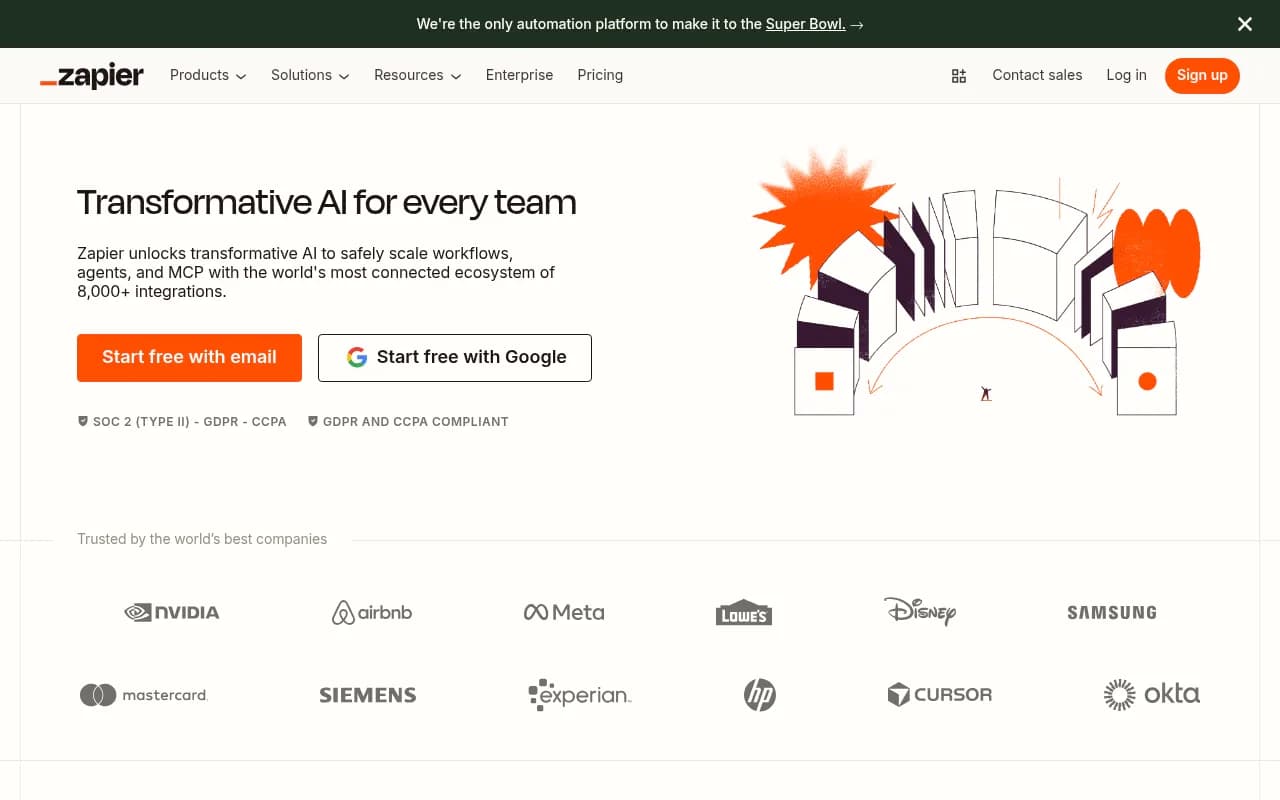
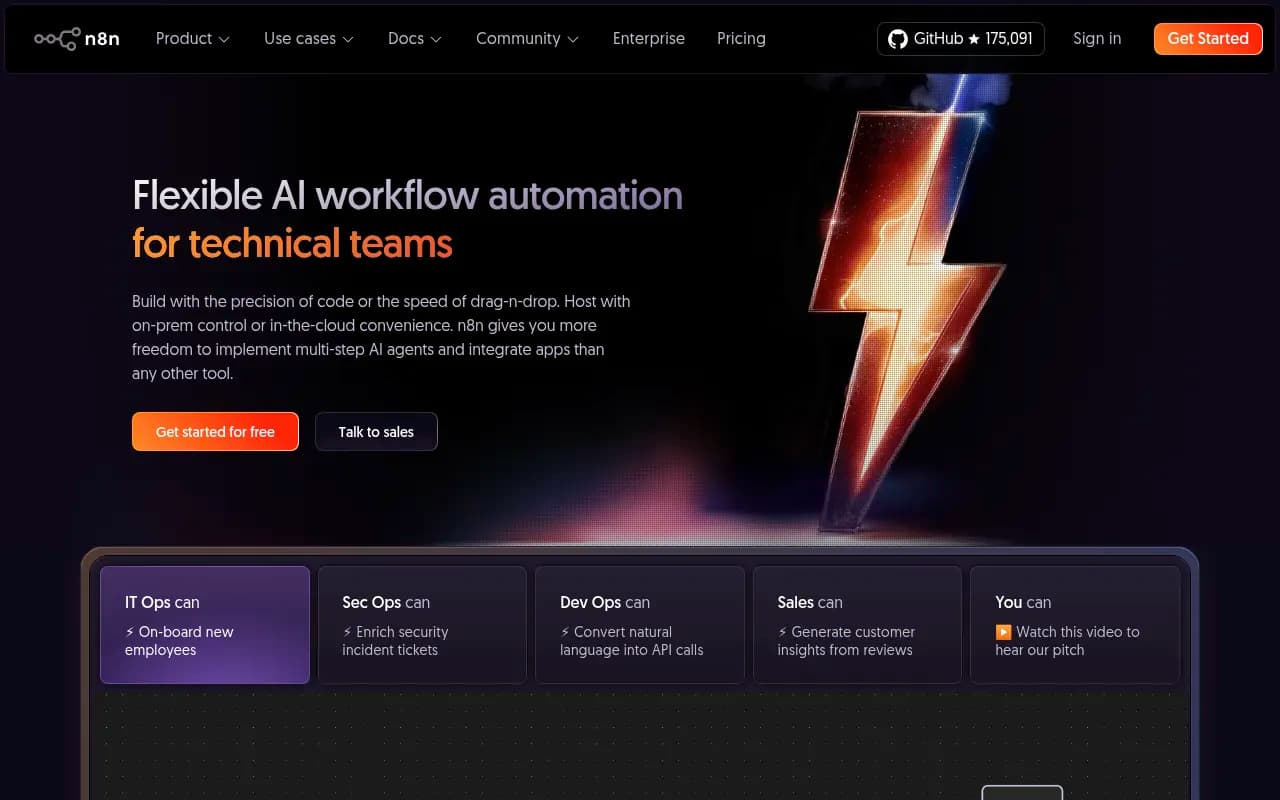
Set up a workflow (via Zapier, n8n, or custom code) that pulls your AI visibility score for priority prompts daily and sends a Slack alert if it drops below a threshold. This is the AI search equivalent of rank drop alerts in traditional SEO.
BI dashboard integration
Pull AI visibility metrics into Looker Studio, Tableau, or whatever BI tool your team uses, alongside your traditional SEO, paid, and organic metrics. This gives leadership a single view of search performance that doesn't artificially exclude AI search.
Attribution modeling
The most advanced use case: connecting AI visibility data to pipeline and revenue. If you can see that your AI visibility for a set of high-intent prompts increased in Q1, and your inbound pipeline from those segments also increased, you're building the case for AI search as a revenue channel. This requires combining API data with your CRM and attribution tools, but it's where the most interesting work is happening.
What to look for in an AI visibility API
Not all platforms expose equally useful APIs. When evaluating options, ask:
Which models are covered? You want data across ChatGPT, Perplexity, Google AI Overviews, Claude, Gemini, and ideally Grok and DeepSeek. A platform that only tracks one or two models gives you an incomplete picture.
What data is returned? Citation URLs, sentiment scores, competitor mentions, and prompt-level breakdowns are the minimum. Platforms that also return prompt volume estimates and difficulty scores give you the data to prioritize, not just monitor.
How fresh is the data? Some platforms query AI models daily, others weekly. For fast-moving categories, daily data matters.
Is there a Looker Studio connector or webhook support? This determines how easily you can get the data into your existing stack without custom engineering work.
Does the platform go beyond monitoring? An API that only returns data is useful. An API that's part of a platform that also helps you fix the gaps -- through content generation, citation analysis, and optimization recommendations -- is more valuable.
Tools with API access worth knowing about
Here's a quick comparison of platforms that offer programmatic access to AI visibility data, along with their key differentiators:
| Platform | API available | Models tracked | Content generation | Prompt volume data | Best for |
|---|---|---|---|---|---|
| Promptwatch | Yes (+ Looker Studio) | 10+ (ChatGPT, Perplexity, Claude, Gemini, Grok, DeepSeek, etc.) | Yes (built-in AI writer) | Yes | Teams that want to track and fix gaps |
| Profound | Yes | 9+ | Limited | Yes | Enterprise brand monitoring |
| AthenaHQ | Limited | 5-6 | No | No | Monitoring-focused teams |
| Otterly.AI | No | 3-4 | No | No | Basic monitoring |
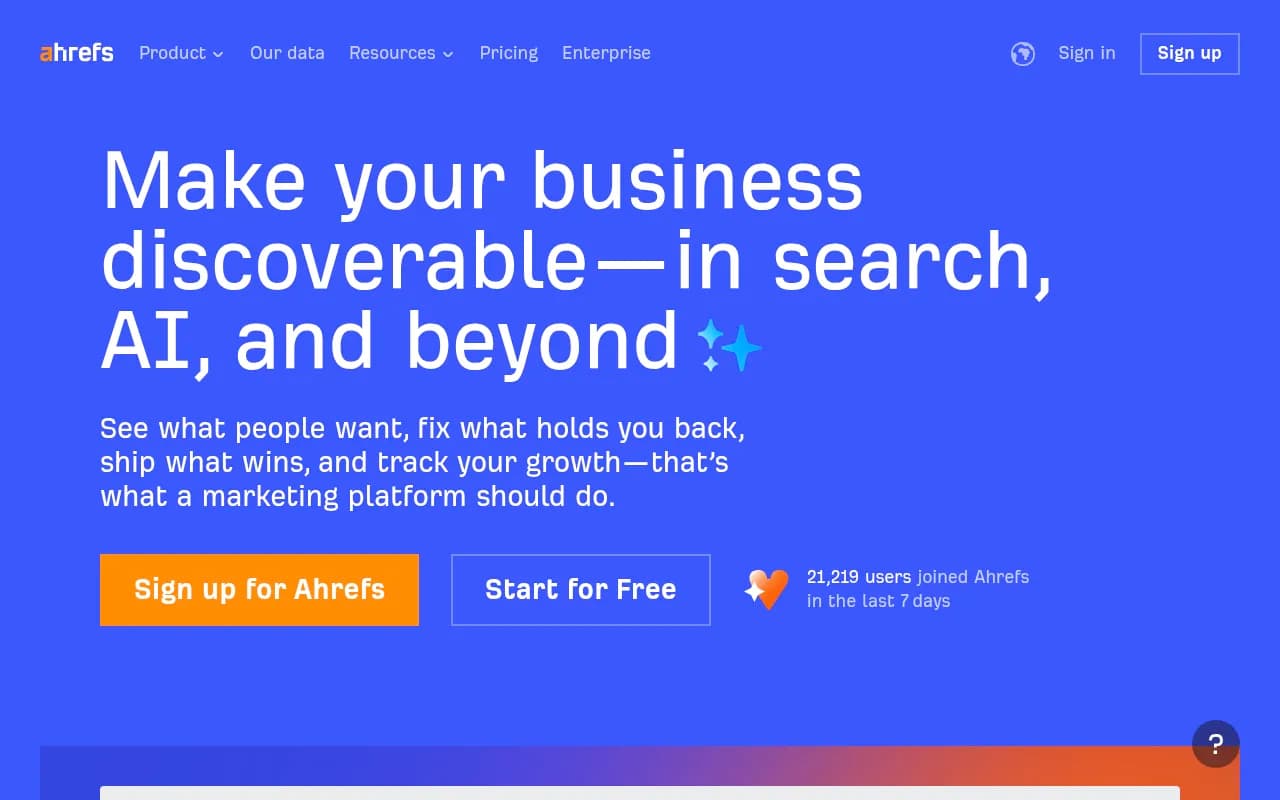
| Ahrefs | Limited (traditional SEO API) | Limited AI coverage | No | No | Traditional SEO teams |
| Semrush | Limited | Fixed prompts only | No | No | Traditional SEO teams |
Profound


Otterly.AI

The table above reflects a real pattern: most platforms are monitoring tools. They show you data. Promptwatch is built around the full loop -- find gaps, generate content to close them, track the results. The API is part of that loop, not a bolt-on.
The action loop: why monitoring alone isn't enough
Here's the thing about AI visibility data: it's only useful if you do something with it.
Most teams that adopt an AI visibility tool go through the same arc. They set it up, look at their visibility scores, feel vaguely concerned about the gaps, and then... nothing changes. The data sits in a dashboard. The content team doesn't see it. The gaps don't get closed.
The teams that actually improve their AI visibility are the ones that connect the data to action. They use the gap analysis to identify which prompts they're missing. They create content specifically designed to answer those prompts. They track whether that content gets cited. They iterate.
Promptwatch is built around this loop explicitly. The Answer Gap Analysis shows you which prompts competitors are visible for and you're not. The built-in AI writing agent generates content grounded in real citation data -- not generic SEO filler, but articles and comparisons designed to get cited by the specific models you're targeting. The page-level tracking shows you whether the new content is working. And the API lets you pull all of this into whatever reporting or automation workflow your team already uses.
That's a different proposition from a monitoring dashboard. It's the difference between knowing you have a problem and having a system to fix it.
Getting started: a practical approach
If you're building AI visibility into your marketing stack for the first time, here's a reasonable sequence:
-
Define your prompt set. What questions would your ideal customer ask an AI model when evaluating your category? Start with 20-50 prompts. These should cover awareness-stage questions ("what is X"), comparison questions ("X vs Y"), and decision-stage questions ("best X for [use case]").
-
Establish a baseline. Run your prompt set through a platform with API access and record your current visibility scores, mention rate, and share of voice versus competitors. This is your starting point.
-
Identify the highest-value gaps. Which high-intent prompts are your competitors visible for and you're not? Prioritize by prompt volume and commercial intent.
-
Create content to close the gaps. This means writing content that directly answers the prompts where you're invisible -- not just publishing more blog posts, but creating content structured the way AI models expect to find it.
-
Connect the API to your stack. Pull your visibility data into your BI dashboard or reporting tool. Set up alerts for significant drops. Include AI visibility metrics in your regular reporting cadence.
-
Track and iterate. Check whether your new content is getting cited. Double down on what works.
The teams doing this systematically are building a compounding advantage. AI models update their training data and retrieval sources over time. Content that gets cited today is more likely to keep getting cited. The gap between brands that have figured this out and those that haven't is widening.
An AI visibility API is how you make this process systematic rather than ad hoc. It's not a luxury feature -- in 2026, it's becoming table stakes for any marketing team that takes AI search seriously.