Key takeaways
- Only a handful of AI visibility platforms expose public APIs in 2026 -- most are dashboard-only tools with no programmatic access
- The APIs that do exist vary wildly in what they expose: some give raw citation data, others give prompt rankings, a few give traffic attribution
- What you can build depends heavily on rate limits, data freshness, and whether the platform tracks the AI models your audience actually uses
- Platforms with richer underlying data (more prompts, more models, more citation sources) produce more useful API outputs
- If you want to close the loop from API data to content action, look for platforms that combine monitoring with content generation capabilities
There's a gap between what AI visibility tools promise and what they actually let you do with the data. Most platforms hand you a dashboard, maybe a CSV export, and call it a day. But if you're running an agency managing 20 clients, or an enterprise team that wants to pipe AI citation data into your existing analytics stack, a dashboard isn't enough.
You need an API.
The problem is that this category is still young. A lot of platforms that launched in 2024 and 2025 built their monitoring infrastructure first and their developer layer second -- or not at all. So finding tools with real, documented, production-ready APIs takes some digging.
This guide covers the six AI visibility platforms that currently offer public API access, what their APIs actually expose, and what you can realistically build on top of each one. I've also included a comparison table at the end so you can see the differences at a glance.
Why API access matters for AI visibility
Before getting into the platforms, it's worth being clear about what "AI visibility" data actually is and why you'd want it programmatically.
When someone asks ChatGPT "what's the best project management tool for remote teams?" -- your brand either appears in that response or it doesn't. AI visibility tools track that. They send prompts to AI models, capture the responses, and record whether your brand was cited, how prominently, and what the surrounding context looked like.
That data is useful in a dashboard. It's much more useful when you can:
- Pull it into a custom BI tool (Looker, Tableau, Power BI)
- Trigger alerts when a competitor's visibility spikes
- Feed citation data into your content planning workflow
- Build client-facing reports without manual exports
- Correlate AI visibility changes with traffic and revenue data from your own systems
That's the case for API access. Now let's look at who actually offers it.
The 6 platforms with public APIs
1. Promptwatch
Promptwatch is the most API-complete platform in this category. It offers a documented REST API alongside a Looker Studio integration, which together cover most of the custom reporting use cases you'd run into.

What the API exposes:
- Brand visibility scores by prompt and by AI model
- Citation data: which pages are being cited, how often, and by which model
- Prompt-level data including volume estimates and difficulty scores
- Competitor visibility comparisons
- AI crawler log data (which AI bots hit which pages, when, and how often)
The crawler log access is genuinely unusual. Most platforms don't surface this at all. Being able to pull logs showing that GPTBot visited your pricing page three times last week but hasn't touched your blog in a month -- and then act on that -- is the kind of signal that's hard to get anywhere else.
What you can build: Custom dashboards that combine AI visibility with GSC data and revenue attribution. Automated alerts when your brand drops below a threshold for a specific prompt. Client reporting pipelines for agencies. Content prioritization workflows that pull prompt volume and difficulty scores to decide what to write next.
The API is available on Professional ($249/mo) and Business ($579/mo) plans. The underlying data covers 10 AI models: ChatGPT, Perplexity, Claude, Gemini, Google AI Overviews, Google AI Mode, Meta/Llama, DeepSeek, Grok, and Mistral.
2. Profound
Profound is the other platform with serious API infrastructure. It's positioned at the enterprise end of the market, and its API reflects that -- more configuration options, more data points, but also a higher price floor.
Profound

What the API exposes:
- Brand mention tracking across 9+ AI models
- Sentiment analysis on AI-generated responses
- Share of voice metrics by topic cluster
- Competitor comparison data
- Historical trend data
Profound's strength is breadth of coverage and the depth of its enterprise data model. If you're a large brand that needs to track visibility across dozens of product lines and hundreds of prompts, the API gives you the flexibility to structure that programmatically rather than through a UI.
What you can build: Enterprise-grade visibility reporting integrated into existing BI stacks. Automated competitive intelligence feeds. Brand health monitoring systems that flag sentiment shifts in AI responses.
The main limitation is cost -- Profound's enterprise pricing puts it out of reach for smaller teams, and the API is not available on entry-level plans.
3. Semrush (AI Overviews tracking)
Semrush added AI Overview tracking to its existing platform, and because Semrush has had an API for years, that data is technically accessible programmatically. This is less a purpose-built AI visibility API and more an extension of an existing SEO data API.
What the API exposes:
- Whether a keyword triggers an AI Overview in Google
- Which domains are cited in AI Overviews for specific keywords
- Traditional rank tracking data alongside AI Overview presence
What you can build: Integrated reports that show traditional rankings and AI Overview presence side by side. Alerts when a keyword you rank for starts triggering AI Overviews (which often cannibalizes click-through). Competitive analysis showing which domains are getting cited in AI Overviews for your target keywords.
The limitation here is scope. Semrush's AI tracking is Google-centric and uses fixed prompt sets -- you can't define custom prompts or track ChatGPT, Perplexity, or other conversational AI models. If your audience is increasingly using ChatGPT for research (and they are), this gap matters.
4. Ahrefs (Brand Radar)
Ahrefs launched Brand Radar as its answer to the AI visibility category, and like Semrush, it sits on top of an existing API infrastructure that's been around for years.
What the API exposes:
- Brand mention tracking in AI-generated content
- Citation source analysis
- Traditional SEO metrics alongside brand radar data
What you can build: Combined SEO and AI visibility reports. Brand mention trend analysis over time. Competitive benchmarking for citation share.
The same caveats apply as with Semrush: Ahrefs Brand Radar uses fixed prompts, which means you're tracking visibility for the prompts Ahrefs chose, not the prompts your actual customers are using. There's also no AI traffic attribution, so you can see that you're being cited but can't connect it to actual visits or conversions.
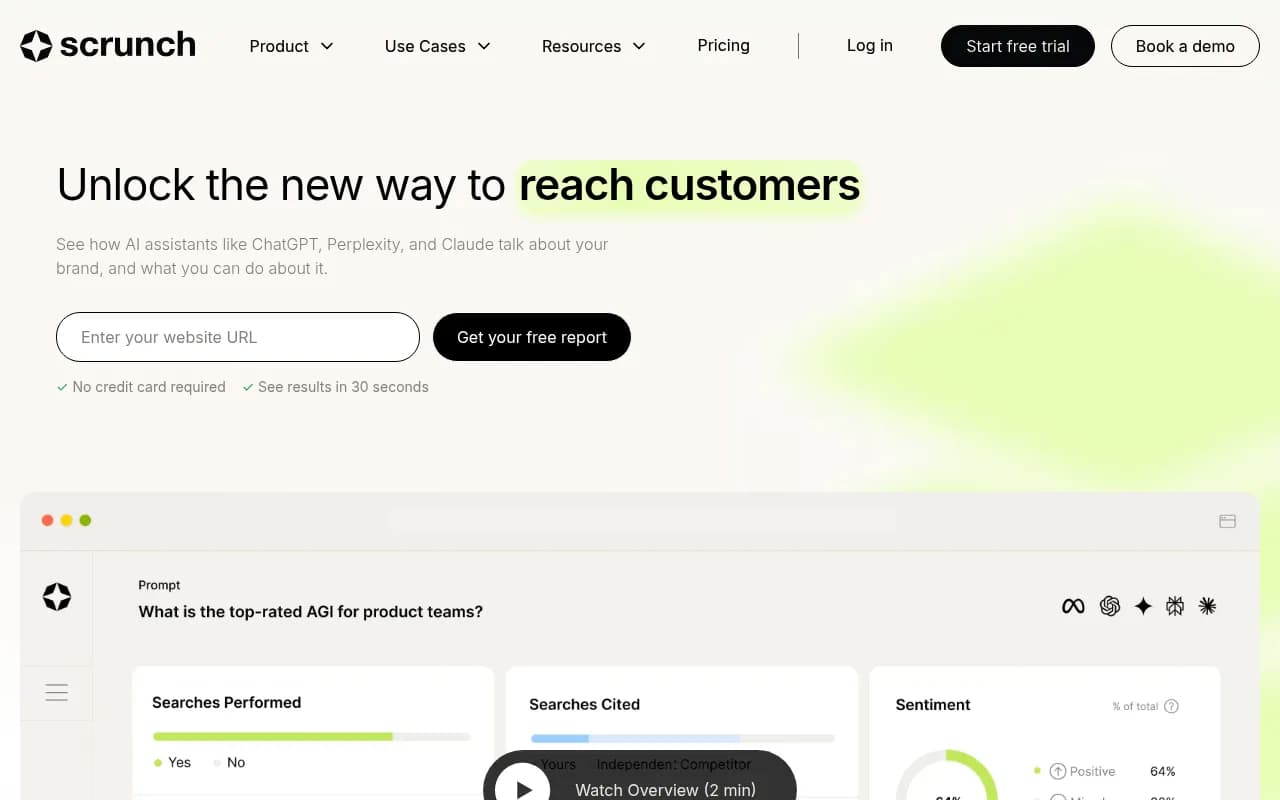
5. Scrunch AI
Scrunch AI has been building out API access as part of its agency-focused positioning. It's a more specialized tool than Semrush or Ahrefs, focused specifically on AI search visibility rather than traditional SEO.
What the API exposes:
- Brand visibility scores across multiple AI models
- Prompt tracking and response capture
- Competitor share of voice data
- Citation analysis
What you can build: White-label reporting pipelines for agencies. Automated visibility score tracking with custom alerting. Multi-client dashboards that pull data for multiple brands in a single API call.
Scrunch's API is reasonably well-documented and the platform has been around long enough that the data model is stable. The limitation is that it lacks some of the deeper features -- no crawler logs, no Reddit/YouTube citation tracking, no content generation -- so the API gives you monitoring data but not the inputs you'd need to act on it.
6. Peec AI
Peec AI is a lighter-weight option that has added API access, making it accessible for smaller teams or developers who want to experiment with AI visibility data without committing to enterprise pricing.

What the API exposes:
- Prompt-based visibility tracking across selected AI models
- Brand mention detection
- Basic competitor comparison
What you can build: Simple monitoring integrations -- Slack alerts when your brand is mentioned or drops from a response, basic dashboards, lightweight client reports.
Peec's API is more limited in scope than the others on this list. It's a good starting point if you want to understand what AI visibility data looks like programmatically, but it won't support complex multi-model analysis or deep citation tracking.
Comparison table
| Platform | API available | Models tracked | Custom prompts | Crawler logs | Citation depth | Content generation | Best for |
|---|---|---|---|---|---|---|---|
| Promptwatch | Yes (REST + Looker Studio) | 10 | Yes | Yes | Deep (880M+ citations) | Yes (built-in AI writer) | Teams that want to act on data, not just see it |
| Profound | Yes | 9+ | Yes | No | Strong | No | Enterprise brands with complex data needs |
| Semrush | Yes (existing API) | Google only | No (fixed prompts) | No | Google AI Overviews only | Limited | Existing Semrush users adding AI tracking |
| Ahrefs | Yes (existing API) | Google-focused | No (fixed prompts) | No | Moderate | No | Existing Ahrefs users adding brand monitoring |
| Scrunch AI | Yes | Multiple | Yes | No | Moderate | No | Agencies needing white-label reporting |
| Peec AI | Yes (limited) | Selected | Yes | No | Basic | No | Small teams or developers experimenting |
What to look for in an AI visibility API
Not all APIs are equal, and the differences matter more than the feature lists suggest. Here are the things worth checking before you commit to building on a platform.
Data freshness
AI search is moving fast. A platform that updates visibility data weekly is fine for trend analysis but useless for catching a competitor surge or a sudden drop in citations. Look for daily or near-real-time data refresh, especially if you're building alerting systems.
Prompt customization
Fixed prompt sets are a real limitation. If you can only track the prompts the platform chose, you're measuring visibility for questions your customers might not actually be asking. Platforms that let you define custom prompts give you data that's actually relevant to your business.
Model coverage
ChatGPT and Perplexity get most of the attention, but Gemini, Claude, and Google AI Mode are all growing. If your API only covers two or three models, you're missing a significant portion of the AI search landscape. Promptwatch covers 10 models; most competitors cover four or fewer.
Rate limits and data volume
If you're building a multi-client reporting system for an agency, you need to understand how many API calls you can make and how much data you can pull per request. Some platforms are generous here; others throttle aggressively at lower plan tiers.
What happens after the data
This is the question most API documentation doesn't answer: once you know your brand is invisible for a set of prompts, what do you do? Platforms that combine monitoring with content generation give you a path from insight to action. Platforms that are monitoring-only leave you to figure that out yourself.
Promptwatch is the clearest example of a platform that closes this loop -- the API surfaces the gaps, and the built-in writing tools help you fill them. That's a different value proposition than pulling data into a spreadsheet and hoping your content team knows what to do with it.
What you can realistically build
To make this concrete, here are four workflows that become possible with API access to AI visibility data.
Automated client reporting for agencies
Pull visibility scores, prompt-level data, and competitor comparisons via API on a weekly schedule. Format them into a branded report template. Send automatically. This eliminates hours of manual work per client and makes AI visibility a standard part of your reporting package rather than an afterthought.
Slack or Teams alerts for brand monitoring
Set up a webhook that fires when your brand drops below a visibility threshold for a high-priority prompt, or when a competitor's visibility spikes. This turns passive monitoring into active brand protection.
Content prioritization pipelines
Pull prompt volume and difficulty scores from the API. Cross-reference with your existing content calendar. Automatically flag prompts where you have low visibility but high search volume as priority content targets. Feed that into your project management tool.
Revenue attribution dashboards
Combine AI visibility data from the API with traffic data from GSC or your analytics platform and revenue data from your CRM. Build a dashboard that shows the relationship between AI citation frequency and actual conversions. This is the analysis that justifies GEO investment to leadership.
The honest summary
Six platforms have public APIs. Two of them (Semrush and Ahrefs) are traditional SEO tools that added AI tracking on top of existing infrastructure -- useful if you're already in their ecosystem, limited if you need custom prompts or multi-model coverage. Two (Profound and Scrunch AI) are purpose-built AI visibility platforms with solid API access but no path from data to content action. One (Peec AI) is a lightweight option for experimentation. And one (Promptwatch) combines deep API access with content generation, crawler logs, and multi-model coverage in a way that no other platform currently matches.
The right choice depends on what you're building. If you just need to pipe visibility scores into an existing dashboard, most of these will work. If you want to build a system that finds gaps, generates content to fill them, and tracks whether it worked -- that's a shorter list.