Key takeaways
- Goodie AI covers 11 AI models (including Amazon Rufus); AI Peekaboo covers 5. If you need breadth of model coverage, Goodie wins by a clear margin.
- Neither tool offers built-in AI content generation -- both are primarily monitoring and analysis platforms. If you need to actually create content that ranks in AI search, you'll need something else.
- AI Peekaboo is almost certainly cheaper and has a self-serve 7-day trial. Goodie AI is quote-only, which usually means enterprise-level spend and a sales cycle.
- Goodie AI's "closed loop" (Research > Monitor > Action > Measure) sounds comprehensive on paper, but the "Action" phase stops at identifying gaps -- it doesn't generate content for you.
- AI Peekaboo is the more practical choice for agencies managing multiple clients who want simple dashboards without a lengthy procurement process.
- For teams that need real optimization (not just monitoring), both tools have meaningful gaps compared to platforms that include content generation and AI crawler log analysis.
Overview
Goodie AI
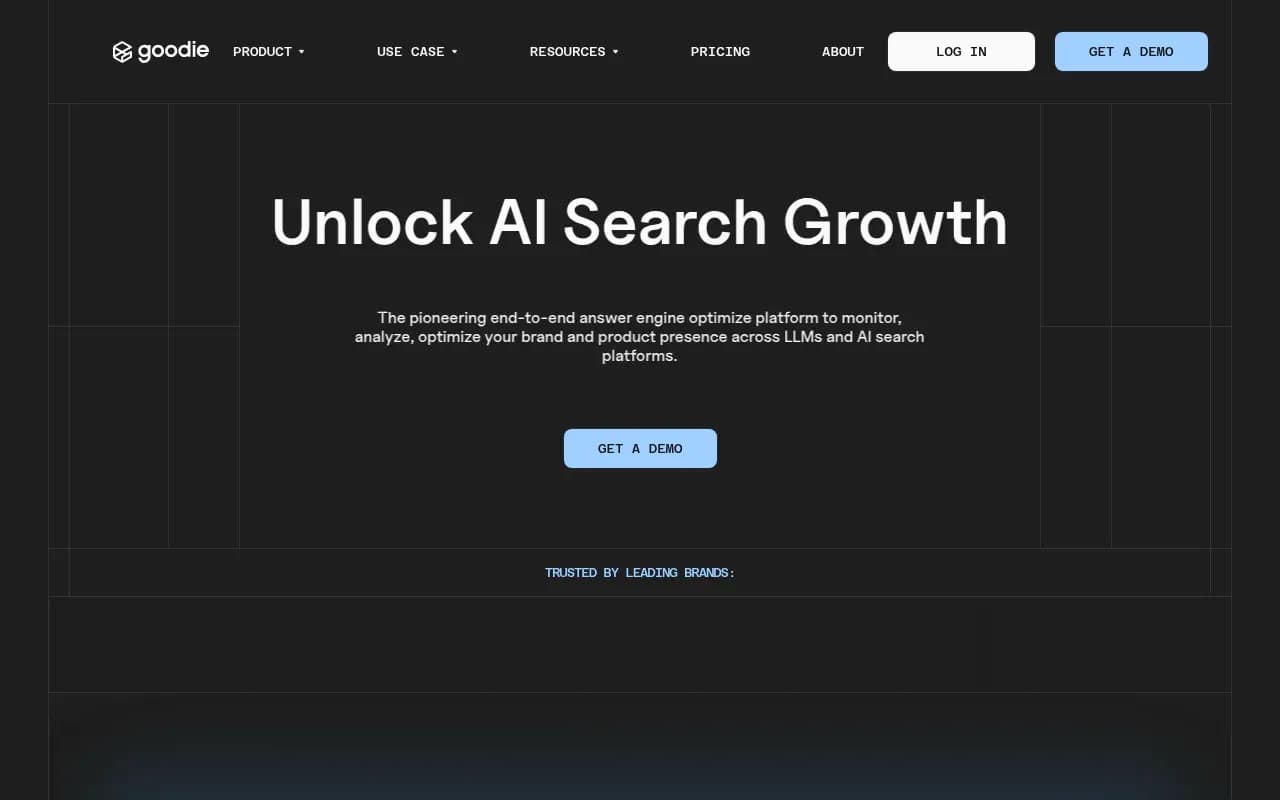
Goodie AI (higoodie.com) positions itself as an "end-to-end AEO platform" with a four-stage closed loop: Research, Monitor, Action, and Measure. It tracks 11 AI models -- one of the widest coverage sets in the market -- including Amazon Rufus, which is a genuinely differentiating feature for e-commerce brands. The platform targets enterprise marketing teams and agencies, and it shows: there's no self-serve pricing, no free trial, and you need to book a demo to even get a look at the product. Brands like Dermalogica and Rathbones are listed as customers, which suggests a mid-to-large enterprise focus.
The "end-to-end" framing is ambitious. Research and Monitor phases are clearly well-developed. The Action and Measure phases are where the platform's actual depth gets harder to verify without a live demo -- the website describes optimization gap identification and ROI attribution, but the specifics are vague.
AI Peekaboo
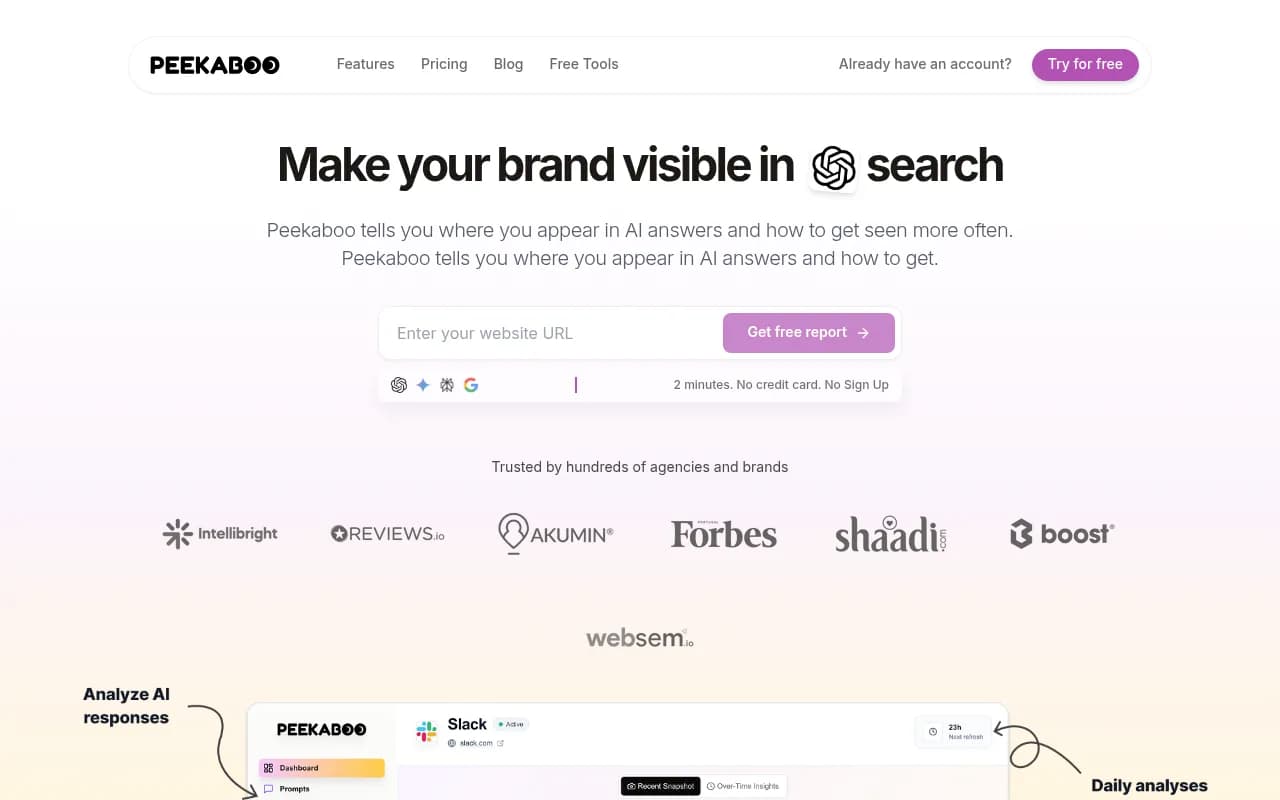
AI Peekaboo (aipeekaboo.com) takes a much simpler approach. It tracks brand mentions across ChatGPT, Gemini, Google AI Overviews, Perplexity, and Google AI Mode, and wraps that in a clean dashboard with multi-client management for agencies. There's a 7-day free trial, no sales call required, and the product is clearly designed to be picked up quickly without a lengthy onboarding process.
The positioning is honest: Peekaboo doesn't claim to be a full optimization suite. It's a monitoring tool with a focus on prompt-level tracking and agency workflows. That clarity is actually refreshing compared to platforms that oversell their capabilities.
Side-by-side comparison
| Feature | Goodie AI | AI Peekaboo |
|---|---|---|
| AI models tracked | 11 (incl. Amazon Rufus, DeepSeek, Grok) | 5 (ChatGPT, Gemini, Perplexity, Google AIO, AI Mode) |
| Pricing model | Custom/quote only | Not public; est. $49-79/mo |
| Free trial | No (demo only) | 7-day free trial |
| Self-serve signup | No | Yes |
| Brand mention tracking | Yes | Yes |
| Citation tracking | Yes | Yes |
| Competitor benchmarking | Yes | Limited |
| Prompt research/volume | Yes | Basic |
| Content gap analysis | Partial (identifies gaps) | No |
| Content generation | No | No |
| AI crawler logs | Not confirmed | No |
| Reddit/YouTube tracking | Not confirmed | No |
| ChatGPT Shopping tracking | No | No |
| ROI/traffic attribution | Yes (claimed) | No |
| Agency/multi-client support | Yes | Yes (core feature) |
| White-label reporting | Not confirmed | Yes |
| API access | Not confirmed | Not confirmed |
| Target audience | Enterprise brands, agencies | Agencies, SMBs |
Head-to-head feature deep-dive
AI model coverage
This is the clearest win for Goodie AI. Eleven models versus five is a significant gap, and the inclusion of Amazon Rufus is genuinely useful for any brand selling on Amazon. Rufus is increasingly influencing purchase decisions on the platform, and almost no other AEO tool tracks it.
Peekaboo's five-model coverage (ChatGPT, Gemini, Perplexity, Google AI Overviews, Google AI Mode) hits the most commonly used consumer AI tools, so for many brands it's sufficient. But if you're in e-commerce, financial services, or any sector where niche AI assistants matter, Goodie's breadth is hard to ignore.
Verdict: Goodie AI wins on coverage.
Monitoring and brand tracking
Both tools track brand mentions and citations across their respective model sets. Goodie AI goes further with sentiment tracking and competitive share-of-voice analysis. Peekaboo focuses on prompt-level tracking -- you pick specific prompts to monitor and see when and how your brand appears in responses to those prompts.
Peekaboo's prompt-level approach is actually quite practical for agencies. You can set up specific queries that matter to a client and report on those directly, rather than sifting through broad visibility scores. Goodie's approach is more comprehensive but also more complex.
Verdict: Tie -- depends on what you need. Peekaboo for prompt-specific tracking; Goodie for broader competitive intelligence.
Research and prompt intelligence
Goodie AI includes a Research phase that covers customer prompt patterns and search volume data. This is useful for understanding which queries to target before you start optimizing. Peekaboo lets you track prompts but doesn't appear to offer volume estimates or difficulty scoring to help you prioritize.
If you're building an AEO strategy from scratch, Goodie's research capabilities give you a better starting point. Peekaboo assumes you already know which prompts matter.
Verdict: Goodie AI wins.
Optimization and content action
This is where both tools show their limits. Goodie AI's "Action" phase identifies optimization gaps and suggests improvements across owned and earned assets. That's useful guidance. But neither Goodie nor Peekaboo actually generates content for you -- you still need to write the articles, update the pages, and publish the content yourself.
For teams that want a platform to close the full loop from "we're invisible for this prompt" to "here's the article that will fix it," neither tool delivers. Worth knowing that Promptwatch does include a built-in AI writing agent that generates content grounded in citation data -- if content creation is a priority, that's worth looking at separately.

Verdict: Goodie AI edges ahead on gap identification, but neither tool generates content.
ROI attribution and measurement
Goodie AI explicitly claims ROI attribution that connects AI visibility to business outcomes. The specifics aren't detailed publicly, but this is a meaningful differentiator if it works as described -- most monitoring tools stop at visibility metrics and leave you to figure out the revenue connection yourself.
Peekaboo doesn't appear to offer traffic attribution or revenue measurement. It's a visibility dashboard, not a business impact tool.
Verdict: Goodie AI wins, assuming the attribution works as claimed.
Agency and multi-client workflows
Peekaboo is clearly built with agencies in mind. Multi-client management, white-label reporting, and a simple onboarding process make it easy to spin up monitoring for a new client without a lengthy setup. The prompt-level tracking also maps well to client reporting -- you can show a client exactly which queries they're appearing in and how that's changing over time.
Goodie AI supports agencies too, but the enterprise positioning and quote-based pricing make it a harder sell for smaller agencies or those with clients who have modest budgets.
Verdict: AI Peekaboo wins for agency workflows.
Ease of access and onboarding
Peekaboo has a 7-day free trial and self-serve signup. You can be tracking prompts within minutes. Goodie AI requires a demo call, a sales conversation, and presumably a contract negotiation before you see the product. That's fine for enterprise procurement, but it's a real friction point for anyone who wants to evaluate quickly.
Verdict: AI Peekaboo wins by a wide margin.
Pricing comparison
| Plan | Goodie AI | AI Peekaboo |
|---|---|---|
| Free trial | No | 7-day free trial |
| Entry-level | Custom quote | Est. ~$49-79/mo |
| Mid-tier | Custom quote | Not disclosed |
| Enterprise | Custom quote | Not disclosed |
| Annual discount | Unknown | Unknown |
| Self-serve | No | Yes |
Goodie AI's pricing opacity is a real issue for anyone trying to budget without a sales call. Enterprise pricing models aren't inherently bad, but the complete absence of even a starting price range makes it hard to know if the tool is in your ballpark. Peekaboo's pricing isn't fully public either, but the free trial at least lets you evaluate the product before committing.
Pros and cons
Goodie AI
Pros:
- Widest AI model coverage in this comparison (11 models, including Amazon Rufus)
- Genuine research phase with prompt volume and pattern data
- Competitive benchmarking and sentiment tracking
- Claims ROI attribution connecting visibility to business outcomes
- Trusted by recognizable enterprise brands
Cons:
- No self-serve access -- requires a demo and sales process
- No public pricing whatsoever
- Content generation is not included despite "end-to-end" positioning
- AI crawler logs and Reddit/YouTube tracking not confirmed
- Harder to evaluate without committing to a sales conversation
AI Peekaboo
Pros:
- 7-day free trial, no credit card required
- Self-serve signup -- you can start immediately
- Clean, simple dashboards that agencies can use without training
- White-label reporting for client-facing work
- Prompt-level tracking is practical for specific campaign monitoring
- Likely more affordable than Goodie AI
Cons:
- Only 5 AI models -- no Amazon Rufus, DeepSeek, Grok, or Claude
- No content gap analysis or content generation
- No traffic attribution or ROI measurement
- Limited competitive intelligence compared to Goodie
- No prompt volume or difficulty scoring to help prioritize
Who should pick which tool
Choose Goodie AI if:
- You're an enterprise brand with a real budget and need the widest possible AI model coverage
- Amazon Rufus tracking matters to your business (e-commerce brands especially)
- You want competitive sentiment analysis and share-of-voice data
- You have the patience for a sales-led procurement process
- ROI attribution to business outcomes is a requirement
Choose AI Peekaboo if:
- You're an agency managing multiple clients who need simple, reportable dashboards
- You want to start tracking today without a sales call
- Your clients' AI search presence is primarily in ChatGPT, Gemini, and Perplexity
- Budget is a constraint and you need a lower entry point
- White-label reporting is important for client relationships
Consider neither if:
- You need content generation built into the platform -- both tools stop at identifying gaps
- You want AI crawler logs to understand how AI engines are indexing your site
- You need Reddit or YouTube tracking to understand what's influencing AI recommendations
- You want prompt volume and difficulty scoring to prioritize your efforts
Final verdict
Goodie AI and AI Peekaboo are solving the same core problem -- understanding where your brand shows up in AI search -- but they're aimed at different buyers. Goodie is the more capable platform for enterprise teams that need broad model coverage and competitive intelligence, and its Amazon Rufus tracking is a genuine differentiator for e-commerce. Peekaboo is the more practical choice for agencies that need to get clients set up quickly, report cleanly, and keep costs manageable.
Neither tool will generate content for you, and both leave a gap between "here's where you're invisible" and "here's how to fix it." If that gap matters to your workflow, you'll need to look beyond both of these platforms. But if monitoring and benchmarking is what you're after, Goodie AI is the more powerful option -- if you can get through the sales process to find out what it actually costs.