Key Takeaways
- AI Rank Checker covers more models: 7 AI engines (ChatGPT, Perplexity, Claude, Gemini, Copilot, Grok, Meta AI) vs Gumshoe's 3 (ChatGPT, Gemini, Perplexity)
- Gumshoe AI has a real free tier: 3 free report runs to test the platform, while AI Rank Checker requires a $5 minimum top-up to start
- Pricing structure differs significantly: Gumshoe charges $0.10 per conversation, AI Rank Checker uses wallet credits starting at $5 with per-keyword pricing
- Gumshoe focuses on persona-based tracking: Built around buyer personas and topic visibility, while AI Rank Checker emphasizes keyword ranking and competitor comparison
- AI Rank Checker better for agencies: Multi-domain tracking with separate dashboards makes it easier to manage multiple clients
- Both skip crawler logs and optimization tools: Neither platform shows you how AI engines crawl your site or helps you create content that ranks better
Overview
Gumshoe AI
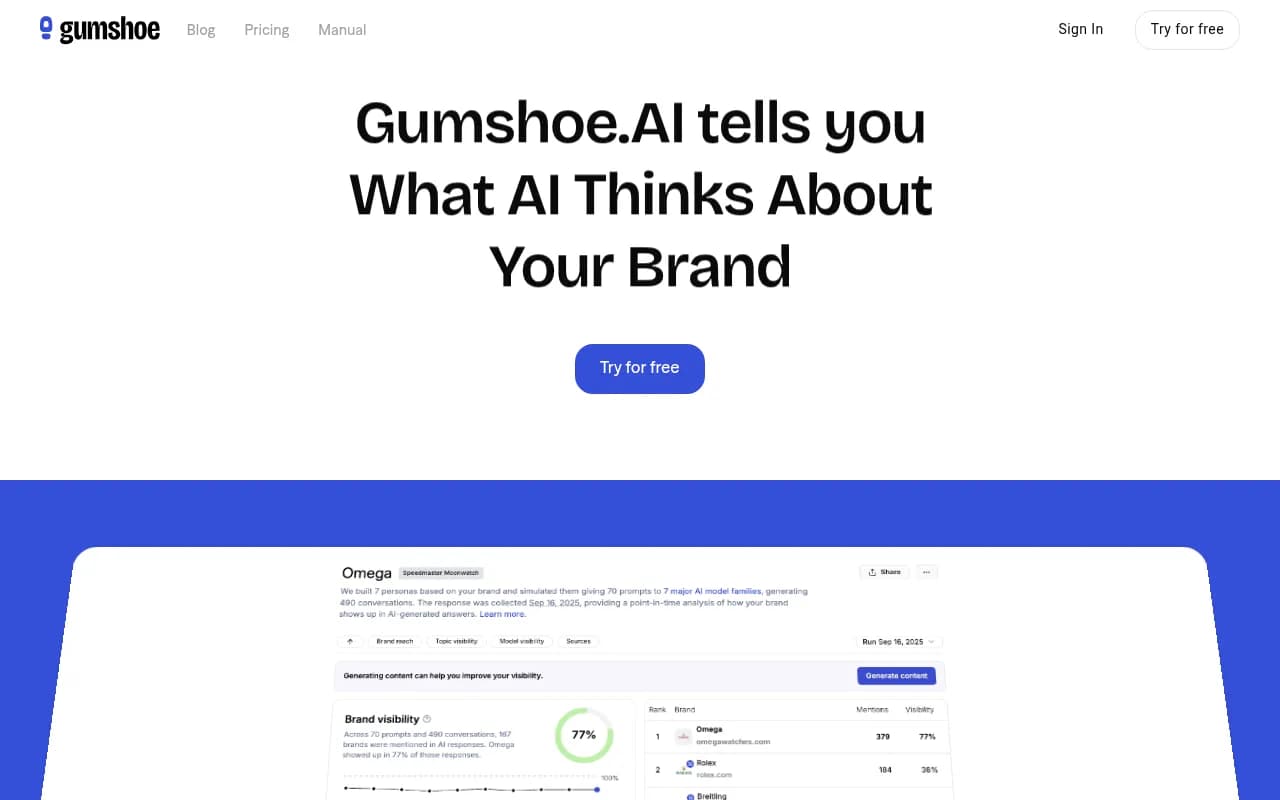
Gumshoe AI positions itself as a brand monitoring tool for AI search. It tracks mentions across ChatGPT, Gemini, and Perplexity with a focus on personas and topics rather than raw keyword rankings. The platform runs reports on demand -- you define your brand, competitors, topics, and buyer personas, then Gumshoe queries the AI models to see who gets mentioned. Pricing is straightforward: $0.10 per conversation after your first 3 free reports.
The interface emphasizes understanding context -- not just "did we get mentioned" but "which personas see us" and "what topics trigger our brand." You get cited sources, competitive rank, and model-by-model breakdowns. Scheduled reports and trend tracking unlock after you start paying.
AI Rank Checker
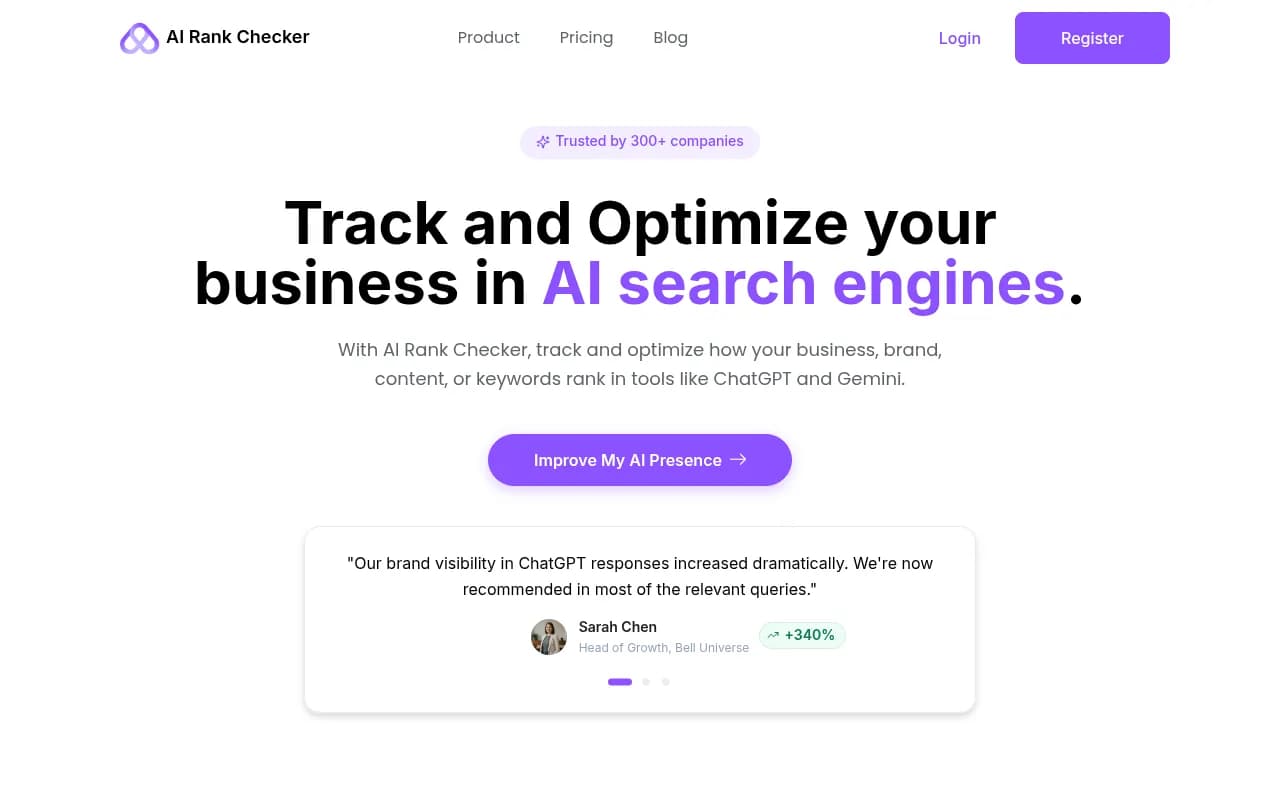
AI Rank Checker takes a more traditional SEO approach to AI search monitoring. You add keywords, it checks where your domain ranks across 7 AI engines, and you track changes over time. The platform supports multi-domain tracking (useful for agencies), competitor comparison, and data export in PDF or CSV.
Pricing uses a wallet system -- top up starting at $5, then pay per keyword check. No subscriptions, no monthly commitments. You pick which AI engines to query for each keyword, so you only pay for what you actually use. The dashboard shows ranking history, competitor positions, and lets you drill into specific keywords across models.
Side-by-Side Comparison
| Feature | Gumshoe AI | AI Rank Checker |
|---|---|---|
| AI models covered | 3 (ChatGPT, Gemini, Perplexity) | 7 (ChatGPT, Perplexity, Claude, Gemini, Copilot, Grok, Meta AI) |
| Free tier | Yes (3 report runs) | No (requires $5 minimum) |
| Pricing model | $0.10/conversation | Wallet credits from $5, per-keyword |
| Persona tracking | ✓ Built-in | ✗ Not available |
| Topic visibility | ✓ Core feature | ✗ Keyword-focused instead |
| Multi-domain support | Limited | ✓ Separate dashboards |
| Competitor tracking | ✓ Competitive rank | ✓ Side-by-side comparison |
| Scheduled reports | ✓ (paid tier) | ✗ Manual checks |
| Data export | ✓ Storage integrations | ✓ PDF and CSV |
| Cited sources | ✓ Shows top sources | ✗ Not mentioned |
| Content recommendations | ✓ AI-assisted generation | ✗ Not available |
| API access | Enterprise only | Not mentioned |
Model coverage and tracking depth
AI Rank Checker wins on breadth. Seven AI engines means you're covering ChatGPT, Perplexity, Claude, Gemini, Copilot, Grok, and Meta AI -- basically everything that matters in 2026. Gumshoe limits you to three: ChatGPT, Gemini, and Perplexity. That's a meaningful gap if your audience uses Claude or if you're trying to track Meta AI recommendations.
But Gumshoe digs deeper with the models it does cover. You're not just checking "does my brand appear for this keyword" -- you're seeing which buyer personas trigger mentions, which topics drive visibility, and what sources AI models cite when they recommend you. AI Rank Checker gives you ranking positions and competitor comparisons, which is useful, but it's a shallower cut.
If you need comprehensive model coverage, AI Rank Checker is the obvious pick. If you want richer context on the models that matter most (ChatGPT, Gemini, Perplexity), Gumshoe's persona and topic layers add real value.
Pricing and cost structure
| Plan | Gumshoe AI | AI Rank Checker |
|---|---|---|
| Free tier | 3 report runs | None |
| Entry price | $0.10/conversation | $5 minimum top-up |
| Subscription required | No | No |
| Volume discounts | Enterprise custom | Wallet-based |
| Enterprise | Custom pricing | Custom pricing |
Gumshoe's pricing is dead simple: ten cents per conversation. A "conversation" means one report run across your defined topics, personas, and competitors. If you're running 50 reports a month, that's $5. If you're running 500, it's $50. Predictable, scales linearly.
AI Rank Checker uses wallet credits. You top up starting at $5, then each keyword check costs credits depending on which AI engines you select. The per-keyword cost isn't published on the site, which makes it harder to estimate monthly spend. The flexibility is nice -- you can check 10 keywords across all 7 engines one month, then just 3 keywords on ChatGPT the next -- but the opacity around per-check pricing is annoying.
Gumshoe's free tier (3 reports) is a real advantage for testing. AI Rank Checker requires you to commit $5 before you see anything. Not a huge barrier, but Gumshoe removes friction.
Persona and topic tracking vs keyword ranking
This is the core philosophical difference. Gumshoe organizes everything around personas and topics. You define buyer personas (e.g. "enterprise IT decision-maker", "small business owner"), then see which personas trigger your brand mentions and which topics you're visible for. The idea: AI search isn't just about keywords, it's about context and intent.
AI Rank Checker sticks with the traditional SEO model: you add keywords, it checks where you rank. Straightforward, familiar, easy to explain to stakeholders who think in terms of "we need to rank for X."
Gumshoe's approach feels more aligned with how people actually use AI search -- they ask questions in natural language, not keyword strings. But it also requires more upfront work to define personas and topics. AI Rank Checker's keyword model is plug-and-play: add your target keywords, start tracking.
If your team already thinks in personas and customer journeys, Gumshoe makes sense. If you want to track specific high-value keywords without the abstraction layer, AI Rank Checker is simpler.
Multi-domain and agency features
AI Rank Checker explicitly supports multi-domain tracking with separate dashboards per brand. This is a big deal for agencies managing 5, 10, or 20 clients -- you're not mixing data or juggling accounts. Each client gets their own view, their own competitors, their own keyword sets.
Gumshoe doesn't highlight multi-domain support in its marketing. The platform seems designed for single-brand use cases. You could probably hack it by creating separate reports, but there's no clean agency workflow.
For agencies or in-house teams managing multiple brands, AI Rank Checker is the better fit. For single-brand monitoring, it doesn't matter.
Data export and reporting
Both platforms let you export data. AI Rank Checker offers PDF and CSV downloads -- standard, works fine for client reports or internal dashboards. Gumshoe mentions "storage integrations" which suggests it can push data to external systems, but details are vague.
Gumshoe has scheduled reports (paid tier), so you can automate weekly or monthly snapshots. AI Rank Checker doesn't mention scheduling -- you run checks manually. If you want set-it-and-forget-it monitoring, Gumshoe wins here.
Neither platform offers the kind of deep reporting you'd get from a full-featured AI visibility platform. You're getting snapshots and trends, not root-cause analysis or optimization recommendations tied to specific pages.
Content optimization and cited sources
Gumshoe shows you which sources AI models cite when they mention your brand. This is genuinely useful -- if ChatGPT keeps citing a specific blog post or a Reddit thread, you know what's working. The platform also offers "AI-assisted content generation" and "optimization recommendations" on the paid tier, though it's unclear how deep these features go.
AI Rank Checker doesn't mention cited sources or content recommendations at all. It's purely a tracking tool -- you see where you rank, but you're on your own for figuring out why or what to do about it.
If you want actionable insights beyond just "here's your rank," Gumshoe gives you more to work with. If you just need the data and you'll handle optimization yourself, AI Rank Checker is fine.
Worth noting: if you're serious about optimizing for AI search -- not just tracking it -- tools like Promptwatch take this further with content gap analysis, AI crawler logs, and a built-in writing agent that generates articles designed to get cited by AI models. Gumshoe and AI Rank Checker both stop at monitoring.

Pros and cons
Gumshoe AI pros
- Real free tier (3 reports) to test before paying
- Persona-based tracking aligns with how people actually use AI search
- Shows cited sources so you know what content is driving mentions
- Scheduled reports and trend tracking (paid tier)
- Simple per-conversation pricing with no surprises
Gumshoe AI cons
- Only 3 AI models (misses Claude, Copilot, Grok, Meta AI)
- No clear multi-domain or agency workflow
- Persona setup requires more upfront work than keyword tracking
- Vague details on "AI-assisted content generation" feature
AI Rank Checker pros
- Covers 7 AI engines -- most comprehensive model coverage
- Multi-domain support with separate dashboards (great for agencies)
- Keyword-based tracking is simple and familiar
- PDF and CSV export for client reporting
- Pay-as-you-go with no subscriptions
AI Rank Checker cons
- No free tier -- requires $5 minimum to start
- Per-keyword pricing not transparent on the website
- No persona or topic-based tracking
- Doesn't show cited sources or offer content recommendations
- No scheduled reports (manual checks only)
Who should pick which tool
Pick Gumshoe AI if:
- You're monitoring a single brand and want deeper context on mentions
- Persona-based insights matter to your team (e.g. you're targeting distinct buyer segments)
- You want to see which sources AI models cite when they recommend you
- You value a free tier to test before committing money
- ChatGPT, Gemini, and Perplexity are your priority models
Pick AI Rank Checker if:
- You're an agency managing multiple client brands
- You need coverage across all major AI engines (especially Claude, Copilot, Grok, Meta AI)
- You prefer straightforward keyword tracking over persona abstraction
- You want separate dashboards per domain
- You're comfortable with wallet-based pricing and manual report runs
Consider a more comprehensive platform if:
- You need to understand how AI engines crawl your site (crawler logs)
- You want to identify content gaps and generate articles that rank in AI search
- You're tracking hundreds of prompts or need API access for custom workflows
- You want attribution data connecting AI visibility to actual traffic and revenue
Final verdict
AI Rank Checker covers more AI models and works better for agencies, but Gumshoe AI offers richer insights with persona tracking and cited sources. If you're managing multiple brands or need Claude/Copilot/Grok coverage, AI Rank Checker is the practical choice. If you're optimizing a single brand and want to understand the "why" behind your mentions, Gumshoe's context layers are worth the narrower model coverage. Both are basic monitoring tools -- they'll tell you where you stand, but they won't help you fix it.