Key takeaways
- Orchly starts at $49/month with a free trial. Meridian requires a demo call and uses custom pricing -- expect a meaningfully higher price point.
- Meridian is a managed service as much as a software platform. You get human experts plus AI agents executing strategy. Orchly is fully self-serve.
- Orchly covers both AI visibility and traditional SEO in one tool: organic rank tracking, website auditing, keyword research, and content publishing. Meridian focuses purely on AI search.
- Orchly has white-label reports and API access, making it a reasonable fit for agencies. Meridian is positioned toward brands, not resellers.
- Both track the major AI models (ChatGPT, Perplexity, Claude, Gemini, Grok), but Meridian also includes Meta AI and DeepSeek in its monitoring.
- If you want to run things yourself and keep costs predictable, Orchly wins on accessibility. If you want a team to handle execution for you and budget isn't the constraint, Meridian is worth a look.
Overview
Meridian
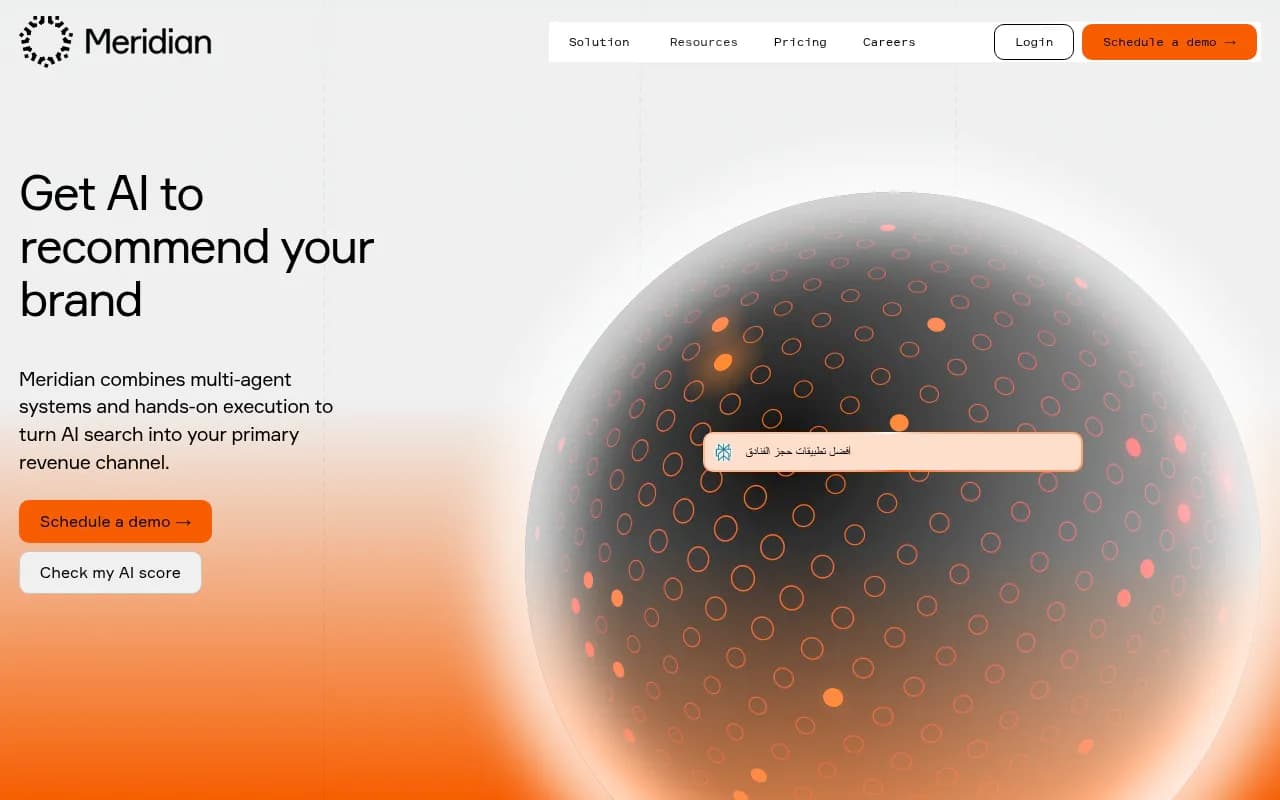
Meridian describes itself as an "agentic AI platform" -- but the more honest framing is that it's a hybrid between a software tool and a managed service. The pitch is that multi-agent AI systems do the heavy lifting on AI search optimization, with human experts guiding execution. Brands get category-level visibility tracking, sentiment monitoring, citation analysis, and competitive benchmarking across ChatGPT, Perplexity, Gemini, Google AI, Claude, Grok, Copilot, DeepSeek, and Meta AI.
The target customer is clearly a mid-market or enterprise brand that wants results without building an internal GEO team. You're not buying a dashboard to stare at -- you're buying a system that does things on your behalf.
Orchly
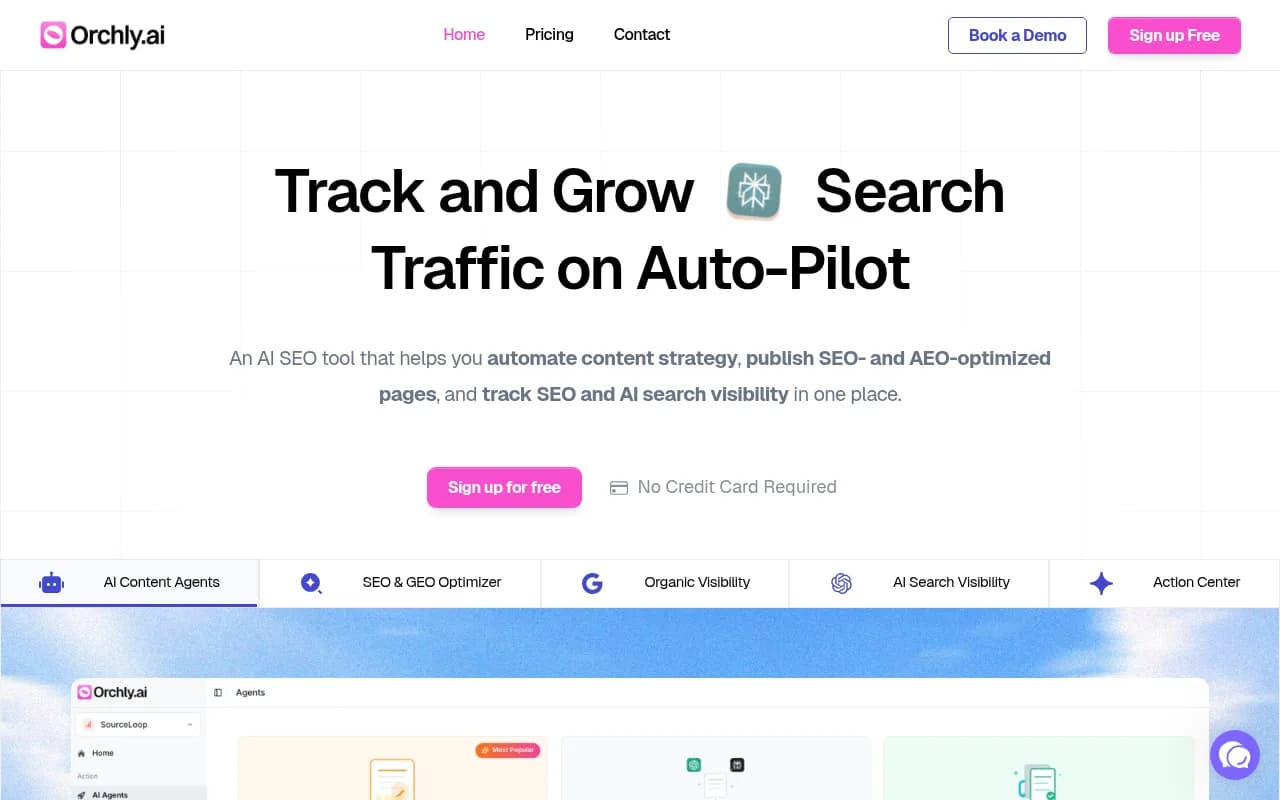
Orchly takes a different approach. It's a self-serve SaaS platform that combines AI search visibility tracking with traditional SEO tools: organic rank tracking, website auditing, keyword research, content writing, and auto-publishing. The idea is that you shouldn't need three separate subscriptions to cover AI search, content creation, and SEO monitoring.
Pricing is transparent and starts low enough that a solo founder or small marketing team can justify it. There's a 14-day free trial, no demo required, and you can be set up in minutes.
Side-by-side comparison
| Feature | Meridian | Orchly |
|---|---|---|
| Pricing model | Custom (demo required) | $49/mo - $125/mo + Enterprise |
| Free trial | No | 14-day free trial |
| AI models tracked | ChatGPT, Perplexity, Claude, Gemini, Grok, Copilot, DeepSeek, Meta AI, Google AI | ChatGPT, Claude, Perplexity, Gemini, Grok, Google |
| Organic SEO tracking | No | Yes (keyword positions, daily tracking) |
| Content writing tools | Managed/agent-executed | Built-in AI content writer |
| Auto-publish | No | Yes |
| Website audit | No | Yes |
| Sentiment analysis | Yes | Yes |
| Competitor tracking | Yes | Yes |
| White-label reports | Not listed | Yes |
| API access | Not listed | Yes |
| Human execution layer | Yes (core differentiator) | No (self-serve only) |
| Ease of setup | Demo-gated | Sign up and go |
| Best for | Mid-market/enterprise brands | SMBs, agencies, in-house SEO teams |
Head-to-head feature deep-dive
Pricing and accessibility
This is where the two tools diverge most sharply.
Orchly publishes its pricing: Essential at $49/month, Pro at $125/month, with a 25% discount on annual plans and a 14-day free trial. You can sign up, connect your site, and start tracking within the hour. No sales call, no waiting.
Meridian shows no pricing on its website. You book a demo, talk to a human, and get a custom quote. That's not inherently bad -- complex managed services often work this way -- but it does mean you can't evaluate cost without investing time in a sales conversation. Based on the positioning (enterprise brands, managed execution, multi-agent systems), expect pricing that's multiples of Orchly's published tiers.
Verdict: Orchly wins on accessibility and price transparency. Meridian is for teams where budget is secondary to outcomes.
AI visibility tracking
Both tools track brand mentions, sentiment, and competitive positioning across the major AI models. The mechanics are similar: you define prompts or categories, the platform queries AI models, and you get visibility scores, sentiment breakdowns, and position rankings.
Meridian's tracking covers a slightly broader model set -- Meta AI and DeepSeek are listed alongside the usual suspects. It also emphasizes category-level tracking, which means you're not just asking "does AI mention my brand?" but "does AI recommend my brand when someone asks about my category?"
Orchly's tracking is solid across ChatGPT, Claude, Perplexity, Gemini, and Grok. It shows visibility percentages per model, sentiment breakdowns (positive/neutral/negative), and competitor comparison. The UI appears clean and dashboard-friendly.
Verdict: Roughly even on core tracking. Meridian has a slight edge on model coverage; Orchly has a cleaner self-serve experience.
Content and optimization tools
This is where the tools take completely different paths.
Orchly has a full content stack built in: an AI SEO content writer, content scheduling, auto-publish, brand voice training, style guide integration, and an "Action Center" that presumably surfaces recommendations. You can go from identifying a content gap to publishing an optimized article without leaving the platform. That's genuinely useful for a small team.
Meridian's content work happens through its managed execution model. The AI agents and human experts create and optimize content on your behalf -- you're not writing anything yourself. Whether that's better depends entirely on your team's capacity and preferences. If you have no one to write content, Meridian's approach is appealing. If you want control over what gets published, it's a constraint.
Verdict: Orchly for teams that want to own their content workflow. Meridian for teams that want to outsource it.
SEO and organic search
Orchly covers traditional SEO in a way Meridian simply doesn't. Daily keyword position tracking, Google organic rankings, internal and external link analysis, website auditing, and keyword research are all included. If you're managing both AI search visibility and conventional SEO, Orchly can replace or reduce your reliance on a separate SEO tool.
Meridian is focused purely on AI search. There's no mention of organic rank tracking, site auditing, or keyword research. It's a deliberate choice -- the platform is built around the thesis that AI search is the primary channel worth optimizing for.
Verdict: Orchly wins clearly here. Meridian doesn't try to compete on traditional SEO.
Agency and team features
Orchly has white-label reports and API access listed as features, which makes it viable for agencies that want to resell or report to clients under their own brand. Multi-site competitor tracking is also included.
Meridian doesn't list white-label or API features publicly. Its model is more "we work with your brand directly" than "you use our tool to serve your clients."
Verdict: Orchly is the better fit for agencies. Meridian is built for direct brand relationships.
The managed service angle
Meridian's biggest differentiator is also its most unusual one: it's not just software. The "expert-led, agent-powered" positioning means you're paying for a team (human + AI) to actively work on your AI search presence. That's closer to a retainer with a specialized agency than a SaaS subscription.
For some brands, that's exactly what they need. If your marketing team is stretched thin, if AI search is a strategic priority but no one has time to learn a new tool, or if you want someone accountable for results rather than just data -- Meridian's model makes sense.
Orchly doesn't offer this. It's software. You get the tools; you do the work.
Verdict: Depends entirely on what you're buying. Managed execution vs. self-serve tooling are genuinely different products.
Pricing comparison
| Plan | Meridian | Orchly |
|---|---|---|
| Free trial | None | 14 days free |
| Entry-level | Custom (demo required) | $49/mo (Essential) |
| Mid-tier | Custom | $125/mo (Pro) |
| Enterprise | Custom | Custom |
| Annual discount | Unknown | 25% off |
Pros and cons
Meridian
Pros:
- Covers more AI models including Meta AI and DeepSeek
- Managed execution means you don't need internal GEO expertise
- Category-level tracking is a smart framing for brand visibility
- Multi-agent + human expert combination is genuinely differentiated
Cons:
- No public pricing -- requires a demo to evaluate cost
- No free trial or self-serve access
- No traditional SEO tools
- No white-label or API features listed
- Harder to evaluate without a sales conversation
Orchly
Pros:
- Transparent pricing starting at $49/month
- Free 14-day trial, no demo required
- Covers AI visibility AND traditional SEO in one platform
- Built-in content writer with auto-publish and scheduling
- White-label reports and API access for agencies
- Action Center for surfacing recommendations
Cons:
- No managed execution layer -- you're on your own
- Slightly narrower AI model coverage (no Meta AI or DeepSeek listed)
- Newer platform with less established track record
- Content quality from AI writer is unproven at scale
Who should pick which tool
Pick Meridian if:
- You're a mid-market or enterprise brand with budget for a managed service
- Your team doesn't have bandwidth to learn and operate a new tool
- You want humans accountable for your AI search results, not just a dashboard
- You're focused exclusively on AI search and don't need traditional SEO features
- You're comfortable with a demo-first, custom-pricing model
Pick Orchly if:
- You want to start quickly without a sales call
- Budget matters and you need predictable monthly pricing
- You need both AI visibility tracking and traditional SEO in one tool
- You're an agency that needs white-label reports and API access
- You want to own your content workflow rather than outsource it
- You're a small to mid-sized team that prefers self-serve software
A note on the broader AI visibility space
Both tools sit in the growing GEO (Generative Engine Optimization) category, which is still maturing fast. If you want to go deeper on tracking how your brand appears across AI search engines -- including features like crawler log analysis, prompt volume scoring, and content gap analysis -- Promptwatch is worth looking at as a complement or alternative.

It's one of the more complete platforms in this space, covering 10 AI models with traffic attribution and content generation built in.
Final verdict
Meridian and Orchly are solving the same underlying problem -- getting brands recommended by AI models -- but they're doing it in fundamentally different ways.
Orchly is the practical choice for most teams in 2026. The pricing is accessible, the feature set is broad (AI visibility plus SEO in one tool), and you can evaluate it without talking to anyone. If you're a marketing team, an agency, or an in-house SEO lead who wants to move fast, Orchly is the easier starting point.
Meridian is for a specific type of buyer: one who wants to hand off AI search optimization entirely and has the budget to do so. If that's you, the managed execution model is genuinely compelling. But you'll need to get on a call to find out if the price makes sense for your situation.
Neither tool is a bad choice -- they're just aimed at different buyers with different constraints.