Key takeaways
- Rankscale has transparent, self-serve pricing starting around $75-150/month with a free trial. Meridian requires a demo call and uses custom pricing -- expect a higher price point.
- Rankscale tracks 17+ AI engines and covers 240+ countries. Meridian covers the major platforms but doesn't publish a specific engine count.
- Meridian is a managed "agentic" service -- it combines monitoring with hands-on execution support. Rankscale is a self-serve analytics platform you operate yourself.
- Rankscale is purpose-built for agencies, with multi-client dashboards and customers like Dentsu, WPP Media, and Publicis Sapient. Meridian targets individual brands and mid-market companies.
- Rankscale includes 94+ technical audit checkpoints and prompt research tools. Meridian emphasizes category-level visibility and sentiment tracking with an AI-driven execution layer.
- Neither tool includes built-in AI content generation -- if you want to close the loop from gap analysis to content creation, you'll need a more complete platform.
Overview
Meridian
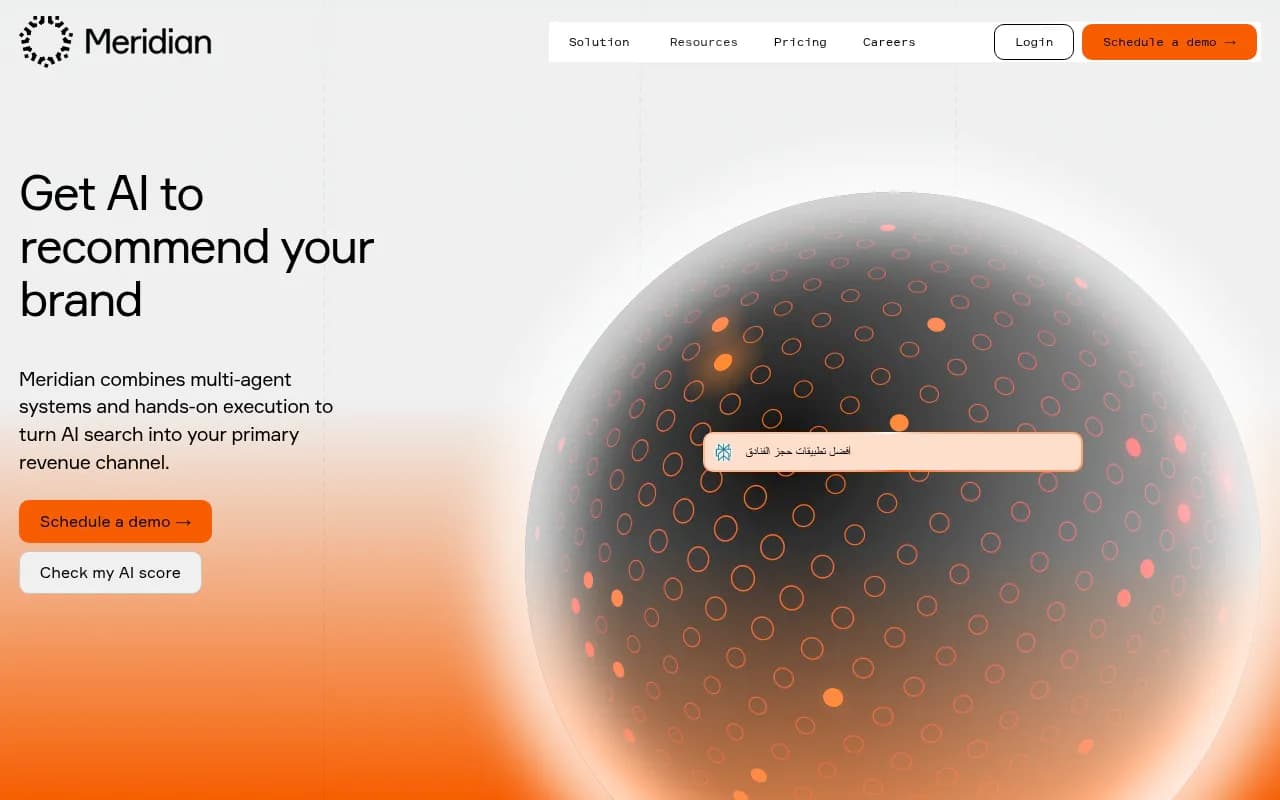
Meridian positions itself as more than a monitoring tool. The pitch is an "agentic AI platform" that combines multi-agent systems with hands-on execution to turn AI search into a revenue channel. In practice, that means you get visibility tracking across the major AI engines (ChatGPT, Perplexity, Gemini, Claude, Grok, DeepSeek, Copilot, Meta AI) plus a team that helps you act on what the data shows.
The product tracks category-level visibility scores, sentiment, citation sources, and competitive benchmarking. The "agentic" framing suggests automation beyond passive dashboards -- Meridian claims to help implement optimizations, not just surface them. That said, pricing is entirely custom and requires a demo, which limits how much you can evaluate it without talking to sales first.
Rankscale
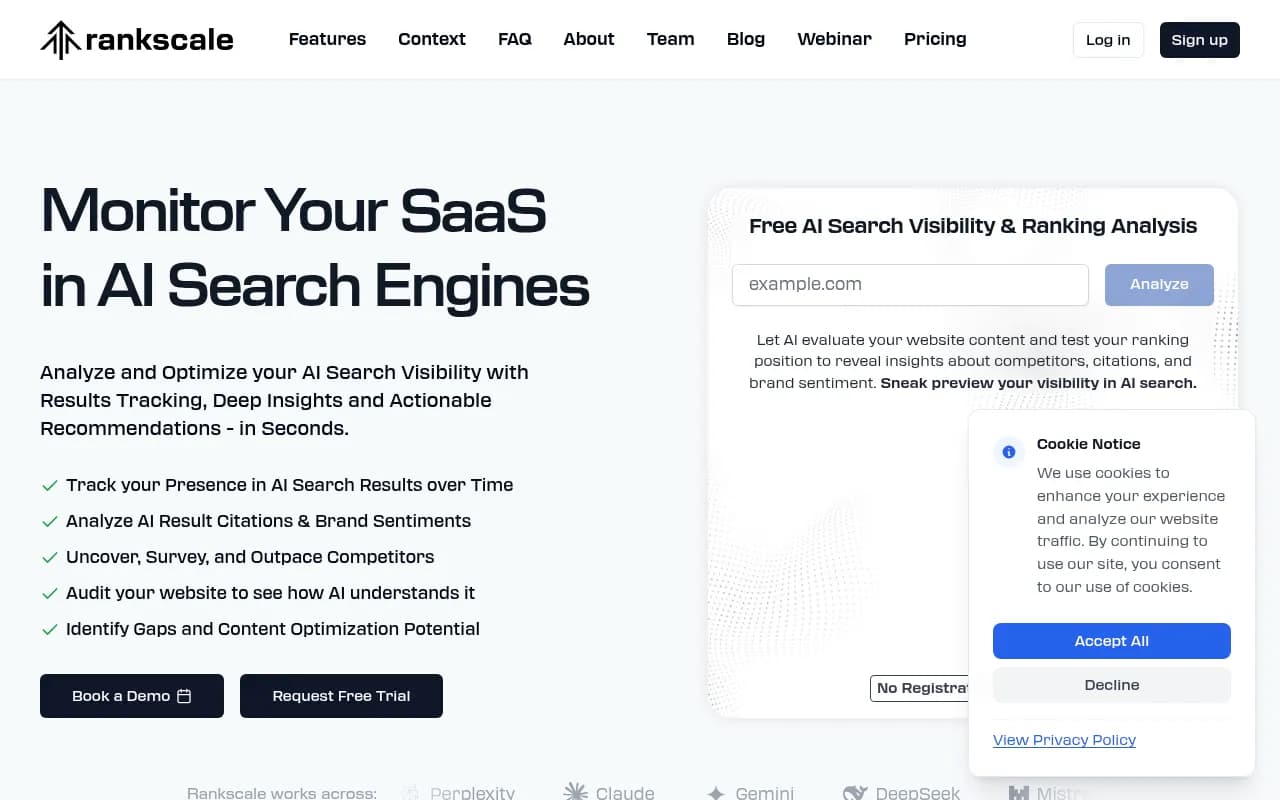
Rankscale is a self-serve AI visibility analytics platform that's clearly built with agencies in mind. It tracks brand presence across 17+ AI engines, covers 240+ countries and all languages, and includes a fairly comprehensive feature set: brand visibility dashboards, AI rank tracking, competitor analysis, citation analysis, sentiment analysis, page audits, and prompt research.
The agency credentials are real -- Dentsu, WPP Media, Publicis Sapient, and Monks are listed as customers alongside brands like Bosch, UBS, and REWE. The 94+ technical audit checkpoints are a differentiator worth noting: Rankscale automatically audits the structural and authority signals AI engines use to verify and cite content, which goes beyond what most monitoring tools offer.
Side-by-side comparison
| Feature | Meridian | Rankscale |
|---|---|---|
| Pricing model | Custom (demo required) | Credit-based, ~$75-150/mo |
| Free trial | No | Yes |
| AI engines tracked | 9+ (major platforms) | 17+ |
| Countries/languages | Not specified | 240+ countries, all languages |
| Brand visibility tracking | Yes | Yes |
| Sentiment analysis | Yes | Yes |
| Citation analysis | Yes | Yes |
| Competitor benchmarking | Yes | Yes |
| Technical site audits | Not specified | Yes (94+ checkpoints) |
| Prompt research | Not specified | Yes |
| AI content generation | No | No |
| Managed/agentic execution | Yes | No |
| Multi-client/agency dashboard | Limited | Yes |
| White-label reporting | Not specified | Yes |
| Self-serve onboarding | No (demo required) | Yes |
| Target audience | Brands, mid-market | Agencies, brands, publishers |
Head-to-head feature deep-dive
Pricing and accessibility
This is the starkest difference between the two tools.
Rankscale has public pricing on a credit-based model, with plans starting around $75-150/month. There's a free trial you can start without talking to anyone. That matters a lot if you're evaluating tools -- you can actually test the product before committing.
Meridian has no public pricing. You book a demo, talk to sales, and get a custom quote. That's not inherently bad (complex, managed services often work this way), but it creates friction for anyone who wants to self-evaluate. Based on the positioning and the managed-service model, expect Meridian's pricing to sit meaningfully higher than Rankscale's entry tiers.
Verdict: Rankscale wins on accessibility and price transparency. Meridian is likely the pricier option, and you can't find out without a sales call.
AI engine coverage
Rankscale publicly claims 17+ AI engines, including ChatGPT, Perplexity, Claude, Gemini, AI Overviews, DeepSeek, Grok, Copilot, Mistral, and AI Mode. The breadth here is notable -- Mistral and AI Mode coverage puts it ahead of many competitors.
Meridian's homepage shows logos for ChatGPT, Perplexity, Gemini, Claude, Google, Copilot, Grok, DeepSeek, and Meta AI -- roughly 9 major platforms. That covers the engines most brands actually care about, but Rankscale's 17+ count suggests broader coverage of smaller or regional models.
Verdict: Rankscale covers more engines. For most brands, Meridian's coverage is probably sufficient, but Rankscale has the edge for comprehensive tracking.
Monitoring and analytics depth
Both tools track the core metrics: visibility scores, sentiment, citations, and competitive benchmarking. Where they diverge is in the depth of supporting analytics.
Rankscale's 94+ technical audit checkpoints stand out. The platform automatically audits structural and authority signals that AI engines use to verify and cite content -- this is closer to a technical SEO audit layer than what most AI visibility tools offer. Combine that with prompt research (volume estimation, intent decoding, prompt density analysis) and you get a more complete picture of why your visibility is what it is.
Meridian's analytics focus on category-level visibility and sentiment. The "agentic" framing implies the platform does more interpretation and recommendation, but the specific analytics features aren't as publicly documented as Rankscale's.
Verdict: Rankscale has more documented, granular analytics. Meridian may compensate with its managed execution layer, but you can't verify that without a demo.
Agency and multi-client support
Rankscale is built for agencies. Multi-brand dashboards, the ability to manage multiple clients, white-label reporting, and a customer list that includes some of the biggest agency networks in the world (Dentsu, WPP Media, Publicis Sapient) all point to a product that's been shaped by agency feedback.
Meridian's positioning is more brand-centric. The "agentic execution" model -- where Meridian's team helps implement changes -- doesn't map as cleanly to an agency workflow where the agency itself is the one doing the implementation for clients.
Verdict: Rankscale is the clear choice for agencies. Meridian is better suited to in-house brand teams.
Execution and optimization support
This is where Meridian's differentiation lives. Most AI visibility tools, including Rankscale, are monitoring platforms -- they show you data and leave you to figure out what to do with it. Meridian claims to go further with "hands-on execution" and multi-agent systems that help implement optimizations.
That's a meaningful difference if it works as advertised. The catch is that "agentic execution" is hard to evaluate from the outside. What does it actually do? How much is automated vs. human-assisted? The website is light on specifics, and without a trial option, you're taking it on faith until you're in a sales conversation.
Rankscale takes the opposite approach: it gives you the data, the audit findings, and the prompt research, then trusts you (or your agency) to act on it. That's less hand-holding but more control.
Verdict: Meridian wins on paper for brands that want managed support. Rankscale wins for teams that prefer to own their workflow.
Prompt research and content intelligence
Rankscale includes a dedicated prompt research module that estimates search volume through semantic reconstruction, decodes intent and prompt density, and helps optimize content for likely question patterns in AI search. That's genuinely useful for prioritizing which prompts to target.
Meridian doesn't publicly document equivalent prompt research capabilities. The focus seems to be more on tracking existing visibility than on discovering new prompt opportunities.
Verdict: Rankscale has a clearer edge here. Prompt research is one of the more actionable features in the AI visibility space, and Rankscale has built it out.
Content generation
Neither tool includes AI content generation. Both will show you where you're invisible and what competitors are winning -- but neither will write the content to close those gaps.
If that's a priority, it's worth knowing that platforms like Promptwatch include a built-in AI writing agent that generates articles and comparisons grounded in citation data, specifically engineered to get cited by ChatGPT, Claude, Perplexity, and other AI models.

Pricing comparison
| Plan | Meridian | Rankscale |
|---|---|---|
| Free trial | No | Yes |
| Entry tier | Custom (demo required) | ~$75-150/mo (credit-based) |
| Mid tier | Custom | Agency pricing on request |
| Enterprise | Custom | Custom |
| Pricing transparency | None | Partial (entry tiers public) |
Rankscale's credit-based model means you pay for what you use, which suits agencies managing multiple clients at different activity levels. Meridian's custom pricing is a black box until you're in a sales conversation.
Pros and cons
Meridian
Pros:
- Managed execution layer -- not just data, but help acting on it
- Multi-agent system designed to automate optimization tasks
- Covers all major AI engines including Meta AI
- Category-level visibility tracking with sentiment and citation data
- Suited for brands that want a partner, not just a tool
Cons:
- No public pricing -- requires a demo to evaluate
- No self-serve trial
- Feature set is hard to verify without a sales conversation
- Less suited to agencies managing multiple clients
- Prompt research and technical audit capabilities not publicly documented
Rankscale
Pros:
- Transparent pricing with a free trial
- 17+ AI engines, 240+ countries
- 94+ technical audit checkpoints
- Purpose-built for agencies with multi-client dashboards
- Prompt research module for discovering new opportunities
- Trusted by major agency networks (Dentsu, WPP Media, Publicis Sapient)
- Self-serve onboarding -- no sales call required
Cons:
- No managed execution -- you own the implementation
- No built-in content generation
- Credit-based pricing can get expensive at scale
- Less differentiated for brands that want a hands-on partner
Who should pick which tool
Pick Meridian if:
- You're an in-house brand team that wants a managed partner, not just a dashboard
- You're willing to pay a premium for execution support alongside monitoring
- You're a mid-market or enterprise brand with budget for custom pricing
- You want someone else to help implement AI search optimizations, not just flag them
Pick Rankscale if:
- You're an agency managing multiple clients
- You want to start immediately with a free trial before committing
- You need coverage across 17+ AI engines and 240+ countries
- You want technical audit capabilities alongside visibility tracking
- You prefer to own your workflow and act on data yourself
- Budget predictability matters -- you want to see pricing before talking to sales
Final verdict
These two tools serve different buyers. Rankscale is the more accessible, agency-ready platform with transparent pricing, broader engine coverage, and a solid technical audit layer. If you're an agency or a brand team that wants to self-serve, it's the easier choice to evaluate and get started with.
Meridian is a harder product to assess from the outside -- the "agentic execution" angle is genuinely interesting, but the lack of a trial and opaque pricing means you're committing to a sales process before you can verify the claims. For brands that want a managed partner and have the budget for it, that might be worth it. For everyone else, Rankscale's combination of depth, transparency, and agency tooling makes it the more practical starting point in 2026.