Key Takeaways
- Meteoria is a dedicated GEO platform built specifically for tracking brand visibility in AI search engines (ChatGPT, Perplexity, Google AI Overview, Gemini, Grok). Ahrefs is a comprehensive SEO suite that added AI search monitoring (Brand Radar) as one feature among many.
- Meteoria starts at €75/mo (about $82) for 25 prompts with unlimited seats and projects. Ahrefs starts at $83/mo (Lite) but Brand Radar is only available on Standard ($166/mo) and higher plans.
- Meteoria monitors 5 AI models with custom prompts, competitor positioning, sentiment analysis, and source tracking. Ahrefs Brand Radar uses a fixed set of prompts and tracks mentions across ChatGPT, Perplexity, and Gemini -- you can't customize the queries.
- If your primary goal is understanding and improving how AI models cite your brand, Meteoria is purpose-built for that. If you need traditional SEO tools (backlink analysis, site audits, rank tracking) plus basic AI monitoring, Ahrefs covers more ground.
- Meteoria has a strong French market presence and offers multilingual support. Ahrefs is a global platform with deeper English-language resources and a massive user base (44% of Fortune 500 companies).
- Neither platform helps you create content that ranks in AI search. If you want to close the loop from monitoring to optimization, tools like Promptwatch add content gap analysis and AI-optimized content generation on top of visibility tracking.

Overview: Two different approaches to AI visibility
Meteoria: GEO-first platform
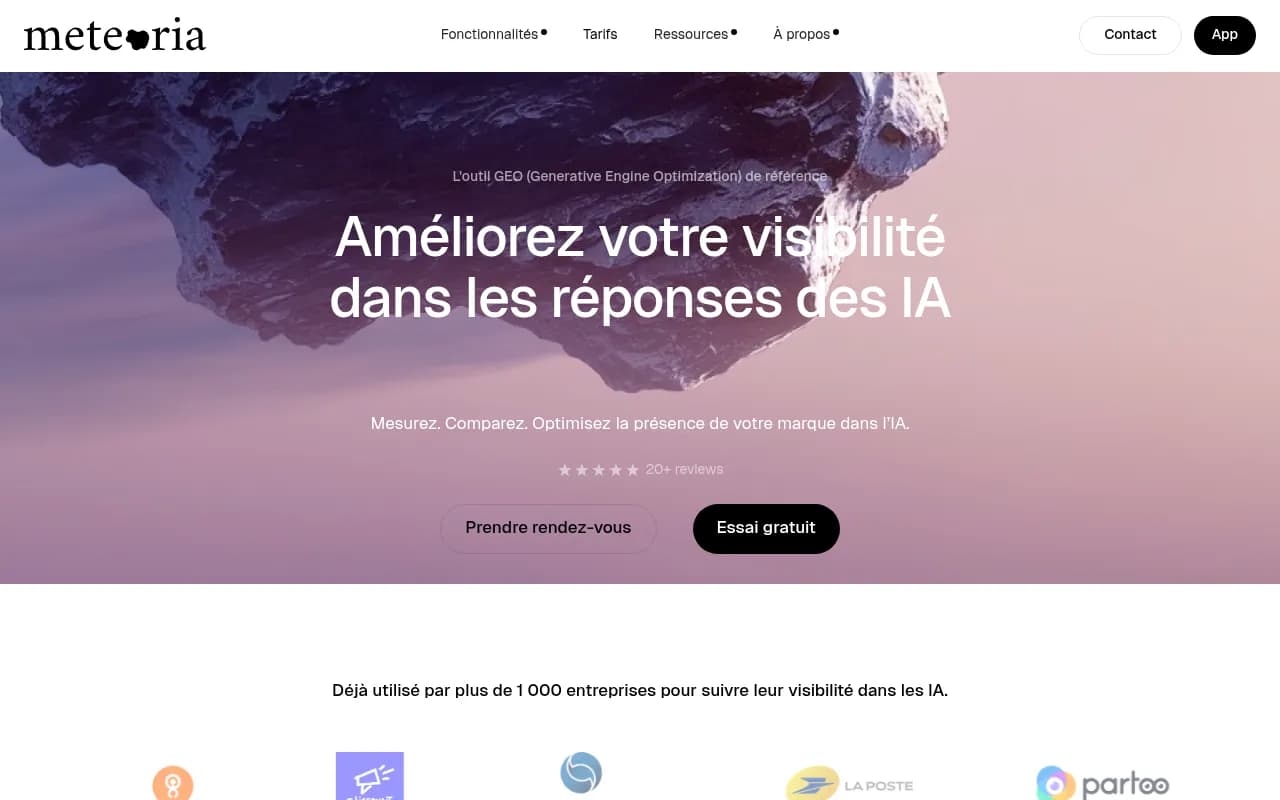
Meteoria launched as a dedicated Generative Engine Optimization (GEO) platform. It's built around one job: track how AI models mention your brand, compare your visibility to competitors, and surface the sources AI engines cite. The interface is in French (with English support), and the company has a strong foothold in the French market -- over 1,000 companies use it, including Cdiscount, Pierre Fabre, La Poste, and Partoo.
You define custom prompts that match your business (product queries, competitor comparisons, industry questions), and Meteoria runs them daily across ChatGPT, Google AI Overview, Perplexity, Gemini, and Grok. You get visibility scores, position rankings, sentiment analysis, and a breakdown of which sources each AI model cited. The pricing is straightforward: €75/mo for 25 prompts (Basic), €175/mo for 100 prompts (Pro), or €300+ for 200+ prompts (Enterprise). All plans include unlimited seats and projects.
Meteoria doesn't do traditional SEO. No backlink analysis, no site audits, no keyword rank tracking in Google Search. It's laser-focused on AI search.
Ahrefs: SEO suite with AI monitoring added
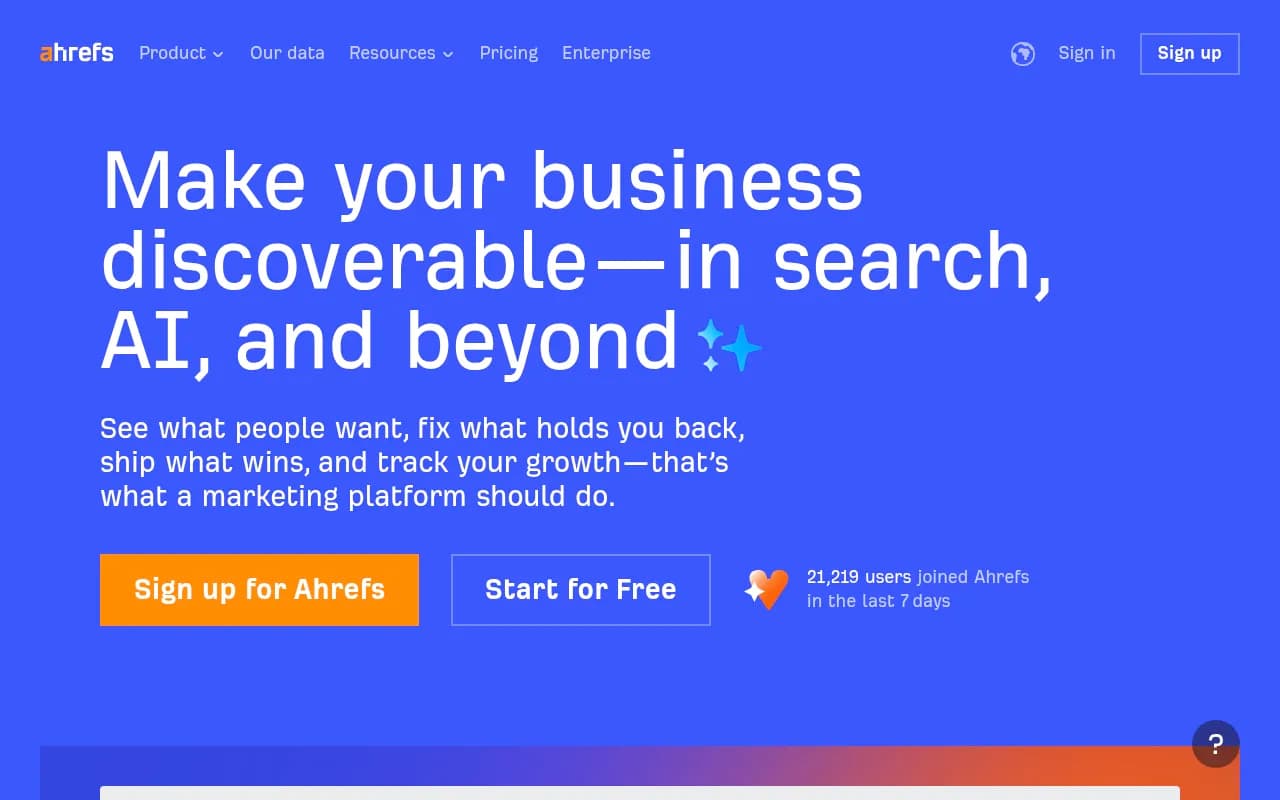
Ahrefs is one of the most established SEO platforms in the world. It's known for having the largest backlink index (over 40 trillion links) and a massive keyword database. The core product is traditional SEO: Site Audit finds technical issues, Site Explorer shows backlinks and organic traffic, Keywords Explorer surfaces search volumes and difficulty scores, Rank Tracker monitors your Google rankings, and Content Explorer helps you find link-worthy content.
In 2024, Ahrefs added Brand Radar -- an AI search monitoring feature that tracks when your brand appears in ChatGPT, Perplexity, and Gemini responses. Brand Radar uses a fixed set of prompts (you can't customize them) and shows you mention frequency, sentiment, and which competitors appear alongside you. It's a useful add-on if you're already using Ahrefs for SEO, but it's not the main event.
Ahrefs pricing starts at $83/mo (Lite plan, very limited features), but Brand Radar is only available on Standard ($166/mo) and higher. Most serious users are on Standard or Advanced ($333/mo). The platform also includes PPC research (via integration with Google Ads data), social media management, and AI-powered content creation tools.
Ahrefs is a Swiss Army knife. Meteoria is a scalpel.
Side-by-side comparison
| Feature | Meteoria | Ahrefs |
|---|---|---|
| Primary focus | AI search visibility (GEO) | Traditional SEO + AI monitoring |
| AI models tracked | ChatGPT, Perplexity, Google AI Overview, Gemini, Grok (5 total) | ChatGPT, Perplexity, Gemini (3 total, via Brand Radar) |
| Custom prompts | Yes -- define your own queries | No -- fixed prompt set |
| Competitor tracking | Yes -- compare visibility and positioning | Yes -- see which competitors appear in AI responses |
| Sentiment analysis | Yes -- explicit and implicit sentiment scoring | Yes -- basic sentiment tracking |
| Source analysis | Yes -- see which URLs AI models cite | Limited -- Brand Radar shows some source data |
| Traditional SEO tools | None | Full suite (backlinks, site audit, rank tracking, keyword research) |
| Content creation | No | Yes -- AI writing assistant, content briefs |
| Starting price | €75/mo (~$82) for 25 prompts | $83/mo (Lite, no Brand Radar) -- Brand Radar starts at $166/mo (Standard) |
| Seats included | Unlimited | Lite: 1 user, Standard: 1 user, Advanced: 3 users |
| Free trial | 7 days | Yes (limited features) |
| Best for | Brands focused on AI search visibility | SEO teams that want AI monitoring as part of a broader toolkit |
Head-to-head feature breakdown
AI search monitoring depth
Meteoria wins here. It tracks 5 AI models (ChatGPT, Perplexity, Google AI Overview, Gemini, Grok) vs Ahrefs' 3 (ChatGPT, Perplexity, Gemini). More importantly, Meteoria lets you define custom prompts. You can test product-specific queries ("best CRM for small businesses"), competitor comparisons ("Salesforce vs HubSpot"), or persona-driven questions ("what accounting software do freelancers recommend"). You control the queries, so you're tracking the prompts that actually matter to your business.
Ahrefs Brand Radar uses a fixed set of prompts. You can't customize them. Ahrefs decides which queries to run, and you see the results. This is fine for basic brand monitoring ("are we mentioned at all?"), but it doesn't let you test specific use cases or optimize for high-value queries.
Meteoria also provides richer source analysis. You see exactly which URLs, Reddit threads, YouTube videos, and domains each AI model cited. Ahrefs Brand Radar shows some source data, but it's less granular.
Verdict: If AI search visibility is your priority, Meteoria gives you more control and deeper insights.
Traditional SEO capabilities
Ahrefs dominates. Meteoria doesn't do traditional SEO at all -- no backlink analysis, no site audits, no keyword rank tracking in Google Search. Ahrefs has been refining these tools for over a decade. Site Explorer shows you every backlink pointing to your site (or a competitor's), along with Domain Rating (DR), referring domains, and anchor text distribution. Site Audit crawls your website and flags technical issues (broken links, slow pages, missing meta tags). Keywords Explorer gives you search volume, keyword difficulty, and SERP analysis for millions of keywords. Rank Tracker monitors your Google rankings over time.
If you need to understand your backlink profile, find link-building opportunities, or track organic search performance, Ahrefs is the standard. Meteoria doesn't even try to compete here.
Verdict: Ahrefs is the clear winner for traditional SEO. Meteoria isn't playing this game.
Competitor analysis
Both platforms offer competitor tracking, but in different contexts.
Meteoria lets you add competitors and compare your AI visibility scores side-by-side. You see your position relative to competitors for each prompt and each AI model. The interface shows heatmaps and trend lines, so you can spot when a competitor starts appearing more often or when you lose ground. You also see which sources AI models cite for competitors, which helps you understand where to publish or which domains to target for backlinks.
Ahrefs competitor analysis is broader. In the traditional SEO context, you can compare backlink profiles, organic traffic estimates, top-ranking keywords, and content gaps (keywords your competitors rank for but you don't). In the Brand Radar context, you see which competitors appear alongside your brand in AI responses and how often.
Meteoria's competitor analysis is deeper for AI search. Ahrefs' competitor analysis is deeper for traditional SEO.
Verdict: Depends on your goal. AI search visibility? Meteoria. Backlink and keyword competition? Ahrefs.
Content creation and optimization
Ahrefs has built-in content tools. The AI writing assistant helps you draft articles, and Content Explorer surfaces high-performing content in your niche (sorted by backlinks, social shares, or organic traffic). You can use this to find content ideas, identify link-building targets, or analyze what's working for competitors. Ahrefs also generates content briefs with keyword suggestions and SERP analysis.
Meteoria doesn't create content. It tells you where you're invisible and which sources AI models prefer, but it doesn't help you write or optimize.
If you want a platform that goes from monitoring to content creation, neither Meteoria nor Ahrefs fully closes the loop. Promptwatch is built around this cycle: it shows you content gaps (prompts competitors rank for but you don't), then generates AI-optimized articles grounded in citation data, then tracks the results. Meteoria and Ahrefs stop at monitoring.
Verdict: Ahrefs has content tools. Meteoria doesn't. But if you want content specifically optimized for AI search (not just traditional SEO), you'll need a third tool.
Ease of use and learning curve
Meteoria is simpler. The interface is focused on one job: track AI visibility. You add prompts, add competitors, and view dashboards. There's not much to learn. The downside is that the interface is primarily in French (English is available, but the French version is more polished). If you're not comfortable with French, you might hit some friction.
Ahrefs is more complex because it does more. The learning curve is steeper -- there are dozens of tools, each with its own interface and terminology (Domain Rating, URL Rating, Ahrefs Rank, etc.). Ahrefs has extensive documentation, video tutorials, and a large community, so you can find answers. But expect to spend time learning the platform.
Verdict: Meteoria is easier to pick up. Ahrefs requires more investment but offers more depth.
Pricing and value
Meteoria's pricing is transparent and includes unlimited seats:
- Basic: €75/mo (~$82) for 25 prompts
- Pro: €175/mo (~$191) for 100 prompts
- Enterprise: €300+/mo (~$328+) for 200+ prompts
All plans include unlimited seats and projects. You're paying for prompt volume, not user count.
Ahrefs pricing is more complex:
- Starter: $29/mo (very limited -- 1 user, 5 projects, 500 crawl credits/mo, no Brand Radar)
- Lite: $83/mo (1 user, 5 projects, 500 crawl credits/mo, no Brand Radar)
- Standard: $166/mo (1 user, 10 projects, 5,000 crawl credits/mo, includes Brand Radar)
- Advanced: $333/mo (3 users, 25 projects, 25,000 crawl credits/mo, includes Brand Radar)
- Enterprise: Custom pricing
Brand Radar (the AI monitoring feature) is only available on Standard and higher. So if you want AI search tracking from Ahrefs, you're paying at least $166/mo. Additional users cost extra on most plans.
If your only goal is AI search visibility, Meteoria is cheaper and includes unlimited seats. If you need traditional SEO tools, Ahrefs gives you more for the money -- but the entry point for AI monitoring is higher.
Verdict: Meteoria is more affordable for AI-only monitoring. Ahrefs is better value if you need the full SEO suite.
Support and community
Ahrefs has a massive user base (44% of Fortune 500 companies) and a well-established support ecosystem. There's a knowledge base, video tutorials, a blog with SEO guides, and an active community. You can find answers to almost any question via search or by asking in forums.
Meteoria is smaller and newer. Support is available (email and chat), but the community and documentation are less extensive. The platform is popular in France, so French-language resources are stronger than English.
Verdict: Ahrefs has better support infrastructure and a larger community.
Pricing comparison
| Plan | Meteoria | Ahrefs |
|---|---|---|
| Entry plan | €75/mo (~$82) -- 25 prompts, unlimited seats | $83/mo (Lite) -- 1 user, no Brand Radar |
| AI monitoring included | All plans | Standard ($166/mo) and higher |
| Mid-tier | €175/mo (~$191) -- 100 prompts, unlimited seats | $166/mo (Standard) -- 1 user, Brand Radar included |
| High-tier | €300+/mo (~$328+) -- 200+ prompts, unlimited seats | $333/mo (Advanced) -- 3 users, Brand Radar included |
| Free trial | 7 days | Yes (limited features) |
| Annual discount | Not specified | 20% off |
Pros and cons
Meteoria pros
- Dedicated GEO platform -- built specifically for AI search visibility
- Custom prompts let you test queries that matter to your business
- Tracks 5 AI models (ChatGPT, Perplexity, Google AI Overview, Gemini, Grok)
- Unlimited seats and projects on all plans
- Lower entry price for AI monitoring (€75/mo vs $166/mo for Ahrefs with Brand Radar)
- Strong French market presence and multilingual support
Meteoria cons
- No traditional SEO tools (backlinks, site audits, rank tracking)
- No content creation or optimization features
- Smaller community and less documentation than Ahrefs
- Interface is primarily French (English available but less polished)
- Newer platform with less brand recognition outside France
Ahrefs pros
- Comprehensive SEO suite with industry-leading backlink index and keyword database
- Brand Radar adds AI search monitoring to an already powerful toolkit
- Tracks traditional search rankings alongside AI mentions
- Built-in content creation tools (AI writing assistant, content briefs)
- Massive user base (44% of Fortune 500) and extensive support resources
- Global platform with strong English-language documentation
Ahrefs cons
- Brand Radar uses fixed prompts -- you can't customize queries
- AI monitoring only available on Standard ($166/mo) and higher plans
- Steeper learning curve due to breadth of features
- Additional users cost extra on most plans
- Tracks only 3 AI models (ChatGPT, Perplexity, Gemini) vs Meteoria's 5
Who should choose which tool
Choose Meteoria if:
- Your primary goal is tracking and improving brand visibility in AI search engines
- You want to define custom prompts that match your specific business needs
- You need to monitor multiple AI models (including Google AI Overview and Grok)
- You have a team and want unlimited seats without paying per user
- You're targeting French-speaking markets or prefer a French-first platform
- You already have traditional SEO covered (or don't need it)
Choose Ahrefs if:
- You need a full SEO platform (backlinks, site audits, rank tracking, keyword research)
- AI search monitoring is a nice-to-have, not your main focus
- You're okay with fixed prompts for Brand Radar (no custom queries)
- You want content creation tools integrated into the same platform
- You value a large user community and extensive documentation
- You're willing to pay $166+/mo for the Standard plan (where Brand Radar lives)
Consider both if:
- You're a large team or agency that needs deep traditional SEO (Ahrefs) plus dedicated AI visibility tracking (Meteoria)
- Budget allows for multiple tools, and you want best-in-class for each category
Look elsewhere if:
- You want a platform that not only monitors AI visibility but also helps you create content optimized for AI search. Promptwatch fills this gap with content gap analysis, AI-optimized content generation, and visibility tracking in one platform.
Final verdict
Meteoria and Ahrefs are solving different problems.
Meteoria is a specialist. It does one thing -- track brand visibility in AI search engines -- and does it well. Custom prompts, 5 AI models, unlimited seats, and a lower price point make it the better choice if AI search visibility is your primary concern. The trade-off is that you get nothing for traditional SEO, and the platform is smaller with less community support.
Ahrefs is a generalist. It's one of the best SEO platforms in the world, and Brand Radar adds AI search monitoring as a bonus feature. If you need backlink analysis, site audits, rank tracking, and keyword research, Ahrefs is hard to beat. But Brand Radar uses fixed prompts (no customization), tracks fewer AI models, and costs more ($166/mo minimum vs €75/mo for Meteoria).
The decision comes down to your priorities. If AI search visibility is your main goal, Meteoria is purpose-built for that. If you need a full SEO toolkit and want basic AI monitoring on the side, Ahrefs makes sense. If you want both deep traditional SEO and deep AI visibility tracking, you might need both tools -- or a platform like Promptwatch that bridges monitoring and optimization for AI search specifically.