Key Takeaways
- Pricing difference: Meteoria starts at €75/mo (roughly $80) for 25 prompts, while Cognizo starts at $300/mo for 350 prompts -- Cognizo costs nearly 4x more but includes 14x more prompts
- Geographic focus: Meteoria is French-built with strong European market focus and French-language support, while Cognizo targets global English-speaking markets
- Content creation: Cognizo includes automated AI-optimized content generation as a core feature, while Meteoria focuses primarily on monitoring and analysis
- AI model coverage: Both track ChatGPT, Perplexity, Google AI Overview, and Gemini, but Meteoria also monitors Grok while Cognizo emphasizes traffic attribution
- Team structure: Meteoria offers unlimited seats on all plans, making it better for agencies and larger teams; Cognizo pricing doesn't specify seat limits
- Maturity: Meteoria has 1,000+ customers including major French brands like La Poste and Cdiscount, while Cognizo appears to be earlier-stage with less public customer data
Overview
Meteoria
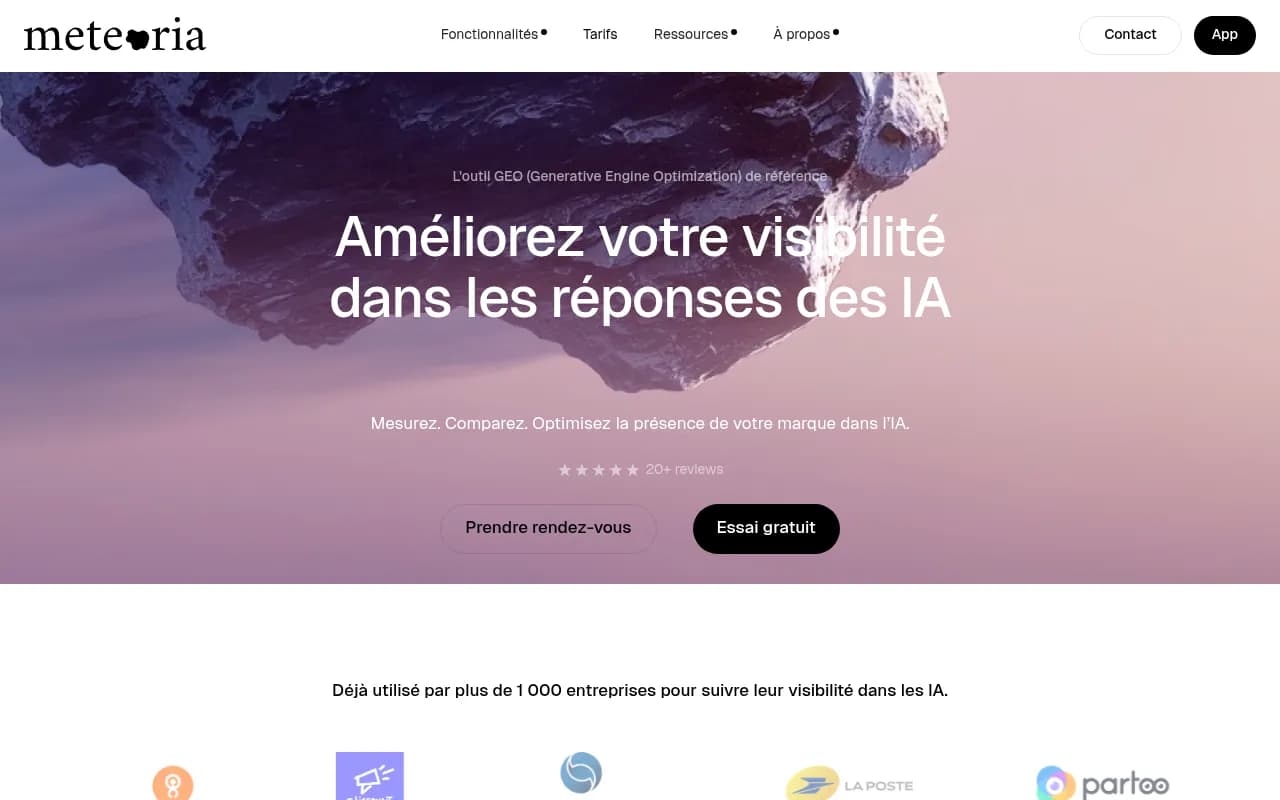
Meteoria is a French GEO (Generative Engine Optimization) platform that monitors brand visibility across AI models including ChatGPT, Perplexity, Google AI Overview, Gemini, and Grok. The platform emphasizes measuring visibility scores, tracking competitor positioning, and analyzing sentiment across custom prompts. With over 1,000 customers and clients like Pierre Fabre, La Poste, and Cdiscount, Meteoria has established itself in the European market. The platform offers unlimited seats across all plans and starts at €75/month for 25 prompts.
Cognizo
Cognizo
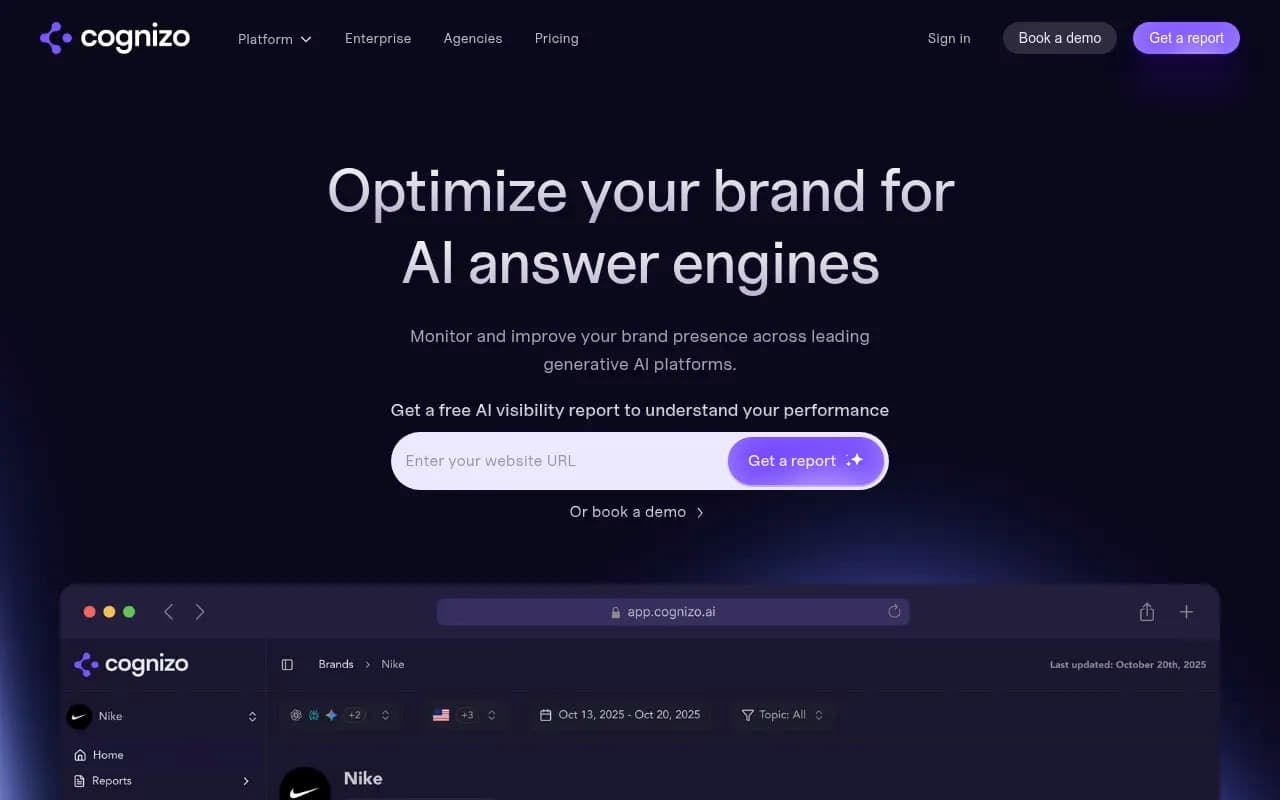
Cognizo is an Answer Engine Optimization (AEO) platform designed to help marketing teams monitor and improve brand visibility across AI search engines. Beyond monitoring, Cognizo emphasizes content creation -- it includes automated tools for generating AI-optimized content based on visibility insights. The platform tracks mentions, citations, and sentiment while also measuring AI-driven traffic to your website. Cognizo starts at $300/month for 350 prompts and targets marketing teams looking for an end-to-end solution from monitoring to content creation.
Side-by-Side Comparison
| Feature | Meteoria | Cognizo |
|---|---|---|
| Starting price | €75/mo (~$80) | $300/mo |
| Prompts (starter tier) | 25 | 350 |
| Free trial | 7 days | Yes (duration unspecified) |
| AI models tracked | ChatGPT, Perplexity, Google AI Overview, Gemini, Grok | ChatGPT, Perplexity, Google AI Overview, Gemini |
| Seat limits | Unlimited on all plans | Not specified |
| Content generation | No (monitoring focus) | Yes (automated AI-optimized content) |
| Traffic attribution | Yes (analyze AI-driven traffic) | Yes (measure AI-driven traffic) |
| Sentiment analysis | Yes (implicit and explicit) | Yes |
| Competitor tracking | Yes | Yes |
| Source analysis | Yes (identify citation sources) | Yes (citation tracking) |
| Geographic targeting | Yes (custom zones) | Not specified |
| Language support | French + others | English-focused |
| Customer base | 1,000+ (strong in France) | Not disclosed |
Pricing comparison
The pricing structures reveal different market positioning.
| Plan | Meteoria | Cognizo |
|---|---|---|
| Entry tier | €75/mo (25 prompts) | $300/mo (350 prompts) |
| Mid tier | €175/mo (100 prompts) | Not disclosed |
| High tier | €300+/mo (200+ prompts) | Not disclosed |
| Seats included | Unlimited | Not specified |
| Free trial | 7 days | Available |
Meteoria's pricing is significantly lower at the entry level, making it accessible for smaller teams or those just starting with GEO. You're paying €75 for 25 prompts versus $300 for 350 prompts with Cognizo. On a per-prompt basis, Meteoria costs €3 per prompt while Cognizo costs roughly $0.86 per prompt at the starter tier -- so Cognizo is actually cheaper per prompt if you need volume.
The unlimited seats on Meteoria plans is a real differentiator for agencies or companies with distributed marketing teams. Cognizo doesn't specify seat limits, which could mean either unlimited access or additional per-seat fees.
AI model coverage
Both platforms cover the major AI search engines, but with slight differences.
Meteoria tracks five models: ChatGPT, Perplexity, Google AI Overview, Gemini, and Grok. The inclusion of Grok (X's AI) is notable for brands active on X/Twitter or targeting that audience.
Cognizo monitors ChatGPT, Perplexity, Google AI Overview, and Gemini. No mention of Grok, but the platform emphasizes "leading generative AI platforms" which suggests they may add models over time.
Neither platform currently tracks Claude, DeepSeek, Mistral, or Meta AI -- models that are gaining traction in 2026. If you need comprehensive coverage across all major LLMs, you might want to look at tools like Promptwatch which monitors 10+ AI models including those gaps.

Monitoring and analytics capabilities
Both platforms offer core monitoring features, but with different emphases.
Meteoria's approach: The platform is built around three pillars -- Measure, Compare, Optimize. You set up custom prompts based on your sector, products, personas, and geographic zones. Meteoria then quantifies thousands of responses to calculate your visibility rate, relative position, and the sources AI models cite. The competitor comparison features let you see how you stack up across different LLMs and identify which sources competitors are getting cited from. Sentiment analysis covers both implicit and explicit sentiment in AI responses.
Cognizo's approach: Cognizo positions itself as a complete platform for "winning in AI search." The monitoring side tracks mentions, citations, and sentiment in real time. The platform analyzes "millions of data points daily" to surface visibility insights. A key differentiator is the emphasis on the customer journey -- Cognizo frames AI search as part of understanding what customers are asking and being part of the answer.
Both platforms track similar metrics (visibility, citations, sentiment, competitor positioning), but Cognizo seems to put more emphasis on the broader strategic picture while Meteoria focuses on granular measurement and comparison.
Content optimization and creation
This is where the platforms diverge most sharply.
Meteoria: The platform's third pillar is "Optimize," but based on the available data, this appears to focus on content analysis rather than content creation. Meteoria analyzes your existing content and traffic to understand compatibility with LLMs and measure concrete results. The optimization seems to be about understanding what's working and what's not, then using those insights to guide your content strategy.
Cognizo: Content creation is a core feature. Cognizo includes automated tools for generating "AI-optimized content that moves the needle." The platform turns visibility insights into content briefs and drafts. Based on the website data, there's a content optimization interface showing article structure, key advantages, and content scores. The workflow appears to go from identifying content opportunities to generating briefs to drafting content -- a full content production pipeline.
If you want a tool that helps you create content based on what you learn, Cognizo has that built in. If you prefer to handle content creation separately and just want monitoring and insights, Meteoria's approach may feel less bloated.
Traffic attribution and measurement
Both platforms track AI-driven traffic, but details are limited.
Meteoria mentions analyzing your traffic to understand results and compatibility with LLMs. This suggests some form of traffic attribution to see which AI interactions lead to website visits.
Cognizo explicitly lists "Measure AI-driven traffic" as a core capability, with the promise to "see how AI interacts with your site and drives human traffic." The phrasing suggests tracking both AI crawler activity and human visitors who arrive via AI recommendations.
Neither platform provides detailed information about implementation (tracking codes, server log analysis, etc.) or the depth of attribution data. This is an area where you'd want to ask specific questions during a demo.
User interface and ease of use
Based on the screenshots and descriptions:
Meteoria: The interface appears clean and data-focused. Screenshots show prompt metrics, competitor heatmaps, and source analysis views. The French-language interface (though likely available in other languages) suggests it's built with European UX sensibilities. The three-pillar structure (Measure, Compare, Optimize) provides a clear mental model.
Cognizo: The dashboard screenshots show a modern interface with content opportunity tables, workflow statuses, and article optimization views. The emphasis on "turning insights into action" suggests a more guided experience that walks you through from monitoring to content creation.
Without hands-on testing, it's hard to judge which is more intuitive. Meteoria seems more analytics-focused, while Cognizo appears to integrate content workflows more tightly.
Customer base and market position
Meteoria has clear traction in the French and European market with 1,000+ customers including recognizable brands like La Poste, Cdiscount, Pierre Fabre, Partoo, and HelloWork. The platform is positioned as "l'outil GEO de référence" (the reference GEO tool) in France.
Cognizo's website mentions "leading marketing teams" as customers but doesn't provide specific customer names or numbers. The platform appears to be earlier in its growth trajectory, which isn't necessarily bad -- it might mean more responsive support and faster feature development.
Pros and cons
Meteoria pros
- Significantly lower entry price (€75 vs $300)
- Unlimited seats on all plans
- Strong European market presence and customer base
- Tracks Grok in addition to other major AI models
- Clear three-pillar methodology (Measure, Compare, Optimize)
- 1,000+ customers provide social proof
Meteoria cons
- Lower prompt volume at entry tier (25 vs 350)
- No built-in content generation tools
- Less information available about traffic attribution implementation
- May have less robust English-language support
- Smaller feature set overall (focused on monitoring)
Cognizo pros
- Much higher prompt volume at starter tier (350 vs 25)
- Built-in AI-optimized content generation
- Integrated workflow from insights to content creation
- Emphasis on measuring AI-driven traffic
- Modern interface with content optimization tools
- Better per-prompt pricing if you need volume
Cognizo cons
- Nearly 4x higher starting price
- Less transparent about customer base and traction
- Doesn't track Grok
- Seat limits not specified (potential hidden costs)
- May be overkill if you just want monitoring
- Less established market presence
Who should pick Meteoria
Meteoria makes sense if you:
- Are a smaller team or just starting with GEO and need a lower entry price
- Operate primarily in European markets or need French-language support
- Have a larger team that needs unlimited seats
- Want focused monitoring and analytics without content generation features
- Prefer to handle content creation with your existing tools and workflows
- Need to track Grok specifically (important for X/Twitter-focused brands)
- Value working with an established platform with proven European customers
Meteoria is the practical choice for agencies managing multiple clients (unlimited seats), European brands, and teams that want monitoring without the content creation overhead.
Who should pick Cognizo
Cognizo makes sense if you:
- Need high prompt volume (350+ prompts monthly)
- Want an end-to-end platform that goes from monitoring to content creation
- Have budget for a more comprehensive tool ($300+/mo)
- Lack in-house content creation resources and want AI-generated drafts
- Prioritize traffic attribution and measuring AI-driven conversions
- Prefer an integrated workflow over connecting multiple tools
- Are a marketing team that wants to consolidate GEO monitoring and content optimization
Cognizo is the better fit for well-funded marketing teams that want a complete solution and are willing to pay for the convenience of having content generation built in.
Final verdict
Pick Meteoria if you want focused, affordable monitoring with unlimited seats. Pick Cognizo if you need high prompt volume and want content generation included.
The decision comes down to budget, prompt volume needs, and whether you want content creation built in. Meteoria at €75/mo is accessible for most teams and the unlimited seats make it agency-friendly, but 25 prompts won't cut it for comprehensive monitoring. Cognizo at $300/mo is a bigger commitment but gives you 350 prompts and a full content pipeline.
For teams just starting with GEO or operating on tighter budgets, Meteoria's entry tier lets you test the waters. For established marketing teams ready to invest in AI visibility and content optimization, Cognizo's integrated approach could save time even if it costs more upfront.
Neither platform is a clear winner across the board -- they're positioned for different segments of the market. Your choice should align with your prompt volume needs, budget constraints, and whether you value standalone monitoring or integrated content creation.