Key Takeaways
- Pricing: GeoGen starts at €20/mo (Micro plan) vs Meteoria at €75/mo (Basic plan) -- GeoGen is 73% cheaper for entry-level monitoring
- Prompt volume: Meteoria's Basic plan includes 25 prompts vs GeoGen's Micro plan with just 10 prompts -- you get 2.5x more queries with Meteoria despite the higher price
- LLM coverage: Meteoria tracks 5 AI models (ChatGPT, Perplexity, Google AI Overview, Gemini, Grok) vs GeoGen's 5 models (ChatGPT, Perplexity, Gemini, Grok, Microsoft Copilot) -- nearly identical coverage with slight differences
- Sentiment analysis: Meteoria includes built-in sentiment tracking (implicit and explicit) across prompts; GeoGen does not mention sentiment analysis as a core feature
- Market focus: Meteoria is French-built with strong European presence and French-language interface; GeoGen targets English-speaking markets with a simpler, more budget-friendly approach
- Action loop: Both platforms are monitoring-focused dashboards -- neither offers content generation, crawler logs, or traffic attribution like action-oriented platforms such as Promptwatch

Overview
Meteoria

Meteoria is a French Generative Engine Optimization platform that monitors brand visibility across ChatGPT, Perplexity, Google AI Overview, Gemini, and Grok. The platform targets European brands with a focus on measuring visibility scores, competitor positioning, and sentiment analysis. Over 1,000 companies reportedly use Meteoria to track their AI search presence. The interface is available in French, and pricing starts at €75/month for 25 prompts with unlimited seats and projects.
Meteoria positions itself as "l'outil GEO de référence" (the reference GEO tool) with a three-pillar approach: measure, compare, optimize. The platform emphasizes quantifying thousands of AI responses to calculate visibility rates, relative positioning, and source attribution.
GeoGen
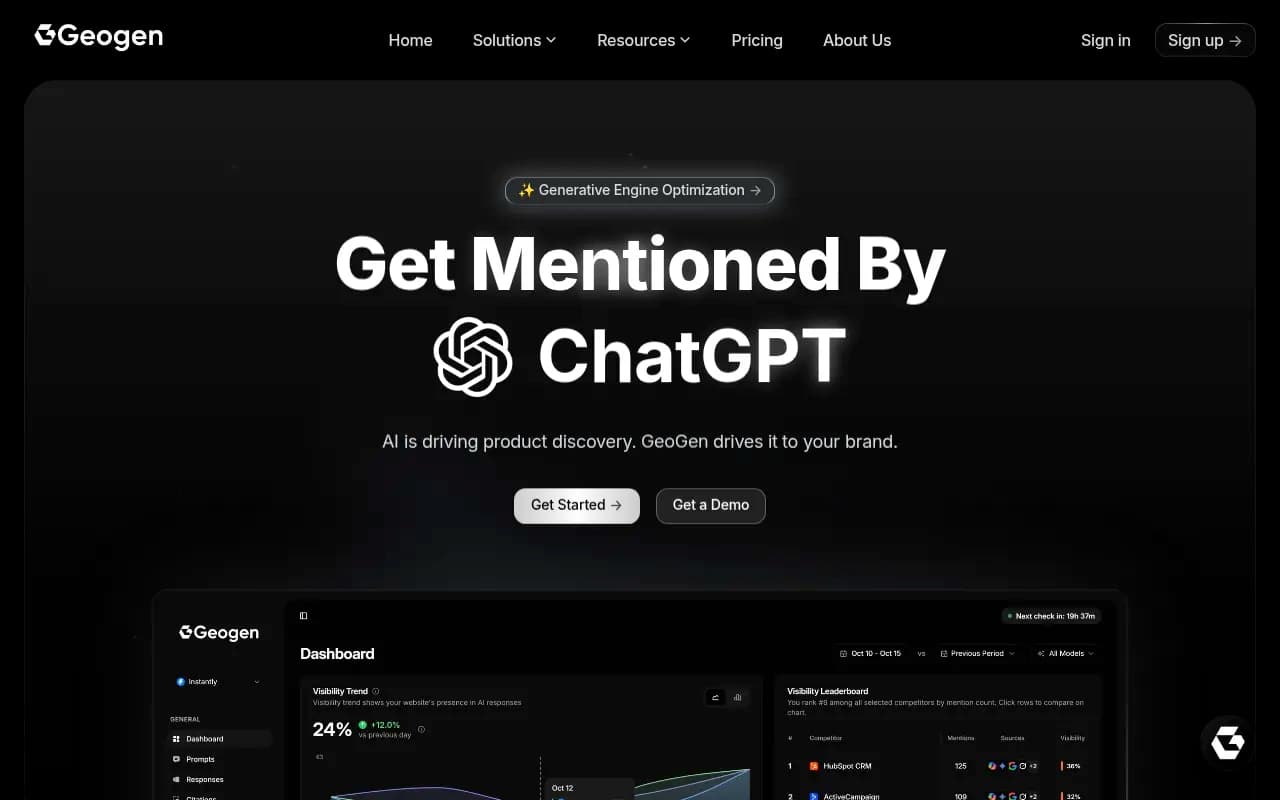
GeoGen is a Generative Engine Optimization platform that tracks brand mentions across ChatGPT, Perplexity, Gemini, Grok, and Microsoft Copilot. The platform targets small to mid-sized brands looking for basic AI visibility tracking at a lower price point. GeoGen starts at €20/month for its Micro plan and scales up to €399/month for the Pro tier. The platform emphasizes simplicity and affordability, with a 20% discount on annual billing.
GeoGen's tagline -- "Get Mentioned By ChatGPT, Gemini, Perplexity, Grok, and Microsoft Copilot" -- reflects its core value proposition: helping brands understand where they show up in AI-generated responses. The platform is used by companies like CloudBlast, GdprWise, ProxyScrape, and TextBroker.
Side-by-side comparison
| Feature | Meteoria | GeoGen |
|---|---|---|
| Starting price | €75/mo (Basic) | €20/mo (Micro) |
| Prompts included (entry tier) | 25 prompts | 10 prompts |
| Free trial | 7 days | Not mentioned |
| LLM coverage | ChatGPT, Perplexity, Google AI Overview, Gemini, Grok (5 models) | ChatGPT, Perplexity, Gemini, Grok, Microsoft Copilot (5 models) |
| Sentiment analysis | Yes (implicit + explicit) | Not mentioned |
| Competitor tracking | Yes | Yes |
| Source attribution | Yes | Not mentioned |
| Unlimited seats | Yes | Not specified |
| Unlimited projects | Yes | Not specified |
| Geographic targeting | Yes (custom zones) | Not specified |
| Persona targeting | Yes | Not specified |
| Language support | French interface, multi-language prompts | English interface |
| Annual discount | Not mentioned | 20% off |
| Enterprise pricing | From €300/mo (200+ prompts) | Custom |
Pricing breakdown
Both platforms use tiered pricing based on prompt volume, but the structures differ significantly.
| Plan | Meteoria | GeoGen |
|---|---|---|
| Entry tier | €75/mo (Basic: 25 prompts) | €20/mo (Micro: 10 prompts) |
| Mid tier | €175/mo (Pro: 100 prompts) | Price not listed (likely €100-200/mo range) |
| High tier | €300+/mo (Enterprise: 200+ prompts) | €399/mo (Pro: prompt count not specified) |
| Free trial | 7 days | Not mentioned |
| Annual discount | Not mentioned | 20% |
Meteoria's pricing is 3.75x higher at the entry level (€75 vs €20), but you get 2.5x more prompts (25 vs 10). On a per-prompt basis, Meteoria costs €3/prompt vs GeoGen's €2/prompt -- a 50% premium. However, Meteoria includes unlimited seats and projects, which could offset the cost for teams.
GeoGen's 20% annual discount brings the Micro plan down to €16/mo (€192/year vs €240/year monthly billing). Meteoria does not advertise an annual discount, which makes GeoGen more attractive for budget-conscious solo users or small teams.
For higher volumes, Meteoria's Pro plan (100 prompts at €175/mo) works out to €1.75/prompt -- better value than the Basic tier. GeoGen's Pro plan at €399/mo does not specify prompt limits, making it hard to compare directly.
LLM coverage and tracking capabilities
Both platforms track five AI models, but the lineups differ slightly.
Meteoria covers:
- ChatGPT
- Perplexity
- Google AI Overview
- Gemini
- Grok
GeoGen covers:
- ChatGPT
- Perplexity
- Gemini
- Grok
- Microsoft Copilot
The key difference: Meteoria includes Google AI Overview (the AI-generated summaries in Google Search), while GeoGen includes Microsoft Copilot. If your audience uses Google Search heavily, Meteoria's coverage is more relevant. If you care about Microsoft's ecosystem (Edge, Bing, Windows Copilot), GeoGen has you covered.
Neither platform tracks Claude, DeepSeek, Meta AI, or Mistral -- models that are growing in usage. For comprehensive coverage across 10+ LLMs, you'd need a platform like Promptwatch, which monitors ChatGPT, Perplexity, Google AI Overviews, Google AI Mode, Claude, Gemini, Meta/Llama, DeepSeek, Grok, Mistral, and Copilot.
Verdict: Meteoria wins for Google-focused brands; GeoGen wins for Microsoft ecosystem tracking. Both are limited compared to platforms with broader LLM coverage.
Visibility metrics and analysis depth
Meteoria emphasizes three core metrics:
- Visibility rate: What percentage of AI responses mention your brand
- Relative position: Where you rank vs competitors in each response
- Source attribution: Which URLs and domains AI models cite when mentioning you
The platform also tracks sentiment -- both explicit ("X is great" vs "X is terrible") and implicit (tone, context, framing). This is useful for brand reputation monitoring, especially if you're concerned about how AI models characterize your company.
GeoGen's website is less specific about metrics. The platform tracks "brand mentions" and "competitor rankings," but does not detail sentiment analysis, source attribution, or the granularity of positioning data. The focus seems to be on basic presence tracking rather than deep analysis.
Verdict: Meteoria offers richer analytics, especially for sentiment and source tracking. GeoGen is simpler but less detailed.
Prompt customization and targeting
Meteoria allows you to customize prompts by:
- Sector/industry
- Product categories
- Personas (who's asking the question)
- Geographic zones
This level of targeting is important if you operate in multiple markets or serve different customer segments. For example, a SaaS company could track prompts like "best CRM for small businesses in France" vs "best CRM for enterprises in Germany" and see how visibility differs by region and audience.
GeoGen does not specify prompt customization options on its website. The platform likely supports custom prompts (that's the whole point of GEO tracking), but the lack of detail suggests less sophistication in targeting and segmentation.
Verdict: Meteoria wins for brands that need granular targeting by persona, geography, or product line.
User interface and ease of use
Meteoria's interface is shown in screenshots on the website. The dashboard displays:
- Visibility scores over time
- Competitor heatmaps
- Source breakdowns (which domains AI models cite)
- Sentiment analysis charts
The design is clean and data-dense, with a focus on visual comparisons. The French-language interface may be a barrier for non-French speakers, though the platform likely supports multi-language prompts.
GeoGen's website shows three dashboard screenshots:
- A main dashboard with brand mention tracking
- A competitor comparison view
- A detailed analysis screen
The interface looks modern and straightforward, with less visual complexity than Meteoria. This could be a plus for users who want simplicity or a minus for users who want deep data exploration.
Verdict: Meteoria for power users who want detailed analytics; GeoGen for users who want a simpler, less overwhelming interface.
Team collaboration and scalability
Meteoria includes unlimited seats and unlimited projects on all plans. This is a huge advantage for agencies or in-house teams managing multiple brands. You can add everyone to the platform without worrying about per-seat fees, and you can track as many brands or product lines as you need within your prompt quota.
GeoGen does not specify seat limits or project limits on its website. The lack of clarity here is a red flag -- most SaaS platforms charge per seat or per project, so the absence of this information suggests either:
- GeoGen has not finalized its team/project pricing model
- The platform is designed for single-user or small-team use
For agencies or larger teams, Meteoria's unlimited seats model is a clear win.
Verdict: Meteoria is built for teams and agencies; GeoGen's team capabilities are unclear.
What's missing from both platforms
Neither Meteoria nor GeoGen offers:
- Content generation: No AI writing tools to create articles optimized for AI search visibility
- Crawler logs: No visibility into which AI models are actually crawling your website and when
- Traffic attribution: No way to connect AI visibility to actual website traffic or revenue
- Prompt intelligence: No data on prompt volumes, difficulty scores, or query fan-outs to prioritize high-value prompts
- Reddit/YouTube tracking: No monitoring of discussions or videos that influence AI recommendations
These are monitoring-only platforms. They show you where you're visible (or invisible) but don't help you fix the problem. If you want to close the loop -- find gaps, create content, track results -- you need a platform that combines monitoring with optimization and content creation.
Pros and cons
Meteoria pros
- Sentiment analysis (implicit + explicit) for brand reputation tracking
- Unlimited seats and projects -- great for agencies and teams
- Geographic and persona targeting for granular insights
- Source attribution to see which domains AI models cite
- 7-day free trial to test before committing
- Strong European presence and French-language support
Meteoria cons
- 3.75x more expensive than GeoGen at entry level (€75 vs €20)
- French-language interface may be a barrier for non-French speakers
- Does not track Microsoft Copilot
- No content generation or optimization tools
- No annual discount mentioned
GeoGen pros
- Cheapest entry point in the GEO space (€20/mo)
- 20% discount on annual billing
- Tracks Microsoft Copilot (important for Bing/Edge users)
- Simple, straightforward interface
- Used by recognizable brands (CloudBlast, ProxyScrape, TextBroker)
GeoGen cons
- Only 10 prompts on entry tier (vs Meteoria's 25)
- No sentiment analysis mentioned
- No source attribution mentioned
- Unclear team/project limits
- No free trial mentioned
- Less detailed analytics compared to Meteoria
- Does not track Google AI Overview
Who should pick which tool
Choose Meteoria if you:
- Need sentiment analysis to monitor brand reputation in AI responses
- Manage multiple brands or clients (unlimited projects)
- Have a team that needs access (unlimited seats)
- Operate in multiple geographies or serve different personas
- Want to see which sources AI models cite when mentioning you
- Prefer a French-language interface or serve European markets
- Can afford €75/mo and want richer analytics
Choose GeoGen if you:
- Have a tight budget and need basic AI visibility tracking (€20/mo)
- Are a solo founder or small team (1-3 people)
- Care about Microsoft Copilot coverage (Bing, Edge, Windows)
- Want a simple, no-frills interface without overwhelming data
- Plan to pay annually (20% discount brings Micro to €16/mo)
- Don't need sentiment analysis or deep source attribution
Choose neither if you:
- Want to actually improve your AI visibility, not just track it -- monitoring alone won't fix the problem
- Need content generation tools to create articles optimized for AI search
- Want to see which AI crawlers are hitting your website and when
- Need to connect AI visibility to actual traffic and revenue
- Want prompt intelligence (volumes, difficulty, query fan-outs) to prioritize efforts
For a platform that combines monitoring with action -- content gap analysis, AI-optimized content generation, crawler logs, and traffic attribution -- Promptwatch is worth exploring. It tracks 10 AI models (vs 5 for Meteoria/GeoGen), includes Reddit and YouTube insights, and helps you close the loop from visibility gaps to content creation to measurable results.
Final verdict
Meteoria is the better platform for teams, agencies, and brands that need detailed analytics, sentiment tracking, and multi-project management. The €75/mo price tag is justified if you value unlimited seats, richer data, and geographic/persona targeting. It's a solid choice for European brands or companies that want to monitor brand reputation in AI responses.
GeoGen wins on price (€20/mo is hard to beat) and simplicity. If you're a solo founder or small team that just wants to know "are we showing up in ChatGPT?" without diving into sentiment analysis or source attribution, GeoGen gets the job done at a fraction of the cost. The 20% annual discount makes it even more attractive for budget-conscious users.
But here's the reality: both platforms are monitoring dashboards. They tell you where you're invisible but don't help you fix it. You'll see the data, feel the pain, and then... what? You're stuck manually creating content, guessing at what AI models want, and hoping it works. For brands serious about AI search visibility, a monitoring-only tool is just the first step. You need a platform that shows you the gaps and helps you close them.