Key Takeaways
- Meteoria costs €75/mo (Basic) vs Promptmonitor's $29/mo (Starter) -- roughly 2.5x more expensive at entry level, but Meteoria includes unlimited seats and projects while Promptmonitor limits both
- Meteoria monitors 5 LLMs (ChatGPT, Perplexity, Google AI Overview, Gemini, Grok) vs Promptmonitor's 3-4 (ChatGPT, Claude, Gemini, Perplexity) -- similar coverage but different model priorities
- Neither platform offers AI crawler logs, content gap analysis, or built-in content generation -- both are monitoring-only dashboards that show you data but don't help you fix visibility gaps
- Meteoria is French-built with a focus on European markets and sentiment analysis; Promptmonitor is US-oriented with basic tracking and source analysis
- For teams that need monitoring plus optimization (content gap analysis, AI writing tools, crawler logs), Promptwatch covers that angle with its end-to-end action loop starting at $99/mo
- Both offer 7-day free trials, but Meteoria's pricing jumps steeply (€175 for 100 prompts) while Promptmonitor scales more gradually ($39 Growth, $129 Pro)
Overview
Meteoria

Meteoria is a French GEO (Generative Engine Optimization) platform that tracks how AI models mention your brand across ChatGPT, Perplexity, Google AI Overview, Gemini, and Grok. The platform runs custom prompts daily, calculates visibility scores, tracks competitor positioning, and analyzes sentiment. It's designed for European markets with multilingual support and starts at €75/month with unlimited seats and projects -- a pricing model that favors agencies and larger teams.
The interface is clean and data-focused. You set up prompts tailored to your industry, products, personas, and geographies, then Meteoria queries the LLMs and quantifies thousands of responses. You get visibility percentages, relative position vs competitors, and the sources each AI cited. There's also sentiment analysis to catch how AI models frame your brand.
Promptmonitor
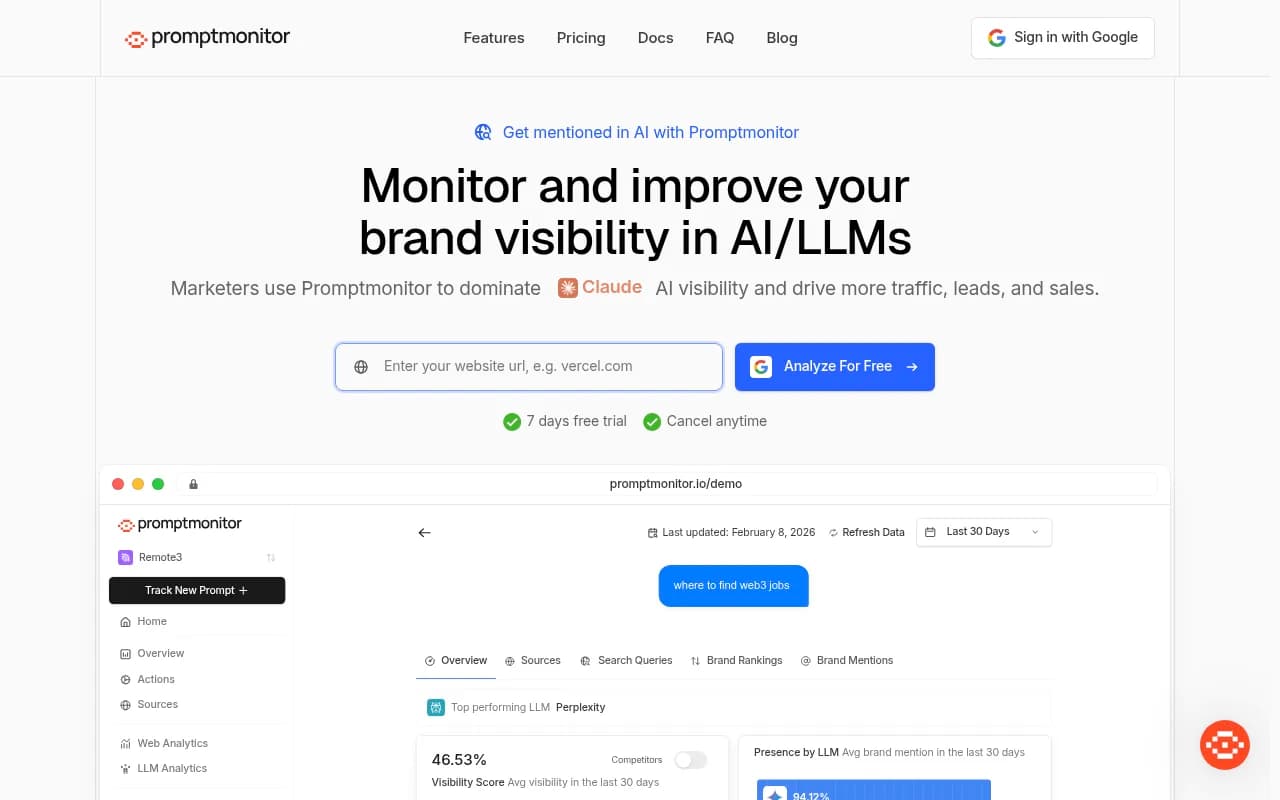
Promptmonitor is a simplified AI visibility tracker that monitors brand mentions across ChatGPT, Claude, Gemini, and Perplexity. It offers basic dashboards showing presence scores, visibility trends over time, and which sources AI models cite when they mention you. Pricing starts at $29/month for the Starter plan, making it one of the cheaper entry points in the GEO space.
The platform is straightforward -- you track prompts, see whether your brand was mentioned, and view charts of your visibility percentage across models. There's a public demo project that shows the interface: daily tracking grids, LLM-by-LLM breakdowns, and source lists. It's a monitoring tool, not an optimization platform. You get the data, but you're on your own to figure out what to do with it.
Side-by-Side Comparison
| Feature | Meteoria | Promptmonitor |
|---|---|---|
| Starting price | €75/mo (~$82) | $29/mo |
| Prompt limits (entry tier) | 25 prompts | Not clearly specified |
| LLM coverage | ChatGPT, Perplexity, Google AI Overview, Gemini, Grok (5 models) | ChatGPT, Claude, Gemini, Perplexity (3-4 models) |
| Seats included | Unlimited | Limited (varies by plan) |
| Projects included | Unlimited | Limited (varies by plan) |
| Sentiment analysis | Yes (implicit & explicit) | No |
| Competitor tracking | Yes | Yes |
| Source analysis | Yes | Yes |
| AI crawler logs | No | No |
| Content gap analysis | No | No |
| Content generation | No | No |
| Traffic attribution | Yes (analytics integration) | Yes (web analytics) |
| Free trial | 7 days | 7 days |
| Target market | Europe (French-first) | US/Global |
Pricing comparison
| Plan | Meteoria | Promptmonitor |
|---|---|---|
| Free tier | None (7-day trial) | None (7-day trial) |
| Entry plan | €75/mo (Basic: 25 prompts, unlimited seats/projects) | $29/mo (Starter: limits not public) |
| Mid-tier | €175/mo (Pro: 100 prompts) | $39/mo (Growth), $129/mo (Pro) |
| High-tier | €300+/mo (Enterprise: 200+ prompts) | Custom (Agency plan) |
| Annual discount | Not specified | Not specified |
Meteoria's pricing is significantly higher at every level, but you get unlimited seats and projects -- a big deal for agencies or companies with multiple brands. Promptmonitor's $29 entry point is attractive for solo marketers or small teams testing the waters, but the feature set is barebones and seat/project limits aren't transparent until you sign up.
Head-to-head feature deep-dive
LLM coverage and tracking depth
Meteoria monitors five models: ChatGPT, Perplexity, Google AI Overview, Gemini, and Grok. The focus on Google AI Overview is smart -- it's a major visibility channel that many competitors ignore. Daily prompt execution across all five models gives you a comprehensive view of where you're showing up and where you're invisible.
Promptmonitor covers ChatGPT, Claude, Gemini, and Perplexity. No Google AI Overview, no Grok, no DeepSeek, no Mistral. The model list is shorter and missing some key players. For a monitoring tool, limited LLM coverage is a real weakness -- you're flying blind on entire channels.
Verdict: Meteoria wins on breadth. Google AI Overview alone is worth the extra coverage.
User interface and data visualization
Meteoria's interface is polished and data-dense. You get visibility scores, position tracking, sentiment breakdowns, and source lists. The platform is built for marketers who want to slice data by geography, persona, product line, and competitor. It's not the simplest tool, but it's powerful once you learn it.
Promptmonitor's UI is cleaner and simpler. The public demo shows basic charts: presence by LLM, visibility trends over time, and daily mention grids. It's easy to understand at a glance, but there's not much depth. You see whether you were mentioned and which sources were cited, but the analysis stops there.
Verdict: Meteoria for teams that need detailed segmentation and reporting. Promptmonitor for users who want a quick dashboard without complexity.
Sentiment analysis
Meteoria includes sentiment analysis -- both implicit (tone, framing) and explicit (positive/negative statements). This is useful for brand monitoring. If an AI model mentions you but frames you negatively, that's a problem you need to know about. Meteoria surfaces those issues.
Promptmonitor doesn't offer sentiment analysis. You know you were mentioned, but not how. For brand reputation tracking, that's a gap.
Verdict: Meteoria. Sentiment matters, especially if you're in a competitive or reputation-sensitive industry.
Competitor tracking and benchmarking
Both platforms let you track competitors and compare your visibility vs theirs. Meteoria shows relative position and visibility scores side-by-side across all tracked brands. You can filter by LLM, geography, and prompt category to see exactly where competitors are beating you.
Promptmonitor also tracks competitors and shows brand rankings within responses. The public demo includes a "Competitors" section with visibility percentages. It's functional but less granular than Meteoria's segmentation.
Verdict: Tie. Both handle competitor tracking adequately, though Meteoria's filtering is more sophisticated.
Source analysis
Meteoria tracks which sources (websites, articles, Reddit threads, etc.) each LLM cites when mentioning your brand or competitors. This is critical for understanding where to publish and what to optimize. If AI models consistently cite a specific publication or forum, you know where to focus your PR and content efforts.
Promptmonitor also provides source tracking. The demo shows a "Sources" tab listing domains cited in AI responses. It's a straightforward list without much additional context or prioritization.
Verdict: Meteoria edges ahead with better context and filtering, but both platforms cover the basics.
Optimization and action tools
This is where both platforms fall short. Neither Meteoria nor Promptmonitor offers:
- AI crawler logs (see which AI bots are hitting your site and what they're reading)
- Content gap analysis (identify prompts where competitors are visible but you're not)
- Prompt intelligence (volume estimates, difficulty scores, query fan-outs)
- Built-in content generation (create articles optimized for AI citations)
They show you the problem -- low visibility, competitor dominance -- but don't help you solve it. You're left to manually figure out what content to create, where to publish, and how to optimize.
If you need those capabilities, Promptwatch fills the gap with its Answer Gap Analysis (shows exactly which prompts you're missing), AI writing agent (generates citation-optimized content), and crawler logs (tracks AI bots indexing your site).

Verdict: Both platforms are monitoring-only. For optimization, you need a different tool.
Traffic attribution and analytics
Meteoria integrates with analytics platforms to track actual traffic from AI referrals. You can connect your web analytics and see whether increased AI visibility translates to real visits and conversions. This closes the loop between visibility and business impact.
Promptmonitor includes a "Web Analytics" section in its interface, suggesting some level of traffic tracking. The public demo doesn't show much detail, but the feature exists.
Verdict: Meteoria appears more robust here, but both platforms acknowledge that visibility without traffic data is incomplete.
Multilingual and multi-region support
Meteoria is built for European markets with strong multilingual support. You can run prompts in French, English, German, Spanish, and other languages, and track visibility by country or region. This is essential if you operate in multiple markets.
Promptmonitor doesn't emphasize multilingual or regional tracking in its marketing. It's likely US/English-focused with limited localization.
Verdict: Meteoria for international teams. Promptmonitor for English-only US businesses.
Pros and cons
Meteoria pros
- Unlimited seats and projects (great for agencies)
- Sentiment analysis included
- Google AI Overview coverage
- Strong multilingual and regional support
- Detailed segmentation and filtering
Meteoria cons
- Expensive (€75/mo entry, €175 for 100 prompts)
- No optimization tools (monitoring only)
- Steeper learning curve
- No AI crawler logs or content gap analysis
Promptmonitor pros
- Cheap entry point ($29/mo)
- Simple, easy-to-understand interface
- 7-day free trial
- Basic competitor and source tracking
Promptmonitor cons
- Limited LLM coverage (no Google AI Overview, Grok, etc.)
- No sentiment analysis
- No optimization or content generation tools
- Seat and project limits unclear
- Lacks depth for serious GEO work
Who should pick which tool
Choose Meteoria if:
- You're an agency managing multiple clients or brands (unlimited seats/projects)
- You operate in European markets or need multilingual tracking
- Sentiment analysis matters for your brand reputation
- You need Google AI Overview visibility data
- You have budget for a premium monitoring tool (€75-€300/mo)
Choose Promptmonitor if:
- You're a solo marketer or small team testing AI visibility tracking
- You want the cheapest entry point to see if GEO matters for your business
- You only care about ChatGPT, Claude, Gemini, and Perplexity
- You prefer simplicity over depth
- You're US-based and English-only
Choose neither if:
- You need optimization tools, not just monitoring -- both platforms show you the problem but don't help you fix it. For content gap analysis, AI writing tools, and crawler logs, look at platforms like Promptwatch that close the action loop.
Final verdict
Meteoria is the better monitoring platform -- more LLMs, sentiment analysis, unlimited seats, and stronger international support. But you pay for it. €75/mo is steep for 25 prompts, and €175 for 100 prompts puts it in premium territory.
Promptmonitor is cheaper and simpler, but it's also limited. No Google AI Overview, no sentiment analysis, and unclear limits on seats and projects. It's fine for dipping your toes into AI visibility tracking, but serious GEO work will outgrow it fast.
The real issue: both are monitoring-only dashboards. They tell you where you're invisible, but they don't help you become visible. You still have to manually create content, optimize pages, and guess at what AI models want. For a complete solution that includes monitoring plus optimization -- content gap analysis, AI-generated articles, crawler logs, and prompt intelligence -- you need a platform built around taking action, not just showing charts.