Key takeaways
- Promptwatch starts at $99/mo and covers 10+ AI models from day one. Bear AI starts at $199/mo and covers only 2 AI models on its Basic plan -- you need Enterprise to get 6+.
- Both tools track prompt visibility and brand mentions in AI responses, but Promptwatch goes further with crawler logs, Reddit/YouTube citation tracking, ChatGPT Shopping monitoring, and query fan-outs. Bear AI doesn't publicly list these capabilities.
- Bear AI has a lead generation angle that Promptwatch doesn't -- it's specifically built to identify and convert high-intent visitors arriving from AI agents, which is a genuinely different use case.
- Promptwatch's content generation is grounded in 880M+ real citation data points. Bear AI includes basic blog creation (2/mo on Basic), but the depth of optimization is different.
- Promptwatch is the better fit for agencies managing multiple brands. Bear AI reads more like a tool for in-house growth teams at a single company.
- Bear AI is Y Combinator-backed and early-stage. Promptwatch has 7,000+ customers and a longer track record. That matters if you're betting a marketing program on a platform.
Overview
Promptwatch

Promptwatch is an end-to-end AI search visibility platform. The core idea is a loop: find the prompts where competitors are visible but you're not, generate content that fills those gaps, then track whether AI models start citing your pages. It monitors ChatGPT, Claude, Perplexity, Gemini, Grok, DeepSeek, Copilot, Meta AI, Mistral, and Google AI Overviews -- all from one dashboard. With 7,000+ customers including Booking.com, Center Parcs, Typeform, and Yelp, it's the most widely adopted platform in this category. Rated 4.7/5 on G2.
Bear AI
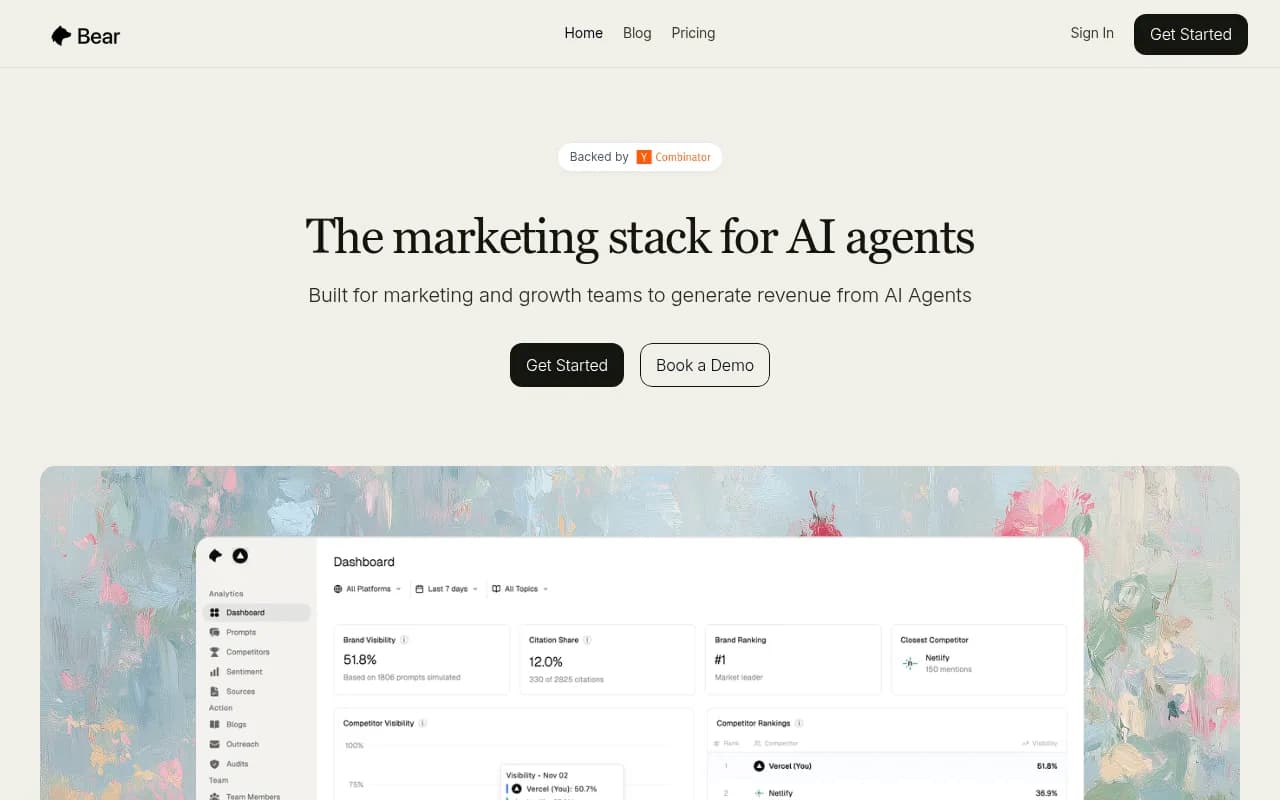
Bear AI is a newer entrant (Y Combinator-backed) that frames itself as "the marketing stack for AI agents." The pitch is slightly different from pure visibility tracking: Bear AI wants to help you not just appear in AI responses, but actually convert the traffic that comes from those appearances. It tracks how AI agents discover and recommend your brand, surfaces trending prompts, and includes tools to identify high-intent visitors from AI sources. The customer list includes Peerspace, Wispr Flow, and a handful of other startups. It's a smaller, earlier-stage product.
Side-by-side comparison
| Feature | Promptwatch | Bear AI |
|---|---|---|
| Starting price | $99/mo | $199/mo |
| Free trial | 7-day free trial | Not publicly listed |
| AI models covered (entry plan) | 10+ | 2 |
| AI models covered (max) | 10+ | 6+ (Enterprise) |
| Prompt tracking | Yes (50-350/mo by plan) | Yes (75/mo on Basic) |
| Content generation | Yes -- AI writing agent, citation-grounded | Yes -- 2 blogs/mo on Basic |
| Answer gap analysis | Yes | Not listed |
| AI crawler logs | Yes | Not listed |
| Citation & source analysis | Yes (880M+ citations) | Partial |
| Reddit/YouTube tracking | Yes | Not listed |
| ChatGPT Shopping tracking | Yes | Not listed |
| Lead generation / visitor ID | No | Yes |
| Traffic attribution | Yes (GSC, snippet, server logs) | Yes (AI traffic analytics) |
| Multi-site support | Yes (up to 5 on Business) | Not listed |
| Agency tier | Yes | Not listed |
| Looker Studio / API | Yes | Not listed |
| G2 rating | 4.7/5 | Not listed |
| Customer count | 7,000+ | Small (early-stage) |
Head-to-head feature deep-dive
Prompt tracking and AI model coverage
This is where the gap is most obvious. Promptwatch's Essential plan ($99/mo) tracks 50 prompts across 10+ AI models. Bear AI's Basic plan ($199/mo) tracks 75 prompts but across only 2 AI models. If you're trying to understand your visibility across the AI search ecosystem -- not just ChatGPT and one other -- Bear AI's entry tier is a real limitation.
Promptwatch also adds prompt intelligence on top of raw tracking: volume estimates, difficulty scores, and query fan-outs that show how one prompt branches into related sub-queries. That lets you prioritize which prompts are worth targeting, rather than just watching them all equally.
Bear AI surfaces "trending prompts" and shows which prompts are high-volume, which is useful, but the depth of prioritization data isn't comparable.
Verdict: Promptwatch wins on model coverage and prompt intelligence at every price point.
Content generation and optimization
Promptwatch's AI writing agent generates articles, listicles, and comparison pages grounded in real citation data. The idea is that the content it produces is specifically engineered to get cited by AI models -- not generic SEO filler. It analyzes which sources AI models actually cite, what topics are missing from your site, and what competitors are being cited for. The result is content with a clear optimization rationale behind it.
Bear AI includes blog creation (2 posts/mo on Basic), but the public-facing information doesn't describe the same level of citation-grounded optimization. It's more of a content creation feature than a content strategy engine.
Verdict: Promptwatch's content generation is more sophisticated and more directly tied to AI citation data.
Traffic attribution and conversion
This is where Bear AI has a genuine differentiator. It's explicitly built to identify high-intent visitors arriving from AI agents and convert them into leads. That's a revenue-focused angle that Promptwatch doesn't directly address -- Promptwatch tracks AI traffic attribution (via GSC integration, a code snippet, or server log analysis) and connects visibility to traffic, but the lead identification piece is Bear AI's territory.
If your primary question is "which AI-referred visitors are most likely to convert, and how do I capture them?" -- Bear AI is thinking about that problem more directly.
Promptwatch's attribution is strong for connecting AI visibility to traffic volume and revenue at a macro level. Bear AI's attribution is more granular at the visitor level.
Verdict: Draw, depending on what you need. Promptwatch for macro attribution; Bear AI for visitor-level lead capture.
Crawler logs and technical AI SEO
Promptwatch shows real-time logs of AI crawlers (ChatGPT, Claude, Perplexity, etc.) hitting your website -- which pages they read, how often they return, and what errors they encounter. This is genuinely useful for diagnosing why AI models might not be citing your content: maybe they can't crawl it, maybe they're hitting errors, maybe they're only reading certain pages.
Bear AI doesn't publicly list crawler log functionality. This is a meaningful gap for anyone doing serious technical optimization for AI search.
Verdict: Promptwatch wins clearly.
Citation and source analysis
Promptwatch has processed 880M+ citations and uses that data to show you exactly which pages, Reddit threads, YouTube videos, and domains AI models cite in their responses. The Reddit and YouTube tracking is particularly interesting -- most brands don't think about those channels as AI citation sources, but they are.
Bear AI shows citation sources and how AI agents discover your brand, but the scale and depth of the citation database isn't comparable to what Promptwatch has built.
Verdict: Promptwatch wins on citation depth and channel coverage.
Ease of use and onboarding
Both tools are SaaS dashboards aimed at marketing teams, not engineers. Promptwatch has been around longer and has more documentation, customer support resources, and a larger user community to draw from. Bear AI is newer and Y Combinator-backed, which usually means a tight product loop and responsive founders -- but also less mature documentation and fewer integrations.
Neither tool requires technical setup beyond a code snippet or GSC connection for traffic attribution.
Verdict: Slight edge to Promptwatch on maturity; Bear AI may have faster support response as an early-stage team.
Pricing comparison
| Plan | Promptwatch | Bear AI |
|---|---|---|
| Entry / Basic | $99/mo (Essential: 1 site, 50 prompts, 5 articles, 10+ models) | $199/mo (Basic: 75 prompts, 2 blogs, 2 AI models) |
| Mid-tier | $249/mo (Professional: 2 sites, 150 prompts, 15 articles, crawler logs) | Not publicly listed |
| Business | $579/mo (Business: 5 sites, 350 prompts, 30 articles) | Not publicly listed |
| Enterprise | Custom pricing | Custom (unlimited prompts, lead gen, 6+ models) |
| Free trial | 7-day free trial | Not publicly listed |
| Annual discount | Yes | Not listed |
At the entry level, Promptwatch is half the price of Bear AI and covers 5x more AI models. The value equation is hard to argue with unless you specifically need Bear AI's lead generation features.
Pros and cons
Promptwatch
Pros:
- Covers 10+ AI models from the cheapest plan
- Full action loop: gap analysis, content generation, tracking -- not just monitoring
- AI crawler logs give technical insight most competitors lack
- Reddit and YouTube citation tracking
- ChatGPT Shopping monitoring
- 7,000+ customers with proven track record
- Agency-ready with multi-site support and Looker Studio integration
- Starts at $99/mo -- competitive for what it includes
Cons:
- No visitor-level lead identification (Bear AI's differentiator)
- Can feel like a lot of features to onboard if you just want basic tracking
- 50 prompts on the Essential plan may feel limiting for larger brands
Bear AI
Pros:
- Lead generation and visitor identification from AI traffic -- a genuinely different capability
- Y Combinator-backed, so likely to iterate quickly
- Focused, clear positioning for growth teams
- Trending prompt discovery is well-presented
Cons:
- $199/mo entry price for only 2 AI models is hard to justify vs. alternatives
- Early-stage product with a smaller customer base and less proven track record
- No publicly listed crawler logs, Reddit/YouTube tracking, or ChatGPT Shopping monitoring
- Limited prompt volume (75/mo on Basic)
- Agency use cases aren't clearly addressed
- Less citation data depth than Promptwatch
Who should pick which tool
Pick Promptwatch if:
- You want to monitor visibility across the full AI search ecosystem (10+ models) from day one
- You need content generation that's grounded in real citation data, not generic AI writing
- You're an agency managing multiple client brands
- You want crawler logs to diagnose technical AI indexing issues
- You're tracking Reddit and YouTube as AI citation sources
- You want a platform with a proven track record and a large user community
Pick Bear AI if:
- Your primary goal is identifying and converting high-intent visitors arriving from AI agents
- You're an in-house growth team at a single company focused on revenue from AI traffic
- You're comfortable with an early-stage product and want to work closely with a YC-backed founding team
- You only care about a small number of AI models (ChatGPT, Claude, maybe one more)
Final verdict
These two tools overlap in the middle -- both track brand mentions in AI responses and both help you understand how AI models are discovering your content. But they diverge at the edges in ways that matter.
Promptwatch is the more complete platform. It covers more AI models, has deeper citation data, generates optimization-grounded content, and gives you crawler logs that most competitors don't offer. For most marketing teams and agencies trying to build a serious AI search visibility program, it's the stronger choice -- and at $99/mo entry vs. Bear AI's $199/mo, the price argument goes the same direction.
Bear AI's lead generation angle is real and worth noting. If you're specifically trying to identify and convert individual visitors coming from AI agents, that's a capability Promptwatch doesn't directly replicate. But for the majority of teams whose first question is "how do we show up more in AI search results?" -- Promptwatch answers that question more completely.