Key takeaways
- Promptwatch monitors 10+ AI models (ChatGPT, Claude, Gemini, Perplexity, Grok, DeepSeek, Mistral, Meta AI, Copilot, Google AI Overviews); LightSite AI covers a narrower set of models
- Promptwatch includes real-time AI crawler logs showing which AI agents hit your pages and when -- LightSite AI has no equivalent feature
- LightSite AI leans into agentic automation: it finds gaps, drafts content, and sends it for approval with minimal manual work; Promptwatch gives you more control and more data to work with
- Promptwatch's data scale is substantially larger (4.5B+ citations processed, 1,780+ brands) and has been independently cited in the Wall Street Journal and Axios; LightSite AI is a newer, smaller player
- Pricing is close at entry level ($99/mo Promptwatch vs $129/mo LightSite AI annually), but Promptwatch's higher tiers include crawler logs, multi-site tracking, and content agents that LightSite AI bundles differently
- Teams that want deep analytics and control should pick Promptwatch; teams that want a more hands-off "find it and ship it" workflow might find LightSite AI's agentic approach appealing
Overview
Promptwatch

Promptwatch is the most established AI search visibility platform in this comparison. It's been around long enough to have processed 4.5 billion citations and prompts, and it's used by brands like Booking.com, Duolingo, Yelp, Typeform, and Shutterstock. The core idea is a full action loop: track where you're invisible, identify the exact content gaps AI models are exposing, generate content to fill those gaps, and then watch your citation scores improve. It's not just a dashboard -- it has actual tools to help you do something about what you find.
The platform covers 10 AI models, which is more than most competitors. It also does things most GEO tools don't touch at all: real-time AI crawler logs, ChatGPT Shopping tracking, Reddit and YouTube citation analysis, and query fan-outs that show how one prompt branches into sub-queries. G2 rates it 4.7/5 stars.
LightSite AI
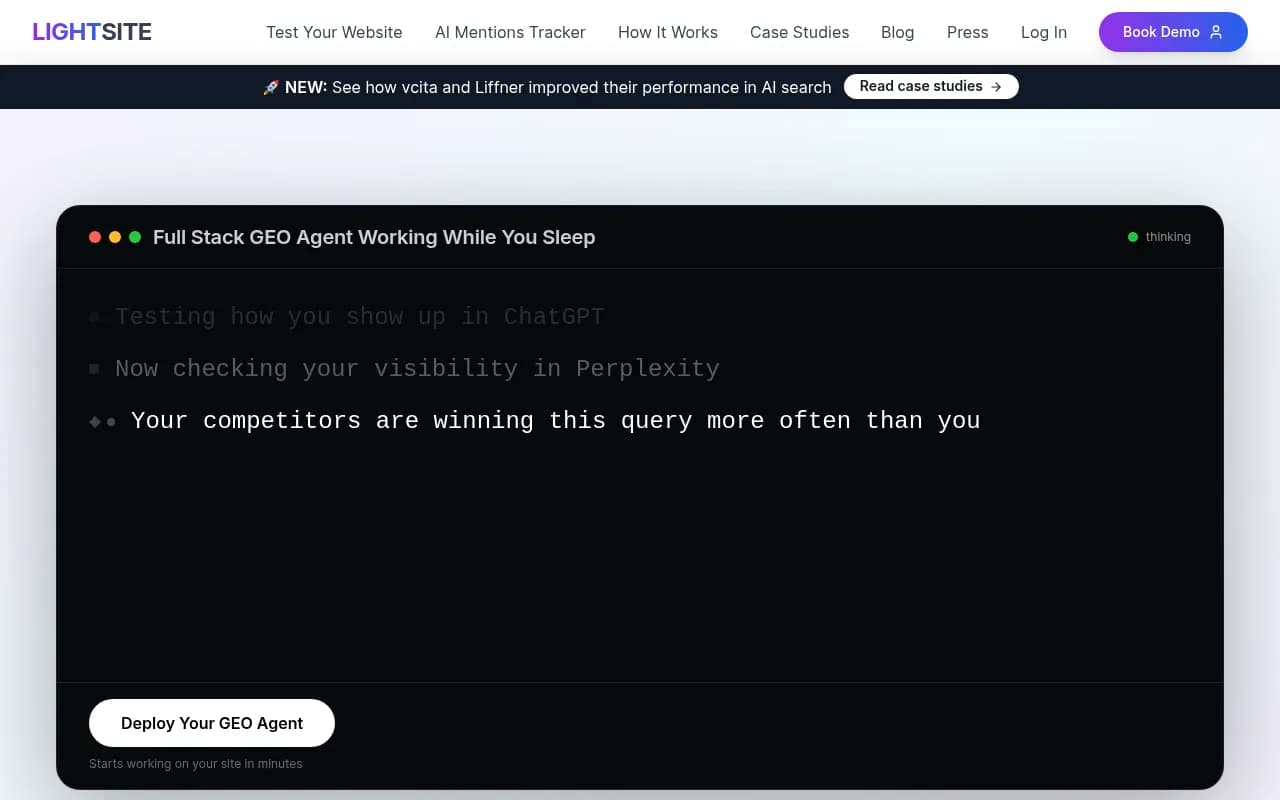
LightSite AI pitches itself as a "full-stack AI agent for SEO, GEO and AEO" built specifically for lean marketing teams. The positioning is interesting: rather than giving you a dashboard full of data to interpret, it tries to do more of the work for you. It finds buyer questions where competitors get cited and you don't, drafts content to fill those gaps, and sends it for your approval before publishing. The tagline "not another GEO dashboard" is a direct shot at the monitoring-only tools in this space.
It's a newer platform with a smaller customer base (brands like vcita, Splenda, SlimFast, and Heartland Food Products Group are listed). The 7-day free trial and annual billing starting at $129/mo make it accessible for smaller teams. The agentic workflow is genuinely differentiated -- but the question is whether the underlying data and model coverage can match what more established platforms provide.
Side-by-side comparison
| Feature | Promptwatch | LightSite AI |
|---|---|---|
| AI models monitored | 10+ (ChatGPT, Claude, Gemini, Perplexity, Grok, DeepSeek, Mistral, Meta AI, Copilot, Google AI Overviews) | Smaller set (exact count not publicly listed) |
| Free tier / trial | Free trial (50 prompts) | 7-day free trial |
| Starting price | $99/mo (Essential) | $129/mo (billed annually) |
| AI crawler logs | Yes (Professional plan+) | No |
| Content generation | Yes -- Content Agents (articles, comparisons, listicles) | Yes -- agentic drafting with approval workflow |
| Answer gap analysis | Yes | Yes |
| Prompt volume & difficulty scoring | Yes | Not confirmed |
| Reddit & YouTube tracking | Yes | Not confirmed |
| ChatGPT Shopping tracking | Yes | Not confirmed |
| Offsite citation analysis | Yes | Not confirmed |
| Multi-site support | Yes (Business: 5 sites) | Not confirmed |
| Agency / white-label | Yes (custom plans) | Not confirmed |
| API access | Yes | Not confirmed |
| Looker Studio integration | Yes | Not confirmed |
| G2 rating | 4.7/5 | Not listed |
| Customer count | 1,780+ brands | Smaller, newer |
| Citations processed | 4.5B+ | Not disclosed |
Head-to-head feature deep-dive
AI model coverage
This is where the gap is most obvious. Promptwatch tracks 10 AI models in real user interfaces -- not just API outputs. That distinction matters because what ChatGPT shows a real user in its interface can differ from what the API returns. LightSite AI's website doesn't specify which models it covers or how many, which makes it hard to evaluate directly. For any brand that cares about visibility across the full AI search ecosystem (not just ChatGPT and Perplexity), Promptwatch's coverage is a clear advantage.
Verdict: Promptwatch wins on model breadth and data fidelity.
Content gap analysis and content generation
Both tools do this, but the approach differs. Promptwatch's Answer Gap Analysis shows you the specific prompts where competitors appear and you don't -- with prompt volume scores and difficulty ratings so you can prioritize. Its Content Agents then generate articles, listicles, and comparison pages grounded in that real prompt data, citation patterns, and competitor analysis.
LightSite AI's agentic approach is more automated. It finds gaps, drafts content, and queues it for approval -- the workflow is designed to minimize the number of decisions you have to make. For a two-person marketing team that doesn't have time to interpret data and write briefs, that's genuinely useful. For a larger team or agency that wants to control the strategy and just use AI for execution, Promptwatch's more granular approach gives you more to work with.
Verdict: Tie, depending on team size and workflow preference. Promptwatch for control; LightSite AI for automation.
AI crawler logs
Promptwatch's crawler logs are one of its most distinctive features. You get real-time visibility into which AI agents (ChatGPT, Claude, Perplexity, etc.) are crawling your site, which pages they're reading, what errors they're hitting, and when a page moves from "crawled" to "cited." That timeline -- from publish to crawl to citation -- is genuinely useful for understanding whether your content optimization is working.
LightSite AI doesn't appear to offer anything equivalent. If you want to understand how AI engines discover and index your content, this is a meaningful gap.
Verdict: Promptwatch wins clearly.
Prompt intelligence
Promptwatch gives you volume estimates and difficulty scores for individual prompts, plus query fan-outs that show how one prompt branches into related sub-queries. This lets you prioritize: go after high-volume, winnable prompts first rather than spreading effort across everything.
LightSite AI's gap-finding is more automated, but it's less clear whether you get the same granularity of prompt-level data to make strategic decisions. The agentic model means LightSite AI is making more of those prioritization calls for you.
Verdict: Promptwatch for teams that want to own the strategy; LightSite AI for teams that want the tool to handle prioritization.
Offsite and third-party citation tracking
Promptwatch tracks which external sources -- Reddit threads, YouTube videos, third-party listicles, brand mentions on other domains -- AI models are citing in their responses. This matters because a lot of AI visibility happens off your own website. Knowing which Reddit post is driving ChatGPT recommendations in your category is actionable in a way that pure on-site analytics can't capture.
LightSite AI's website doesn't mention equivalent offsite tracking capabilities.
Verdict: Promptwatch wins.
Ease of use and workflow
LightSite AI's pitch is explicitly about reducing friction for lean teams. The agentic model -- where the tool finds the work, drafts the output, and asks for approval -- is a real workflow advantage for teams that are stretched thin. You don't need to become a GEO expert to get value out of it.
Promptwatch has put effort into onboarding (reviews consistently mention it's easy to get started), but the platform is more data-rich and therefore more complex. There's more to learn, more to configure, and more decisions to make. That's a feature for power users and a friction point for small teams.
Verdict: LightSite AI wins on ease of use for lean teams; Promptwatch wins for teams that want depth.
Agency and enterprise support
Promptwatch has dedicated agency plans, multi-site support (up to 5 sites on Business, more on custom plans), Looker Studio integration, and an API for custom workflows. It's clearly built to support agencies managing multiple clients.
LightSite AI's positioning is toward lean in-house teams, and its website doesn't highlight agency-specific features or white-label options.
Verdict: Promptwatch wins for agencies.
Pricing comparison
| Plan | Promptwatch | LightSite AI |
|---|---|---|
| Free / trial | Free trial (50 prompts, 5 articles) | 7-day free trial |
| Entry paid | $99/mo (Essential: 1 site, 50 prompts) | $129/mo billed annually |
| Mid tier | $249/mo (Professional: 2 sites, 150 prompts, crawler logs) | Not publicly detailed |
| Upper tier | $579/mo (Business: 5 sites, 350 prompts, 30 articles) | Not publicly detailed |
| Agency / Enterprise | Custom pricing | Not confirmed |
| Annual discount | Yes | Yes (required at $129/mo) |
A few things worth noting here. Promptwatch's $99/mo Essential plan is cheaper at entry, but it doesn't include crawler logs -- those come at $249/mo on Professional. LightSite AI's $129/mo is billed annually, so you're committing upfront. If you're not sure yet, Promptwatch's free trial with 50 prompts gives you more room to evaluate before paying.
Pros and cons
Promptwatch
Pros:
- Broadest AI model coverage in the market (10+ models)
- Real-time AI crawler logs -- unique capability most competitors lack
- Massive data scale (4.5B+ citations, 1,780+ brands)
- Prompt volume and difficulty scoring for strategic prioritization
- Reddit, YouTube, and offsite citation tracking
- ChatGPT Shopping and entity tracking
- Strong agency support (API, Looker Studio, multi-site, custom plans)
- 4.7/5 on G2 with a track record of independent press coverage
Cons:
- More complex platform -- there's a learning curve
- Crawler logs only available on $249/mo+ plans
- Can feel like a lot of data to manage for a small team
- Dutch company (Promptwatch B.V.) -- some US-based teams may prefer a US vendor
LightSite AI
Pros:
- Agentic workflow reduces manual work for lean teams
- "Find it, draft it, approve it" model is genuinely differentiated
- 7-day free trial with no credit card friction
- Positioned for teams without dedicated GEO expertise
- Covers SEO, GEO, and AEO in one tool
Cons:
- Newer platform with less publicly verifiable data scale
- Model coverage not clearly specified
- No AI crawler logs
- Prompt volume and difficulty scoring not confirmed
- Less suited for agencies or multi-brand management
- Annual billing required at entry price point
- Fewer third-party reviews to validate claims
Who should pick which tool
Pick Promptwatch if:
- You need to track visibility across 10+ AI models, not just ChatGPT and Perplexity
- You want AI crawler logs to understand how AI agents discover and index your content
- You're an agency managing multiple clients or brands
- You want prompt volume and difficulty data to prioritize your GEO strategy
- Reddit and YouTube citation tracking matters to your category
- You need ChatGPT Shopping or entity tracking
- You want a platform with a proven track record and independent data validation
Pick LightSite AI if:
- You're a small, lean marketing team without dedicated GEO resources
- You want a more automated workflow where the tool handles prioritization and drafting
- You're newer to GEO and want something that reduces the learning curve
- You don't need crawler logs or multi-model coverage right now
- You want to try something before committing to a larger platform
Final verdict
These two tools are solving the same problem -- AI search invisibility -- but from different angles. Promptwatch is the more mature, data-rich platform with broader model coverage, deeper analytics, and capabilities (crawler logs, Reddit tracking, ChatGPT Shopping) that LightSite AI simply doesn't match yet. For any team that takes AI search visibility seriously as a channel, Promptwatch gives you more to work with.
LightSite AI's agentic approach is genuinely interesting and could be a better fit for lean teams that want the tool to do more of the thinking. But "not another GEO dashboard" is a positioning claim, not a data claim -- and until LightSite AI publishes more specifics about model coverage, citation data, and prompt intelligence, it's hard to evaluate it on equal footing.
If you're choosing between the two in 2026: Promptwatch is the safer, more proven bet for teams that want depth and control. LightSite AI is worth a 7-day trial if you're a small team that wants automation over analytics.