LightSite AI Review 2026
Helps brands track and improve their presence in generative AI search results, with tools for entity recognition, citation tracking, and AI Overview rankings.
Key takeaways
- LightSite AI goes beyond basic AI search monitoring by deploying autonomous agents that handle technical structured data setup, content creation, and outreach -- not just dashboards
- Lacks several capabilities found in Promptwatch: no AI traffic attribution, no query fan-outs, no Reddit/YouTube citation tracking, no ChatGPT Shopping monitoring, and no prompt volume/difficulty scoring
- Best suited for small-to-mid-size marketing teams that want a more hands-off GEO setup, particularly those without dedicated technical SEO resources
- Pricing starts at $129/month (billed annually) with a 7-day free trial; enterprise pricing is custom
- The "autonomous agent" framing is a differentiator on paper, but the depth of analytics and optimization data lags behind more established platforms
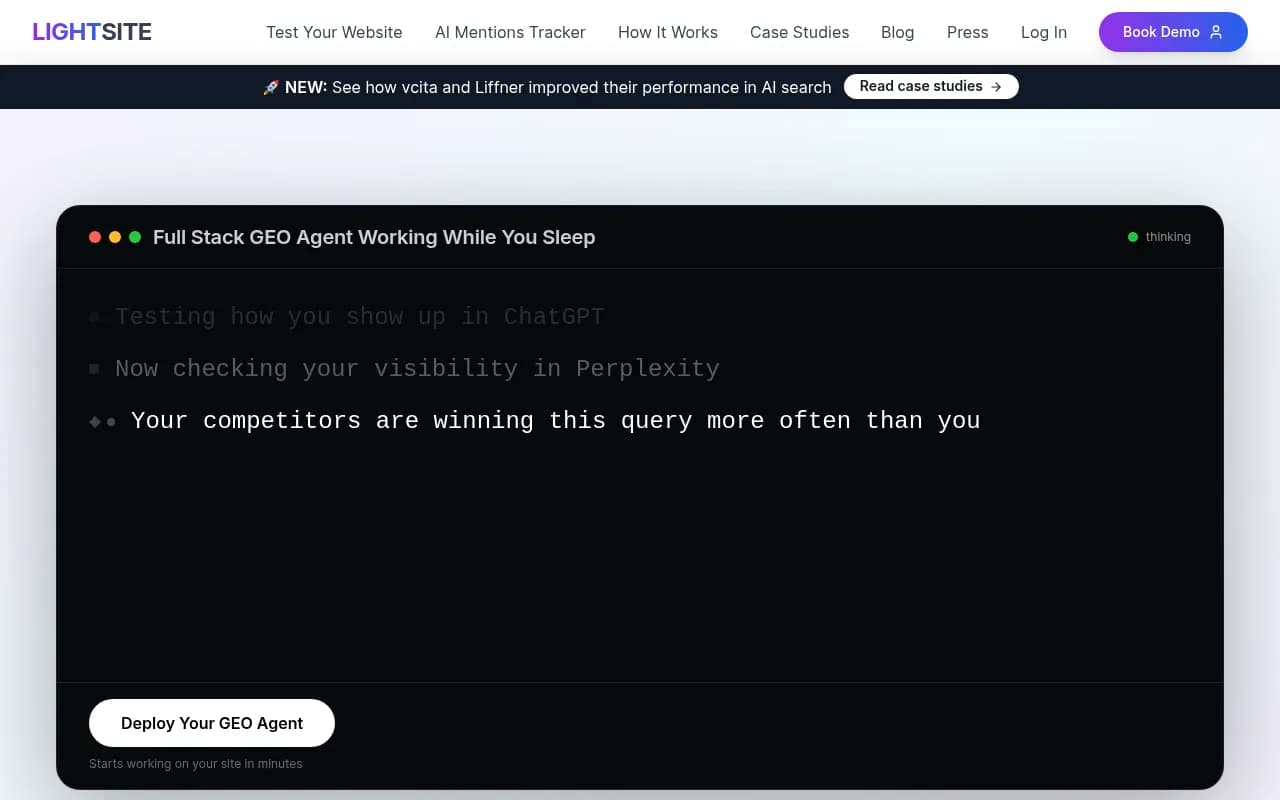
LightSite AI is a generative engine optimization platform built around the idea that most marketing teams don't have time to manually manage their AI search presence. Instead of giving you a dashboard full of data and leaving you to figure out what to do with it, LightSite deploys what it calls "autonomous GEO agents" -- software that handles technical implementation, content suggestions, competitor analysis, and outreach prep on your behalf. The pitch is simple: set it up, and it works while you sleep.
The platform targets brands that want to appear in AI-generated answers from ChatGPT, Claude, Gemini, and Perplexity. It covers the full stack, at least in theory: structured data injection, AI crawl monitoring, brand mention tracking, content gap analysis, and even automated outreach for link building. That's a broader scope than most GEO tools, which tend to focus on one or two of those areas.
LightSite launched in 2024 and has picked up a mix of early adopters including Wolt, Vcita, and Else Nutrition. It's been covered by Business Insider, Associated Press, and MarketWatch, mostly around its research on how LLMs determine brand trust. The company has also published a 30-day crawl experiment across 5 million bot requests examining how structured data affects AI visibility -- which is more original research than most competitors produce.
Key features
Autonomous GEO agents The headline feature. Rather than requiring you to manually run audits or implement recommendations, LightSite deploys agents that continuously monitor and act on your behalf. In practice, this means the platform handles structured data injection, sitemap updates, and content suggestions automatically. The "autonomous" label is somewhat aspirational -- you still need to approve outreach campaigns and review content before it goes live -- but the automation layer is more developed than most competitors offer.
MCP layer for LLMs LightSite sets up and maintains what it calls a "machine-readable layer" on your site -- essentially a structured data and schema markup infrastructure designed to make your content easier for LLMs to parse and cite. This includes:
- Dynamic JSON-LD injection across the site (products, services, FAQs, articles)
- Continuously updated sitemaps aligned with live content
- Automatic setup without requiring developer involvement This is one of the more technically differentiated features. Most GEO monitoring tools don't touch your site at all; LightSite actually modifies it.
AI search analytics The platform tracks how your brand appears across AI answers from ChatGPT, Claude, Gemini, and Perplexity. You get a visibility dashboard showing where you appear, where you don't, and how your positioning compares to competitors. Sentiment analysis is included -- so you can see not just whether you're mentioned, but how you're described.
AI Position Intelligence This is LightSite's branded feature for semantic query analysis. It identifies queries where you lead, share visibility, or lose to competitors, and surfaces suggested content or PR actions based on those gaps. It's similar in concept to answer gap analysis, though the depth of prompt-level data (volume estimates, difficulty scoring, query fan-outs) isn't clearly documented in the platform's public materials.
AI crawl monitoring The platform logs which AI crawlers and bots visit your site, how often, and which pages they hit. This is genuinely useful for understanding whether your content is being discovered and indexed by AI systems. The Pro plan includes this; the Starter plan has a lighter version. Notably, this is one area where LightSite and Promptwatch overlap -- both offer crawler log visibility, though Promptwatch's implementation covers more AI models explicitly.
Competitor intelligence Agents analyze why competitors get cited in AI answers and surface opportunities automatically. You can see where competitors appear instead of you and what content or technical factors are helping them win. The platform claims to identify unlinked mentions, listicles, and other placement opportunities where your brand should be included but isn't.
Content creation LightSite generates blog posts, comparison pages, LinkedIn posts, and Reddit posts based on AI search opportunities it identifies. This is a meaningful differentiator from pure monitoring tools. The content is supposedly grounded in real AI search data rather than generic SEO templates, though the quality and specificity of the output depends heavily on how well the underlying opportunity detection works.
Outreach automation The platform finds contacts, prepares outreach messages, and helps launch campaigns once you approve them. This covers link building and brand mention acquisition. It's an ambitious scope -- combining GEO monitoring with outreach tooling in one platform -- though the execution quality for this feature is harder to evaluate from public information alone.
Brand authority tracking Tracks where your brand is mentioned across the web, where mentions exist but aren't linked, and surfaces key opportunities. This feeds into the outreach workflow and helps prioritize where to focus link-building efforts.
Who is it for
LightSite AI fits best with marketing teams at small-to-mid-size companies (roughly 10-200 employees) that want to establish an AI search presence but don't have dedicated technical SEO resources. The automatic structured data setup and no-code implementation are genuinely useful for teams that can't afford to have a developer implement schema markup manually. A SaaS company with a two-person marketing team, a regional e-commerce brand, or a professional services firm trying to show up in ChatGPT answers -- these are the natural users.
The platform also makes sense for digital marketing agencies managing multiple client sites, particularly at the Enterprise tier where unlimited domains are included. The done-for-you service component at Enterprise (content creation, social media strategy, Reddit campaigns) is essentially a managed GEO service, which could appeal to agencies that want to white-label or bundle AI search optimization into their offerings.
Who should probably look elsewhere: large enterprise brands with complex analytics requirements, teams that need deep prompt-level data (volume, difficulty, fan-outs), or organizations that want to connect AI visibility directly to revenue through traffic attribution. LightSite's analytics are solid for awareness and positioning, but the platform doesn't appear to offer the kind of traffic attribution or conversion tracking that ties AI impressions to actual business outcomes.
Integrations and ecosystem
LightSite has a Shopify integration available through the Shopify App Store, which is notable for e-commerce brands. The annual Pro plan on Shopify runs $3,588/year. Beyond Shopify, the platform's integration story is relatively thin based on available information -- there's no clear mention of Google Search Console integration, Looker Studio connectors, or a public API.
The platform does include AI crawl monitoring that works across major AI bots (ChatGPT, Claude, Perplexity, Gemini), which functions as a passive integration with those systems. The structured data layer it deploys is designed to be read by LLMs, so in a sense the "integration" with AI search engines is baked into the product's core function.
There's a LinkedIn presence and the platform has been discussed in SEO communities on Reddit, but no dedicated Discord community or developer documentation was found in public sources.
Pricing and value
LightSite's pricing is structured across three tiers:
Starter -- $129/month (billed annually)
- Single user
- Basic AI readiness check
- Light AI crawler monitoring
- Core structured data setup (JSON-LD for organization, key pages, FAQs)
- Automatic updates, no coding required
Pro -- $299/month (billed annually)
- Everything in Starter, plus unlimited users
- Single domain/brand
- Full AI visibility dashboard with competitor comparison
- AI Position Intelligence (semantic query analysis)
- Dynamic JSON-LD injection across the entire site
- AI crawl monitoring with bot-level detail
- Brand authority tracking (mentions, unlinked mentions, opportunities)
- Daily limits on LLM search and NLP analytics
Enterprise -- Custom pricing
- Everything in Pro, plus unlimited brands/domains
- Full done-for-you service (SEO, content, social media, Reddit campaigns)
- Unlimited LLM search analysis
- Premium SLA support
A 7-day free trial is available. There's also a free GEO checker tool on the site that tests your website's AI search readiness without requiring signup.
Compared to competitors: Promptwatch's Professional plan at $249/month covers more AI models (10 vs. LightSite's 4), includes prompt volume and difficulty scoring, Reddit/YouTube citation tracking, and AI traffic attribution -- features LightSite doesn't clearly offer. Otterly.AI and Peec.ai are cheaper but monitoring-only. LightSite sits in an interesting middle ground: more action-oriented than pure monitoring tools, but less analytically deep than Promptwatch at a similar price point.
The Shopify pricing ($3,588/year for Pro) is notably higher than the standard annual rate ($299/month = $3,588/year), so it's the same price -- just packaged differently for the Shopify channel.
Strengths and limitations
What LightSite does well:
- Technical implementation without developers. The automatic structured data injection and sitemap management is a real differentiator. Most GEO tools tell you what to fix; LightSite actually fixes it. For teams without technical SEO resources, this is valuable.
- Broader scope than monitoring-only tools. Content creation, outreach automation, and brand authority tracking in one platform means fewer tools to manage. The workflow from "identify gap" to "create content" to "build links" is more connected than most competitors offer.
- Original research and thought leadership. The 30-day crawl experiment and LLM brand trust research give the platform credibility in a space full of vague claims. This matters when evaluating whether a GEO tool actually understands how AI search works.
- Shopify integration. E-commerce brands have a direct path to setup without custom development.
Honest limitations:
- Analytics depth is limited compared to leading platforms. There's no clear evidence of prompt volume scoring, query fan-outs, or difficulty metrics that help prioritize which queries to target. Without this, you're optimizing somewhat blind.
- No AI traffic attribution. LightSite doesn't appear to connect AI visibility to actual website traffic or revenue. You can see impressions and mentions, but not whether they're driving clicks or conversions. Promptwatch's traffic attribution (via code snippet, GSC integration, or server log analysis) closes this loop in a way LightSite doesn't.
- Missing channels. No Reddit citation tracking, no YouTube source analysis, no ChatGPT Shopping monitoring. These are increasingly important as AI search expands beyond text answers into product recommendations and community-sourced content.
- Limited model coverage. The platform focuses on ChatGPT, Claude, Gemini, and Perplexity. Promptwatch monitors 10+ models including Grok, DeepSeek, Mistral, Meta AI, and Copilot -- which matters for brands with global or diverse audiences.
- Daily limits on LLM analytics at Pro tier. The fact that the Pro plan has daily limits on LLM search and NLP analytics is a meaningful constraint for teams running frequent queries or managing multiple campaigns.
Bottom line
LightSite AI is a reasonable choice for small marketing teams that want to get started with GEO without hiring a developer or managing multiple tools. The automatic structured data setup alone saves meaningful time, and the content creation and outreach features mean you're not just looking at a dashboard -- you're actually doing something with the data.
That said, teams that need serious analytics depth -- prompt volume data, traffic attribution, Reddit/YouTube citation tracking, multi-model coverage across 10+ AI engines -- will find LightSite's capabilities fall short. For that level of rigor, Promptwatch is the stronger option: it covers more AI models, connects visibility to actual traffic, and provides the kind of prompt intelligence that lets you prioritize where to focus.
Best use case: A growing SaaS or e-commerce brand with a small marketing team that wants to establish a technical AI search foundation and generate content for AI visibility, without needing deep analytics or developer support.
Tags:
Frequently asked questions
What is LightSite AI?
How much does LightSite AI cost?
How is LightSite AI different from monitoring-only GEO tools?
Which AI search engines does LightSite AI monitor?
Do I need a developer to use LightSite AI?
Is there a free version of LightSite AI?
Similar and alternative tools to LightSite AI