Key takeaways
- Promptwatch and Yext solve related but genuinely different problems. Promptwatch is built for AI search visibility and GEO optimization; Yext is built for multi-location digital presence management across traditional and AI search.
- Promptwatch starts at $99/month. Yext typically costs $10,000-$100,000+ per year. That's not a small gap -- it's a fundamentally different buyer.
- If you're a single-brand or agency trying to rank in ChatGPT, Claude, or Perplexity, Promptwatch is the more direct tool. If you're managing 50+ physical locations and need listings, reviews, and local pages in one place, Yext is the more natural fit.
- Promptwatch's content generation is tied to real citation data -- it shows you which prompts competitors rank for that you don't, then writes content to close those gaps. Yext generates AI-optimized local pages but doesn't do LLM citation gap analysis.
- Yext's Scout feature adds AI search competitive intelligence, but it's layered on top of a local listings platform. Promptwatch was built from the ground up for LLM visibility.
- Neither tool replaces the other. The real question is which problem you're trying to solve first.
Overview
Promptwatch

Promptwatch is an AI search visibility platform used by 7,000+ brands and agencies. The core idea is a three-step loop: find where you're invisible in AI search, generate content that gets cited, and track whether it works. It monitors 10 LLMs including ChatGPT, Claude, Perplexity, Gemini, Grok, DeepSeek, and Copilot. Beyond tracking, it gives you crawler logs (so you can see which pages AI bots are actually reading), prompt volume and difficulty scores, citation source analysis, and a built-in AI writing agent that generates content grounded in real citation data. Rated 4.7/5 on G2, and customers include Booking.com, Center Parcs, ABN AMRO, and Typeform.
Yext
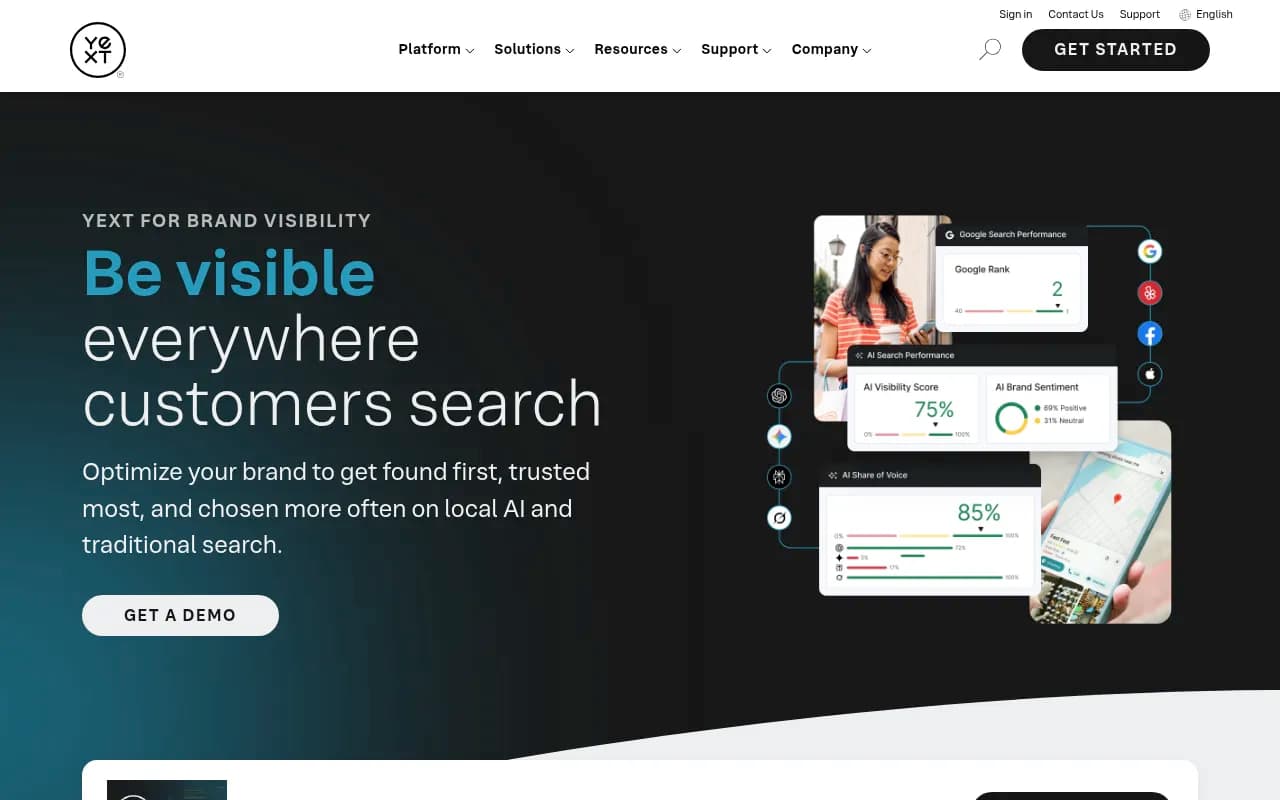
Yext is an enterprise digital presence platform for multi-location brands. Its core product is a Knowledge Graph -- a centralized data layer that syncs your business information (hours, addresses, menus, services) across 200+ publishers including Google, Apple Maps, Bing, Facebook, and Yelp. On top of that sits listings management, review management, local pages, social content, and a site search product. More recently, Yext launched Scout, an AI search and competitive intelligence agent that benchmarks your local visibility against competitors in both traditional and AI search. Customers include McDonald's, IHG, FedEx, Samsung, and Subway -- brands managing thousands of locations.
Side-by-side comparison
| Feature | Promptwatch | Yext |
|---|---|---|
| Primary use case | AI search visibility & GEO optimization | Multi-location digital presence management |
| Target customer | Marketing teams, SEO teams, agencies | Enterprise multi-location brands (50+ locations) |
| AI models monitored | 10 (ChatGPT, Claude, Perplexity, Gemini, Grok, DeepSeek, Copilot, Mistral, Meta AI, Google AI Overviews) | AI search via Scout (primarily Google AI, ChatGPT) |
| Local listings management | No | Yes (200+ publishers) |
| Review management | No | Yes |
| Local pages | No | Yes |
| Content generation for AI | Yes (citation-grounded articles, listicles, comparisons) | Yes (AI-optimized local pages) |
| Prompt/query gap analysis | Yes (Answer Gap Analysis) | No |
| AI crawler logs | Yes | No |
| Citation analysis | Yes (880M+ citations) | No |
| Reddit & YouTube tracking | Yes | No |
| ChatGPT Shopping tracking | Yes | No |
| Prompt volume & difficulty | Yes | No |
| Competitor heatmaps | Yes | Yes (Scout) |
| Multi-language/region | Yes | Yes |
| Free trial | Yes (7 days) | Yes (demo-based) |
| Starting price | $99/month | ~$10,000+/year |
| G2 rating | 4.7/5 | 4.3/5 |
| API & integrations | Yes (API, Looker Studio, GSC) | Yes (extensive enterprise integrations) |
Head-to-head feature deep-dive
AI search monitoring
Promptwatch was built specifically for this. It tracks how 10 different LLMs respond to prompts relevant to your brand, shows you which competitors are being cited and why, and gives you prompt-level data including volume estimates and difficulty scores. The crawler log feature is genuinely useful -- you can see exactly which pages ChatGPT or Perplexity's bots are crawling, how often, and whether they're hitting errors. That's the kind of data that helps you fix indexing issues before they become visibility problems.
Yext's Scout is a newer addition that benchmarks your brand's visibility in AI search at the local level. It's designed for multi-location brands that want to know how a specific store or branch appears in AI-generated local recommendations. That's a real and useful thing to track, but it's a narrower slice of AI search than what Promptwatch covers. Scout doesn't give you citation analysis, prompt gap data, or crawler logs.
Verdict: Promptwatch wins on AI search depth. Yext's Scout is useful for local AI search benchmarking but isn't a full GEO platform.
Content generation and optimization
Promptwatch's content generation is tied directly to its citation and gap analysis. The workflow goes: identify prompts where competitors appear but you don't, see what content those competitors have that you're missing, then use the built-in AI writing agent to generate articles or comparisons that are specifically designed to get cited. The output is grounded in 880M+ citations analyzed -- so it's not generic content, it's content shaped by what AI models actually cite.
Yext generates AI-optimized local pages at scale. If you're a franchise with 500 locations, Yext can generate location-specific pages with structured data that helps AI engines understand each location's hours, services, and reviews. That's valuable for local search. But it's a different kind of content generation -- it's about structured data and local page templates, not about writing articles that rank in LLM responses.
Verdict: Different tools for different content needs. Promptwatch for LLM citation-optimized content; Yext for structured local pages at scale.
Local listings and digital presence
This is where Yext has no real competition from Promptwatch. Yext's Knowledge Graph syncs your business data across 200+ publishers -- Google Business Profile, Apple Maps, Bing Places, Facebook, Yelp, TripAdvisor, and many more. It handles hours, menus, photos, attributes, and keeps everything consistent. Inconsistent NAP (name, address, phone) data is a real problem for multi-location brands, and Yext solves it at scale.
Promptwatch doesn't do any of this. It has no listings management, no review management, no local pages product. If your primary problem is "our 300 locations have inconsistent Google Business Profile data," Promptwatch isn't the tool.
Verdict: Yext wins outright. Promptwatch doesn't compete here.
Pricing and accessibility
This is probably the starkest difference between the two tools.
| Plan | Promptwatch | Yext |
|---|---|---|
| Free tier | 7-day free trial | Demo only |
| Entry level | $99/month (Essential) | ~$10,000+/year (custom) |
| Mid tier | $249/month (Professional) | Custom |
| Higher tier | $579/month (Business) | Custom (can reach $100K+/year) |
| Agency/Enterprise | Custom pricing | Custom pricing |
Promptwatch's Essential plan at $99/month covers 1 site, 50 prompts, and 5 articles per month. The Professional plan at $249/month adds crawler logs, state/city tracking, and 15 articles. For most marketing teams and agencies, these tiers are accessible without a procurement process.
Yext's pricing is location-based and module-based. A brand with 100 locations using listings, reviews, and pages could easily spend $30,000-$60,000 per year. The enterprise sales process is real -- you're not signing up with a credit card.
Verdict: Promptwatch is dramatically more accessible. Yext's pricing reflects its enterprise scope, but it's a significant barrier for smaller brands.
Reporting and integrations
Promptwatch connects to Google Search Console, offers a Looker Studio integration for custom dashboards, and has an API for custom workflows. It also supports server log analysis for traffic attribution -- useful for connecting AI visibility to actual revenue. The platform is designed to be self-serve, so reporting is built into the dashboard without needing a dedicated analyst.
Yext has extensive enterprise integrations -- Salesforce, HubSpot, various CMS platforms, and its own API. Its reporting covers listings performance, review sentiment, page traffic, and now Scout's AI search benchmarks. The depth of reporting is impressive, but it's designed for enterprise teams with dedicated analysts and often requires implementation support.
Verdict: Promptwatch is more self-serve and accessible. Yext's integrations are broader but require more setup and expertise.
Competitor analysis
Promptwatch's Answer Gap Analysis shows you exactly which prompts your competitors appear for that you don't. Competitor heatmaps let you compare AI visibility across LLMs side by side. You can see which pages, Reddit threads, or YouTube videos are being cited in competitor responses -- and use that to inform your content strategy.
Yext's Scout benchmarks your local visibility against nearby competitors in traditional and AI search. It tells you how you compare on ratings, listing completeness, and AI search presence at the local level. That's useful for a franchise operator who wants to know why a competitor's location is outranking theirs in Google Maps.
Verdict: Different competitive intelligence for different use cases. Promptwatch for LLM-level competitor analysis; Yext for local search competitive benchmarking.
Pros and cons
Promptwatch
Pros:
- Purpose-built for AI search visibility -- not a feature bolted onto a legacy platform
- Monitors 10 LLMs with real citation and prompt data
- Content generation is grounded in actual citation analysis, not generic AI writing
- AI crawler logs give you visibility into how bots discover and read your site
- Accessible pricing starting at $99/month with a free trial
- Reddit and YouTube tracking -- channels most competitors ignore
- ChatGPT Shopping tracking for e-commerce brands
- Strong agency support with multi-client management and Looker Studio integration
Cons:
- No local listings management, review management, or local pages
- Doesn't help with NAP consistency across directories
- Newer platform compared to Yext's decade-plus of market presence
- Prompt limits on lower tiers may feel restrictive for large sites
Yext
Pros:
- Best-in-class local listings management across 200+ publishers
- Knowledge Graph keeps business data consistent at scale
- Review management and local pages in one platform
- Scout adds AI search competitive intelligence for local brands
- Proven at massive scale (McDonald's, FedEx, IHG)
- Extensive enterprise integrations
- Strong implementation and support resources
Cons:
- Pricing is enterprise-only -- not accessible for smaller brands or agencies
- Scout's AI search features are narrower than dedicated GEO platforms
- No LLM citation analysis, crawler logs, or prompt gap analysis
- No content generation for LLM citation optimization
- Sales-led process means slower time to value
- Overkill for brands without a significant physical location footprint
Who should pick which tool
Pick Promptwatch if:
- You want to track and improve how your brand appears in ChatGPT, Claude, Perplexity, and other LLMs
- You're a marketing team, SEO team, or agency focused on AI search visibility
- You want to generate content that actually gets cited by AI models
- You're a single-brand or multi-brand company without a large physical location network
- You want to start quickly without a lengthy enterprise sales process
- Budget is a real consideration -- $99-$579/month vs $10K+/year matters
Pick Yext if:
- You manage 50+ physical locations and need consistent listings across directories
- Review management and local pages are core to your marketing operations
- You're an enterprise brand (restaurant chain, hotel group, retail chain) with complex local presence needs
- You have the budget and team to support an enterprise platform
- Local search (Google Maps, Apple Maps) is as important as AI search to your strategy
- You need Scout's local-level AI search benchmarking alongside your listings management
Final verdict
These two tools are less competitors and more tools that happen to overlap on one feature: AI search visibility. Yext is an enterprise local presence platform that has added AI search monitoring. Promptwatch is an AI search visibility platform, full stop.
If your primary challenge is managing listings, reviews, and local pages for dozens or hundreds of locations, Yext is the right call -- nothing else at its scale does what it does. But if your challenge is understanding and improving how AI models talk about your brand, and you want to actually do something about it rather than just watch a dashboard, Promptwatch is the more direct answer. The pricing difference alone ($99/month vs $10K+/year) makes the decision obvious for most teams that aren't enterprise multi-location brands.
For brands that need both -- say, a hotel chain that wants Yext for listings and also wants deep LLM citation tracking -- the tools aren't mutually exclusive. They solve different enough problems that running both is a reasonable choice.