Key Takeaways
- Quattr is an execution platform with AI content generation and automated linking built in. AthenaHQ is monitoring-first with optimization recommendations but no content creation tools.
- AthenaHQ tracks 8+ AI models vs Quattr's 5, giving you broader visibility across the AI search landscape.
- Pricing transparency differs drastically: AthenaHQ has self-serve plans at $295/month with a $95 trial month. Quattr requires custom enterprise quotes typically starting at $500-$1,000+/month.
- Quattr bundles traditional SEO tools with GEO features. AthenaHQ is purely AI search focused -- no keyword research, backlink analysis, or classic SEO.
- AthenaHQ is backed by Y Combinator and used by Coinbase, ZoomInfo, and SoFi. Quattr's client list includes WP Engine, Marriott, and Coursera.
- For teams that need to create content fast, Quattr's GIGA agent is the differentiator. For teams that just want visibility tracking and insights, AthenaHQ is more straightforward.
Overview: Two approaches to AI search visibility
Quattr: AI-native SEO suite with GEO built in
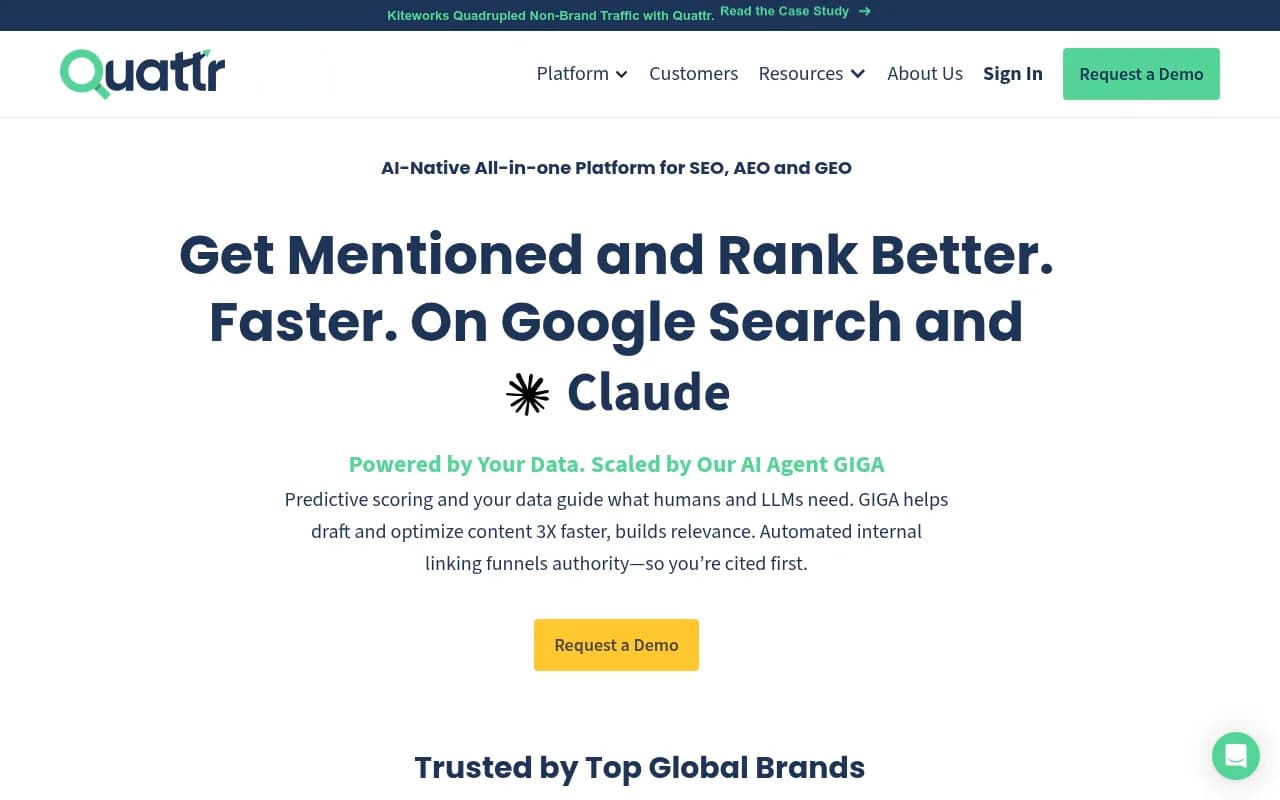
Quattr positions itself as an "AI-native all-in-one platform for SEO, AEO and GEO." The pitch: stop stitching together old SEO tools. Quattr's GIGA AI agent helps you research topics, draft optimized content, auto-link pages, and win rankings plus AI citations on Google and ChatGPT.
It's an execution-led platform. You're not just tracking where you show up in AI search results -- you're using Quattr's AI to generate the content that gets you cited. Automated internal linking funnels authority to the right pages. Predictive scoring tells you what to prioritize.
Quattr covers 5 AI platforms: ChatGPT, Claude, Perplexity, Gemini, and Google AI Mode. It also includes traditional SEO features like keyword research and technical audits, making it a replacement for your entire SEO stack.
Pricing is custom enterprise, typically $500-$1,000+/month. You need to request a demo to get a quote. Free test drive available.
AthenaHQ: Pure-play GEO monitoring and insights

AthenaHQ is a Y Combinator-backed GEO platform that does one thing: track and optimize your brand's visibility across AI search. It monitors 8+ AI models including ChatGPT, Perplexity, Google AI Overviews, Claude, Gemini, and others.
The focus is visibility tracking, competitor analysis, citation source intelligence, and optimization recommendations. You see where you're being cited, where competitors are beating you, and what content gaps exist. AthenaHQ doesn't generate content for you -- it tells you what to fix and where to publish.
Used by Coinbase, ZoomInfo, SoFi, and other enterprise brands. Featured in Forbes and the Wall Street Journal for helping brands navigate the "post-Google era."
Pricing is transparent: $295/month self-serve ($95 first month), with a credit-based model where 1 credit = 1 AI query. Enterprise custom pricing available. Annual plans get a 17% discount. Free audit available.
Side-by-side comparison
| Feature | Quattr | AthenaHQ |
|---|---|---|
| AI models tracked | 5 (ChatGPT, Claude, Perplexity, Gemini, Google AI Mode) | 8+ (ChatGPT, Perplexity, Google AI Overviews, Claude, Gemini, others) |
| Content generation | ✓ GIGA AI agent drafts and optimizes content | ✗ Recommendations only |
| Automated internal linking | ✓ Yes | ✗ No |
| Traditional SEO tools | ✓ Keyword research, technical audits, backlinks | ✗ Pure GEO focus |
| Competitor analysis | ✓ Yes | ✓ Yes |
| Citation source tracking | ✓ Yes | ✓ Yes |
| Pricing transparency | Custom enterprise quotes | Self-serve $295/mo |
| Free trial | Test drive available | $95 first month |
| Starting price | $500-$1,000+/mo | $295/mo |
| Best for | Teams replacing entire SEO stack + GEO | Teams focused purely on AI search visibility |
| Client examples | WP Engine, Marriott, Coursera | Coinbase, ZoomInfo, SoFi |
| Platform type | Execution platform (create + optimize) | Monitoring platform (track + recommend) |
Head-to-head feature breakdown
AI model coverage
AthenaHQ tracks more AI platforms -- 8+ models vs Quattr's 5. Both cover the big ones (ChatGPT, Claude, Perplexity, Gemini, Google AI), but AthenaHQ extends to additional LLMs that Quattr doesn't list publicly.
For most brands, the 5 platforms Quattr covers represent 90%+ of AI search volume. But if you want comprehensive visibility across every emerging AI model, AthenaHQ's broader coverage matters.
Verdict: AthenaHQ wins on breadth. Quattr covers the essentials.
Content creation and optimization
This is where Quattr pulls ahead. The GIGA AI agent drafts content based on predictive scoring and your data. It optimizes existing pages and suggests what to write next. Automated internal linking builds topical authority without manual work.
AthenaHQ doesn't generate content. It shows you what's missing and where competitors are winning, but you're on your own to create the actual content. You get optimization recommendations -- specific gaps to fill, sources to target, angles to cover -- but no AI writing assistant.
If your team has writers and just needs direction, AthenaHQ's recommendations are enough. If you're resource-constrained and need to scale content fast, Quattr's GIGA agent is a huge time-saver.
Verdict: Quattr wins decisively if content creation is a priority. AthenaHQ is fine if you have content resources already.
Traditional SEO vs pure GEO
Quattr bundles traditional SEO tools with GEO features. You get keyword research, technical audits, backlink analysis, and all the classic SEO workflows alongside AI search tracking. It's a full replacement for tools like Ahrefs or Semrush.
AthenaHQ is purely AI search focused. No keyword research. No backlink tracking. No technical SEO audits. If you need those features, you're keeping your existing SEO stack and adding AthenaHQ on top.
This is a positioning difference. Quattr wants to be your only SEO tool. AthenaHQ wants to be your AI search specialist.
Verdict: Depends on your stack. Quattr consolidates tools. AthenaHQ is a focused add-on.
Competitor intelligence
Both platforms offer competitor analysis -- see where rivals are getting cited, what prompts they're winning, and what sources AI models prefer.
Quattr's competitor features are integrated into the broader SEO suite. You're comparing traditional rankings alongside AI citations.
AthenaHQ's competitor analysis is more granular on the GEO side. You see citation share, sentiment analysis, and AI search volume trends for each competitor. The focus is entirely on AI search performance, not traditional SERP rankings.
Verdict: Tie. Both deliver solid competitor insights, just with different contexts.
Citation source intelligence
Both platforms show you which sources AI models are citing -- the websites, articles, and pages that influence AI responses.
Quattr uses this data to guide content creation. GIGA drafts content that targets the sources AI models trust.
AthenaHQ surfaces citation sources for manual analysis. You see what's working and can decide where to publish, what to link to, or what partnerships to pursue.
Verdict: Tie on data quality. Quattr automates the next step (content creation). AthenaHQ leaves it to you.
User interface and workflow
Quattr is a full SEO platform, so the interface is dense. You're navigating between traditional SEO modules and GEO dashboards. It's powerful but has a learning curve.
AthenaHQ is cleaner and more focused. The entire interface is built around AI search visibility. You see your citation trends, competitor gaps, and optimization priorities in one unified dashboard. Less overwhelming for teams that only care about GEO.
Verdict: AthenaHQ is easier to navigate if you're purely focused on AI search. Quattr's breadth comes with complexity.
Pricing and accessibility
AthenaHQ is transparent: $295/month self-serve, $95 for the first month. Credit-based model where each AI query costs one credit. You know exactly what you're paying before you sign up.
Quattr requires a demo and custom enterprise pricing. Typical range is $500-$1,000+/month, but you won't see a number until you talk to sales. This is standard for enterprise SEO platforms, but it's a barrier for smaller teams.
Verdict: AthenaHQ wins on accessibility. Quattr's pricing model is enterprise-only.
Integration and workflow automation
Quattr's automated internal linking is a standout feature. It builds topical clusters and funnels authority without manual work. This is rare in the GEO space.
AthenaHQ doesn't automate content workflows. You export insights and act on them manually or through your existing CMS.
Neither platform lists extensive third-party integrations publicly. Both are relatively self-contained.
Verdict: Quattr's automation features are more advanced. AthenaHQ is more of a monitoring dashboard.
Pricing comparison
| Plan | Quattr | AthenaHQ |
|---|---|---|
| Entry price | Custom quote, typically $500-$1,000+/mo | $295/mo ($95 first month) |
| Pricing model | Enterprise custom | Credit-based (1 credit = 1 AI query) |
| Free trial | Test drive available | $95 first month trial |
| Annual discount | Not disclosed | 17% off |
| Transparency | Requires demo/sales call | Self-serve, public pricing |
| Best for | Enterprise teams with budget | Mid-market teams, self-serve buyers |
Quattr's pricing is opaque and enterprise-focused. You're committing to a sales process before you see a number. AthenaHQ's self-serve model is more accessible for teams that want to start fast without procurement approvals.
Pros and cons
Quattr pros
- GIGA AI agent generates and optimizes content automatically
- Automated internal linking builds topical authority
- Full SEO suite included -- replace multiple tools
- Predictive scoring prioritizes high-impact work
- Strong client roster (WP Engine, Marriott, Coursera)
Quattr cons
- Custom enterprise pricing with no public rates
- Requires demo/sales process to get started
- Tracks fewer AI models than AthenaHQ (5 vs 8+)
- Interface complexity due to bundled SEO features
- Overkill if you only need GEO monitoring
AthenaHQ pros
- Tracks 8+ AI models for broader visibility
- Transparent self-serve pricing at $295/month
- Clean, focused interface for GEO workflows
- Y Combinator-backed with strong enterprise clients
- $95 first month makes it easy to test
- Credit-based model scales with usage
AthenaHQ cons
- No content generation -- recommendations only
- No traditional SEO features (keyword research, backlinks, audits)
- Requires separate content creation resources
- Less automation than Quattr's GIGA agent
- Monitoring-first approach means more manual work
Who should pick which tool
Pick Quattr if:
- You want to replace your entire SEO stack with one AI-native platform
- Content creation speed is a bottleneck and you need AI assistance
- You have budget for enterprise pricing ($500-$1,000+/month)
- Automated internal linking and topical clustering matter to your strategy
- You're optimizing for both traditional SEO and AI search simultaneously
- You're comfortable with a sales process and custom pricing
Pick AthenaHQ if:
- You only care about AI search visibility, not traditional SEO
- You have content resources and just need tracking + insights
- You want transparent, self-serve pricing without sales calls
- Broader AI model coverage (8+ platforms) is important
- You prefer a focused, clean interface over an all-in-one suite
- You're a mid-market team or want to test GEO before committing big budget
If you're also looking to track how your brand shows up in AI search results with real-time crawler logs and traffic attribution, Promptwatch covers that angle alongside either platform.

Final verdict
Quattr and AthenaHQ solve different problems. Quattr is an execution platform that generates content and automates optimization. AthenaHQ is a monitoring platform that tracks visibility and surfaces insights.
If you need to scale content creation fast and want AI to do the heavy lifting, Quattr's GIGA agent is worth the premium. If you have content resources and just need to know where you stand in AI search, AthenaHQ's focused approach and transparent pricing make more sense.
The pricing gap is real. AthenaHQ at $295/month is accessible for most marketing teams. Quattr at $500-$1,000+/month is an enterprise commitment. You're paying for the content generation and automation features -- decide if that's worth it for your workflow.
Both platforms deliver on AI search visibility. The question is whether you need a monitoring dashboard or a full execution engine.