Quattr Review 2026
Helps brands improve visibility in AI search results with tracking, analytics, and optimization features for generative AI platforms.
Key takeaways
- Monitoring-only approach: Quattr tracks AI visibility across ChatGPT, Claude, Perplexity, Gemini, and Google AI Mode, but lacks content gap analysis, AI crawler logs, and traffic attribution that Promptwatch offers
- Strong traditional SEO foundation: Excellent for keyword research, technical audits, and internal linking automation—particularly useful for enterprise teams managing large sites
- AI content generation included: Built-in GIGA AI agent helps draft and optimize content, though it's more focused on traditional SEO than AI search optimization
- Unified workflow: Consolidates multiple SEO tools into one platform, reducing context-switching for marketing teams
- Enterprise pricing: Custom pricing for larger teams, with no transparent public pricing tiers

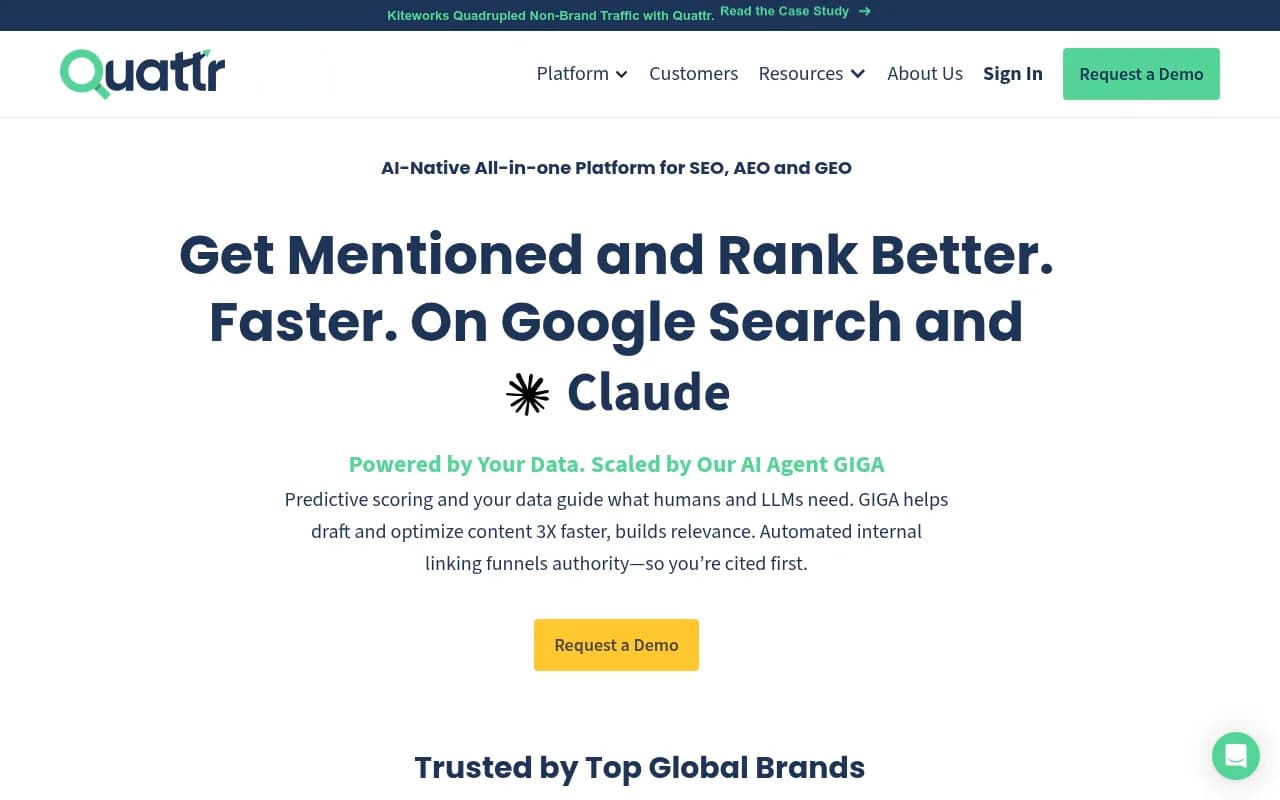
Quattr positions itself as an "AI-native" SEO platform that bridges traditional search engine optimization with Answer Engine Optimization (AEO) and Generative Engine Optimization (GEO). Founded to address the fragmentation of SEO tools, it targets mid-market and enterprise marketing teams at companies like WP Engine, Marriott, Coursera, and McAfee. The platform's core promise: stop stitching together keyword tools, content editors, and analytics dashboards—do everything in one place.
The platform monitors brand mentions and citations across ChatGPT, Claude, Perplexity, Gemini, and Google AI Mode, alongside traditional Google Search rankings. It's built around GIGA, an AI agent that assists with content creation, optimization, and internal linking. Quattr launched as a traditional SEO platform and has expanded into AI search visibility as generative AI engines became mainstream in 2023-2024.
Key features
AI visibility & rank tracking: Quattr monitors where your brand appears in AI-generated responses across five major LLMs (ChatGPT, Claude, Perplexity, Gemini, Google AI Mode). You see citation share, market share, and which competitors are mentioned instead of you. The dashboard shows real-time performance across both traditional SERPs and AI answer engines. However, unlike Promptwatch, Quattr doesn't provide AI crawler logs showing which pages AI models are actually reading, nor does it offer traffic attribution to connect AI visibility to actual revenue.
GIGA AI content agent: The platform's built-in AI writing assistant helps draft content optimized for both search engines and AI models. It suggests topics based on keyword data, generates outlines, and writes drafts that incorporate semantic richness and Q&A formats. You can preview changes in a sandbox before publishing. The content generation is solid for traditional SEO but doesn't leverage the 880M+ citations and prompt volume data that platforms like Promptwatch use to engineer content specifically for AI model citation.
Unified keyword research & strategy: Quattr consolidates keyword discovery, competitor analysis, and opportunity identification in one interface. It shows search volume, difficulty scores, and which keywords competitors rank for. The platform identifies content gaps where competitors have coverage but you don't. This is strong for traditional SEO but lacks the prompt intelligence and query fan-outs that show how one user question branches into sub-queries in AI search.
Automated internal linking: One of Quattr's standout features. The platform uses AI to automatically suggest and implement internal links between high-authority pages and newer content. It analyzes your site's topical structure and builds relevance clusters. The automation saves hours of manual work and helps distribute link equity across your site. This is particularly valuable for large enterprise sites with thousands of pages.
Technical SEO audits at scale: Quattr pulls Lighthouse reports for accessibility, performance, mobile-friendliness, and SEO compliance across your entire site. It generates task lists for developers and tracks mitigation progress. The platform identifies crawl errors, broken links, slow-loading pages, and other technical issues that hurt rankings. This is table-stakes functionality but executed well.
Content optimization sandbox: Before publishing changes, you can preview how updated title tags, meta descriptions, headings, and body copy will affect search results. The sandbox shows predicted ranking improvements based on Quattr's algorithms. This reduces the risk of publishing changes that hurt performance.
Ranking factor analysis: The platform breaks down how your pages score on content quality, keyword relevance, performance, accessibility, and mobile-friendliness. It compares your scores to competitors and highlights specific gaps. You can resolve issues directly within the platform without switching to other tools.
Multi-language & multi-region support: Quattr tracks rankings and AI visibility across different languages and geographic regions. This is useful for global brands managing localized content. However, it doesn't offer the customizable persona targeting that lets you see how different user types (e.g. "SaaS founder" vs "enterprise CTO") get different AI responses.
Who is it for
Quattr is built for mid-market and enterprise marketing teams managing large websites with hundreds or thousands of pages. The ideal customer is a company with $10M+ in revenue, a dedicated SEO team or agency, and the budget for a premium platform. Think SaaS companies, e-commerce brands, hospitality chains, and B2B enterprises that rely heavily on organic search traffic.
The platform particularly shines for teams that are tired of juggling Ahrefs for keyword research, Clearscope for content optimization, Screaming Frog for technical audits, and separate tools for rank tracking. If you're spending hours exporting data from one tool and importing it into another, Quattr's unified workflow saves real time.
It's also a good fit for companies that have already invested in traditional SEO and now want to expand into AI search visibility. If you're ranking well on Google but not getting cited by ChatGPT or Perplexity, Quattr gives you visibility into that gap.
Who should NOT use Quattr: Small businesses and solopreneurs on tight budgets. The platform is priced for enterprise customers and lacks transparent public pricing. If you're a freelance SEO consultant or a startup with under 50 pages, you'll find better value in more affordable tools. Additionally, if your primary goal is optimizing for AI search and you need deep capabilities like content gap analysis, AI crawler logs, and traffic attribution, Promptwatch offers a more complete solution specifically built for that use case.
Integrations and ecosystem
Quattr integrates with Google Search Console to pull ranking data, impressions, and clicks. It connects to Google Analytics for traffic analysis and conversion tracking. The platform also integrates with BigQuery for custom data exports and advanced reporting.
For content management, Quattr works with WordPress, allowing you to push optimized content directly to your CMS. It supports Looker Studio for custom dashboards and reporting.
The platform offers an API for developers who want to build custom workflows or integrate Quattr data into internal tools. However, the API documentation is not publicly available—you need to contact their team for access.
Notably missing: integrations with Reddit, YouTube, or other platforms where AI models source information. Promptwatch tracks Reddit discussions and YouTube videos that influence AI recommendations, a channel Quattr doesn't cover. There's also no Slack integration for team notifications or collaboration.
Pricing and value
Quattr does not publish transparent pricing on its website. Based on third-party sources and user reports, the platform operates on custom enterprise pricing, typically starting around $500-$1,000+ per month for mid-market teams. Larger enterprises with multiple sites and advanced needs can expect to pay several thousand dollars monthly.
The platform offers a free "test drive"—a live demo where Quattr's team analyzes some of your top pages and shows you the platform in action. This is not a self-service free trial; you need to schedule a call with their sales team.
Compared to competitors, Quattr is positioned as a premium all-in-one solution. Traditional SEO tools like Ahrefs ($99-$999/mo) and Semrush ($139-$499/mo) are more affordable but don't cover AI search visibility. AI-specific platforms like Promptwatch ($99-$579/mo) offer more transparent pricing and deeper AI optimization capabilities at a lower entry point.
The value proposition depends on your needs. If you're replacing 3-4 separate tools (keyword research, content optimization, technical audits, rank tracking) with Quattr, the consolidation can justify the cost. But if you're primarily focused on AI search visibility, you're paying for a lot of traditional SEO features you may not need, while missing the action-oriented capabilities that platforms like Promptwatch provide.
Strengths and limitations
Strengths:
- Unified workflow: Genuinely consolidates multiple SEO functions in one platform, reducing context-switching and data export/import headaches
- Automated internal linking: The AI-powered linking engine is a real time-saver for large sites and helps build topical authority
- Enterprise-grade technical audits: Lighthouse reports at scale with developer task lists make it easy to coordinate with engineering teams
- Strong traditional SEO foundation: Keyword research, competitor analysis, and content optimization are all solid
- GIGA AI agent: The built-in content generation is helpful for drafting and optimizing articles
Limitations:
- Monitoring-only for AI search: Quattr shows you where you're visible in AI engines but doesn't help you fix the gaps. Missing content gap analysis (Answer Gap Analysis), AI crawler logs, traffic attribution, and Reddit/YouTube tracking that Promptwatch provides
- No transparent pricing: The lack of public pricing tiers makes it hard to evaluate cost vs. value without talking to sales
- Limited AI model coverage: Monitors 5 AI engines (ChatGPT, Claude, Perplexity, Gemini, Google AI Mode) vs. Promptwatch's 10+ (including DeepSeek, Grok, Mistral, Meta AI, Copilot)
- No prompt intelligence: Doesn't show prompt volumes, difficulty scores, or query fan-outs that help prioritize which prompts to target
- Missing traffic attribution: Can't connect AI visibility to actual revenue or visitor analytics
Bottom line
Quattr is a solid choice for enterprise marketing teams that want to consolidate traditional SEO tools and add basic AI search visibility tracking. If you're managing a large site, need automated internal linking, and want one platform for keyword research, content optimization, and technical audits, it delivers real value.
However, if your primary goal is optimizing for AI search—getting cited by ChatGPT, Claude, and Perplexity—Quattr's monitoring-only approach leaves you stuck. You'll see where you're invisible but won't get the tools to fix it. For teams serious about AI search optimization, Promptwatch offers a more complete solution with content gap analysis, AI content generation grounded in 880M+ citations, crawler logs, traffic attribution, and Reddit/YouTube tracking—all at a more transparent and affordable price point.
Frequently asked questions
What is Quattr and who is it for?
How much does Quattr cost?
What AI models does Quattr monitor?
How does Quattr compare to Promptwatch for AI search optimization?
What are Quattr's main features?
Does Quattr have a free plan?
Similar and alternative tools to Quattr