Key Takeaways
- Quattr and Amplitude solve fundamentally different problems: Quattr is an AI-native SEO/GEO platform for search visibility and content optimization, while Amplitude is a product analytics platform for tracking user behavior inside digital products
- Pricing models differ drastically -- Amplitude offers a generous free tier (10K MTUs) and starts at $49/mo, while Quattr is enterprise-focused with typical pricing around $500-$1,000+/month
- Quattr tracks how your brand appears in Google, ChatGPT, Claude, Perplexity, and other AI engines, then helps you create optimized content to win rankings and citations. Amplitude tracks what users do after they arrive on your site or in your app.
- Target users are completely different: Quattr serves SEO teams, content marketers, and digital agencies. Amplitude serves product managers, growth teams, and data analysts.
- You can (and many companies do) use both tools together -- Quattr drives qualified traffic from search and AI, Amplitude analyzes what happens next
- If you need AI search visibility and content optimization, Quattr is the answer. If you need to understand user behavior and run product experiments, Amplitude is the answer. There's almost no overlap.
Overview: Two tools, two worlds
Quattr: AI-native SEO and GEO platform
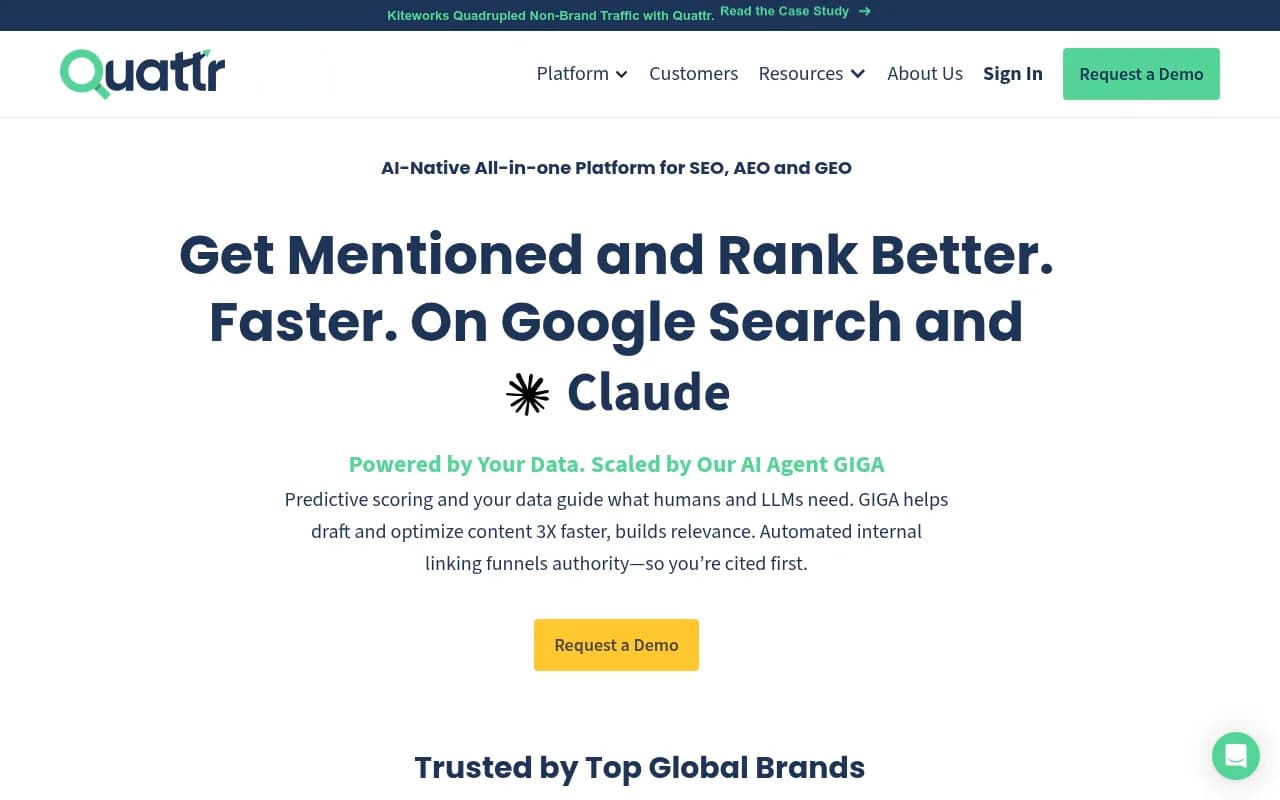
Quattr positions itself as an "AI-native all-in-one platform for SEO, AEO, and GEO" -- which translates to: it helps you rank in traditional Google search (SEO), appear in Google AI Overviews (AEO), and get cited by ChatGPT, Claude, Perplexity, Gemini, and other generative AI platforms (GEO). The platform combines search visibility tracking with an AI agent called GIGA that helps draft and optimize content 3x faster, builds topical relevance, and automates internal linking to funnel authority.
Quattr's pitch is that old-school SEO toolkits weren't built for today's search landscape. They argue winning now means becoming the direct answer in AI Overviews and the trusted source AI models cite -- not just ranking for links. The platform tracks your mentions across multiple AI engines, identifies content gaps, and helps you create optimized content that both humans and LLMs need.
Trusted by brands like Marriott, WP Engine, McAfee, Coursera, and Bluehost. Enterprise-focused with custom pricing typically starting around $500-$1,000+/month. Free test drive available.
Amplitude: Product analytics for digital products
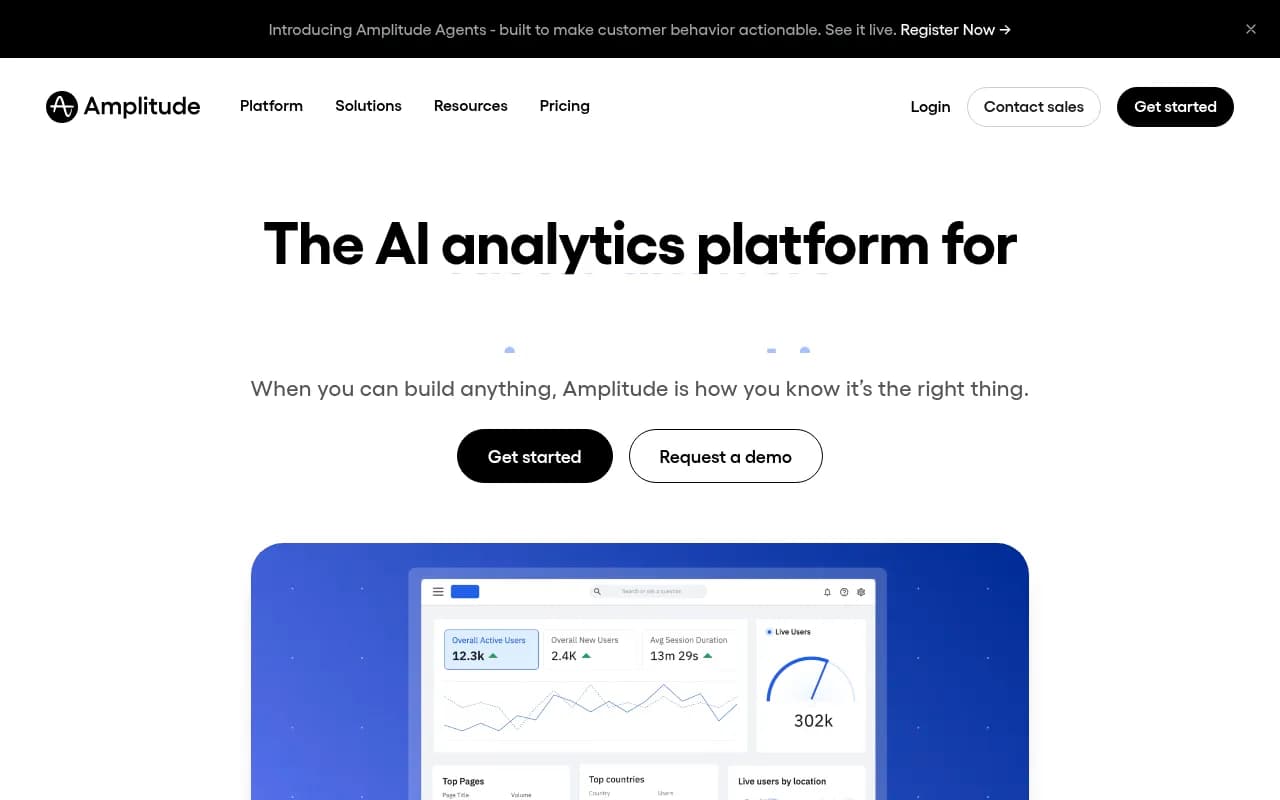
Amplitude is a digital analytics platform that tracks user behavior inside your product -- web apps, mobile apps, SaaS platforms, e-commerce sites. It answers questions like: Which features drive retention? Where do users drop off? What paths lead to conversion? Which cohorts are most valuable?
The platform combines event tracking, funnel analysis, cohort analysis, retention curves, user journey mapping, and A/B testing. Amplitude's AI capabilities focus on surfacing insights from behavioral data -- anomaly detection, predictive analytics, automated recommendations. They recently introduced AI Agents that continuously monitor data and flag issues 24/7.
Used by Square, Walmart, NBC, Atlassian, and thousands of product teams. Pricing is usage-based: free tier up to 10K monthly tracked users (MTUs), Plus plan from $49/month for 300K MTUs, Growth and Enterprise plans with custom pricing (typically $2K-$50K+/year depending on scale).
Side-by-side comparison
| Feature | Quattr | Amplitude |
|---|---|---|
| Primary use case | SEO, AEO, GEO -- search visibility and content optimization | Product analytics -- user behavior tracking and experimentation |
| What it tracks | Rankings, AI citations, mentions across Google, ChatGPT, Claude, Perplexity, Gemini, Google AI Mode | User events, sessions, funnels, retention, conversion paths inside digital products |
| Target users | SEO teams, content marketers, digital agencies | Product managers, growth teams, data analysts |
| AI capabilities | GIGA agent for content drafting, optimization, internal linking | AI Agents for anomaly detection, predictive analytics, insight surfacing |
| Content creation | Yes -- AI-assisted content drafting and optimization | No |
| Free tier | No (free test drive available) | Yes -- up to 10K MTUs |
| Starting price | ~$500-$1,000+/mo (custom enterprise pricing) | $49/mo for 300K MTUs (Plus plan) |
| Integrations | SEO tools, CMSs, search engines, AI platforms | Data warehouses, CDPs, marketing tools, product stacks |
| Ease of use | Moderate learning curve (SEO/GEO concepts) | Moderate to steep (analytics and SQL knowledge helpful) |
| Support | Enterprise support included | Varies by plan (community, email, dedicated CSM) |
| API access | Likely available (enterprise) | Yes (all paid plans) |
| Best for | Brands that need to rank in search and get cited by AI models | Product teams that need to understand user behavior and optimize conversion |
Head-to-head feature deep-dive
Core purpose and positioning
Quattr and Amplitude operate in completely different domains. Quattr is about getting found -- it tracks how your brand appears in search results and AI-generated responses, then helps you create content that ranks and gets cited. Amplitude is about understanding what happens after someone arrives -- it tracks user actions inside your product to help you optimize features, flows, and conversion.
Think of it this way: Quattr lives in the "acquisition" and "awareness" stages of the funnel. Amplitude lives in "activation", "engagement", "retention", and "monetization". There's almost no functional overlap.
Verdict: Not comparable. Choose based on whether you need search visibility (Quattr) or product analytics (Amplitude).
Tracking and monitoring capabilities
Quattr tracks:
- Keyword rankings in Google Search
- Mentions and citations in ChatGPT, Claude, Perplexity, Gemini, Google AI Mode
- AI Overview appearances
- Competitor visibility across search and AI engines
- Content gaps and opportunities
- Internal linking structure and authority flow
Amplitude tracks:
- User events (clicks, page views, form submissions, purchases, etc.)
- Session data and user journeys
- Funnel conversion rates
- Retention and churn metrics
- Cohort behavior over time
- Feature adoption and usage patterns
Quattr's tracking is outward-facing -- how the world sees you. Amplitude's tracking is inward-facing -- what users do inside your product.
Verdict: Completely different tracking domains. Quattr for external visibility, Amplitude for internal behavior.
AI and automation features
Quattr's AI agent GIGA:
- Drafts SEO-optimized content based on search intent and competitor analysis
- Suggests content improvements to win AI citations
- Automates internal linking to funnel authority to key pages
- Predicts which content will rank and get cited
Amplitude's AI capabilities:
- AI Agents that monitor data 24/7 and flag anomalies
- Predictive analytics for churn risk and conversion likelihood
- Automated insight surfacing ("Users who do X are 3x more likely to convert")
- Natural language queries (ask questions in plain English)
Quattr's AI is generative -- it creates content. Amplitude's AI is analytical -- it surfaces insights from existing data.
Verdict: Both use AI, but for entirely different purposes. Quattr generates content, Amplitude generates insights.
Content creation and optimization
Quattr includes built-in content creation tools:
- AI-assisted article drafting
- SEO optimization recommendations
- Content gap analysis (what competitors rank for that you don't)
- Internal linking suggestions
- Optimization for AI citations (structured data, clear answers, authoritative tone)
Amplitude has zero content creation features. It's purely an analytics platform. You'd use Amplitude data to inform what content to create (e.g. "Users who read blog post X convert 2x more, so let's create more content like that"), but Amplitude itself doesn't help you write it.
Verdict: Quattr wins by default. Amplitude isn't in this game.
Analytics and reporting
Quattr's analytics focus on search performance:
- Ranking trends over time
- AI citation frequency and share of voice
- Competitor benchmarking
- Content performance metrics
- Traffic attribution (which content drives conversions)
Amplitude's analytics focus on user behavior:
- Event tracking and custom dashboards
- Funnel analysis with drop-off identification
- Retention curves and cohort analysis
- User journey mapping
- Experimentation results (A/B tests, feature flags)
- Revenue analytics and LTV modeling
Amplitude's analytics are far deeper and more sophisticated for understanding user behavior. Quattr's analytics are specialized for search and AI visibility.
Verdict: Amplitude is a full-featured analytics platform. Quattr's analytics serve a specific niche (search/AI visibility).
Integrations and ecosystem
Quattr integrates with:
- Google Search Console
- Content management systems (WordPress, etc.)
- SEO tools (likely Ahrefs, Semrush, etc.)
- AI platforms for citation tracking
Amplitude integrates with:
- Data warehouses (Snowflake, BigQuery, Redshift)
- CDPs (Segment, mParticle, RudderStack)
- Marketing tools (Braze, Iterable, Customer.io)
- Product tools (LaunchDarkly, Optimizely, Pendo)
- BI tools (Looker, Tableau, Mode)
- 100+ other integrations
Amplitude has a much larger integration ecosystem because it sits at the center of the product data stack. Quattr's integrations are more specialized for SEO and content workflows.
Verdict: Amplitude has broader integration coverage. Quattr integrates deeply with SEO/content tools.
Ease of use and learning curve
Quattr requires understanding of:
- SEO fundamentals (keywords, rankings, backlinks)
- GEO/AEO concepts (AI citations, generative engine optimization)
- Content strategy and optimization
- Competitive analysis
Amplitude requires understanding of:
- Event tracking and data modeling
- Analytics concepts (funnels, cohorts, retention)
- SQL is helpful but not required
- Experimentation and statistical significance
Both have moderate learning curves. Quattr is easier if you already know SEO. Amplitude is easier if you already know product analytics. Neither is plug-and-play for beginners.
Verdict: Roughly equal difficulty, but for different skill sets. SEO knowledge for Quattr, analytics knowledge for Amplitude.
Pricing and value
Quattr:
- Custom enterprise pricing, typically $500-$1,000+/month
- Free test drive available
- Pricing scales with number of sites, keywords tracked, and features needed
- No public pricing tiers
Amplitude:
- Free tier: up to 10K MTUs (monthly tracked users)
- Plus: $49/month for 300K MTUs
- Growth: custom pricing (typically $2K-$10K+/month)
- Enterprise: custom pricing (typically $10K-$50K+/year)
- Pricing scales with MTUs and feature access
Amplitude is significantly cheaper for small teams and startups (free tier is generous). Quattr is enterprise-focused from the start. For large organizations, both can reach similar price points, but they're solving different problems so the comparison isn't apples-to-apples.
Verdict: Amplitude is more accessible for small teams. Quattr is priced for enterprise SEO budgets.
Pricing comparison
| Plan | Quattr | Amplitude |
|---|---|---|
| Free tier | No (free test drive) | Yes -- up to 10K MTUs |
| Entry-level | ~$500-$1,000+/mo (custom) | $49/mo (Plus, 300K MTUs) |
| Mid-tier | Custom enterprise pricing | Custom (Growth, typically $2K-$10K+/mo) |
| Enterprise | Custom (likely $1K-$5K+/mo) | Custom (typically $10K-$50K+/year) |
| Billing | Monthly or annual | Monthly or annual (annual discounts) |
| Free trial | Test drive available | 30-day trial on paid plans |
Pros and cons
Quattr pros
- Tracks AI citations across ChatGPT, Claude, Perplexity, Gemini, Google AI Mode -- critical for 2026 search landscape
- Built-in AI content generation (GIGA agent) speeds up content creation 3x
- Combines traditional SEO with GEO/AEO in one platform
- Automated internal linking to funnel authority
- Content gap analysis shows exactly what competitors rank for that you don't
Quattr cons
- Enterprise pricing only -- not accessible for small teams or startups
- No public pricing transparency
- Steeper learning curve if you're new to GEO/AEO concepts
- Limited analytics compared to dedicated product analytics platforms
- Focused solely on search/AI visibility -- doesn't track user behavior inside your product
Amplitude pros
- Generous free tier (10K MTUs) makes it accessible for startups
- Deep product analytics with funnel analysis, cohorts, retention curves, journey mapping
- Strong experimentation features (A/B testing, feature flags)
- Massive integration ecosystem (100+ tools)
- AI Agents for automated anomaly detection and insight surfacing
- Transparent pricing tiers
Amplitude cons
- Zero content creation or SEO features
- Doesn't track search visibility or AI citations
- Moderate to steep learning curve for analytics concepts
- Pricing can escalate quickly as MTUs grow
- Requires proper event tracking implementation (technical setup)
- Not useful if your primary goal is getting found in search or AI engines
Who should pick which tool
Choose Quattr if you:
- Run an SEO team, content marketing team, or digital agency
- Need to rank in Google Search and get cited by ChatGPT, Claude, Perplexity, and other AI engines
- Want AI-assisted content creation and optimization
- Need to track competitor visibility across search and AI platforms
- Have an enterprise SEO budget ($500-$1,000+/month)
- Care about external visibility (how the world finds you)
Choose Amplitude if you:
- Manage a digital product (web app, mobile app, SaaS, e-commerce)
- Need to understand user behavior inside your product
- Want to optimize conversion funnels, retention, and engagement
- Run A/B tests and product experiments
- Need deep analytics on feature adoption and user journeys
- Have a small team (free tier) or growth/enterprise budget ($49/mo to $50K+/year)
- Care about internal behavior (what users do after they arrive)
Use both if you:
- Need to drive qualified traffic from search and AI (Quattr) AND understand what those users do once they land (Amplitude)
- Run a content-driven product where both acquisition and engagement matter
- Have budget for complementary tools that solve different problems
- Want to close the loop from "how do we get found?" to "what do users do next?"
Worth noting: if you're specifically focused on AI search visibility and want a platform that not only tracks citations but also helps you optimize content to win them, Promptwatch is another option to consider. It tracks how your brand appears across 10 AI models (ChatGPT, Claude, Perplexity, Gemini, etc.), shows you content gaps with Answer Gap Analysis, and includes an AI writing agent to generate articles that rank in AI search. Unlike monitoring-only tools, Promptwatch is built around the action loop: find gaps, create optimized content, track results.

Final verdict
Quattr and Amplitude aren't competitors -- they're complementary tools that solve completely different problems. Quattr is for getting found in search and AI engines. Amplitude is for understanding what users do inside your product.
If you're an SEO team trying to rank in Google and get cited by ChatGPT, Quattr is the obvious choice. If you're a product team trying to optimize conversion funnels and retention, Amplitude is the obvious choice. If you're a growth-focused company that needs both acquisition and engagement analytics, you'll likely end up using both (or tools like them) in your stack.
The only scenario where you'd genuinely be choosing between these two is if you have a limited budget and need to prioritize: do we focus on getting more traffic (Quattr) or understanding the traffic we already have (Amplitude)? In that case, the answer depends on your current bottleneck. If no one can find you, fix acquisition first. If people find you but don't convert, fix engagement first.
One-liner summary: Quattr drives qualified traffic from search and AI. Amplitude tells you what to do with that traffic once it arrives. Pick based on which problem you need to solve right now.