Key Takeaways
- Quattr is an optimization platform with content generation; Authoritas is a monitoring platform with sentiment tracking. If you need to create content that ranks in AI search, Quattr's GIGA agent is the differentiator. If you need deep tracking with sentiment analysis and licensing insights, Authoritas wins.
- Pricing transparency favors Authoritas. Authoritas starts at £99/mo with clear tiers up to £799/mo. Quattr uses custom enterprise pricing (typically $500-$1,000+/mo) with no public starter plans -- harder to budget for smaller teams.
- Authoritas is built for publishers; Quattr is built for brands and eCommerce. Authoritas offers licensing insights and IP tracking for content monetization. Quattr focuses on ranking improvements, internal linking automation, and conversion-driven SEO.
- Both cover the major LLMs (ChatGPT, Perplexity, Claude, Gemini, Google AI Overviews), but Authoritas explicitly lists DeepSeek and Bing AI. Coverage is roughly equivalent for most use cases.
- Quattr's automated internal linking and predictive scoring are unique. Most AI visibility tools (including Authoritas) don't automate on-page SEO tasks. Quattr funnels authority across your site automatically.
- If you're deciding between monitoring-only vs action-oriented, Quattr takes action; Authoritas shows you the data. This is the core trade-off.
Overview: Two different approaches to AI search visibility
Quattr: AI-native SEO suite with content generation
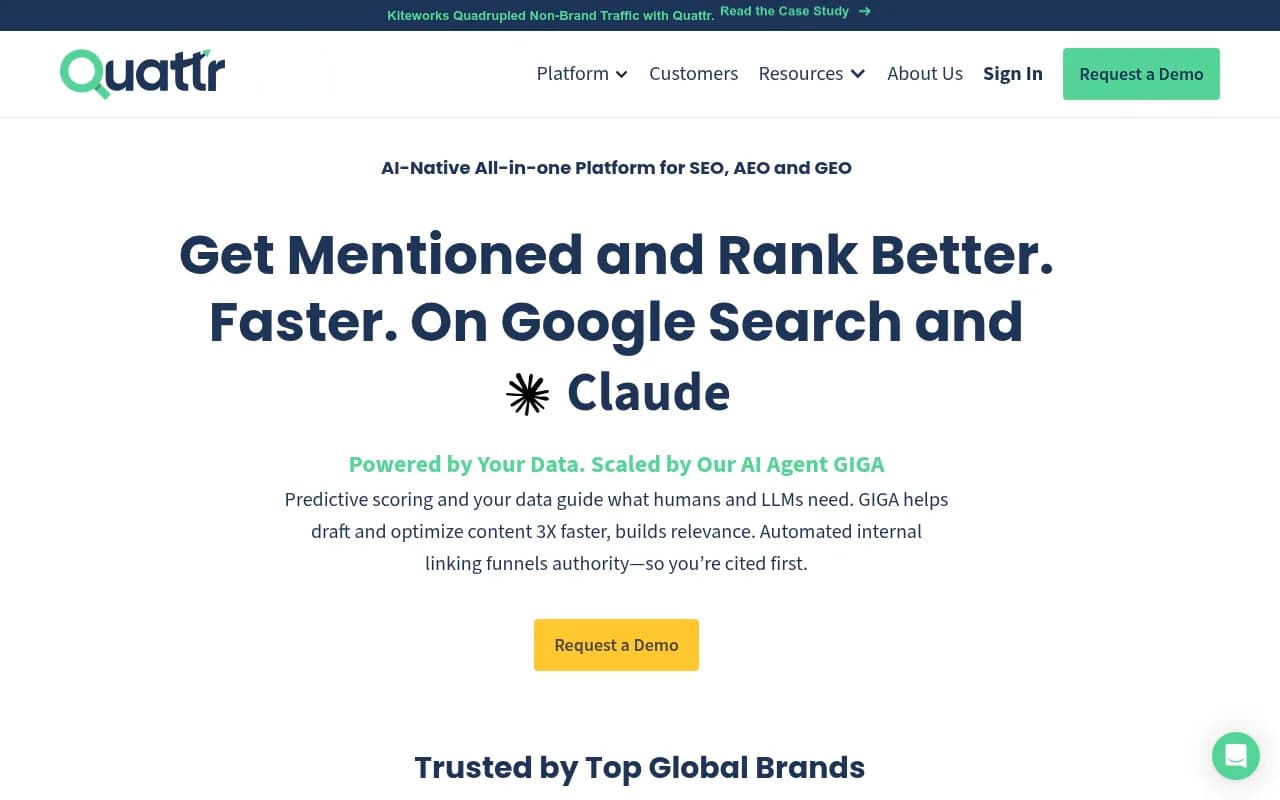
Quattr positions itself as an "AI-native all-in-one platform for SEO, AEO, and GEO" -- meaning traditional search engine optimization, answer engine optimization (AI Overviews), and generative engine optimization (ChatGPT, Claude, Perplexity). The core pitch: stop stitching together old SEO tools. Quattr's AI agent (GIGA) helps you research topics, draft optimized content, auto-link pages, and win rankings and citations on Google and AI platforms.
What makes Quattr different is the execution layer. Most AI visibility tools tell you where you stand. Quattr's GIGA agent uses predictive scoring and your data to draft and optimize content 3x faster, build topical relevance, and automate internal linking to funnel authority. The goal is to be cited first in AI responses, not just tracked.
Quattr is used by brands like WP Engine, Marriott, McAfee, Coursera, and Bluehost. Pricing is custom enterprise, typically $500-$1,000+/mo. Free test drive available.
Authoritas AI Tracker: Monitoring platform with sentiment analysis

Authoritas combines AI search monitoring with traditional SEO tools. The AI Tracker module tracks brand mentions, sentiment, and visibility across ChatGPT, Perplexity, Claude, Gemini, DeepSeek, Google AI Overviews, and Bing AI. Built for eCommerce brands, publishers, and agencies managing competitive niches with global reach.
The platform is split into two main audiences: brands (track performance and optimize across search engines and LLMs) and publishers (understand how AI platforms use your content, unlock licensing revenue, protect IP). The publisher angle is unique -- Authoritas explicitly helps publishers track content consumption across AI platforms for potential monetization.
Authoritas has transparent tiered pricing: Essential (£99/mo), Expert (£799/mo), and custom enterprise. This makes it more accessible for smaller teams compared to Quattr's enterprise-only model.
Side-by-side comparison
| Feature | Quattr | Authoritas AI Tracker |
|---|---|---|
| Starting price | Custom ($500-$1,000+/mo typical) | £99/mo (Essential) |
| Free tier | Free test drive | No |
| AI models tracked | ChatGPT, Perplexity, Claude, Gemini, Google AI Overviews, Google AI Mode | ChatGPT, Perplexity, Claude, Gemini, Google AI Overviews, Bing AI, DeepSeek |
| Content generation | Yes (GIGA AI agent) | No |
| Sentiment analysis | Not emphasized | Yes |
| Automated internal linking | Yes | No |
| Traditional SEO tools | Yes (keyword research, on-page optimization) | Yes (SEO data and tools) |
| Publisher-specific features | No | Yes (licensing insights, IP tracking) |
| Predictive scoring | Yes | Not mentioned |
| Target audience | Brands, eCommerce, agencies | Brands, publishers, eCommerce, agencies |
| Pricing transparency | Low (custom only) | High (public tiers) |
| API access | Not mentioned | Not mentioned |
| Multi-language support | Not mentioned | Not mentioned |
Head-to-head feature breakdown
AI search monitoring coverage
Both platforms cover the major LLMs that matter in 2026: ChatGPT, Perplexity, Claude, Gemini, and Google AI Overviews. Authoritas explicitly lists Bing AI and DeepSeek in their marketing materials. Quattr mentions Google AI Mode as a separate entity.
In practice, the coverage is roughly equivalent for most brands. DeepSeek has gained traction in 2026, so Authoritas's explicit support is a small edge. But if you're primarily concerned with ChatGPT, Perplexity, and Google AI Overviews (the big three for most brands), both platforms have you covered.
Verdict: Tie, with a slight edge to Authoritas for explicitly listing DeepSeek and Bing AI.
Content creation and optimization
This is where the platforms diverge sharply.
Quattr's GIGA AI agent is built to draft and optimize content based on predictive scoring, your existing data, and what LLMs need to cite you. The pitch is "3x faster" content creation with automated internal linking to funnel authority. GIGA doesn't just suggest topics -- it helps you write the content and wire it into your site architecture.
Authoritas doesn't generate content. It tracks where you appear (or don't appear) in AI responses, analyzes sentiment, and shows you competitive gaps. You get the insights, but you're on your own for content creation.
Verdict: Quattr wins decisively if content creation is part of your workflow. Authoritas is monitoring-only.
Sentiment analysis and brand safety
Authoritas emphasizes sentiment tracking -- understanding not just whether you're mentioned in AI responses, but how you're portrayed. This is critical for brand reputation management. If an LLM is citing you negatively or associating your brand with problems, you need to know.
Quattr doesn't highlight sentiment analysis in their marketing. The focus is on getting cited and ranking, not on analyzing the tone of those citations.
Verdict: Authoritas wins for brand safety and reputation monitoring.
Traditional SEO integration
Both platforms combine AI search tracking with traditional SEO tools. Quattr calls itself an "AI-native SEO suite" and includes keyword research, on-page optimization, and automated internal linking. The internal linking automation is a standout feature -- most SEO tools require manual work to build link equity across your site.
Authoritas offers "SEO data and tools" alongside AI tracking. The platform has been around longer as a traditional SEO tool, so the SEO side is mature. But it doesn't emphasize automation the way Quattr does.
Verdict: Quattr edges ahead for automation (internal linking). Authoritas is solid but more manual.
Publisher-specific features
Authoritas explicitly targets publishers with features for tracking content consumption across AI platforms, licensing insights, and IP protection. The pitch: understand how AI platforms use your content, unlock licensing revenue, protect your IP. This is a direct response to the publisher revenue crisis as LLMs scrape and summarize content without compensation.
Quattr doesn't address publishers as a separate audience. The platform is built for brands and eCommerce sites trying to rank and convert.
Verdict: Authoritas is the only choice for publishers looking to monetize AI platform usage.
Pricing and accessibility
Authoritas has transparent tiered pricing starting at £99/mo (Essential) and scaling to £799/mo (Expert), with custom enterprise pricing above that. This makes it accessible for smaller teams and agencies who need predictable budgeting.
Quattr uses custom enterprise pricing with no public starter tiers. Based on their target customers (Marriott, McAfee, Coursera), the typical range is $500-$1,000+/mo. Free test drive available, but you have to talk to sales to get a quote.
Verdict: Authoritas wins for pricing transparency and accessibility. Quattr is enterprise-only.
Predictive scoring and prioritization
Quattr's predictive scoring is a key differentiator. The platform uses your data to guide what humans and LLMs need, then prioritizes content creation and optimization based on that scoring. This helps you focus on high-impact work instead of guessing.
Authoritas doesn't emphasize predictive scoring or prioritization in their marketing. You get tracking data, but the platform doesn't tell you what to fix first.
Verdict: Quattr wins for strategic prioritization.
Pricing comparison
| Plan | Quattr | Authoritas AI Tracker |
|---|---|---|
| Starter/Essential | Not available | £99/mo |
| Mid-tier | Not available | Not publicly listed |
| Expert/Professional | Custom ($500-$1,000+/mo typical) | £799/mo |
| Enterprise | Custom | Custom |
| Free trial | Free test drive | Not mentioned |
Quattr's lack of public pricing makes it harder to budget for smaller teams. Authoritas's tiered structure is more predictable.
Pros and cons
Quattr pros
- AI writing agent (GIGA) generates content that ranks in AI search
- Automated internal linking funnels authority across your site
- Predictive scoring prioritizes high-impact work
- Strong focus on execution, not just monitoring
- Trusted by major brands (Marriott, McAfee, Coursera)
Quattr cons
- Custom enterprise pricing only -- no starter tiers
- Less transparent about pricing than competitors
- Doesn't emphasize sentiment analysis or brand safety
- Not built for publishers (no licensing insights)
Authoritas pros
- Transparent tiered pricing starting at £99/mo
- Strong sentiment analysis for brand reputation monitoring
- Publisher-specific features (licensing insights, IP tracking)
- Explicitly tracks DeepSeek and Bing AI
- Accessible for smaller teams and agencies
Authoritas cons
- No content generation -- monitoring only
- Doesn't automate on-page SEO tasks (internal linking, etc.)
- Less emphasis on strategic prioritization
- Doesn't highlight predictive scoring or AI-driven recommendations
Who should pick which tool
Pick Quattr if:
- You need to create content that ranks in AI search, not just track where you stand
- Automated internal linking and on-page SEO automation matter to you
- You're a mid-market or enterprise brand with budget for custom pricing
- You want predictive scoring to prioritize high-impact work
- You're focused on eCommerce or brand marketing (not publishing)
Pick Authoritas if:
- You're a publisher looking to track content consumption and unlock licensing revenue
- Sentiment analysis and brand reputation monitoring are priorities
- You need transparent, predictable pricing starting under £100/mo
- You want to track DeepSeek and Bing AI explicitly
- You're a smaller team or agency that can't commit to enterprise pricing
Consider both if:
- You're a large organization that needs monitoring (Authoritas) and content creation (Quattr) as separate workflows
- You're managing multiple brands with different needs (publishers vs eCommerce)
Worth noting: if you're also looking to track AI crawler logs, prompt volumes, and Reddit/YouTube influence on AI recommendations, Promptwatch covers those angles with a focus on closing the loop from visibility to content creation to traffic attribution. It's a different approach than either Quattr or Authoritas -- more about finding content gaps and generating articles grounded in citation data.

Final verdict
Quattr and Authoritas solve different problems. Quattr is an optimization platform with content generation. Authoritas is a monitoring platform with sentiment tracking.
If you need to take action on AI search visibility gaps -- create content, automate internal linking, prioritize high-impact work -- Quattr is the better choice. The GIGA agent and predictive scoring make it an execution platform, not just a dashboard.
If you need deep tracking with sentiment analysis, transparent pricing, and publisher-specific features (licensing insights, IP protection), Authoritas is the better choice. It's more accessible for smaller teams and has features Quattr doesn't address.
The pricing gap is significant. Authoritas starts at £99/mo with clear tiers. Quattr is custom enterprise pricing ($500-$1,000+/mo typical) with no public starter plans. If budget predictability matters, Authoritas wins.
For most brands and eCommerce sites: Quattr if you have the budget and need content creation. Authoritas if you need monitoring and sentiment analysis at a lower price point. For publishers: Authoritas is the only platform built for your use case.