Summary
- Real crawler logs prove AI bots visited your site—citation counts alone don't tell you if ChatGPT, Perplexity, or Claude actually read your content or just ignored it
- Most GEO platforms lack crawler log tracking—tools like Otterly.AI, Peec.ai, and AthenaHQ monitor citations but can't show you which pages AI bots crawled, when they visited, or what errors they encountered
- Server log analysis is the gold standard—platforms that parse your actual server logs (like Promptwatch) reveal real bot behavior: which pages GPTBot and PerplexityBot requested, response codes, crawl frequency, and indexing gaps
- Vanity metrics create false confidence—a high citation count means nothing if AI bots never crawled the pages you optimized, or if they hit 404s and gave up
- Behavioral bot detection is critical in 2026—AI-powered bots now mimic human behavior to bypass traditional defenses, making real-time log analysis the only way to separate legitimate AI crawlers from sophisticated scrapers

Why Crawler Logs Matter More Than Citation Counts
Most GEO platforms sell you a dashboard of citation metrics: how many times ChatGPT mentioned your brand, which prompts triggered your content, your visibility score vs competitors. These numbers feel good. They're also incomplete.
Citation tracking tells you what AI models said in their responses. It doesn't tell you what they read from your website. If ChatGPT cites your competitor instead of you, is it because their content is better—or because GPTBot never crawled your new landing page?
You can't answer that question without crawler logs. Server logs are the ground truth: they show exactly which pages AI bots requested, when they visited, what HTTP status codes your server returned, and whether the bot came back later or gave up. This is the difference between monitoring outputs (citations) and understanding inputs (what AI models actually see when they try to read your site).
A 2026 analysis from Quattr notes that platforms using server logs can "prove real-time AI crawler activity" and enable teams to "submit new content for faster AI discovery." That's the action loop: see what's missing, fix it, confirm the bot came back and indexed it. Citation-only tools can't close that loop.
The Vanity Metrics Problem
Vanity metrics in GEO look like progress but don't connect to outcomes. A few examples:
Citation volume without context: Your brand was mentioned 47 times this month. Great—but were those mentions positive recommendations or just passing references? Did they include a link to your site? Citation counts are directional at best.
Visibility scores with no traffic data: You're "visible" in 60% of tracked prompts. But if those prompts have zero search volume, or if users never click through to your site from AI answers, the visibility score is decorative.
Competitor benchmarks without action: You rank #3 behind two competitors for a key prompt. The dashboard shows you're losing. It doesn't show you why—what content gaps exist, which pages competitors have that you don't, or what specific angles AI models prefer.
A LinkedIn post from early 2026 warns that "metrics like last click have become vanity metrics" in the AI search era. The same applies to GEO: if you're tracking outputs (citations, mentions, visibility scores) without understanding the inputs (crawler behavior, content gaps, indexing status), you're measuring the wrong things.
Real Crawler Logs vs Synthetic Monitoring
There are two ways to track AI bot activity: real server logs and synthetic monitoring.
Real Server Logs
Your web server records every HTTP request it receives, including the user agent (e.g. "GPTBot", "PerplexityBot", "Claude-Web"). Parsing these logs reveals:
- Which pages each AI bot requested
- Timestamps (when they visited, how often they return)
- HTTP status codes (200 OK, 404 Not Found, 403 Forbidden, 500 Server Error)
- Response times and payload sizes
- Referrer data (if the bot followed a link)
This is objective data. The bot either hit your server or it didn't. If GPTBot requested /new-product-page and got a 404, you know ChatGPT can't cite that page because it never successfully read it.
Synthetic Monitoring
Synthetic monitoring means the GEO platform runs test queries through AI models and records the responses. This tells you what the model said, but not what it read. If ChatGPT cites a competitor, synthetic monitoring shows you the citation. It doesn't show you whether GPTBot ever tried to crawl your equivalent page, or if it did and encountered an error.
Most GEO platforms use synthetic monitoring exclusively. They query ChatGPT, Perplexity, Claude, and Gemini with your tracked prompts, parse the responses, and build dashboards. This is useful for understanding outputs. It's blind to inputs.
Platforms with Real Crawler Log Tracking
As of early 2026, very few GEO platforms offer real crawler log analysis. Here's what we found:
| Platform | Crawler Logs | Log Sources | Real-Time Alerts | Action Loop |
|---|---|---|---|---|
| Promptwatch | Yes | Server logs, GSC, code snippet | Yes | Full (gap analysis + content generation + tracking) |
| Quattr | Yes | Server logs | Not specified | Partial (tracking + recommendations) |
| Profound | No | Synthetic only | N/A | Monitoring only |
| Otterly.AI | No | Synthetic only | N/A | Monitoring only |
| Peec.ai | No | Synthetic only | N/A | Monitoring only |
| AthenaHQ | No | Synthetic only | N/A | Monitoring only |
| Search Party | No | Synthetic only | N/A | Monitoring only |
Promptwatch is the only platform we verified that combines real-time crawler log tracking with content optimization tools. It parses server logs to show which pages GPTBot, PerplexityBot, Claude-Web, and other AI crawlers requested, surfaces errors (404s, 403s, timeouts), and tracks crawl frequency. When you publish new content, you can see when the bots return and whether they successfully indexed it.
Otterly.AI

Quattr mentions server log integration in its public materials but focuses primarily on traditional SEO. The GEO features appear newer and less developed than the core SEO platform.
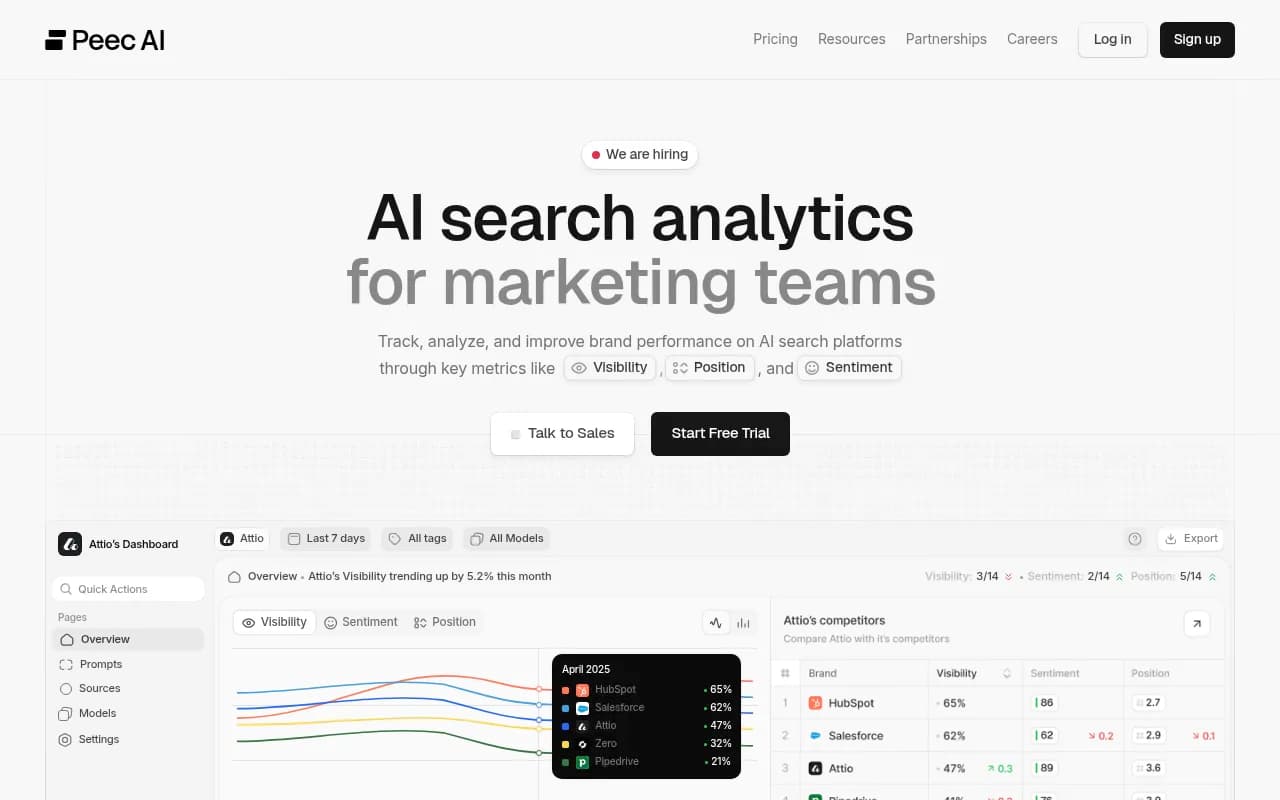
Platforms like Otterly.AI, Peec.ai, and AthenaHQ are monitoring-only dashboards. They show you citations and visibility scores but provide no insight into bot behavior. If your visibility drops, you're guessing at the cause.
What Real Crawler Logs Reveal
When you have access to actual server logs, you can answer questions that citation tracking can't:
Did the bot even try to crawl this page? You published a new comparison guide targeting a high-value prompt. Your citation count didn't change. Is the content weak, or did GPTBot never visit the page? Logs tell you immediately.
Why did the bot stop crawling my site? GPTBot visited 50 pages last month, 12 pages this month. What happened? Logs show you: maybe your server started returning 500 errors, or your CDN blocked the bot's IP range, or your robots.txt changed and accidentally disallowed AI crawlers.
Which pages are AI bots reading most often? You assume your homepage and product pages matter most. Logs reveal that AI bots spend more time on your blog and documentation. That's where you should focus optimization.
Are AI bots hitting paywalled or gated content? If PerplexityBot requests /premium-report and gets a 403 Forbidden, Perplexity can't cite that content. You're invisible not because your content is weak, but because the bot can't access it.
How fast do AI bots discover new content? You published a new guide on Monday. GPTBot crawled it on Wednesday. Claude-Web hasn't visited yet. This tells you which models are actively indexing your site and which ones are stale.
None of this is visible in citation-only dashboards.
The 2026 Bot Detection Challenge

A February 2026 article from STCLab warns that "AI-powered automation tools are driving a sharp rise in intelligent DDoS attacks and malicious bot traffic." These bots "disguise themselves as legitimate users and increasingly bypass traditional network-layer defenses such as IP reputation filtering, CAPTCHA, and geo-blocking."
This matters for GEO because not every bot claiming to be GPTBot is actually GPTBot. Scrapers spoof user agents. Competitors run automated tools to monitor your content. Security researchers probe for vulnerabilities. If your "crawler log" analysis just greps for "GPTBot" in the user agent string, you're seeing noise mixed with signal.
Real behavioral analysis looks at:
- Request patterns: Legitimate AI crawlers follow links, respect robots.txt, and crawl at predictable intervals. Scrapers hammer random URLs, ignore robots.txt, and spike traffic unpredictably.
- IP verification: OpenAI publishes the IP ranges GPTBot uses. If a request claims to be GPTBot but comes from an AWS IP in a different range, it's spoofed.
- Response handling: Real AI crawlers parse HTML, follow redirects, and handle JavaScript rendering (sometimes). Dumb scrapers just grab raw HTML and move on.
Platforms that parse server logs without validating bot identity are showing you garbage data. You think GPTBot visited 200 pages last week. Half of those requests were scrapers.
Platforms That Show You What's Missing (Not Just What Happened)
The best GEO platforms don't just report crawler activity—they tell you what's missing and help you fix it.
Promptwatch does this with Answer Gap Analysis: it shows you which prompts your competitors are visible for but you're not, then surfaces the specific content gaps (topics, angles, questions) your site is missing. The built-in AI writing agent generates articles grounded in real citation data (880M+ citations analyzed), prompt volumes, and competitor analysis. You're not guessing what to write—you're filling documented gaps.
This is the difference between a monitoring tool and an optimization platform. Monitoring tools (Otterly.AI, Peec.ai, AthenaHQ) show you the scoreboard. Optimization platforms show you the scoreboard and the playbook.
How to Evaluate Crawler Log Quality in a Demo
If a GEO platform claims to track AI crawler activity, ask these questions:
Where does the crawler data come from? Real server logs, Google Search Console, a code snippet you install, or synthetic monitoring? Only the first three give you real bot behavior.
Can you show me which pages GPTBot requested yesterday? If they can't pull up a list of URLs with timestamps and status codes, they're not tracking real logs.
What happens if a bot gets a 404 or 500 error? Do you see that in the dashboard? Can you set up alerts? If not, you're flying blind when things break.
How do you verify bot identity? Do you validate IP ranges and request patterns, or just trust the user agent string? Spoofed bots are a real problem in 2026.
Can you show me crawl frequency over time? Pull up a chart showing how often GPTBot, PerplexityBot, and Claude-Web visited your site over the last 90 days. If the platform can't do this, they're not tracking real logs.
What's the latency between a bot visit and dashboard visibility? Real-time is ideal. If there's a 24-hour delay, you're making decisions on stale data.
The Action Loop: Find Gaps, Fix Them, Confirm Bots Indexed the Fix
The reason crawler logs matter is they close the optimization loop:
- Find the gaps: Answer Gap Analysis (or equivalent) shows you which prompts competitors rank for but you don't, and what content is missing.
- Create content that ranks: Write or generate articles targeting those gaps. Publish them.
- Confirm bots crawled the new content: Check server logs. Did GPTBot request the new page? When? Did it get a 200 OK or an error? If the bot hasn't visited yet, submit the URL directly or wait for the next crawl.
- Track results: See your visibility scores improve as AI models start citing the new content. Page-level tracking shows exactly which pages are being cited, how often, and by which models.
Without step 3, you're publishing content and hoping. With crawler logs, you know.
Citation Tracking Still Matters (But It's Not Enough)
This isn't an argument against citation tracking—it's an argument that citation tracking alone is insufficient. You need both:
- Citation data tells you what AI models said and which sources they cited. This is the output.
- Crawler logs tell you what AI bots read and whether they successfully indexed your content. This is the input.
Platforms that only show citations are showing you half the picture. Platforms that show both give you the full story.
Recommendations
If you're evaluating GEO platforms in 2026, prioritize tools that:
- Track real crawler activity via server logs, not just synthetic monitoring
- Validate bot identity to filter out scrapers and spoofed requests
- Surface content gaps and help you fix them, not just report the problem
- Close the action loop by confirming bots indexed your new content
Promptwatch is the only platform we found that does all four. It combines real-time crawler log tracking, Answer Gap Analysis, AI content generation, and page-level citation tracking. You see what's broken, fix it, and confirm the fix worked.
For teams that need basic monitoring without optimization, Otterly.AI and Peec.ai are cheaper alternatives. Just understand you're buying a dashboard, not a solution.
Otterly.AI
Final Thoughts
The GEO industry in 2026 is full of vanity metrics. Citation counts, visibility scores, and competitor benchmarks feel like progress. They're not actionable without crawler logs.
Real crawler logs show you what AI bots actually did: which pages they requested, when they visited, what errors they encountered, and whether they came back. This is the data you need to optimize for AI search. Everything else is guessing.
If your GEO platform can't show you server logs, you're monitoring outputs without understanding inputs. That's not optimization—it's just reporting.