Key takeaways
- Traditional SEO tools don't track what ChatGPT, Perplexity, or Claude say about your brand -- you need a dedicated AI visibility tool for that.
- There's a meaningful difference between tools that just monitor your brand mentions and tools that help you act on what they find. Most tools in this space only do the former.
- Promptwatch is the only platform in this comparison that closes the full loop: find gaps, generate content, track results.
- Otterly.AI and Peec.ai are solid entry points for teams on tighter budgets, but they stop at monitoring.
- Rankshift is a newer player worth watching for smaller teams that want simple, affordable tracking.
Why tracking your brand in ChatGPT actually matters now
Here's a scenario that's playing out for thousands of brands right now. A potential customer opens ChatGPT and asks something like "what's the best project management tool for remote teams?" ChatGPT gives them a confident, detailed answer. Your brand might be in that answer. Or it might not be. You have absolutely no idea.
That's the AI visibility gap. And it's not a niche problem anymore. Brands appear in roughly 90% of Google AI Mode responses according to a Search Engine Land analysis, and ChatGPT has become a genuine research tool for purchasing decisions. If you're not tracking what these models say about you, you're flying blind during a part of the customer journey that's growing fast.
The challenge is that traditional SEO tools -- Ahrefs, Semrush, Google Search Console -- weren't built for this. They track rankings and clicks from traditional search. They don't query ChatGPT at 2am to see if your brand got mentioned in a response about your category.
That's why a new category of tools has emerged. And in 2026, there are now enough options that choosing between them actually requires some thought.
The four tools compared
Let's look at the four main contenders: Promptwatch, Peec.ai, Otterly.AI, and Rankshift. These represent different points on the spectrum from "basic monitoring" to "full optimization platform."
Promptwatch

Promptwatch is the most complete option in this comparison. It monitors your brand across 10 AI models -- ChatGPT, Perplexity, Claude, Gemini, Google AI Overviews, Google AI Mode, Grok, DeepSeek, Copilot, and Meta AI -- but the monitoring is almost the least interesting part of what it does.
The real value is what happens after you see the data. Promptwatch's Answer Gap Analysis shows you the specific prompts where competitors are getting cited but you're not. Not vague categories -- actual prompts, with data on volume and difficulty. Then its built-in AI writing agent generates content designed to get cited by those models, grounded in analysis of over 880 million real citations. You publish the content, and then you track whether your visibility scores improve.
That loop -- find gaps, create content, track results -- is what separates Promptwatch from every other tool in this comparison. Most competitors show you a dashboard. Promptwatch shows you a dashboard and then helps you do something about it.
A few other things worth knowing: Promptwatch logs actual AI crawler activity on your site (which pages ChatGPT's bot read, how often it returns, any errors it hit), tracks prompt volumes and difficulty scores so you can prioritize, monitors Reddit and YouTube discussions that influence AI recommendations, and includes ChatGPT Shopping tracking for brands selling products. The citation database behind all of this -- 1.1 billion citations, clicks, and prompts processed -- is genuinely large.
Pricing starts at $99/month for the Essential plan (1 site, 50 prompts, 5 articles). The Professional plan at $249/month adds crawler logs, more prompts, and city/state-level tracking. Business is $579/month for 5 sites.
Peec.ai

Peec.ai is a solid monitoring tool, particularly for SaaS and B2B brands. It tracks visibility across ChatGPT, Perplexity, and Google AI Overviews, and its dashboard is clean and easy to read. The competitor benchmarking is genuinely useful -- you can see how your brand stacks up against specific competitors for specific prompts, which gives you a clearer picture of where you're losing ground.
At €89/month, it's priced reasonably for what it does. The limitation is that it's primarily a monitoring tool. You'll see the data, but Peec doesn't help you act on it. There's no content generation, no gap analysis that tells you what to write, no crawler logs. It's a good starting point if you want to understand your current AI visibility without committing to a larger platform.
One thing Peec does well that's worth mentioning: its reporting is clean enough to share with clients or stakeholders who aren't deep in the weeds on GEO. If you need to show an executive or a client "here's where we stand in AI search," Peec's output is presentable.
Otterly.AI
Otterly.AI

Otterly.AI is the budget entry point in this comparison. At $29/month, it's one of the most affordable AI visibility tools on the market, and it's well-regarded in SEO communities for that reason. It handles prompt-based tracking across ChatGPT, Perplexity, and Google AI Overviews, and it includes some GEO audit functionality that's useful for agencies running initial assessments.
The trade-off is depth. Otterly doesn't have crawler logs, doesn't track Reddit or YouTube, doesn't do content generation, and lacks the citation analysis that makes Promptwatch's recommendations so specific. For a small team or a freelancer who just wants to know whether their brand is showing up in AI answers, Otterly is a reasonable starting point. For anyone who wants to actually move the needle, it'll feel limiting fairly quickly.
That said, Zapier has noted Otterly as one of the most accessible tools for getting started in AI visibility tracking, and that reputation is earned. It does what it says it does, at a price that's hard to argue with.
Rankshift

Rankshift is the newest player in this group and takes a slightly different angle. It focuses on tracking brand visibility across ChatGPT, Perplexity, and other AI search engines, with an interface designed to be approachable for smaller teams. It's positioned as an accessible entry point, similar to Otterly in terms of target audience.
What Rankshift does reasonably well is surface competitive comparisons -- showing you where you rank relative to competitors for specific prompts. The reporting is straightforward. Like Otterly and Peec, though, it's a monitoring tool rather than an optimization platform. You'll know what's happening, but you won't get much help changing it.
Rankshift's own blog has noted that it and Otterly "provide accessible entry points for small teams," while Peec and Promptwatch "appeal to marketers who want broader testing capabilities." That's a fair self-assessment.
Side-by-side comparison
| Feature | Promptwatch | Peec.ai | Otterly.AI | Rankshift |
|---|---|---|---|---|
| AI models tracked | 10 (ChatGPT, Perplexity, Claude, Gemini, Grok, DeepSeek, Copilot, Meta AI, Google AI Overviews, Google AI Mode) | ChatGPT, Perplexity, Google AI Overviews | ChatGPT, Perplexity, Google AI Overviews | ChatGPT, Perplexity, others |
| Answer gap analysis | Yes | No | No | No |
| AI content generation | Yes (built-in writing agent) | No | No | No |
| AI crawler logs | Yes | No | No | No |
| Reddit/YouTube tracking | Yes | No | No | No |
| ChatGPT Shopping tracking | Yes | No | No | No |
| Prompt volume/difficulty scores | Yes | No | No | No |
| Competitor benchmarking | Yes | Yes | Basic | Yes |
| Traffic attribution | Yes (GSC, code snippet, server logs) | No | No | No |
| Starting price | $99/mo | €89/mo | $29/mo | Varies |
| Best for | Teams that want to monitor AND improve AI visibility | SaaS/B2B monitoring, clean reporting | Budget-conscious teams, agencies starting out | Small teams, simple tracking |
Which tool should you actually use?
The honest answer depends on what you're trying to do.
If you just want to know whether your brand is showing up in ChatGPT and Perplexity, and you don't have budget or bandwidth to do much about it yet, Otterly.AI at $29/month is a reasonable starting point. It won't overwhelm you, and it'll give you a baseline.
If you need clean, shareable reporting and want to benchmark against specific competitors -- particularly in a B2B or SaaS context -- Peec.ai is worth considering. The €89/month price is fair for what you get, and the dashboard is genuinely presentable.
If you're a smaller team that wants simple competitive tracking without a lot of complexity, Rankshift is worth a look.
But if you actually want to improve your AI visibility rather than just measure it, Promptwatch is the only tool in this comparison that helps you do that. The gap analysis tells you exactly what content is missing. The writing agent helps you create it. The crawler logs tell you whether AI bots are even reading your site properly. And the traffic attribution connects all of it back to actual business results.
The monitoring-only tools will tell you that you're losing to a competitor in ChatGPT responses. Promptwatch tells you why and helps you fix it.
What to look for beyond these four
The AI visibility tool market is moving fast. A few other tools worth knowing about:
Profound is the enterprise standard -- deep features, serious price tag ($99/month and up, but enterprise tiers go much higher). Worth it for large brands with complex tracking needs.
Profound

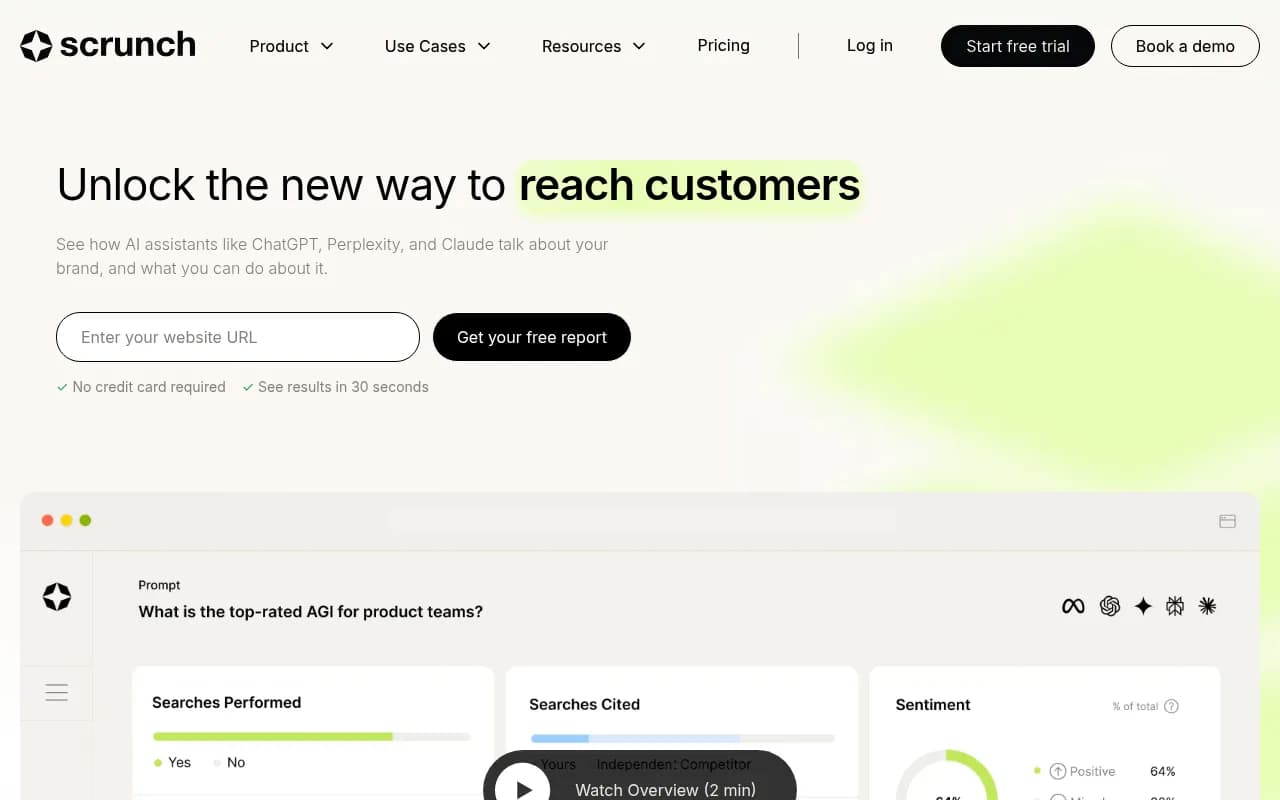
Scrunch AI is another monitoring-focused platform with decent coverage across LLMs.
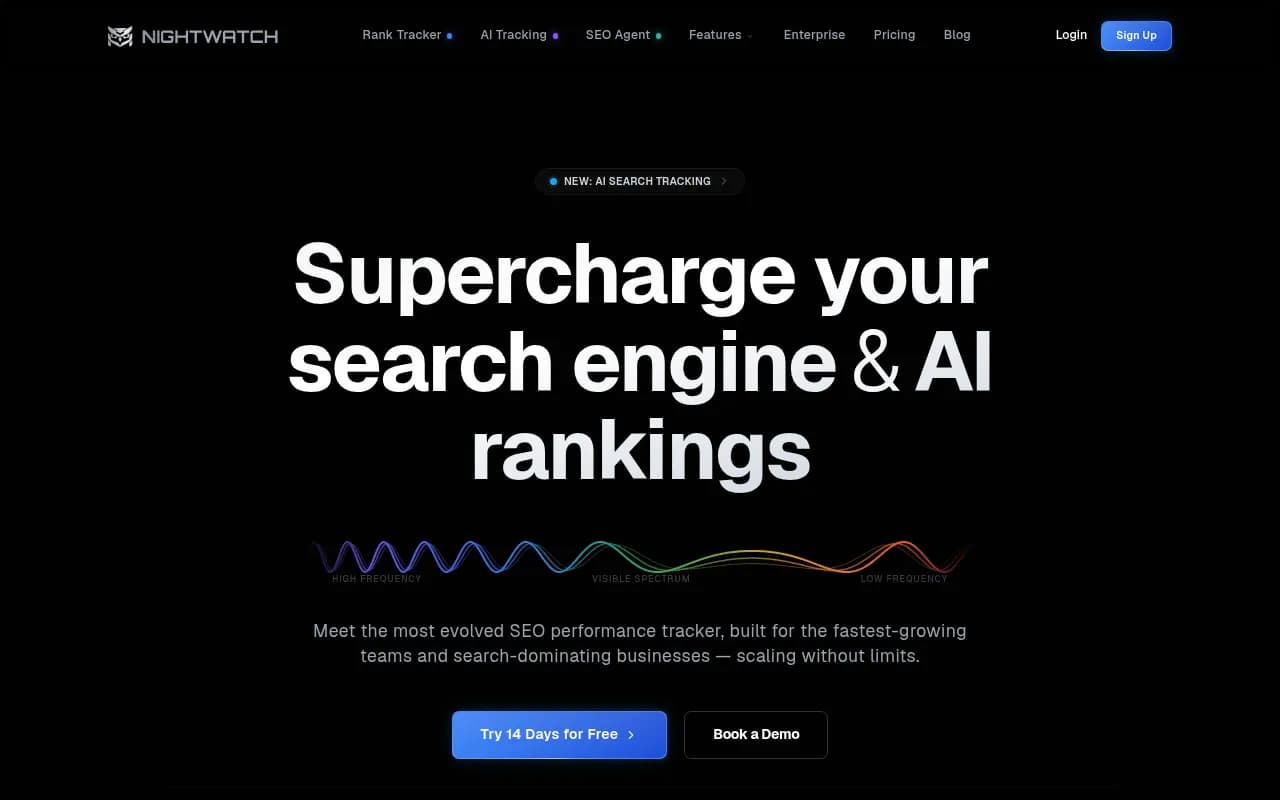
Nightwatch is interesting if you want traditional SEO tracking and AI visibility in one place -- it has an AI add-on that sits on top of its rank tracking infrastructure.
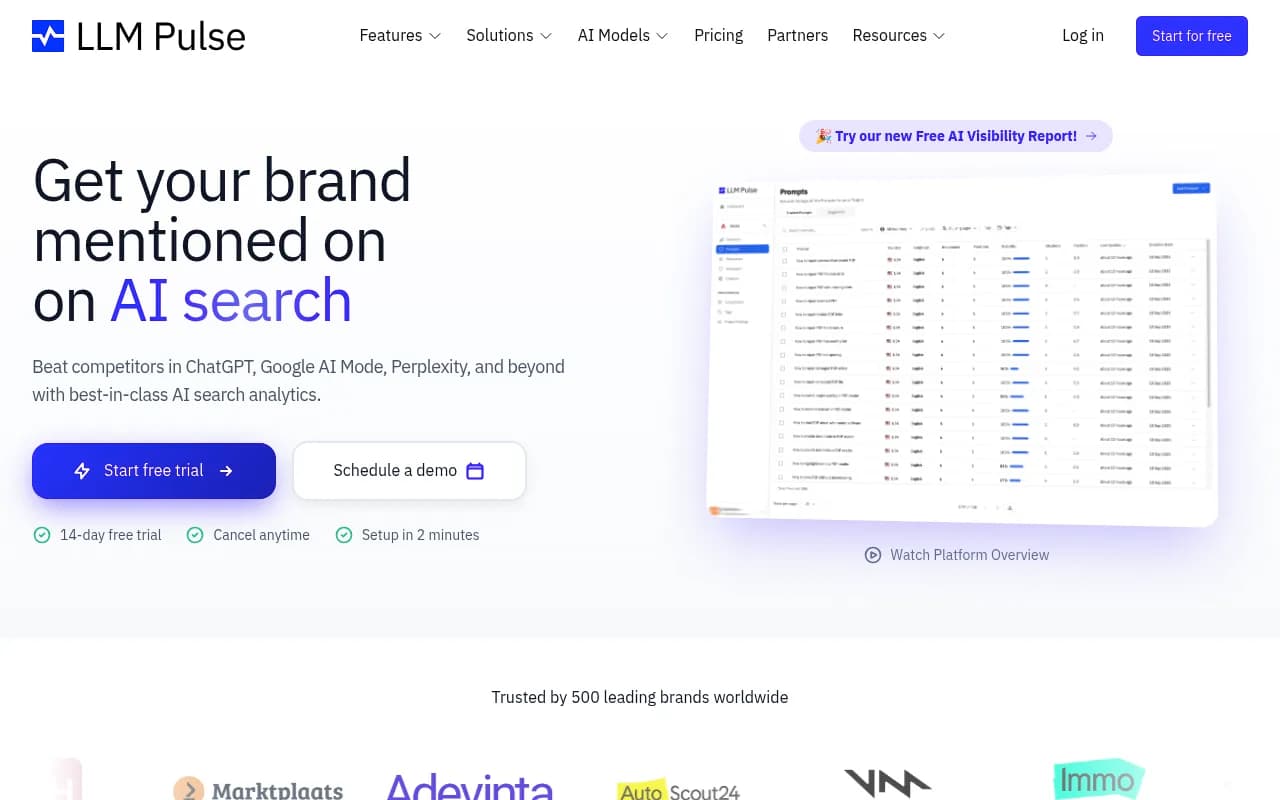
LLM Pulse focuses specifically on brand recommendations and sentiment across LLMs, which is a slightly different angle than pure visibility tracking.
The bigger picture
One thing worth being clear about: tracking your brand in ChatGPT is not the same as optimizing for traditional search. The signals that make a brand visible in AI responses -- being cited by authoritative sources, having clear and specific content that answers questions directly, appearing in Reddit discussions that AI models reference -- are different from what drives Google rankings.
That's why the most useful tools in this space aren't just dashboards. They're tools that help you understand the citation ecosystem, identify where your content is missing, and create material that AI models actually want to reference.
Most tools in this market stop at the dashboard. If you want to close the loop from "I'm invisible in ChatGPT" to "I'm now being cited regularly," the path runs through a platform that does more than monitor.
The market has matured enough in 2026 that you don't have to guess which tools do what. The comparison above should give you a clear enough picture to make a decision that fits your team's actual needs and budget.