Key Takeaways
- XFunnel is being acquired by HubSpot (2026), which will likely change its roadmap, pricing, and integration strategy -- existing users should prepare for transition
- AI Peekaboo is built for agencies with white-labeling and multi-client management, while XFunnel targets enterprise brands directly
- XFunnel offers experimentation and advanced analytics features that Peekaboo lacks, but Peekaboo is simpler to set up and likely more affordable
- Both are monitoring-only platforms -- neither includes content gap analysis, AI crawler logs, or content generation capabilities
- If you need to track AI visibility AND optimize content based on what's missing, Promptwatch covers both angles with built-in content generation and gap analysis
- For pure monitoring on a budget with agency features, Peekaboo wins. For enterprise-scale analytics (if you're okay with the HubSpot transition), XFunnel has more depth.
Overview
XFunnel
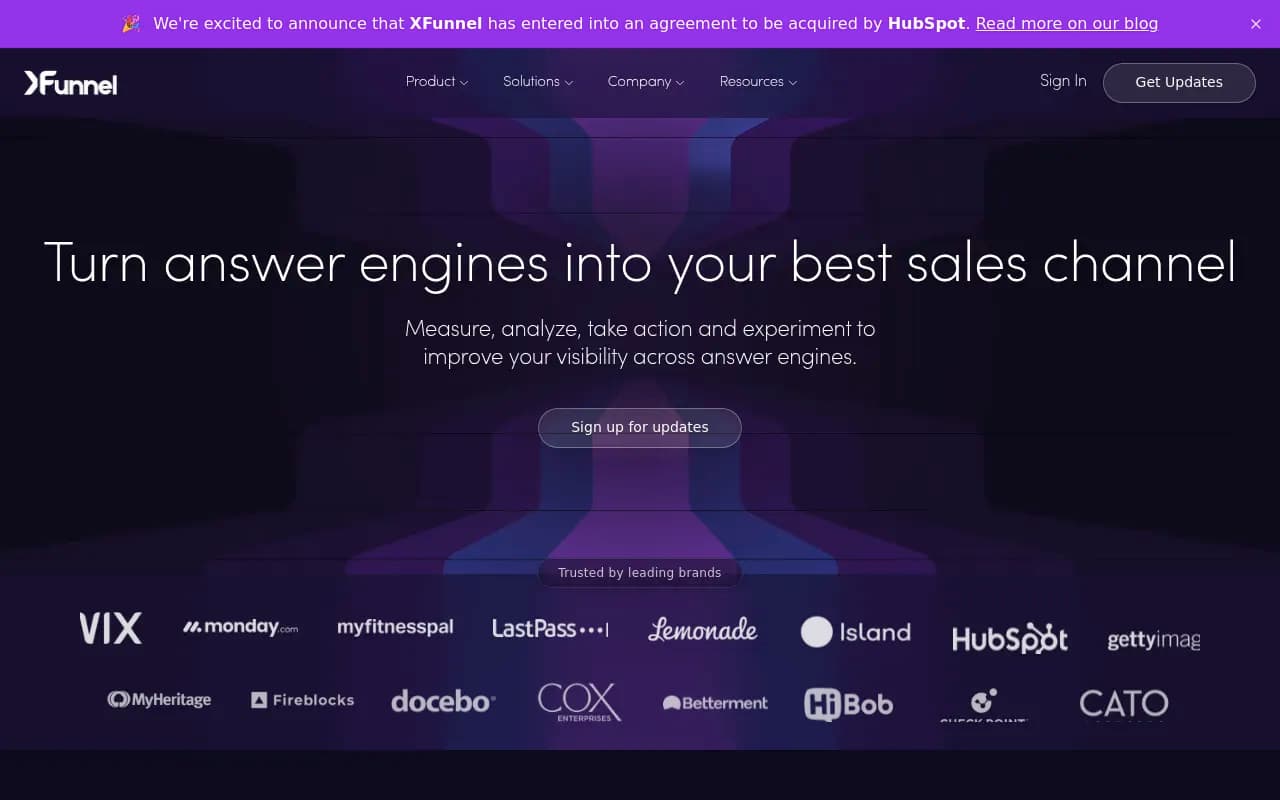
XFunnel positions itself as a generative engine optimization platform for marketing teams, with a client roster that includes Wix, Monday.com, MyFitnessPal, LastPass, and other major brands. The big news: XFunnel announced in 2026 that it's entering an agreement to be acquired by HubSpot. This acquisition will likely reshape the product -- tighter CRM integration, broader distribution through HubSpot's ecosystem, but also potential pricing changes and feature consolidation. If you're evaluating XFunnel today, you're really evaluating what it will become inside HubSpot.
The platform focuses on measuring, analyzing, and experimenting to improve visibility across "answer engines" (AI-powered search). It offers citation tracking, question discovery, and experimentation features. Pricing is custom enterprise (contact sales), which signals a focus on larger organizations with dedicated budgets.
AI Peekaboo
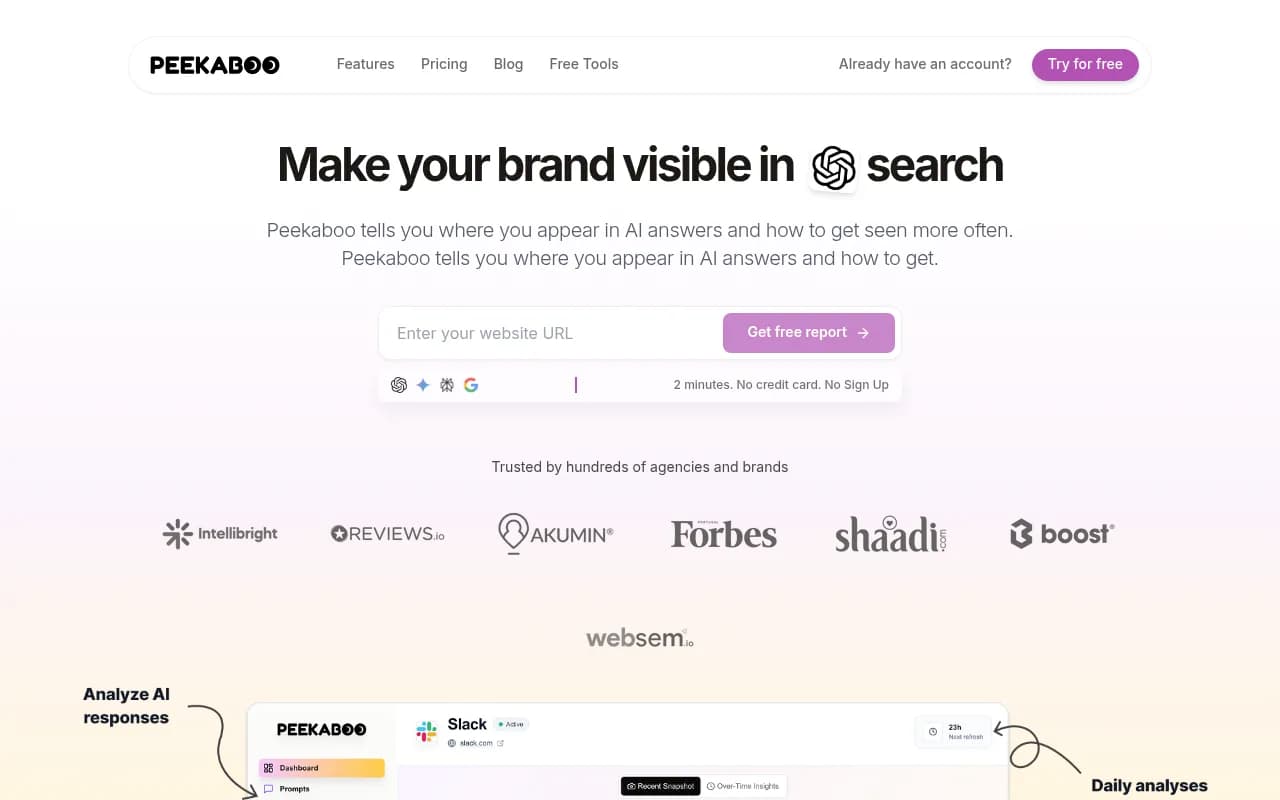
AI Peekaboo is a straightforward AI visibility monitoring tool that tracks brand mentions across ChatGPT, Perplexity, Gemini, Google AI Overviews, and Google AI Mode. It's explicitly built for agencies -- white-labeling, multi-client dashboards, and Looker Studio integration are core features. The pitch is simple: see when and how AI models mention your brand, track competitors, and package that data for clients.
Pricing isn't publicly listed, but based on market positioning and the 7-day free trial, it likely starts around $49-79/mo. That makes it one of the more accessible entry points in the GEO space. The trade-off: you get basic monitoring, not the advanced analytics or experimentation layer that enterprise platforms offer.
Side-by-side comparison
| Feature | XFunnel | AI Peekaboo |
|---|---|---|
| Target audience | Enterprise marketing teams | Agencies, freelancers, small teams |
| Pricing model | Custom enterprise (contact sales) | Estimated $49-79/mo, 7-day trial |
| AI models tracked | Answer engines (specific list not detailed) | ChatGPT, Perplexity, Gemini, Google AIO, Google AI Mode |
| White-labeling | Not emphasized | Yes, full white-label for agencies |
| Multi-client management | No | Yes |
| Citation tracking | Yes | Yes |
| Competitor tracking | Yes | Yes |
| Experimentation features | Yes | No |
| Content gap analysis | No | No |
| AI crawler logs | No | No |
| Content generation | No | No |
| Looker Studio integration | Not mentioned | Yes |
| HubSpot acquisition | In progress (2026) | Independent |
Feature deep-dive
Monitoring capabilities
Both platforms track when your brand appears in AI-generated answers. XFunnel calls this "citation tracking" and ties it to a broader analytics framework -- you can see trends over time, compare against competitors, and drill into which queries trigger mentions. The dashboard is built for enterprise users who want to present data to stakeholders.
AI Peekaboo offers the same core tracking but packages it for agency workflows. You set up prompts you want to monitor, see an "AI visibility score," and export reports for clients. The Looker Studio integration is a nice touch for agencies that already use Google's reporting stack. The interface is simpler -- less depth, faster setup.
Neither platform tells you WHY you're not being cited or what content you're missing. They show you the scoreboard, not the playbook. If you want to understand content gaps and generate optimized articles based on what AI models are looking for, that's where Promptwatch comes in -- it combines monitoring with Answer Gap Analysis and an AI writing agent that creates content grounded in real citation data.

Experimentation and optimization
XFunnel includes experimentation features that let you test different optimization strategies and measure impact on AI visibility. This is a differentiator -- most GEO platforms stop at monitoring. The idea is you can try different content approaches, schema markup changes, or site structure tweaks, then see if your citation rate improves.
AI Peekaboo doesn't have this layer. It's pure monitoring. You see the data, you make changes on your own, you check back later. For agencies running multiple clients on tight budgets, that's often enough -- the value is in the reporting, not the experimentation.
Verdict: If you're running optimization experiments at scale, XFunnel's tooling is more sophisticated. If you just need to track and report, Peekaboo's simplicity is fine.
Agency features
AI Peekaboo is explicitly built for agencies. White-labeling means you can rebrand the dashboard and reports as your own. Multi-client management means you can switch between client accounts without logging in and out. Looker Studio integration means you can pull Peekaboo data into custom reports alongside other metrics.
XFunnel doesn't emphasize any of this. The client list (Wix, Monday.com, etc.) is all direct brands, not agencies reselling the tool. If you're an agency, you'd be buying XFunnel for your own brand monitoring, not reselling it to clients.
Verdict: Peekaboo wins for agencies. XFunnel isn't built for that use case.
Enterprise analytics
XFunnel's enterprise focus shows up in the analytics depth. You get trend analysis, competitor benchmarking, and the ability to slice data by different dimensions. The platform is built for teams that need to justify budget spend and show ROI to leadership.
AI Peekaboo's analytics are simpler -- visibility scores, mention counts, basic competitor comparisons. It's enough to show a client "you're mentioned 40% of the time for these queries, your competitor is mentioned 60%," but it doesn't have the layered analysis that enterprise teams expect.
Verdict: XFunnel has more analytical horsepower. Peekaboo is adequate for basic reporting.
Model coverage
AI Peekaboo explicitly lists five models: ChatGPT, Perplexity, Gemini, Google AI Overviews, Google AI Mode. That's transparent and covers the major players.
XFunnel's site references "answer engines" without specifying which ones. That's a red flag -- you'd need to ask sales for the full list. Given their enterprise positioning, they likely cover the same major models, but the lack of transparency is frustrating.
Verdict: Peekaboo gets points for clarity. XFunnel should publish their model list.
HubSpot acquisition impact
This is the elephant in the room. XFunnel announced in 2026 that it's being acquired by HubSpot. What does that mean?
Short-term: Existing customers will likely see tighter integration with HubSpot CRM, better lead tracking, and possibly bundled pricing if you're already a HubSpot customer.
Long-term: HubSpot acquisitions often mean feature consolidation. XFunnel's standalone product may become a module inside HubSpot's marketing suite. Pricing could shift from custom enterprise to HubSpot's tiered model. The roadmap will align with HubSpot's priorities, not XFunnel's original vision.
If you're evaluating XFunnel today, you're betting on HubSpot's execution of the integration. If you're already deep in the HubSpot ecosystem, that's probably a good bet. If you want a standalone GEO tool that won't change ownership, look elsewhere.
What both platforms are missing
Neither XFunnel nor AI Peekaboo offers:
- AI crawler logs (see which AI bots are hitting your site and what they're reading)
- Content gap analysis (identify which prompts competitors rank for but you don't)
- Prompt intelligence (volume estimates, difficulty scores, query fan-outs)
- Content generation (create optimized articles based on citation data)
- Reddit/YouTube tracking (surface discussions that influence AI recommendations)
- Traffic attribution (connect AI visibility to actual revenue)
These are table-stakes features in more comprehensive platforms. If you need them, you're looking at tools like Promptwatch, which combines monitoring with actionable optimization -- showing you what's missing, then helping you create content that gets cited.
Pricing comparison
| Plan | XFunnel | AI Peekaboo |
|---|---|---|
| Entry pricing | Custom (contact sales) | ~$49-79/mo (estimated) |
| Free trial | Not mentioned | 7 days |
| Pricing transparency | Low (enterprise sales model) | Low (not publicly listed) |
| Target buyer | Enterprise marketing teams | Agencies, small teams |
Neither platform publishes detailed pricing, which is frustrating. XFunnel's "contact sales" model typically means $500+/mo minimums. AI Peekaboo's trial and agency focus suggest a lower entry point, but you'll need to request a quote.
For reference, Promptwatch starts at $99/mo (Essential plan) with transparent pricing and a free trial -- no sales calls required.
Pros and cons
XFunnel pros
- Used by major enterprise brands (social proof)
- Experimentation features for testing optimization strategies
- Advanced analytics and competitor benchmarking
- HubSpot acquisition may bring better CRM integration
XFunnel cons
- HubSpot acquisition creates uncertainty about future roadmap and pricing
- Custom enterprise pricing (high barrier to entry)
- No agency-focused features (white-labeling, multi-client)
- Lacks content gap analysis and optimization tools
- Model coverage not transparently listed
AI Peekaboo pros
- Built for agencies (white-labeling, multi-client management)
- Lower estimated entry price (~$49-79/mo)
- Looker Studio integration for custom reporting
- Clear model coverage (ChatGPT, Perplexity, Gemini, Google AIO, Google AI Mode)
- Simple setup, faster onboarding
AI Peekaboo cons
- Basic monitoring only -- no experimentation or advanced analytics
- No content gap analysis or optimization features
- Pricing not publicly listed (requires quote)
- Less analytical depth than enterprise platforms
- No AI crawler logs or traffic attribution
Who should pick which tool
Pick XFunnel if:
- You're an enterprise marketing team with budget for custom pricing
- You want experimentation features to test optimization strategies
- You need advanced analytics and competitor benchmarking
- You're already invested in the HubSpot ecosystem and see the acquisition as a positive
- You're okay with the uncertainty of a platform in transition
Pick AI Peekaboo if:
- You're an agency managing multiple clients and need white-labeling
- You want a simple, affordable monitoring tool without enterprise complexity
- You use Looker Studio and want to integrate AI visibility data into existing reports
- You need faster setup and don't require deep analytics
- You're comfortable with basic monitoring and will handle optimization separately
Pick neither if:
- You need content gap analysis to understand what you're missing
- You want AI crawler logs to see how AI bots interact with your site
- You need built-in content generation to create optimized articles
- You want prompt intelligence (volume, difficulty, query fan-outs)
- You need to connect AI visibility to actual traffic and revenue
In those cases, look at Promptwatch -- it's the only platform that combines monitoring with actionable optimization, showing you what's missing and helping you create content that gets cited by AI models.
Final verdict
XFunnel and AI Peekaboo serve different buyers. XFunnel is an enterprise platform with advanced analytics and experimentation features, but the HubSpot acquisition creates uncertainty about its future. AI Peekaboo is a simpler, agency-focused tool with white-labeling and multi-client management at a lower price point.
If you're an agency, Peekaboo is the obvious choice. If you're an enterprise team already using HubSpot, XFunnel's integration may be valuable (once the acquisition completes). If you're a mid-market brand that needs more than monitoring -- content gap analysis, optimization tools, AI crawler logs -- both platforms fall short. That's where comprehensive GEO platforms like Promptwatch come in, combining visibility tracking with the tools to actually improve your rankings in AI search.
The bottom line: XFunnel has more depth but comes with acquisition risk and enterprise pricing. Peekaboo is simpler and cheaper but lacks optimization features. Neither gives you the full picture of why you're not being cited or how to fix it.