Key Takeaways
- XFunnel is enterprise-focused with custom pricing and HubSpot acquisition backing, while AI Rank Checker offers pay-as-you-go credits starting at $5 with no subscriptions
- AI Rank Checker tracks 7 AI engines explicitly (ChatGPT, Perplexity, Claude, Gemini, Copilot, Grok, Meta AI) and supports multi-domain tracking ideal for agencies
- XFunnel serves major brands like Wix, Monday.com, and LastPass with sentiment tracking and deeper analytics, but requires sales contact for pricing
- Neither platform includes content optimization or generation—both are monitoring-focused tools
- If you need transparent pricing and flexibility, AI Rank Checker wins. If you're an enterprise team needing advanced features and CRM integration, XFunnel is the play
- For teams that also want content gap analysis and AI-optimized article generation to actually improve visibility (not just track it), Promptwatch complements either tool by closing the optimization loop
Overview: Two approaches to AI search visibility
XFunnel
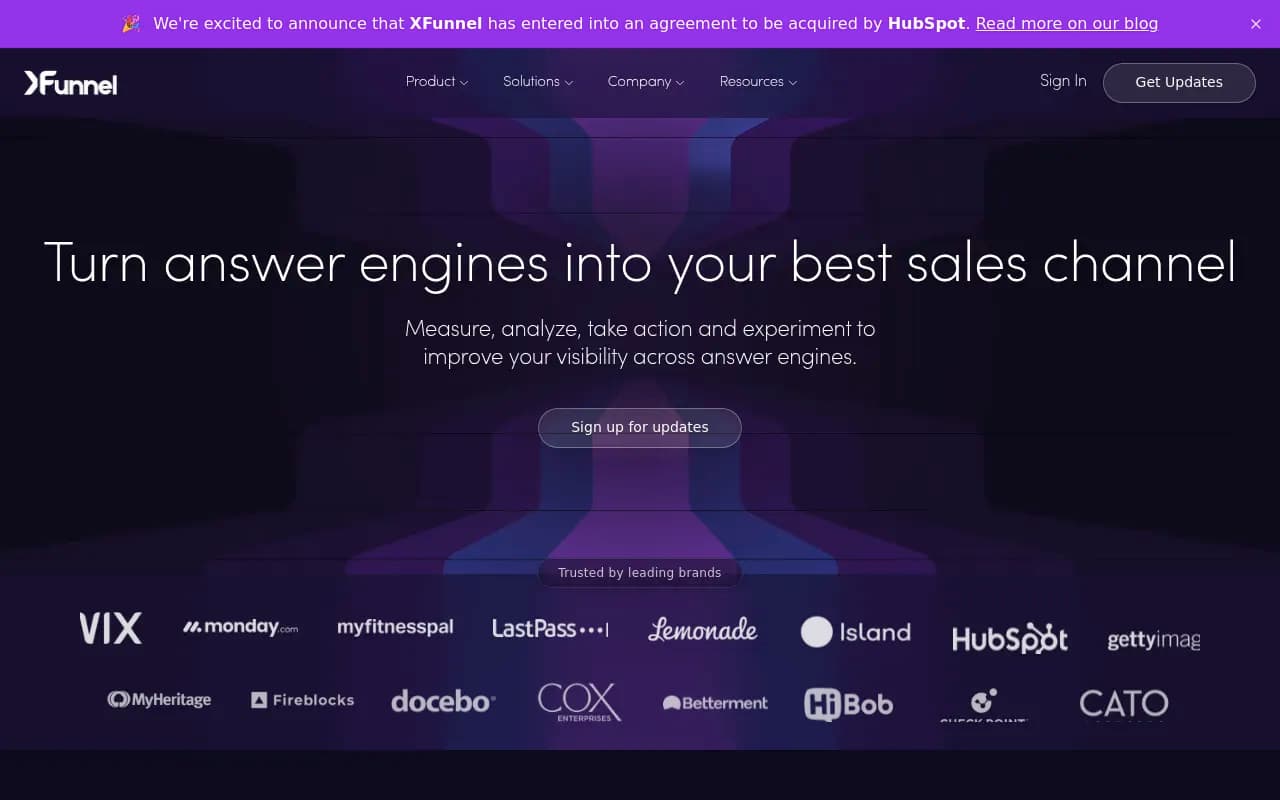
XFunnel positions itself as a generative engine optimization platform for marketing teams. It's built for enterprises—clients include Wix, Monday.com, MyFitnessPal, LastPass, and other recognizable brands. The platform tracks brand visibility across AI-powered search engines and offers sentiment analysis against competitors. In early 2026, XFunnel announced it's being acquired by HubSpot, which signals both validation and likely deeper CRM integration down the road. Pricing is custom enterprise only—you have to contact sales.
AI Rank Checker
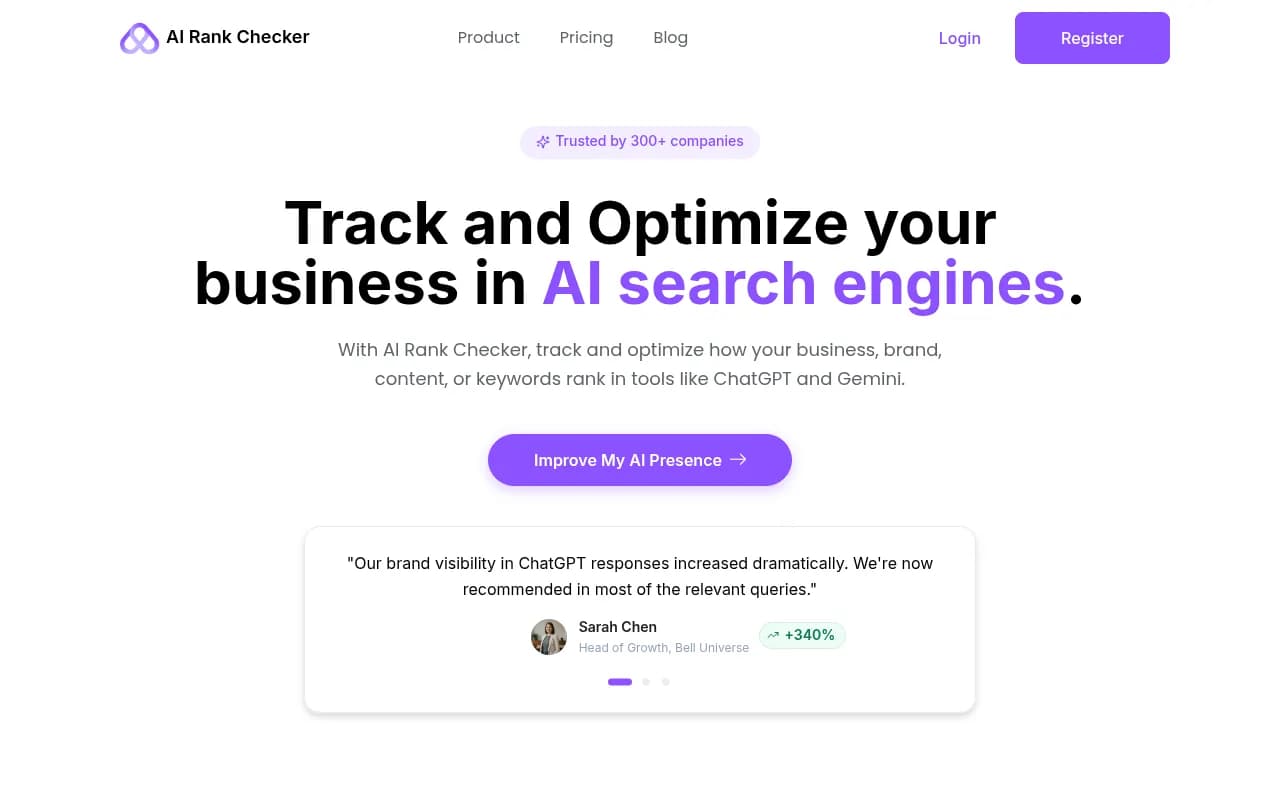
AI Rank Checker takes a different approach: pay-as-you-go credits with no subscriptions. You top up your wallet starting at $5 and pay only for the keywords and AI engines you check. It tracks 7 AI platforms (ChatGPT, Perplexity, Claude, Gemini, Copilot, Grok, Meta AI) and supports multi-domain tracking with separate dashboards per brand. The tool is designed for marketers, agencies, and SEO teams who want transparency and flexibility without enterprise sales cycles. Export reports as PDF or CSV.
Side-by-side comparison
| Feature | XFunnel | AI Rank Checker |
|---|---|---|
| Pricing model | Custom enterprise (contact sales) | Pay-as-you-go from $5 |
| Free tier | One-time audit | No |
| AI engines tracked | Not publicly listed | 7 (ChatGPT, Perplexity, Claude, Gemini, Copilot, Grok, Meta AI) |
| Multi-domain tracking | Not highlighted | Yes, separate dashboards |
| Sentiment analysis | Yes | No |
| Competitor tracking | Yes | Yes |
| Export reports | Likely yes | PDF and CSV |
| HubSpot integration | Yes (acquisition announced) | No |
| Ideal for | Enterprises, large marketing teams | Agencies, small-to-mid teams, budget-conscious marketers |
| Contract commitment | Likely annual | None (credits don't expire) |
| Public customer logos | Wix, Monday.com, LastPass, Lemonade, Getty Images | 300+ companies (no specific logos) |
| Content optimization | No | No |
Pricing: Enterprise vs pay-as-you-go
This is the clearest dividing line.
XFunnel doesn't list pricing publicly. You contact sales, go through a demo, and get a custom quote. Based on the client roster (major SaaS brands, financial services companies, enterprise HR platforms), you're looking at thousands per month minimum, likely with annual contracts. The one-time free audit is a lead-gen tool, not a self-serve option.
AI Rank Checker is the opposite. Top up $5, $50, $500—whatever you need. Each keyword check costs a small amount (pricing per check isn't listed on the site, but the model is transparent). No monthly fees. No sales calls. Credits sit in your wallet until you use them. This works well for agencies that bill clients per project, or small teams that want to check visibility sporadically without paying for a full platform every month.
If budget transparency and low entry cost matter, AI Rank Checker is the only option here. If you're a large team with budget and you want enterprise features, XFunnel's pricing model won't scare you off.
AI engine coverage
AI Rank Checker explicitly lists 7 engines: ChatGPT, Perplexity, Claude, Gemini, Copilot, Grok, and Meta AI. You pick which ones to check for each keyword, and you only pay for what you use.
XFunnel's website doesn't specify which AI engines it tracks. It refers to "answer engines" and "AI-powered search engines" broadly. Based on competitor research and the category, it likely covers the major ones (ChatGPT, Perplexity, Gemini), but the lack of transparency here is a gap. You'd need to ask during the sales process.
For most marketers, the 7 engines AI Rank Checker covers are the ones that matter. If XFunnel tracks more obscure or regional AI engines, that could be a differentiator for global brands, but we don't have confirmation.
Multi-domain and agency use cases
AI Rank Checker explicitly supports tracking multiple domains with separate dashboards per brand. This is a huge win for agencies managing 5, 10, or 20 clients. You can organize everything in one account, export client-specific reports, and bill based on actual usage.
XFunnel doesn't highlight multi-domain tracking on its site. It's built for enterprise clients, so it probably supports multiple brands within a single organization (e.g. a company with several product lines), but the focus is on single-brand optimization at scale. If you're an agency, you'd need to ask whether XFunnel offers white-label reporting or multi-tenant setups.
For agencies, AI Rank Checker's structure is more practical. For in-house teams at large companies, XFunnel's enterprise focus fits better.
Feature depth: Sentiment vs simplicity
XFunnel includes sentiment tracking—how your brand is being talked about in AI responses compared to competitors. This is a more advanced feature that goes beyond "are we mentioned?" to "are we mentioned positively or negatively?" For reputation-sensitive brands (financial services, healthcare, B2B SaaS), this matters.
AI Rank Checker doesn't offer sentiment analysis. It tracks whether you're mentioned, where you rank, and which competitors appear. That's it. The focus is on visibility and ranking position, not tone or context.
XFunnel also benefits from the HubSpot acquisition. We don't know the full integration roadmap yet, but it's reasonable to expect tighter CRM connections, workflow automation, and possibly AI search data feeding into HubSpot's attribution models. If you're already a HubSpot shop, this could be a big deal.
AI Rank Checker is simpler by design. You get ranking data, competitor comparisons, and export options. No sentiment, no CRM hooks, no advanced analytics. For many teams, that simplicity is a feature, not a bug.
Reporting and exports
Both platforms support exporting data, but AI Rank Checker makes it explicit: PDF and CSV downloads with ranking history, competitors, and keywords. You can hand these reports to clients or executives without extra formatting.
XFunnel likely has reporting (any enterprise tool does), but the specifics aren't detailed on the site. You'd expect dashboards, visualizations, and probably API access for custom integrations, but again—you have to ask sales.
What neither tool does: Content optimization
Here's the gap both platforms share. XFunnel and AI Rank Checker are monitoring tools. They tell you where you stand in AI search results, but they don't help you fix it.
You can see that your competitor ranks for "best project management software" in ChatGPT and you don't. Great. Now what? You still need to figure out what content to create, which angles to cover, and how to structure it so AI models cite you.
This is where a platform like Promptwatch fits in. Promptwatch doesn't just track visibility—it shows you the content gaps (which prompts competitors rank for but you don't), then helps you generate AI-optimized articles grounded in real citation data. You can use XFunnel or AI Rank Checker to monitor results, and Promptwatch to actually create the content that moves the needle.

If you're serious about improving AI search visibility (not just measuring it), you need both: a tracker and an optimizer. Neither XFunnel nor AI Rank Checker solves the full loop on their own.
Customer base and trust signals
XFunnel lists impressive logos: Wix, Monday.com, MyFitnessPal, LastPass, Lemonade, Getty Images, HubSpot, Cato Networks, Check Point. These are real enterprise brands with serious marketing budgets. The HubSpot acquisition adds another layer of credibility—HubSpot doesn't buy tools that don't work.
AI Rank Checker claims "300+ companies" but doesn't show logos. The testimonials on the site (Elena Rodriguez, Sarah Chen, Marcus Webb) include percentage increases (+428%, +340%, +215%) but no verifiable company names or LinkedIn profiles. This is a yellow flag. The testimonials might be real, but without verification, they read like stock marketing copy.
If brand trust and proven enterprise adoption matter to you, XFunnel has the edge. If you're willing to try a tool based on its features and pricing model rather than social proof, AI Rank Checker is still worth testing.
Pros and cons
XFunnel pros
- Enterprise-grade platform trusted by major brands
- Sentiment tracking and competitor analysis
- HubSpot acquisition means future CRM integration and backing from a major player
- Built for large marketing teams with complex needs
- Free one-time audit to test the platform
XFunnel cons
- Custom pricing with no transparency—requires sales contact
- Likely expensive and overkill for small teams or agencies
- AI engine coverage not publicly listed
- No clear multi-domain or white-label support for agencies
- Monitoring-only—no content optimization or generation
AI Rank Checker pros
- Pay-as-you-go pricing starting at $5—no subscriptions or contracts
- Tracks 7 AI engines with transparent selection
- Multi-domain tracking with separate dashboards (ideal for agencies)
- Simple, focused feature set without bloat
- Export reports as PDF or CSV
AI Rank Checker cons
- No sentiment analysis or advanced analytics
- Testimonials lack verification (no logos, LinkedIn profiles, or company names)
- No CRM integrations or workflow automation
- Monitoring-only—no content optimization or generation
- Less proven with enterprise clients compared to XFunnel
Who should pick which tool
Pick XFunnel if:
- You're an enterprise marketing team with budget for custom pricing
- You need sentiment tracking and deeper competitive analysis
- You're already using HubSpot and want tighter integration
- You're managing a single large brand (or a few brands within one org)
- You want a platform backed by a major acquisition and proven with Fortune 500 clients
Pick AI Rank Checker if:
- You're an agency managing multiple client domains
- You want transparent, pay-as-you-go pricing with no subscriptions
- You need flexibility to check AI visibility sporadically without monthly fees
- You're a small-to-mid-size team or solo marketer on a budget
- You value simplicity and don't need sentiment analysis or CRM hooks
Pick neither (or use alongside Promptwatch) if:
- You need content gap analysis and AI-optimized article generation, not just monitoring
- You want to actually improve your AI search visibility, not just track it
- You need crawler logs, Reddit/YouTube insights, or prompt intelligence to guide your content strategy
Final verdict
XFunnel and AI Rank Checker serve different markets. XFunnel is the enterprise play—proven with major brands, backed by HubSpot, built for teams with budget and complex needs. AI Rank Checker is the flexible, transparent option for agencies and smaller teams who want to track AI visibility without enterprise pricing or sales cycles.
If you're Wix or Monday.com, you pick XFunnel. If you're a 3-person agency managing 10 clients, you pick AI Rank Checker. The pricing model alone makes the decision for most teams.
But here's the real issue: both tools are trackers, not optimizers. They tell you where you stand, but they don't help you climb. If you want to actually improve your AI search visibility—find content gaps, generate optimized articles, track the impact—you need a platform that closes the loop. That's where tools like Promptwatch come in. Use XFunnel or AI Rank Checker to monitor, use Promptwatch to optimize, and you've got the full stack.