Key Takeaways
- Pricing accessibility: AthenaHQ offers transparent self-serve pricing at $295/month with a $95 first-month trial, while XFunnel requires sales contact for custom enterprise quotes -- making AthenaHQ more accessible for mid-market teams
- HubSpot acquisition changes the game: XFunnel entered an agreement to be acquired by HubSpot in 2025, which may affect roadmap, pricing, and standalone availability going forward
- Enterprise vs. flexible positioning: XFunnel targets large marketing teams with enterprise-only pricing; AthenaHQ serves both self-serve customers and enterprise clients with a credit-based model
- AI model coverage: AthenaHQ explicitly tracks 8+ LLMs; XFunnel's coverage isn't publicly detailed but claims to monitor "AI-powered search engines"
- Content optimization approach: Both platforms offer optimization capabilities beyond monitoring, but AthenaHQ makes automated recommendations more prominent in their positioning
- Customer base overlap: Both serve recognizable brands (XFunnel: Wix, Monday.com, LastPass; AthenaHQ: Coinbase, ZoomInfo, SoFi), indicating enterprise credibility on both sides
Overview
XFunnel
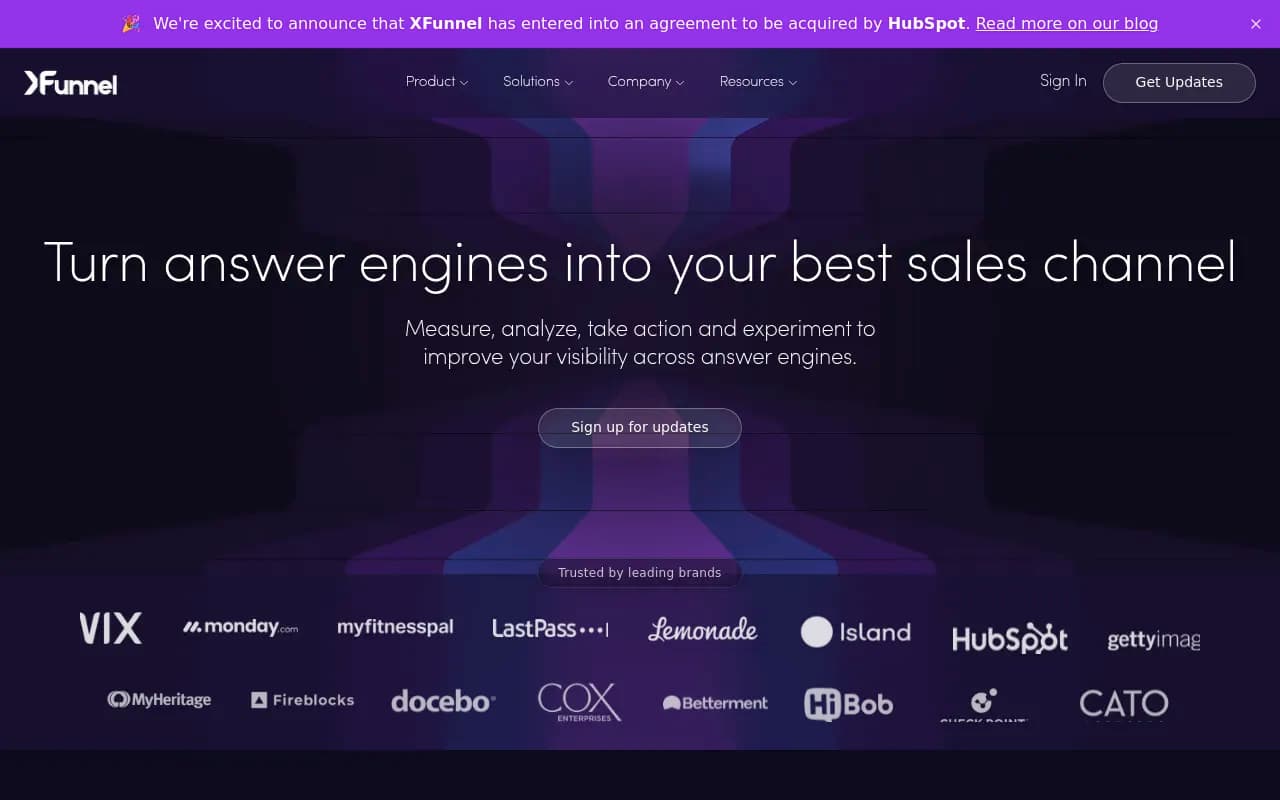
XFunnel is a generative engine optimization platform built for marketing teams to track and improve brand visibility across AI-powered search engines. The platform positions itself around helping teams "measure, analyze, take action and experiment" to improve visibility in answer engines. XFunnel's client roster includes major brands like Wix, Monday.com, MyFitnessPal, LastPass, and Getty Images.
The big news: XFunnel announced in 2025 that it entered an agreement to be acquired by HubSpot. This acquisition will likely reshape the product's future -- whether it becomes part of HubSpot's marketing suite or continues as a standalone tool remains to be seen. For teams evaluating XFunnel today, this transition is a major consideration.
XFunnel uses custom enterprise pricing (contact sales only), which signals a focus on larger organizations with substantial budgets and complex needs.
AthenaHQ

AthenaHQ is a GEO/AEO platform that helps marketing teams monitor and optimize how their brand appears in AI search results. The platform explicitly tracks 8+ LLMs including ChatGPT, Perplexity, Google AI Overviews, and Claude. AthenaHQ serves enterprise clients like Coinbase, ZoomInfo, and SoFi, but also offers a self-serve tier starting at $295/month.
AthenaHQ uses a credit-based pricing model where 1 credit = 1 AI query, giving teams control over usage and costs. The platform emphasizes end-to-end workflow management, automated content optimization recommendations, and citation source analysis. They've also published research like the "State of AI Search 2026 Report" and have been featured in Forbes and the Wall Street Journal.
The platform positions itself as a complete toolkit for AI Engine Optimization specialists, with features spanning monitoring, optimization, and strategic reporting.
Side-by-side comparison
| Feature | XFunnel | AthenaHQ |
|---|---|---|
| Pricing model | Custom enterprise (contact sales) | Self-serve $295/mo + enterprise custom |
| Entry price | Unknown (enterprise only) | $95 first month, then $295/mo |
| Free trial | Not specified | Yes ($95 first month trial) |
| AI models tracked | Not publicly specified | 8+ LLMs (ChatGPT, Perplexity, Google AI Overviews, Claude, etc.) |
| Credit-based usage | No | Yes (1 credit = 1 AI query) |
| Self-serve option | No | Yes |
| Enterprise plans | Yes (only option) | Yes (custom pricing) |
| Content optimization | Yes (details limited) | Yes (automated recommendations) |
| Citation tracking | Yes | Yes (with source analysis) |
| Ownership status | Being acquired by HubSpot | Independent (Y Combinator backed) |
| Target customer | Large enterprise marketing teams | Mid-market to enterprise |
| Annual discount | Unknown | 17% off annual plans |
Pricing: transparency vs. enterprise-only
This is where the two platforms diverge most sharply.
XFunnel uses custom enterprise pricing with no public pricing information. You have to contact sales to get a quote. This approach is common for enterprise-focused tools, but it creates friction for teams that want to evaluate cost before investing time in a sales conversation. For large organizations with complex needs and substantial budgets, this isn't a dealbreaker -- you're going to have custom requirements anyway. But for mid-market teams or those exploring GEO for the first time, the lack of pricing transparency is a barrier.
AthenaHQ offers transparent self-serve pricing: $295/month with a $95 first-month trial. The credit-based model (1 credit = 1 AI query) gives you control over usage and costs. Annual plans get a 17% discount. Enterprise customers can still get custom pricing, but the self-serve option makes it easy to start without a sales process. This flexibility is a major advantage for teams that want to test the platform before committing to an enterprise contract.
Pricing comparison
| Plan type | XFunnel | AthenaHQ |
|---|---|---|
| Self-serve entry | Not available | $95 first month, then $295/mo |
| Enterprise | Custom (contact sales) | Custom (contact sales) |
| Annual discount | Unknown | 17% off |
| Usage model | Unknown | Credit-based (1 credit = 1 query) |
Verdict: AthenaHQ wins on pricing accessibility. The self-serve option and transparent pricing make it easier to get started, especially for mid-market teams. XFunnel's enterprise-only approach works for large organizations but creates friction for everyone else.
AI model coverage and tracking capabilities
AthenaHQ explicitly states it tracks 8+ LLMs, including ChatGPT, Perplexity, Google AI Overviews, and Claude. The platform emphasizes cross-platform AI visibility tracking as a core feature. You get citation tracking, source analysis, and visibility metrics across all these engines.
XFunnel mentions tracking across "AI-powered search engines" and helping teams improve visibility in "answer engines," but the website doesn't specify which AI models are covered or how many. The client testimonials and case studies suggest comprehensive coverage, but the lack of specifics makes it harder to evaluate.
Both platforms appear to cover the major AI search engines that matter for brand visibility, but AthenaHQ's transparency about exactly which models they track is helpful for evaluation.
Verdict: AthenaHQ provides more clarity on AI model coverage. If you need to know exactly which LLMs you're tracking before you buy, AthenaHQ makes that information public.
Content optimization and actionability
Both platforms position themselves as more than just monitoring dashboards -- they help you take action to improve visibility.
XFunnel describes its value as helping teams "measure, analyze, take action and experiment." The website mentions improving visibility and conversion across AI platforms, but specific optimization features aren't detailed publicly. The platform likely includes recommendations and optimization workflows given its enterprise positioning, but you'll need to talk to sales to understand the details.
AthenaHQ makes content optimization more explicit in its positioning. The platform offers:
- Automated content optimization recommendations
- Citation source analysis (understand which sources AI models are citing)
- End-to-end GEO workflow management
- Link building insights based on citation patterns
AthenaHQ's marketing emphasizes the "action" side of the equation -- not just showing you where you're invisible, but helping you fix it. The platform includes tools for AEO/GEO specialists to manage the entire optimization workflow.
If you're also looking to track how your brand shows up in AI search results and get specific guidance on content gaps, Promptwatch takes a different angle by showing you exactly which prompts competitors rank for but you don't, then helping you generate content to fill those gaps.

Verdict: Both platforms offer optimization capabilities, but AthenaHQ makes the optimization workflow more prominent in their public positioning. XFunnel likely has similar features but doesn't detail them as clearly.
Enterprise features and integrations
XFunnel is built for enterprise marketing teams. The client roster (Wix, Monday.com, LastPass, Getty Images, HubSpot) signals a focus on large organizations with complex needs. The HubSpot acquisition suggests deep integration with HubSpot's marketing suite is coming, which could be a major advantage for HubSpot customers -- or a limitation if you're not in the HubSpot ecosystem.
The platform mentions helping teams "improve conversion across AI platforms," which suggests tracking beyond just citations to actual business outcomes. But again, specifics aren't public.
AthenaHQ serves enterprise clients (Coinbase, ZoomInfo, SoFi) but also supports mid-market teams through the self-serve tier. The platform includes:
- ROI tracking for AI optimization efforts
- Executive-level dashboards for strategic oversight
- Cross-platform visibility tracking
- End-to-end workflow management for GEO specialists
AthenaHQ's positioning around "empowering next-gen marketing teams" suggests a focus on modern marketing orgs that want to own AI search optimization as a core channel, not just monitor it passively.
Verdict: XFunnel has a stronger enterprise-only focus and the HubSpot acquisition may bring powerful integrations for HubSpot customers. AthenaHQ offers enterprise capabilities but with more flexibility for mid-market teams.
User experience and ease of use
Neither platform provides detailed public demos or screenshots, so evaluating UX requires a trial or demo.
XFunnel positions itself around helping teams "turn answer engines into your best sales channel." The video on their homepage shows a dashboard interface, but details are limited. Given the enterprise focus, expect a robust but potentially complex interface built for marketing teams with dedicated GEO specialists.
AthenaHQ emphasizes role-based workflows -- different views for AEO/GEO managers, CMOs, SEO teams, PR teams, content marketers, and brand marketers. This suggests a flexible interface that adapts to different use cases. The platform describes itself as a "command center" for AI search optimization, which implies a centralized dashboard approach.
The credit-based model in AthenaHQ gives you direct control over usage, which can simplify budgeting and cost management compared to opaque enterprise pricing.
Verdict: Hard to judge without hands-on testing, but AthenaHQ's role-based approach and self-serve option suggest a more accessible onboarding experience. XFunnel likely requires more setup and sales involvement.
The HubSpot acquisition factor
This is the elephant in the room. XFunnel announced in 2025 that it entered an agreement to be acquired by HubSpot. What does this mean for customers?
Potential upsides:
- Deep integration with HubSpot's CRM and marketing suite
- More resources and development capacity
- Potentially bundled pricing for HubSpot customers
- Stronger enterprise support and infrastructure
Potential downsides:
- Uncertainty about standalone availability
- Possible forced migration to HubSpot ecosystem
- Roadmap changes to align with HubSpot priorities
- Pricing changes or restructuring
If you're already a HubSpot customer, this acquisition could be a major win -- seamless integration between your CRM, marketing automation, and AI search optimization. If you're not in the HubSpot ecosystem, it introduces uncertainty. Will XFunnel continue as a standalone product? Will pricing change? Will features be locked behind HubSpot subscriptions?
AthenaHQ, by contrast, is independent (backed by Y Combinator) and focused entirely on GEO/AEO. There's no acquisition uncertainty, and the roadmap is driven by AI search optimization needs, not a larger platform strategy.
Verdict: The HubSpot acquisition is a double-edged sword. Great for HubSpot customers, uncertain for everyone else. AthenaHQ offers more stability and independence.
Customer base and credibility
Both platforms serve recognizable brands, which signals enterprise credibility.
XFunnel clients: Wix, Monday.com, MyFitnessPal, LastPass, Lemonade, Getty Images, HubSpot, Fireblocks, Cato Networks, Betterment, Check Point
AthenaHQ clients: Coinbase, ZoomInfo, SoFi, OneSignal, Nextiva, Paperless Post, DeVry University, Volkswagen, Motion
Both lists include major B2B SaaS companies, financial services firms, and enterprise brands. XFunnel skews slightly more toward established tech companies, while AthenaHQ includes a mix of fintech, SaaS, and education.
AthenaHQ has been featured in Forbes and the Wall Street Journal and published the "State of AI Search 2026 Report," which signals thought leadership in the space.
Verdict: Both platforms have strong enterprise credibility. XFunnel has a longer client list publicly displayed, but AthenaHQ's media coverage and research publications add credibility.
Support and onboarding
Neither platform provides detailed public information about support tiers or onboarding processes.
XFunnel, as an enterprise-only platform, likely includes dedicated account management, custom onboarding, and priority support as part of the package. Expect white-glove service for large contracts.
AthenaHQ offers both self-serve and enterprise tiers, which suggests tiered support. Self-serve customers likely get standard support (email, documentation, knowledge base), while enterprise customers get dedicated account management. The $95 first-month trial suggests a low-friction onboarding process for self-serve customers.
Verdict: XFunnel likely offers more hands-on support for enterprise customers, but AthenaHQ's self-serve option makes it easier to get started without waiting for sales cycles.
Pros and cons
XFunnel pros
- Strong enterprise client roster (Wix, Monday.com, LastPass, Getty Images)
- HubSpot acquisition brings potential for deep CRM/marketing integration
- Built specifically for large marketing teams with complex needs
- Focus on conversion and business outcomes, not just citations
XFunnel cons
- No public pricing -- requires sales contact for quotes
- No self-serve option for mid-market teams
- HubSpot acquisition creates uncertainty about standalone availability and roadmap
- Limited public information about AI model coverage and specific features
- May become HubSpot-only, limiting flexibility for non-HubSpot customers
AthenaHQ pros
- Transparent self-serve pricing ($295/mo) with $95 first-month trial
- Credit-based model gives control over usage and costs
- Explicitly tracks 8+ LLMs (ChatGPT, Perplexity, Google AI Overviews, Claude, etc.)
- Automated content optimization recommendations and citation source analysis
- Serves both mid-market and enterprise customers
- Independent platform with focused GEO/AEO roadmap
- Featured in Forbes and WSJ, published State of AI Search 2026 Report
- 17% discount on annual plans
AthenaHQ cons
- Smaller public client list compared to XFunnel
- Less information about specific integrations with other marketing tools
- Credit-based model requires managing usage and budgeting credits
- May lack the deep CRM integration that XFunnel will get through HubSpot
Who should choose which platform
Choose XFunnel if:
- You're a large enterprise with a substantial GEO budget and need custom solutions
- You're already a HubSpot customer and want seamless integration with your existing stack
- You have a dedicated GEO team and need white-glove enterprise support
- You're willing to navigate the uncertainty of the HubSpot acquisition in exchange for potential future integrations
- You prioritize conversion tracking and business outcomes over granular AI model coverage details
Choose AthenaHQ if:
- You're a mid-market team or want to start with a self-serve option before committing to enterprise pricing
- You need transparent pricing and want to control costs with a credit-based model
- You want explicit clarity on which AI models you're tracking (8+ LLMs including ChatGPT, Perplexity, Claude)
- You need automated content optimization recommendations and citation source analysis
- You prefer an independent platform focused entirely on GEO/AEO without acquisition uncertainty
- You want to test the platform with a low-cost first month ($95) before scaling up
- You're not locked into the HubSpot ecosystem and want flexibility
Final verdict
AthenaHQ is the better choice for most teams in 2026. The transparent self-serve pricing, explicit AI model coverage, and credit-based flexibility make it more accessible and predictable than XFunnel's enterprise-only approach. The platform serves enterprise clients (Coinbase, ZoomInfo) while also supporting mid-market teams -- a range XFunnel doesn't offer.
XFunnel's HubSpot acquisition is a wild card. If you're a HubSpot customer, the future integration could be powerful. But for everyone else, it introduces uncertainty about pricing, roadmap, and standalone availability. AthenaHQ's independence and focused GEO/AEO roadmap offer more stability.
Both platforms serve recognizable enterprise brands and offer content optimization beyond just monitoring. But AthenaHQ makes its optimization workflow and AI model coverage more transparent, which matters when you're evaluating a new category of tools.
For teams just getting started with GEO, AthenaHQ's $95 first-month trial and self-serve option remove the friction of sales cycles and custom quotes. For large enterprises already in the HubSpot ecosystem, XFunnel may be worth exploring despite the acquisition uncertainty -- but request detailed information about transition plans and future pricing before committing.