Key Takeaways
- Pricing transparency: LLMrefs costs $79/mo for 500 prompts with unlimited projects and team seats. XFunnel requires contacting sales for custom enterprise pricing -- expect to pay significantly more.
- Target audience: XFunnel is built for large enterprise marketing teams (clients include Wix, Monday.com, LastPass). LLMrefs targets SEO teams and agencies who want straightforward keyword tracking.
- Tracking approach: LLMrefs organizes monitoring around keywords with automated prompt generation. XFunnel focuses on brand citations and visibility across AI engines without emphasizing keyword rankings.
- HubSpot acquisition: XFunnel was acquired by HubSpot in early 2026, which will likely change its standalone availability and integration focus. LLMrefs remains an independent platform.
- AI engine coverage: LLMrefs explicitly tracks 11 AI search engines. XFunnel's coverage isn't publicly detailed but includes major platforms.
- Trial access: LLMrefs offers a 7-day free trial, no credit card needed. XFunnel requires sales contact to discuss trial availability.
Overview
XFunnel
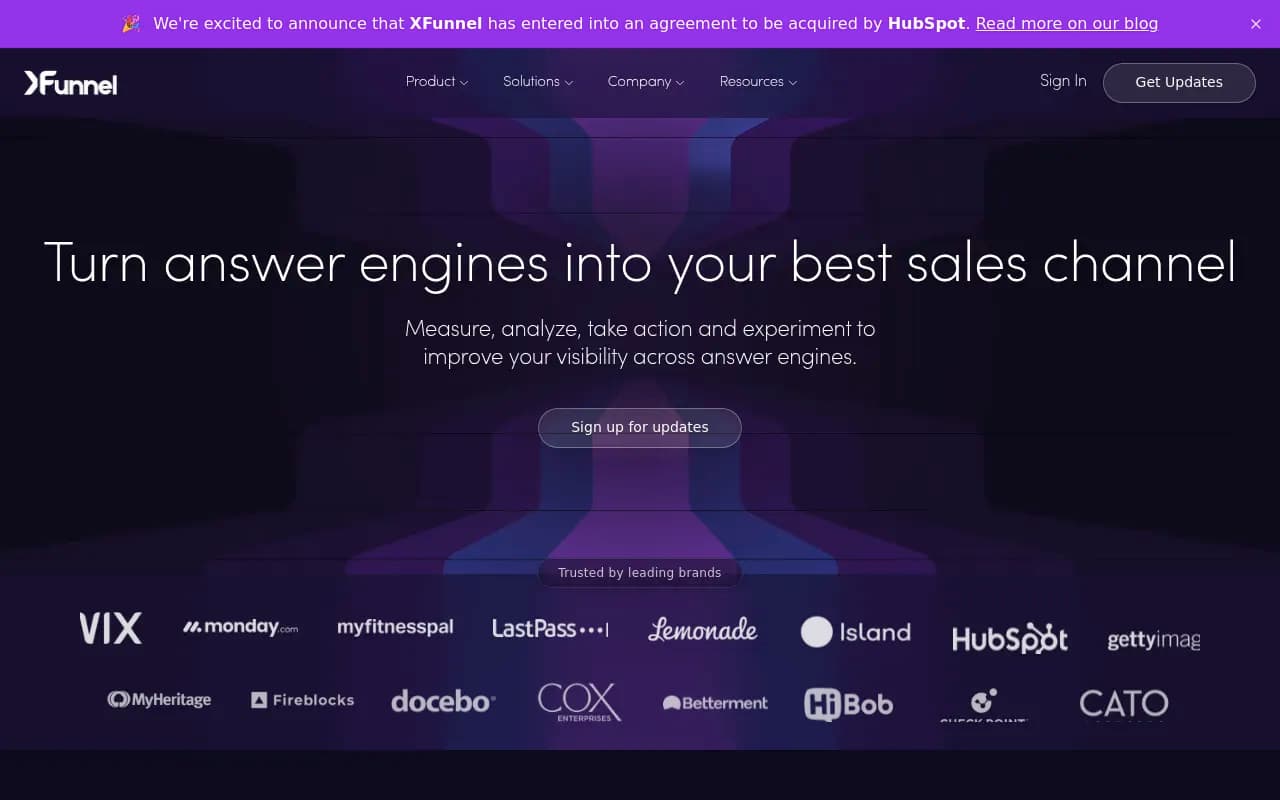
XFunnel positions itself as a generative engine optimization platform for marketing teams. The platform tracks brand visibility and citations across AI-powered search engines, with a focus on helping teams measure, analyze, and improve their presence in AI-generated results. Their client roster includes major brands like Wix, Monday.com, MyFitnessPal, LastPass, and HubSpot (who acquired them in early 2026). The platform uses custom enterprise pricing, which signals it's built for organizations with substantial budgets and complex needs.
LLMrefs
LLMrefs
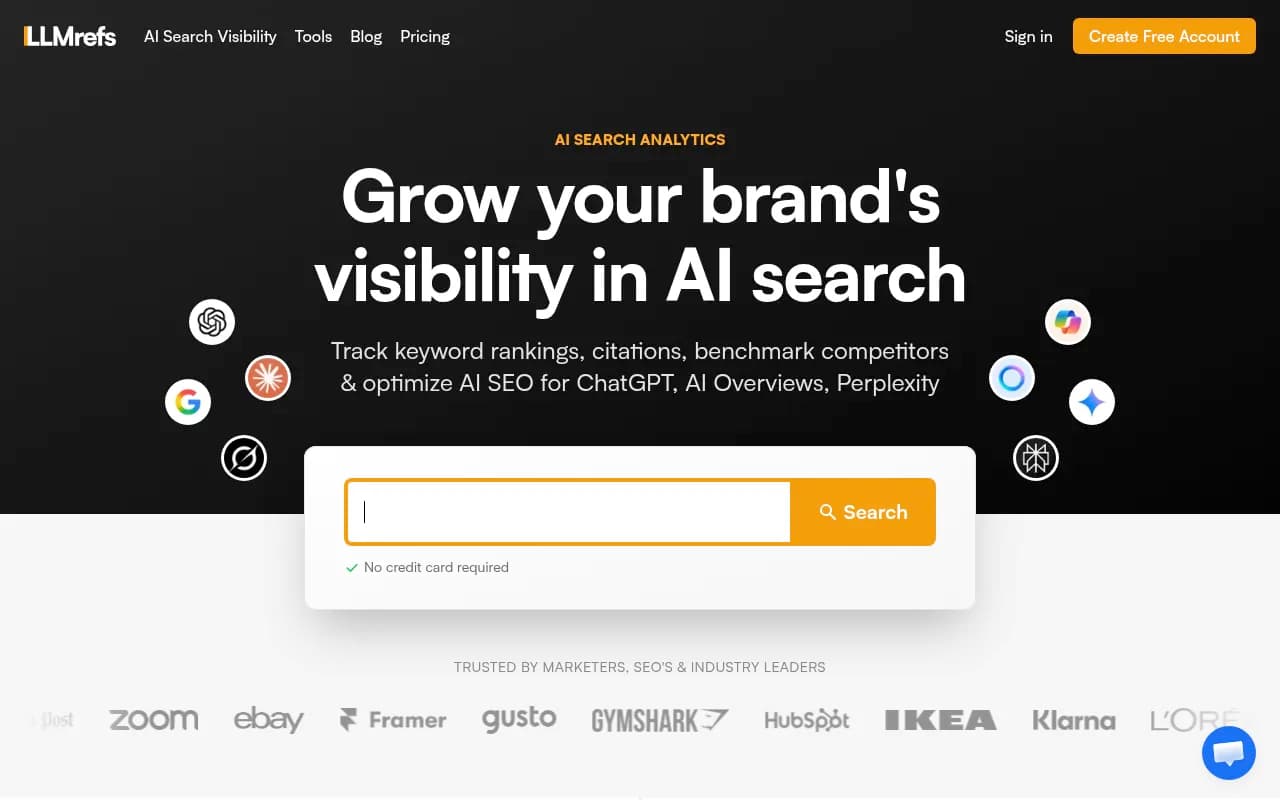
LLMrefs takes a keyword-first approach to AI search analytics. Instead of tracking individual prompts, it organizes monitoring around keywords -- a familiar model for SEO teams. The platform tracks rankings, citations, and brand mentions across 11 AI engines including ChatGPT, Google AI Overviews, Perplexity, Claude, and Gemini. It's used by companies like eBay, Framer, Gymshark, IKEA, and Shopify. At $79/mo for 500 prompts with unlimited projects, domains, and team seats, it's priced for agencies and mid-market teams.
Side-by-Side Comparison
| Feature | XFunnel | LLMrefs |
|---|---|---|
| Pricing | Custom enterprise (contact sales) | $79/mo for 500 prompts |
| Free trial | Not publicly disclosed | 7-day trial, no credit card |
| AI engines tracked | Not publicly specified | 11 engines (ChatGPT, Claude, Perplexity, AI Overviews, Gemini, Grok, Meta AI, Copilot, etc.) |
| Tracking approach | Brand citations & visibility | Keyword rankings with automated prompts |
| Projects/domains | Unknown | Unlimited |
| Team seats | Unknown | Unlimited |
| Country coverage | Unknown | 50+ countries |
| Competitor benchmarking | Yes | Yes |
| Source citation analysis | Yes | Yes |
| Target audience | Enterprise marketing teams | SEO teams & agencies |
| HubSpot integration | Deep (acquired by HubSpot) | Not specified |
| Pricing transparency | No (sales contact required) | Yes (public pricing) |
Tracking methodology
XFunnel's approach
XFunnel focuses on brand visibility and citation tracking across AI search engines. The platform helps teams discover relevant search questions, track where their brand appears in AI-generated answers, and measure citation frequency. It's designed around the idea of turning AI answer engines into sales channels -- tracking how often your brand gets recommended and in what contexts.
The platform doesn't publicly detail whether it uses keyword-based tracking or prompt-based monitoring. Based on their marketing, it seems oriented around brand mentions and citation analysis rather than traditional keyword rankings. This makes sense for their enterprise audience, who care more about "Are we being recommended?" than "Do we rank #1 for this keyword?"
LLMrefs' approach
LLMrefs organizes everything around keywords. You input keywords you want to track, and the platform automatically generates relevant prompts to test across AI engines. This is closer to how SEO teams already think -- you're not managing hundreds of individual prompts, you're tracking keyword visibility.
For each keyword, LLMrefs shows:
- Which AI engines mention your brand
- Your ranking position in responses
- Citation sources AI models are pulling from
- Competitor mentions and rankings
- Geographic variations across 50+ countries
This keyword-first model makes it easier to scale tracking without manually crafting prompts for every variation you want to monitor.
AI engine coverage
XFunnel
XFunnel doesn't publish a specific list of which AI engines it monitors. Their marketing mentions "AI-powered search engines" and "answer engines" generically. Based on industry context, they likely cover the major platforms (ChatGPT, Perplexity, Google AI Overviews), but you'd need to confirm exact coverage with their sales team.
LLMrefs
LLMrefs explicitly tracks 11 AI search engines:
- OpenAI ChatGPT
- Anthropic Claude
- Google AI Overviews
- Google AI Mode
- Google Gemini
- Perplexity AI
- xAI Grok
- Microsoft Copilot
- Meta AI
- Plus two others not specified on their homepage
This is one of the more comprehensive coverage lists in the GEO space. The platform monitors across 50+ countries, so you can track regional variations in AI responses.
Pricing and plans
| Plan | XFunnel | LLMrefs |
|---|---|---|
| Entry tier | Custom (contact sales) | $79/mo |
| Prompts included | Unknown | 500 prompts/mo |
| Projects | Unknown | Unlimited |
| Domains | Unknown | Unlimited |
| Team seats | Unknown | Unlimited |
| Free trial | Not disclosed | 7 days, no credit card |
| Annual discount | Unknown | Not specified |
The pricing difference here is stark. LLMrefs gives you transparent pricing and unlimited projects/domains/seats for $79/mo. XFunnel requires a sales conversation and custom pricing, which typically means significantly higher costs -- likely in the thousands per month for enterprise contracts.
For agencies managing multiple clients, LLMrefs' unlimited projects and domains at a fixed price is a clear win. For large enterprises with complex needs and big budgets, XFunnel's custom approach might offer more tailored solutions (though you're paying for that customization).
Competitor analysis features
XFunnel
XFunnel includes competitor benchmarking, letting you see how your brand's AI visibility compares to competitors. The platform helps identify gaps where competitors are getting cited but you're not. This feeds into their broader narrative of turning AI engines into sales channels -- if competitors are being recommended and you're not, that's lost revenue.
LLMrefs
LLMrefs offers competitor benchmarking across all tracked keywords. You can see which competitors rank for the same keywords, how often they're cited, and what sources AI engines are pulling from. The keyword-based approach makes it easy to compare rankings side-by-side, similar to traditional SEO rank tracking.
Both platforms cover the basics here. The difference is in how the data is organized -- XFunnel around brand mentions, LLMrefs around keyword positions.
Integration and workflow
XFunnel
XFunnel's biggest integration story is HubSpot. The platform was acquired by HubSpot in early 2026, and their homepage prominently features "XFunnel + HubSpot" messaging. This suggests deep integration with HubSpot's CRM, marketing automation, and analytics tools.
For teams already using HubSpot, this could be a major advantage -- your AI visibility data lives alongside your other marketing metrics. For teams not on HubSpot, it's unclear how the acquisition will affect standalone access to XFunnel.
Other integrations aren't publicly detailed.
LLMrefs
LLMrefs doesn't highlight specific integrations on their homepage. The platform appears to be a standalone analytics tool. For agencies and SEO teams, this might be fine -- you're pulling reports and insights from LLMrefs to inform content strategy elsewhere.
The lack of integration details suggests LLMrefs is focused on being a best-in-class tracking tool rather than a full-stack marketing platform.
User experience and interface
Neither platform offers public demos or screenshots on their homepages, so we're working with limited information here.
XFunnel
XFunnel's marketing emphasizes "measure, analyze, take action and experiment." This suggests a workflow-oriented interface that guides teams through the optimization process. Testimonials mention the platform being used "daily" by marketing teams, which implies it's designed for frequent check-ins rather than occasional reporting.
LLMrefs
LLMrefs' keyword-first approach likely means an interface familiar to anyone who's used traditional SEO rank tracking tools. You're looking at keyword lists, ranking positions, and trend charts. The 7-day free trial (no credit card required) makes it easy to test the interface yourself.
Target audience and use cases
XFunnel is built for:
- Large enterprise marketing teams with substantial budgets
- Organizations already using HubSpot who want integrated AI visibility tracking
- Brands focused on being recommended in AI-generated answers (e.g. product recommendations, service comparisons)
- Teams that need custom solutions and are willing to pay for them
LLMrefs is built for:
- SEO teams and agencies who think in terms of keywords
- Mid-market companies that want transparent, predictable pricing
- Agencies managing multiple client domains (unlimited projects/domains)
- Teams that want to get started quickly without sales calls
- Organizations tracking AI visibility across multiple countries
If you're a solo SEO consultant or small agency, LLMrefs' pricing and unlimited seats make it accessible. If you're a Fortune 500 marketing team with a six-figure software budget, XFunnel's enterprise focus might be a better fit.
The HubSpot acquisition factor
XFunnel announced in early 2026 that it entered an agreement to be acquired by HubSpot. This changes the calculus for potential customers.
What this likely means:
- XFunnel will be integrated into HubSpot's platform, possibly as a native feature
- Standalone access to XFunnel might be phased out or limited to HubSpot customers
- Pricing and packaging will likely change as it becomes part of HubSpot's suite
- Feature development will prioritize HubSpot integration over standalone capabilities
If you're considering XFunnel:
- Ask their sales team directly about the acquisition timeline and what it means for standalone customers
- Understand whether you'll need a HubSpot subscription to continue using XFunnel
- Get clarity on pricing stability during the transition
If you're not a HubSpot customer: The acquisition makes XFunnel a riskier choice. You might be buying into a platform that won't exist as a standalone product in 12-18 months. LLMrefs, as an independent platform, doesn't carry this uncertainty.
Content optimization and action
Neither XFunnel nor LLMrefs emphasizes content creation or optimization features on their homepages. Both are primarily tracking and analytics platforms.
If you're looking for a platform that not only tracks AI visibility but also helps you create content optimized for AI search, Promptwatch takes a different approach. It combines tracking with Answer Gap Analysis (showing exactly which prompts competitors rank for but you don't) and an AI writing agent that generates content grounded in citation data. That action loop -- find gaps, create content, track results -- is what separates optimization platforms from monitoring-only tools.

For XFunnel and LLMrefs, you're getting visibility into the problem (where you're not being cited) but you'll need to solve it elsewhere.
Pros and cons
XFunnel pros:
- Trusted by major enterprise brands (Wix, Monday.com, LastPass)
- Deep HubSpot integration (if you're a HubSpot customer)
- Focus on turning AI engines into sales channels aligns with revenue goals
- Competitor benchmarking included
XFunnel cons:
- No transparent pricing -- requires sales contact
- HubSpot acquisition creates uncertainty for standalone customers
- Limited public information about features and AI engine coverage
- Enterprise pricing likely puts it out of reach for small teams and agencies
LLMrefs pros:
- Transparent pricing at $79/mo
- Unlimited projects, domains, and team seats
- Keyword-first approach familiar to SEO teams
- 7-day free trial, no credit card required
- Tracks 11 AI engines across 50+ countries
- Used by major brands (eBay, Gymshark, IKEA)
LLMrefs cons:
- No public information about integrations
- Less emphasis on enterprise features and custom solutions
- Newer platform with less public case study material
Who should choose which
Choose XFunnel if:
- You're a large enterprise with a substantial marketing software budget
- You're already a HubSpot customer and want integrated AI visibility tracking
- You need custom solutions and are willing to pay for them
- You're focused on brand mentions and citations rather than keyword rankings
- You can navigate the uncertainty of the HubSpot acquisition
Choose LLMrefs if:
- You're an SEO team or agency that thinks in terms of keywords
- You want transparent, predictable pricing
- You're managing multiple client domains (agencies)
- You want to get started quickly without sales calls
- You need to track AI visibility across multiple countries
- You prefer a platform that won't be absorbed into a larger ecosystem
Choose neither if:
- You want a platform that helps you create content, not just track visibility. Look at Promptwatch for an optimization platform that includes Answer Gap Analysis and AI content generation alongside tracking.
Final verdict
For most SEO teams and agencies, LLMrefs is the clearer choice. The transparent pricing, keyword-first approach, and unlimited projects make it practical and scalable. You can start a free trial today and be tracking AI visibility within hours.
XFunnel is built for a different buyer -- large enterprises with complex needs and big budgets. But the HubSpot acquisition adds a layer of risk. If you're not already a HubSpot customer, you might be buying into a platform that won't exist as a standalone product in a year. Ask hard questions about the acquisition timeline before committing.
If you're choosing between these two, the decision comes down to: Do you need enterprise customization and HubSpot integration (XFunnel), or do you want straightforward keyword tracking at a transparent price (LLMrefs)? For most teams reading this, the answer is LLMrefs.