Key Takeaways
- Pricing gap is massive: OtterlyAI starts at $29/mo with transparent tiers up to $189/mo for 100 prompts. XFunnel requires custom enterprise pricing with no public rates -- expect a sales process and likely 5-10x the cost of OtterlyAI's top tier.
- Target audience split: XFunnel is built for enterprise marketing teams at companies like Wix, Monday.com, LastPass, and Getty Images. OtterlyAI serves 20,000+ marketers including small businesses, agencies, and solo practitioners. If you're not running marketing for a major brand, OtterlyAI is the realistic choice.
- HubSpot acquisition changes the game: XFunnel entered an agreement to be acquired by HubSpot (announced on their site). This means deep HubSpot integration but also uncertainty about standalone availability and future pricing for non-HubSpot customers.
- Monitoring scope: OtterlyAI explicitly tracks 6 AI platforms (ChatGPT, Google AI Overviews, Perplexity, AI Mode, Gemini, Copilot). XFunnel's coverage is less transparent on their public site but positions around "answer engines" broadly.
- Both are monitoring-first tools: Neither platform offers built-in content generation or optimization workflows. You get dashboards, citation tracking, and competitive data -- but you're on your own for creating content that ranks. If you need the full loop (find gaps, generate content, track results), you'd need to supplement with other tools.
- Setup speed: OtterlyAI advertises setup-to-first-insight in under 15 minutes. XFunnel's enterprise approach likely involves longer onboarding, custom configuration, and account management.
Overview
XFunnel: Enterprise GEO for major brands
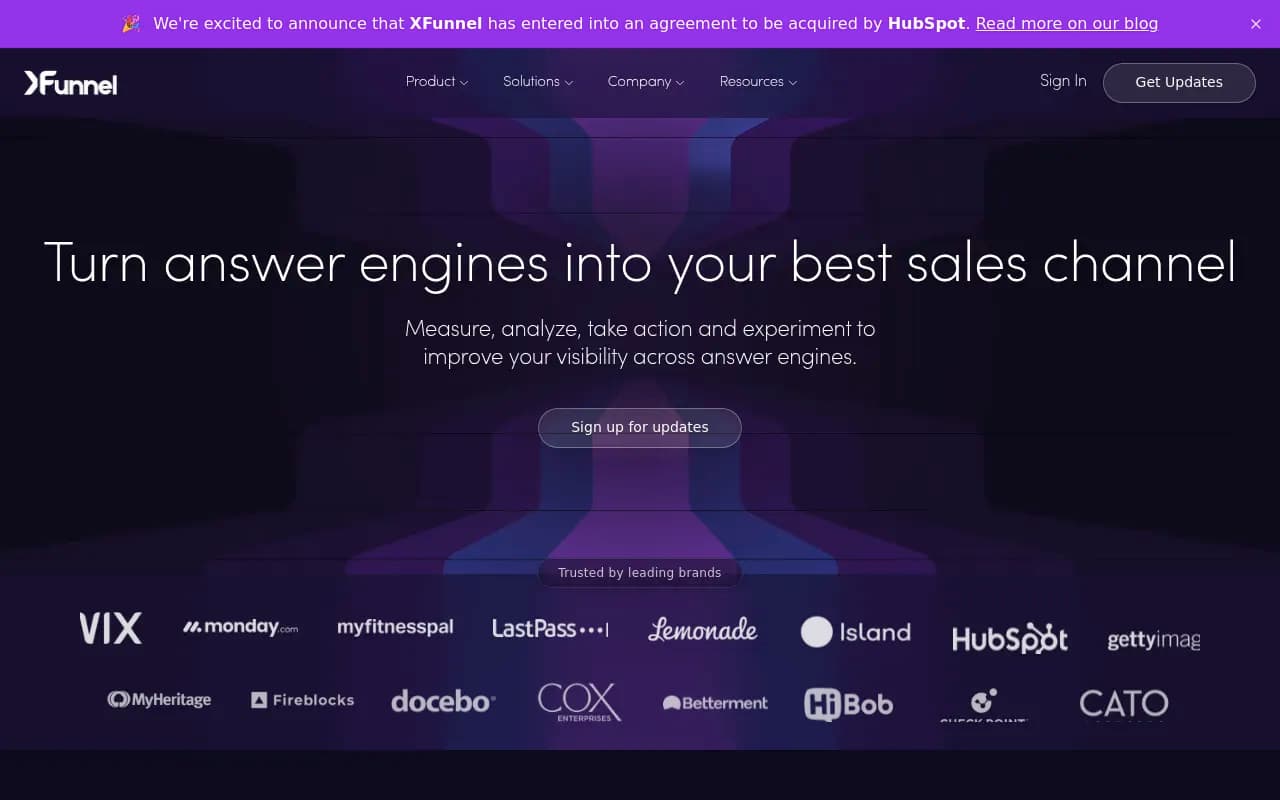
XFunnel positions itself as a generative engine optimization platform for marketing teams at scale. The client roster tells the story: Wix, Monday.com, MyFitnessPal, LastPass, Lemonade, Getty Images, Fireblocks, Cox, Betterment. These aren't small businesses experimenting with AI search -- they're established brands with dedicated marketing teams and budgets to match.
The big news: XFunnel announced an agreement to be acquired by HubSpot. This acquisition brings deep integration with HubSpot's marketing suite but raises questions about standalone pricing and availability for teams not already in the HubSpot ecosystem.
XFunnel's pitch centers on "measure, analyze, take action and experiment" to improve visibility across answer engines. The focus is on structured hypothesis testing and sustainable improvement -- language that signals a platform built for teams running formal optimization programs, not quick wins.
Pricing is custom enterprise only. No public rates, no self-serve signup. You're talking to sales.
OtterlyAI: Accessible AI search monitoring
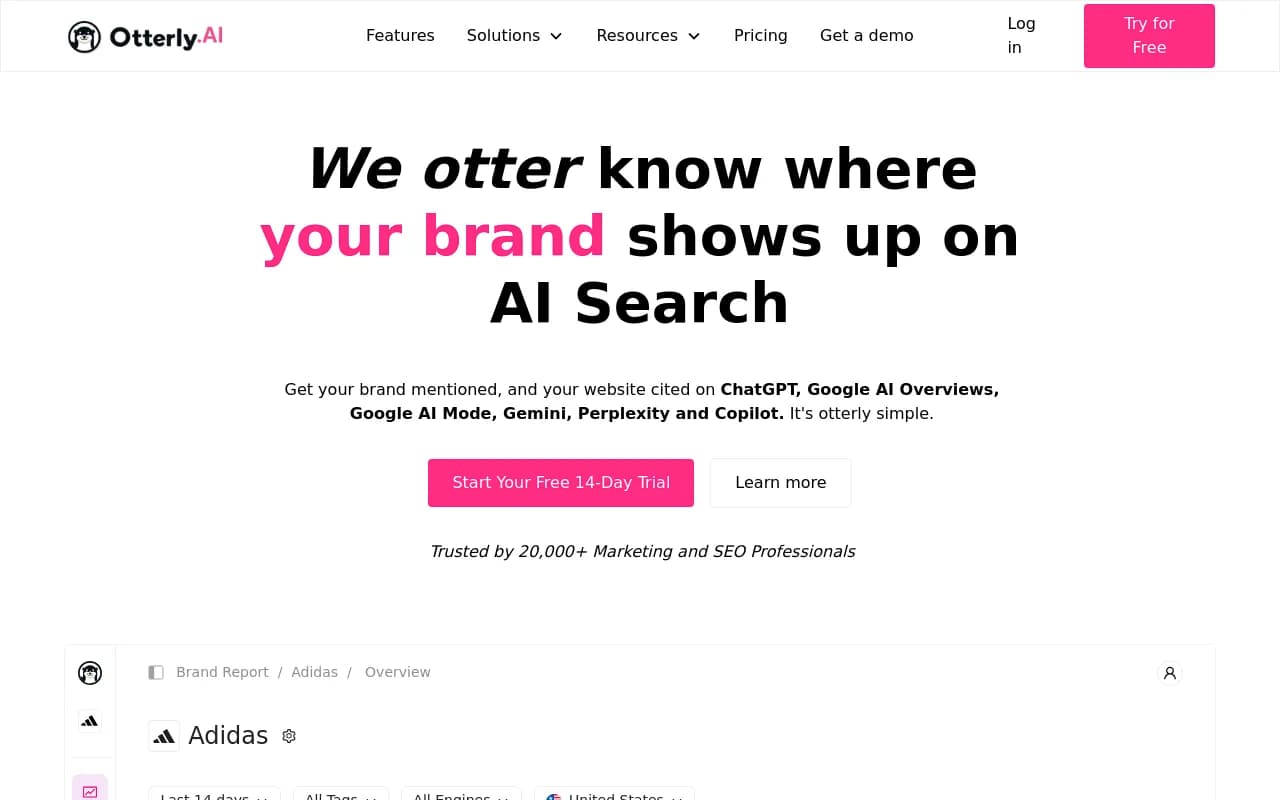
OtterlyAI takes the opposite approach: transparent pricing, fast setup, and a focus on making AI search monitoring accessible. With 20,000+ marketers using the platform, they've built a tool that works for everyone from solo consultants to mid-market companies.
The platform monitors 6 AI search engines: ChatGPT, Google AI Overviews, Perplexity, Google AI Mode, Gemini, and Microsoft Copilot. You get brand mention tracking, website citation monitoring, Share of Voice metrics, and competitive benchmarking across all six platforms.
OtterlyAI's value proposition is straightforward: see where you show up, what's being said, and which content gets cited. The GEO Audit tool analyzes 25+ on-page factors to reveal what's holding your site back. But unlike platforms that help you fix those issues, OtterlyAI stops at showing you the data.
Pricing starts at $29/mo for 15 prompts (Lite tier) and goes to $189/mo for 100 prompts (Standard tier), with a Premium tier available. Free trial included. Setup takes under 15 minutes according to their marketing.
Side-by-Side Comparison
| Feature | XFunnel | OtterlyAI |
|---|---|---|
| Starting price | Custom (enterprise sales) | $29/mo (15 prompts) |
| Free trial | Unknown | Yes |
| Target audience | Enterprise marketing teams | SMBs, agencies, solo marketers |
| AI platforms monitored | Not publicly specified | 6 (ChatGPT, AI Overviews, Perplexity, AI Mode, Gemini, Copilot) |
| HubSpot integration | Deep (being acquired by HubSpot) | None mentioned |
| Setup time | Longer (enterprise onboarding) | ~15 minutes |
| Prompt volume (max tier) | Custom | 100 prompts (Standard), more on Premium |
| Content generation | No | No |
| GEO audit | Yes (hypothesis testing focus) | Yes (25+ on-page factors) |
| Competitive tracking | Yes | Yes (Share of Voice) |
| Self-serve signup | No | Yes |
| Transparency | Low (no public pricing/features) | High (clear pricing, feature list) |
Pricing comparison
| Plan | XFunnel | OtterlyAI |
|---|---|---|
| Free tier | None | Free trial |
| Entry tier | Custom pricing (contact sales) | $29/mo (Lite: 15 prompts) |
| Mid tier | Custom pricing | $189/mo (Standard: 100 prompts) |
| Enterprise | Custom pricing | Premium tier (contact for pricing) |
| Annual discount | Unknown | Likely available |
The pricing gap here is the defining difference. OtterlyAI gives you a clear path from $29/mo to $189/mo with transparent prompt limits. XFunnel requires a sales conversation for any pricing information. Based on their enterprise client roster and HubSpot acquisition, expect XFunnel to cost significantly more -- likely starting in the low four figures per month for teams that qualify.
Feature deep-dive
AI platform coverage
OtterlyAI wins on transparency. They explicitly list 6 platforms: ChatGPT, Google AI Overviews, Perplexity, Google AI Mode, Gemini, and Copilot. You know exactly what you're monitoring.
XFunnel's website talks about "answer engines" and "AI-powered search engines" but doesn't specify which platforms they track. This vagueness is common in enterprise tools where coverage might be customized per client, but it makes comparison difficult.
For most teams, OtterlyAI's 6-platform coverage hits the major players. If you need monitoring for niche or emerging AI search engines, you'd need to ask XFunnel directly what they support.
Verdict: OtterlyAI for transparency and clear coverage. XFunnel may offer more platforms but won't tell you without a sales call.
Brand monitoring and citation tracking
Both platforms track brand mentions and website citations across AI search results. This is table stakes for any GEO tool.
OtterlyAI shows you which brands get recommended, which websites get cited, and where you stand. Their Share of Voice metric lets you benchmark against competitors across all 6 platforms. The interface is designed for quick insights -- you can see your visibility status in minutes.
XFunnel approaches monitoring through a lens of experimentation and hypothesis testing. Their messaging emphasizes "measure, analyze, take action and experiment" -- suggesting a more structured, scientific approach to tracking changes over time. This fits their enterprise audience, where teams are running formal optimization programs with quarterly goals and executive reporting.
Both platforms lack real-time alerting for new mentions (at least not advertised). You're checking dashboards, not getting notifications when your brand appears in a new AI response.
Verdict: Tie for core functionality. OtterlyAI is faster to insights; XFunnel is built for structured programs.
Keyword research and prompt discovery
OtterlyAI includes AI keyword research to "discover the Search Prompts your audience is asking on ChatGPT, Perplexity, and Google." This helps you identify conversational keywords and new content opportunities. The feature is positioned as a way to "uncover fresh conversational keywords to guide your content."
XFunnel's website mentions "discover relevant search questions" but provides less detail on how this works or what data sources they use.
Neither platform appears to offer prompt volume estimates or difficulty scoring -- features you'd find in more advanced GEO platforms like Promptwatch, which provides prompt intelligence with volume estimates and query fan-outs to help you prioritize high-value prompts.
Verdict: OtterlyAI has clearer keyword research features. Both lack advanced prompt metrics.
GEO auditing and optimization
OtterlyAI's GEO Audit tool analyzes 25+ on-page factors to show what's holding your site back from earning citations. You get a list of strengths and weaknesses with recommendations for improvement. But the platform stops there -- it shows you the problems, you fix them yourself.
XFunnel emphasizes hypothesis testing and experimentation. Their approach seems more consultative, likely with account managers helping enterprise clients design and run optimization experiments. The "take action" part of their pitch is less about automated recommendations and more about strategic guidance.
Neither platform offers built-in content generation or automated optimization. You're getting diagnostic data, not solutions. If you want a platform that helps you create content optimized for AI search, you'd need to look elsewhere or supplement with AI writing tools.
Verdict: XFunnel for strategic guidance (if you have an account manager). OtterlyAI for DIY audits.
Competitive analysis
OtterlyAI provides Share of Voice tracking across competitors. You can see which brands dominate AI search results for your target prompts and track your position over time. The competitive data is presented in dashboards designed for quick comparison.
XFunnel's competitive features aren't detailed on their public site, but their enterprise positioning suggests more sophisticated benchmarking. With clients like Wix and Monday.com, they're likely tracking competitive dynamics at a strategic level -- market share shifts, category positioning, and long-term trends.
Both platforms lack the depth of competitive intelligence you'd get from tools that analyze citation sources, Reddit discussions, or YouTube content that influences AI recommendations. For that level of insight, platforms like Promptwatch offer Reddit and YouTube tracking alongside traditional citation analysis.
Verdict: OtterlyAI for accessible competitive dashboards. XFunnel for enterprise-level strategic analysis (probably).
Integration and workflow
XFunnel's HubSpot acquisition is the headline here. If you're a HubSpot customer, XFunnel will likely integrate deeply with your marketing workflows -- connecting AI search data to your CRM, campaign tracking, and reporting. This is huge for teams already invested in the HubSpot ecosystem.
For non-HubSpot customers, the acquisition raises questions. Will XFunnel remain available as a standalone product? Will pricing change? The announcement doesn't clarify these details.
OtterlyAI doesn't advertise integrations with other marketing platforms. You're exporting data manually or using their dashboards as a standalone tool. For most small-to-mid-size teams, this is fine -- you check OtterlyAI weekly, note changes, and adjust your content strategy accordingly.
Neither platform offers API access (at least not publicly documented), which limits custom reporting and automation.
Verdict: XFunnel wins for HubSpot users. OtterlyAI is standalone but simpler.
User interface and ease of use
OtterlyAI advertises setup-to-first-insight in under 15 minutes. Their interface is designed for marketers who want quick answers: Which prompts am I visible for? How do I compare to competitors? What's my Share of Voice?
XFunnel's enterprise positioning suggests a more complex interface with deeper functionality. You're probably getting custom dashboards, executive reports, and data exports tailored to your organization's needs. This power comes with a learning curve and likely requires training.
For solo marketers or small teams, OtterlyAI's simplicity is a feature. For enterprise teams with dedicated analysts, XFunnel's complexity might unlock more value.
Verdict: OtterlyAI for ease of use. XFunnel for enterprise power users.
Pros and cons
XFunnel pros
- Enterprise-grade platform trusted by major brands (Wix, Monday.com, LastPass, Getty Images)
- Deep HubSpot integration (being acquired by HubSpot)
- Structured approach to hypothesis testing and experimentation
- Likely offers account management and strategic guidance
- Built for teams running formal GEO programs with executive reporting
XFunnel cons
- No public pricing -- requires sales conversation and likely high cost
- HubSpot acquisition creates uncertainty for standalone availability
- Less transparency about which AI platforms are monitored
- Overkill for small businesses and solo marketers
- Longer setup and onboarding process
- No self-serve signup or free trial (as far as publicly visible)
OtterlyAI pros
- Transparent pricing starting at $29/mo
- Free trial available
- Monitors 6 major AI platforms with clear coverage
- Fast setup (under 15 minutes to first insights)
- Accessible for small businesses, agencies, and solo marketers
- 20,000+ users suggests proven value at scale
- GEO Audit tool with 25+ on-page factors
- Share of Voice competitive tracking
OtterlyAI cons
- No content generation or optimization automation
- Limited to monitoring and auditing -- you fix problems yourself
- No HubSpot or CRM integrations
- Prompt limits on lower tiers (15 prompts on $29/mo plan)
- Less strategic guidance compared to enterprise platforms
- No API access for custom reporting (not publicly documented)
Who should pick which tool
Choose XFunnel if:
- You're an enterprise marketing team at a mid-to-large company
- You're already a HubSpot customer or planning to adopt HubSpot
- You have budget for custom enterprise software (likely $1,000+/mo)
- You want account management and strategic guidance, not just a dashboard
- You're running formal GEO programs with quarterly goals and executive reporting
- You need to track AI search visibility for a major brand with complex competitive dynamics
- You're comfortable with a sales process and custom pricing
Choose OtterlyAI if:
- You're a small-to-mid-size business, agency, or solo marketer
- You want transparent pricing and fast setup
- You need to monitor AI search visibility across ChatGPT, Perplexity, and Google AI platforms
- You prefer self-serve tools over enterprise sales processes
- You're starting with GEO and want to prove value before scaling investment
- You want competitive Share of Voice tracking without enterprise complexity
- You're willing to handle optimization yourself based on audit data
Consider alternatives if:
- You need built-in content generation alongside monitoring. Neither XFunnel nor OtterlyAI creates content for you -- they just show you where you're visible and what's missing. If you want a platform that helps you close those gaps with AI-generated content grounded in citation data, tools like Promptwatch combine monitoring with content creation workflows.
- You need deep citation source analysis. Both platforms track which websites get cited, but neither offers the level of detail you'd get from platforms that analyze Reddit discussions, YouTube videos, and other sources that influence AI recommendations.
- You're looking for free tools. OtterlyAI has a free trial but no permanent free tier. If budget is zero, you're manually checking ChatGPT and Perplexity yourself.
Final verdict
This comparison comes down to budget and scale. OtterlyAI is the practical choice for 95% of teams reading this. At $29-189/mo with transparent pricing and fast setup, it delivers AI search monitoring without enterprise complexity. You get 6-platform coverage, competitive tracking, and GEO audits in a tool you can start using today.
XFunnel is built for a different world -- enterprise marketing teams at major brands with HubSpot ecosystems and budgets to match. If you're running marketing for Wix or Monday.com, XFunnel makes sense. If you're a 5-person startup or a solo consultant, the sales process alone will waste your time.
The HubSpot acquisition tilts this further. If you're deep in HubSpot, XFunnel becomes compelling despite the price. If you're not, the acquisition creates uncertainty about standalone availability and future direction.
Neither platform solves the full GEO loop. Both show you where you're invisible and what's missing, but neither helps you create the content to fix it. You're getting diagnostic tools, not solutions. For teams that want monitoring plus optimization, you'll need to supplement with content creation tools or look at platforms that combine both.
Bottom line: Start with OtterlyAI unless you're an enterprise HubSpot customer with a five-figure marketing software budget. It's 1/10th the likely cost of XFunnel, transparent about what you get, and delivers the core value (AI search visibility tracking) without the enterprise overhead.