Key takeaways
- XFunnel is a pure AI visibility tracker (now owned by HubSpot) with deep citation analysis and question discovery. Search Atlas is a full SEO automation platform that includes AI visibility as one module alongside content creation, technical fixes, and link building.
- Pricing transparency: Search Atlas offers public tiered pricing from $99/mo with a 7-day trial. XFunnel requires contacting sales for custom enterprise pricing, making it harder to evaluate cost upfront.
- Search Atlas actively creates and publishes content via its AI agent (OTTO SEO). XFunnel only monitors and reports -- you still need to create content elsewhere.
- XFunnel's HubSpot acquisition means future integration with HubSpot's CRM and marketing tools, but also uncertainty about standalone product direction.
- If you only care about tracking AI search visibility and already have content/SEO tools, XFunnel is the specialist choice. If you want one platform that handles SEO automation and AI visibility together, Search Atlas is the all-in-one option.
- For agencies managing multiple clients, Search Atlas's transparent pricing and bundled toolset (60+ tools replaced) makes more economic sense than paying for XFunnel plus separate SEO tools.
Overview
XFunnel
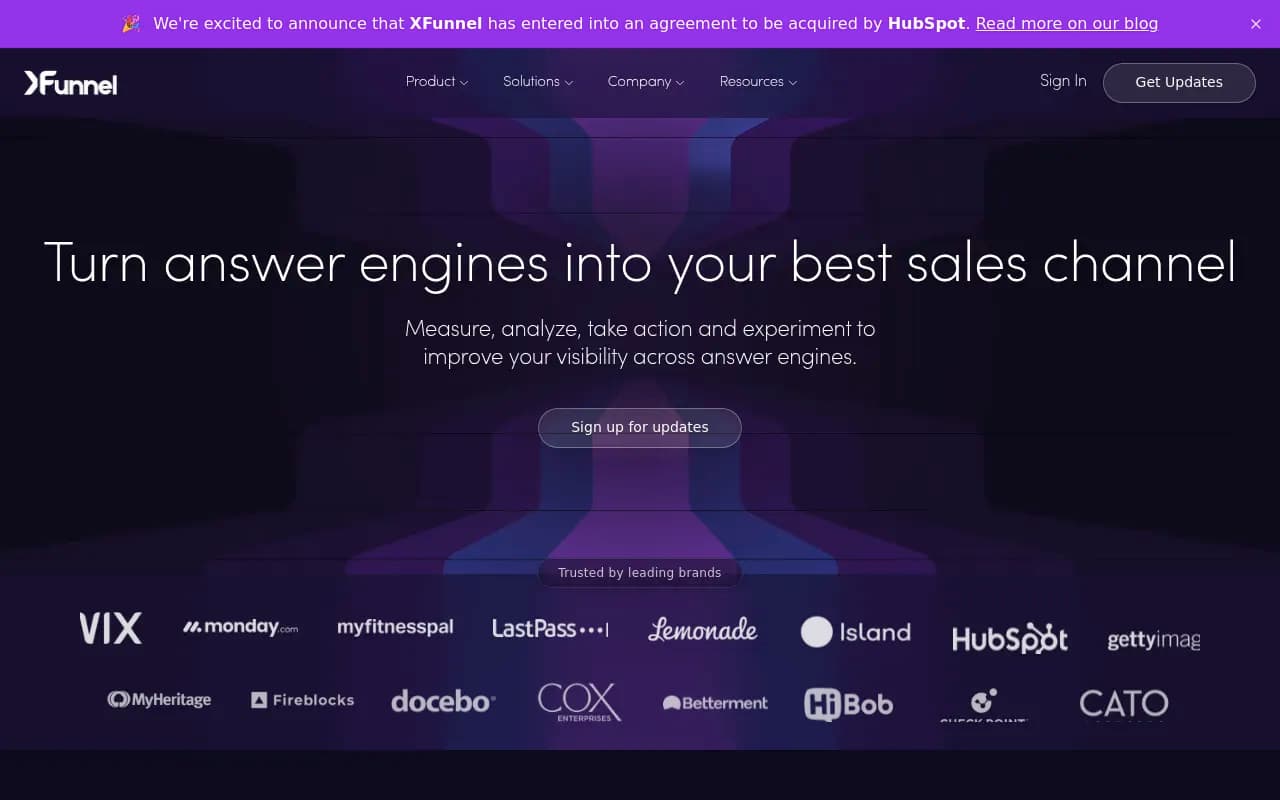
XFunnel positions itself as a generative engine optimization (GEO) platform built specifically for marketing teams tracking brand visibility across AI-powered search engines. The company made headlines in early 2026 when it announced an acquisition agreement with HubSpot, signaling the growing importance of AI search visibility in the marketing stack. XFunnel's client roster includes major brands like Wix, Monday.com, MyFitnessPal, LastPass, and Lemonade -- all enterprise-level companies with dedicated marketing teams.
The platform focuses on three core activities: measuring brand mentions across answer engines, analyzing which questions trigger those mentions, and tracking citation sources. It's a monitoring and analytics tool first and foremost. You won't find content creation, technical SEO fixes, or link building here. XFunnel assumes you have those capabilities elsewhere and just need visibility into how AI engines perceive your brand.
Search Atlas
Search Atlas takes a fundamentally different approach. It's an all-in-one SEO automation platform that happens to include AI visibility tracking as one of many modules. The platform's core value proposition is replacing 12+ separate tools with a single dashboard that handles technical SEO, content creation, link building, local SEO, Google Ads, and yes, AI search visibility (what they call AEO -- Answer Engine Optimization).
The standout feature is OTTO SEO, an AI agent that doesn't just analyze but actually executes tasks: fixing technical issues, generating content, building links, optimizing for local search. Search Atlas targets agencies and brands managing multiple sites who want automation, not just insights. Clients include Autotrader, Hyundai, Penn, and various digital marketing agencies. Pricing is transparent and tiered, starting at $99/mo with a 7-day free trial.
Side-by-side comparison
| Feature | XFunnel | Search Atlas |
|---|---|---|
| Primary focus | AI visibility tracking only | Full SEO automation + AI visibility |
| AI search monitoring | Deep citation tracking, question discovery | AI visibility module (AEO) as part of broader platform |
| Content creation | No -- monitoring only | Yes -- AI content generation + automated publishing |
| Technical SEO | No | Yes -- automated site audits and fixes |
| Link building | No | Yes -- automated outreach and placement |
| Local SEO | No | Yes -- multi-location management |
| Google Ads | No | Yes -- campaign management |
| AI agent/automation | No -- manual analysis | Yes -- OTTO SEO executes tasks autonomously |
| Pricing model | Custom enterprise (contact sales) | Transparent tiers: $99, $249, $399/mo |
| Free trial | One-time free audit | 7-day full platform trial |
| Target customer | Enterprise marketing teams | Agencies and brands of all sizes |
| Ownership | Acquired by HubSpot (2026) | Independent (LinkGraph company) |
AI visibility tracking capabilities
XFunnel's approach
XFunnel treats AI visibility as the entire product. When you log in, you're looking at dashboards showing where your brand appears across answer engines like ChatGPT, Perplexity, Claude, and Google AI Overviews. The platform tracks citations -- which sources AI models reference when mentioning your brand -- and surfaces the specific questions that trigger brand mentions.
The question discovery feature is particularly useful. XFunnel identifies search queries where competitors get mentioned but you don't, giving you a content gap roadmap. You can see volume estimates and track changes over time. The interface is clean and purpose-built for marketers who need to report AI visibility metrics to leadership.
What you won't get: any help creating the content to close those gaps. XFunnel shows you the problem but leaves the solution to you.
Search Atlas's approach
Search Atlas bundles AI visibility (they call it AEO) into a broader SEO workflow. The platform monitors AI search engines and tracks brand mentions, but it's one tab among many. The real difference is what happens next: Search Atlas can generate content optimized for AI visibility, publish it to your site, and track the results.
The OTTO SEO agent can analyze AI visibility gaps and autonomously create articles targeting those gaps. It's not as specialized as XFunnel's pure monitoring interface, but it closes the loop from insight to action. For teams that want one platform handling both traditional SEO and AI visibility, this integration makes sense.
The trade-off: if you only care about AI visibility metrics and already have robust content creation processes, Search Atlas's bundled approach might feel like paying for features you don't need.
Content and optimization capabilities
| Capability | XFunnel | Search Atlas |
|---|---|---|
| AI content generation | None | Yes -- OTTO SEO creates optimized articles |
| Content publishing | None | Yes -- automated publishing to WordPress, Shopify, etc. |
| Content optimization | None | Yes -- on-page SEO recommendations |
| Topical mapping | None | Yes -- AI-generated content clusters |
| Keyword research | Limited (question discovery) | Yes -- full keyword research suite |
| Competitor content analysis | Yes -- citation source analysis | Yes -- content gap analysis + SERP tracking |
This is where the platforms diverge most sharply. XFunnel is read-only. Search Atlas is read-write. If your team has dedicated content creators and you just need visibility data, XFunnel's focus is an advantage. If you're a lean team or agency juggling multiple clients, Search Atlas's automation saves hours of manual work.
Technical SEO and site health
XFunnel doesn't touch technical SEO. It assumes your site is already optimized and just needs AI visibility tracking layered on top.
Search Atlas includes a full site audit crawler that identifies broken links, duplicate content, slow pages, mobile issues, schema markup problems, and 100+ other technical issues. OTTO SEO can automatically fix many of these issues without manual intervention. For agencies managing client sites, this is table stakes functionality that XFunnel simply doesn't address.
Verdict: If you need technical SEO capabilities, Search Atlas is the only option here. XFunnel isn't trying to compete in this space.
Pricing breakdown
| Plan | XFunnel | Search Atlas |
|---|---|---|
| Entry point | Custom (contact sales) | $99/mo (Starter) |
| Mid-tier | Custom (contact sales) | $249/mo (Growth) |
| High-tier | Custom (contact sales) | $399/mo (Pro) |
| Enterprise | Custom (contact sales) | Custom pricing |
| Free trial | One-time audit | 7 days full access |
| Pricing transparency | None -- must talk to sales | Fully public |
XFunnel's enterprise-only pricing model is a barrier for smaller teams and agencies. You can't evaluate cost without a sales conversation, and the client roster (Wix, Monday.com, LastPass) suggests pricing is calibrated for companies with significant marketing budgets.
Search Atlas's transparent tiering makes it easy to start small and scale. The $99/mo Starter plan includes basic AI visibility tracking, content creation, and site audits -- enough to test the platform's value before committing to higher tiers. For agencies billing clients monthly, predictable pricing matters.
If you're a solo consultant or small agency, Search Atlas is the only realistic option here. If you're an enterprise with budget flexibility, XFunnel's custom pricing might include white-glove service and integrations that justify the cost.
Integration and workflow
XFunnel's HubSpot acquisition is the elephant in the room. The platform will likely integrate tightly with HubSpot's CRM, marketing automation, and reporting tools. If you're already a HubSpot customer, this could be a major advantage -- AI visibility data flowing directly into your existing dashboards and workflows.
The downside: uncertainty. HubSpot hasn't detailed how XFunnel will evolve post-acquisition. Will it remain a standalone product? Will pricing change? Will features get absorbed into HubSpot's broader platform? If you're evaluating XFunnel in 2026, you're betting on HubSpot's product roadmap, not just XFunnel's current capabilities.
Search Atlas integrates with WordPress, Shopify, Google Analytics, Google Search Console, and major SEO tools. It's built to be the central hub for SEO workflows, with APIs for custom integrations. The platform is stable and independent -- no acquisition uncertainty.
For teams already invested in HubSpot, XFunnel's future integration is compelling. For everyone else, Search Atlas's current integrations are more predictable.
Reporting and analytics
XFunnel's reporting is built for executive dashboards. You get clean visualizations of AI visibility trends, citation sources, and question coverage. The interface is polished and designed for stakeholders who want high-level metrics without diving into technical details.
Search Atlas offers more granular reporting across SEO, AI visibility, content performance, and technical health. The reports are comprehensive but can feel overwhelming if you only care about AI visibility. The platform includes white-label reporting for agencies presenting to clients.
If you're reporting AI visibility to C-suite executives, XFunnel's focused dashboards are easier to present. If you're managing SEO holistically and need detailed cross-channel reports, Search Atlas provides more depth.
Who should choose XFunnel
XFunnel makes sense if:
- You're an enterprise marketing team with budget for specialized tools
- AI visibility tracking is a strategic priority and you need deep analytics
- You already have robust SEO, content, and technical capabilities in-house
- You're a HubSpot customer excited about future CRM integration
- You prefer best-of-breed tools over all-in-one platforms
- You're comfortable with custom enterprise pricing and sales-driven onboarding
XFunnel is the specialist choice. It does one thing -- AI visibility tracking -- and does it well. The HubSpot acquisition adds credibility and hints at powerful future integrations, but also introduces uncertainty about product direction.
Who should choose Search Atlas
Search Atlas makes sense if:
- You're an agency managing multiple client sites and need automation
- You want one platform replacing 12+ separate SEO tools
- You need content creation and publishing, not just monitoring
- You prefer transparent pricing and the ability to start small
- You want an AI agent that executes tasks, not just surfaces insights
- You're managing SEO holistically (technical, content, links, local, AI visibility)
- You value product stability and aren't betting on acquisition outcomes
Search Atlas is the all-in-one choice. It's built for teams that want to consolidate tools and automate workflows. The AI visibility tracking isn't as specialized as XFunnel's, but the ability to act on insights within the same platform is a major efficiency gain.
Worth noting: if you're looking to track AI visibility and also need help creating content that ranks in AI search, Promptwatch offers a middle-ground approach with content gap analysis, AI content generation grounded in citation data, and page-level tracking across 10 AI models.

Pros and cons
XFunnel pros
- Deep AI visibility analytics with citation tracking and question discovery
- Clean, executive-friendly reporting interface
- Strong enterprise client roster (Wix, Monday.com, LastPass)
- Future HubSpot integration for CRM/marketing automation workflows
- Specialized focus means no feature bloat
XFunnel cons
- No content creation or optimization capabilities -- monitoring only
- Custom enterprise pricing with no transparency or free trial (just one-time audit)
- Acquisition uncertainty -- unclear how HubSpot will evolve the product
- Not accessible for small teams or agencies without enterprise budgets
- Requires separate tools for SEO, content, technical fixes, link building
Search Atlas pros
- All-in-one platform replacing 12+ tools (SEO, content, links, local, AI visibility)
- OTTO SEO agent executes tasks autonomously, not just insights
- Transparent tiered pricing starting at $99/mo with 7-day free trial
- AI content generation and automated publishing included
- Full technical SEO audits and fixes
- Built for agencies with white-label reporting and multi-site management
Search Atlas cons
- AI visibility tracking is less specialized than XFunnel's dedicated approach
- Feature breadth can feel overwhelming if you only need AI monitoring
- Interface is dense with options -- steeper learning curve
- Not ideal if you already have preferred tools for SEO/content and just need AI visibility layered on top
Final verdict
These platforms serve different buyers. XFunnel is for enterprise marketing teams with dedicated SEO/content resources who need a specialized AI visibility tracker and are willing to pay custom pricing for it. The HubSpot acquisition adds future integration potential but also product uncertainty.
Search Atlas is for agencies and brands who want one platform automating SEO and AI visibility together. The transparent pricing, free trial, and AI agent that actually executes tasks make it the practical choice for teams consolidating tools and workflows.
If you're choosing between them: ask yourself whether you need monitoring or automation. XFunnel monitors. Search Atlas automates. Pick based on whether you want insights or action.