Key Takeaways
- Zerply is 3x cheaper with a free tier (500 credits/month) and paid plans from $99/month vs AthenaHQ's $295/month starting price
- Zerply generates and publishes content automatically using AI agents; AthenaHQ only monitors and recommends -- you still write everything yourself
- AthenaHQ is built for enterprise with clients like Coinbase, ZoomInfo, and SoFi; Zerply targets smaller teams and agencies that want automation
- Both track major AI models (ChatGPT, Perplexity, Claude, Gemini) but take different approaches: Zerply focuses on action (content creation), AthenaHQ on analysis (visibility dashboards)
- If you need a monitoring dashboard for executive reporting, AthenaHQ wins. If you want a platform that actually fixes the gaps it finds, Zerply is the better bet.
- Worth noting: if you're serious about AI visibility and want the most comprehensive platform that combines monitoring with content optimization, Promptwatch offers answer gap analysis, AI content generation, crawler logs, and Reddit/YouTube tracking that neither Zerply nor AthenaHQ fully match.

Overview: Two different philosophies
Zerply: The autonomous SEO agent
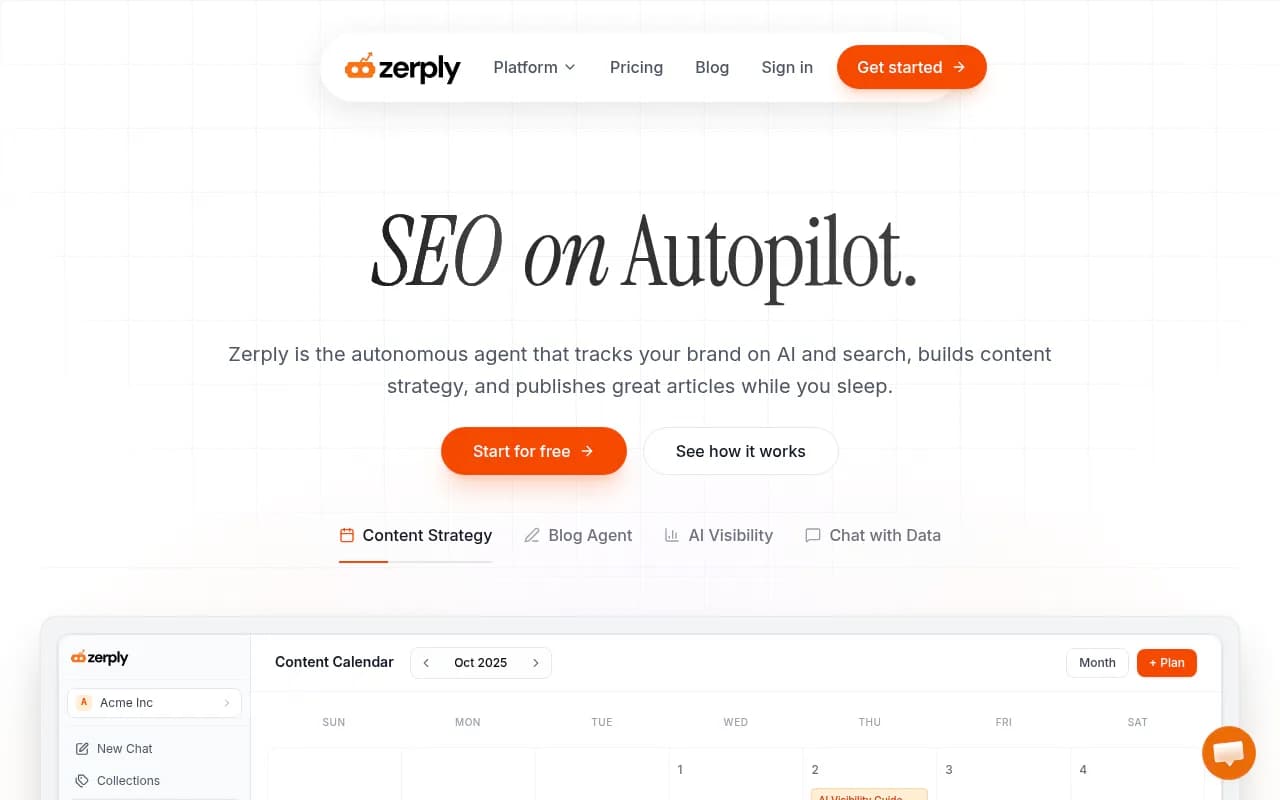
Zerply positions itself as an "agentic AI SEO platform" -- basically, specialized AI workers that monitor your site, find content gaps, plan your editorial calendar, write articles, and publish them to WordPress while you sleep. The pitch is automation: instead of manually analyzing data and creating content, you set up agents that do it for you.
The platform combines three pillars: AI visibility tracking (how you appear in ChatGPT, Perplexity, etc.), SEO research chat (ask questions about your Search Console data), and autonomous content agents. It's designed for teams that want to reduce the 47+ hours per week they spend on manual marketing work.
Pricing starts with a free plan (500 credits/month) and paid plans from $99/month. The target audience is marketing teams, agencies, and solopreneurs who want AI to handle the grunt work.
AthenaHQ: The enterprise visibility dashboard

AthenaHQ is a Generative Engine Optimization (GEO) platform focused on one core question: how does your brand appear in AI-generated answers? It tracks 8+ AI models (ChatGPT, Perplexity, Google AI Overviews, Claude, Gemini, etc.) and provides citation tracking, sentiment analysis, and share of voice metrics.
The client roster skews enterprise: Coinbase, ZoomInfo, SoFi, Volkswagen, DeVry University. The platform is built for CMOs, brand managers, and GEO specialists who need executive-level dashboards and ROI tracking for AI search strategy.
Pricing is credit-based: $295/month for self-serve ($95 first month promo), with enterprise custom pricing. No free tier. The focus is monitoring and analysis -- you get recommendations for improvement, but you still create the content yourself.
Side-by-Side Comparison
| Feature | Zerply | AthenaHQ |
|---|---|---|
| Starting Price | Free (500 credits/mo), paid from $99/mo | $295/mo ($95 first month), no free tier |
| Free Tier | ✓ Yes | ✗ No |
| AI Content Generation | ✓ Autonomous agents write & publish | ✗ Recommendations only |
| AI Models Tracked | Major models (ChatGPT, Perplexity, Claude, Gemini) | 8+ models including all major LLMs |
| WordPress Integration | ✓ Direct publishing | Not specified |
| Google Search Console | ✓ Connected for chat analysis | Not specified |
| Citation Tracking | ✓ Yes | ✓ Yes, detailed |
| Sentiment Analysis | Not specified | ✓ Yes |
| Share of Voice | Not specified | ✓ Yes |
| Content Calendar | ✓ Auto-scheduled by agents | ✗ Manual |
| Target Audience | SMBs, agencies, solopreneurs | Enterprise, commercial businesses |
| Automation Level | High (agents do the work) | Low (you do the work) |
| Executive Dashboards | Not emphasized | ✓ Built for C-suite |
Pricing: Zerply wins on affordability
| Plan Type | Zerply | AthenaHQ |
|---|---|---|
| Free Tier | 500 credits/month | None |
| Entry Paid | $99/month | $295/month ($95 first month) |
| Mid-Tier | Not specified | Not specified |
| Enterprise | Not specified | Custom pricing |
| Annual Discount | Not specified | 17% off |
| Credit Model | Yes (credits for queries) | Yes (1 credit = 1 AI query) |
Zerply is objectively cheaper. The free tier alone makes it accessible to anyone who wants to test AI visibility tracking without spending money. At $99/month for paid plans, it's roughly one-third the cost of AthenaHQ's $295/month entry point.
AthenaHQ's pricing reflects its enterprise positioning. The $95 first-month rate is a trial hook, but you're paying $295/month ongoing. For large brands with budgets, that's fine. For a three-person startup, it's a tough sell.
Both use credit-based models where each AI query costs one credit. This means your actual cost depends on how many prompts you track. Zerply's 500 free credits let you test ~500 queries per month before paying anything.
AI visibility tracking: Both cover the essentials
Both platforms monitor how your brand appears in AI-generated responses. You input prompts (e.g. "best CRM software", "top project management tools"), and the platform queries ChatGPT, Perplexity, Claude, etc. to see if you're mentioned, how you're positioned, and what sources are cited.
AthenaHQ goes deeper on analytics:
- Sentiment analysis (positive, neutral, negative mentions)
- Share of voice (your % vs competitors in AI responses)
- Citation source tracking (which pages, Reddit threads, YouTube videos get cited)
- Competitor gap analysis (prompts where competitors appear but you don't)
Zerply focuses on action:
- Identifies content gaps (prompts where you're not visible)
- Autonomous agents create content to fill those gaps
- Auto-schedules and publishes to WordPress
The difference: AthenaHQ tells you what's wrong. Zerply tells you what's wrong and then fixes it.
If you're a brand manager who needs to report AI visibility metrics to executives, AthenaHQ's dashboards are built for that. If you're a marketer who needs to actually improve visibility (not just track it), Zerply's agents do the heavy lifting.
Content generation: Zerply's killer feature
This is where the platforms diverge completely.
Zerply:
- AI agents analyze your site and find content gaps
- Agents draft articles based on those gaps
- Agents schedule posts to your content calendar
- Agents publish directly to WordPress
- You review and approve, but the default is automation
AthenaHQ:
- Provides optimization recommendations
- Shows you which prompts to target
- Suggests citation sources to reference
- You still write the content yourself (or hire writers)
Zerply's pitch is "SEO on autopilot." The agents are supposed to reduce the 47+ hours per week marketing teams spend on manual work. In practice, this means you're trusting AI to write articles that will rank in both traditional search and AI search.
AthenaHQ doesn't generate content. It's a monitoring and analysis platform. You get the insights, you create the content. For enterprise teams with dedicated content writers, that's fine. For small teams wearing multiple hats, it's a bottleneck.
Verdict: If you want a platform that actually creates content, Zerply is the only option here. If you want to maintain full editorial control and just need visibility data, AthenaHQ works.
SEO research and data analysis
Zerply includes an "SEO Research Chat" feature where you connect Google Search Console, upload documents, and ask questions in natural language. Example: "Which pages dropped traffic in the last 30 days?" The platform queries your connected data sources and answers.
This is useful for teams that don't want to manually export CSVs and build pivot tables. You get conversational insights from your existing tools.
AthenaHQ doesn't emphasize this kind of traditional SEO analysis. The focus is AI search, not Google Search Console integration. If you need both traditional SEO insights and AI visibility tracking, Zerply covers more ground.
User experience and target audience
Zerply:
- Designed for speed and automation
- Content calendar view shows your entire month at a glance
- Agents fill gaps automatically
- Feels like a tool for marketers who want to move fast
- Free tier makes it low-risk to test
AthenaHQ:
- Built for enterprise workflows
- Executive dashboards for C-suite reporting
- ROI tracking and multi-brand management
- Feels like a tool for GEO specialists and brand managers at large companies
- No free tier means you're committing $295/month upfront
The client logos tell the story. AthenaHQ lists Coinbase, ZoomInfo, SoFi, Volkswagen -- brands with marketing budgets in the millions. Zerply doesn't list client logos on their homepage, which suggests they're targeting a broader, less enterprise-heavy audience.
If you're a solopreneur or a 5-person startup, Zerply is the obvious choice. If you're a Fortune 500 brand with a dedicated GEO team, AthenaHQ's enterprise features make sense.
Integration and workflow
Zerply integrations:
- WordPress (direct publishing)
- Google Search Console (data analysis)
- Multi-step reasoning engine for complex queries
AthenaHQ integrations:
- Not detailed on public site
- Likely API access for enterprise customers
- Focus is on AI model tracking, not traditional tool integrations
Zerply's WordPress integration is a big deal if you run a content site. You can go from gap analysis to published article without leaving the platform. AthenaHQ doesn't offer this -- you'd export insights, write content elsewhere, publish manually.
What's missing from both platforms
Neither Zerply nor AthenaHQ offers:
- AI crawler logs (see which AI models are actually crawling your site and when)
- Reddit and YouTube tracking (surface discussions that influence AI recommendations)
- ChatGPT Shopping monitoring (track product recommendation carousels)
- Prompt volume estimates (know which prompts are high-traffic vs low-traffic)
- Multi-language and multi-region tracking (monitor AI responses in different countries/languages)
If those features matter to you, Promptwatch covers all of them -- plus the content generation and gap analysis that Zerply offers, combined with the deep analytics that AthenaHQ provides. It's worth comparing all three if you're making a serious investment in AI visibility.
Pros and cons
Zerply pros:
- Free tier with 500 credits/month
- Paid plans start at $99/month (3x cheaper than AthenaHQ)
- AI agents generate and publish content automatically
- WordPress integration for seamless publishing
- Google Search Console integration for traditional SEO insights
- Content calendar with auto-scheduling
- Designed for speed and automation
Zerply cons:
- Less detailed analytics than AthenaHQ (no sentiment analysis or share of voice)
- Newer platform with less enterprise credibility
- Trusting AI agents to write content may not work for all brands
- Exact AI model coverage not specified on site
AthenaHQ pros:
- Tracks 8+ AI models comprehensively
- Detailed sentiment analysis and share of voice metrics
- Citation source tracking shows exactly what's being referenced
- Built for enterprise with executive dashboards and ROI tracking
- Proven client roster (Coinbase, ZoomInfo, SoFi, Volkswagen)
- Multi-brand management for agencies
AthenaHQ cons:
- No free tier (starts at $295/month)
- Monitoring-only -- doesn't generate or publish content
- Overkill for small teams or solopreneurs
- $95 first-month rate is promotional; ongoing cost is $295/month
- Less emphasis on traditional SEO integrations
Who should pick Zerply
Pick Zerply if:
- You're a small team, agency, or solopreneur with a limited budget
- You want a platform that actually creates content, not just monitors visibility
- You run a WordPress site and want seamless publishing
- You need traditional SEO insights (Search Console integration) alongside AI visibility
- You want to test AI visibility tracking for free before committing
- You're comfortable trusting AI agents to draft articles (with your review)
Zerply is the better choice for teams that want automation and can't afford $295/month for monitoring alone. The free tier makes it risk-free to test.
Who should pick AthenaHQ
Pick AthenaHQ if:
- You're an enterprise brand with a dedicated GEO or brand marketing team
- You need executive dashboards and ROI tracking for C-suite reporting
- You want deep analytics (sentiment, share of voice, citation sources)
- You manage multiple brands or clients and need multi-brand tracking
- You have the budget for $295/month and prefer monitoring over automation
- You want to maintain full editorial control and write content in-house
AthenaHQ is built for large companies that need visibility data to inform strategy. If you're Coinbase or Volkswagen, the price is irrelevant and the analytics are worth it.
Final verdict
Zerply and AthenaHQ solve different problems.
AthenaHQ is a monitoring dashboard. It tells you how you appear in AI search, tracks sentiment and share of voice, and provides detailed analytics for reporting. It's built for enterprise teams with budgets and dedicated GEO specialists. If you need to prove ROI to executives or manage multiple brands, it's a solid choice -- but you're paying $295/month for insights, not action.
Zerply is an automation platform. It finds content gaps, generates articles, schedules posts, and publishes to WordPress. It's built for small teams that want AI to do the work, not just tell them what to do. At $99/month (or free for 500 credits), it's accessible to anyone. The trade-off: less detailed analytics and you're trusting AI agents to write content.
For most teams reading this comparison, Zerply is the better value. You get AI visibility tracking plus content generation for one-third the price. AthenaHQ makes sense if you're a large brand that needs enterprise features and already has writers on staff.
One more thing: if you're serious about AI visibility and want a platform that combines the best of both worlds -- deep analytics like AthenaHQ plus content optimization and generation like Zerply, plus features neither offers (crawler logs, Reddit tracking, ChatGPT Shopping, prompt volumes) -- check out Promptwatch. It's the only platform rated as a "Leader" across all GEO categories in 2026 comparisons, and it's built around the action loop: find gaps, generate content, track results. Worth a look if you're making a long-term investment in AI search visibility.