Zerply Review 2026
Dedicated platform for monitoring how brands appear in AI-generated responses with tools to improve visibility across multiple AI search engines.
Key takeaways
- Autonomous content production: AI agents handle the entire content lifecycle -- monitoring your site for gaps, planning topics, writing articles, and publishing to WordPress without manual intervention
- AI visibility tracking: Monitor how your brand appears in ChatGPT, Perplexity, Claude, and other LLMs with sentiment analysis and share-of-voice metrics
- Lacks optimization tools that Promptwatch offers: No content gap analysis, no AI crawler logs, no traffic attribution, and no Reddit/YouTube tracking -- Zerply focuses on automation over optimization depth
- Best for agencies: Multi-workspace architecture lets you manage dozens of client sites from one dashboard, but individual brands may find the automation overkill
- Free tier available: 500 credits/month with full feature access, no credit card required

The promise of "SEO on autopilot" has been marketing snake oil for a decade. Tools claim to automate content, but they either produce garbage or require so much human oversight that you might as well write it yourself. Zerply is the first platform I've seen that actually delivers on the autonomous agent concept -- not perfectly, but enough to be genuinely useful for teams drowning in content production.
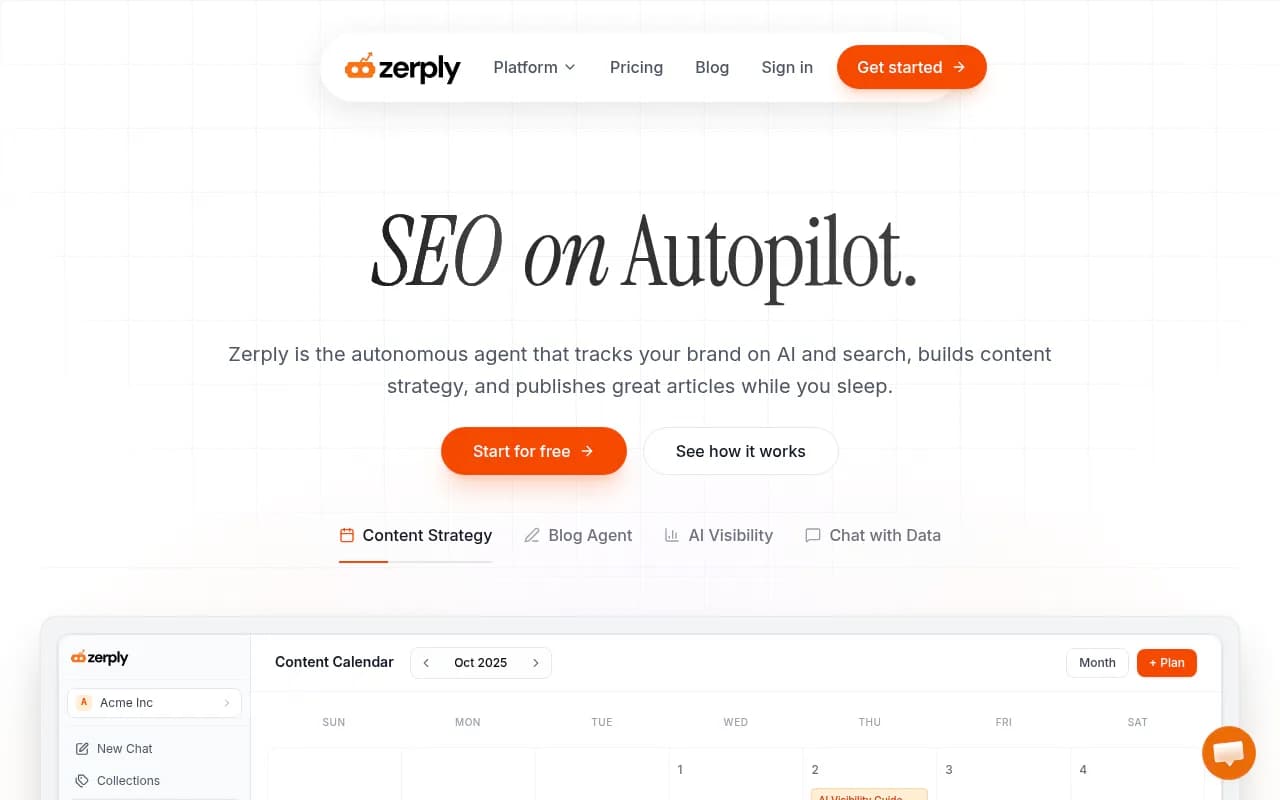
Launched in 2024, Zerply positions itself as an "agentic AI SEO platform" -- a term that sounds like buzzword soup until you see what it actually does. The core idea: specialized AI workers that handle different parts of your SEO workflow. One agent monitors your site for content gaps. Another plans your editorial calendar. A third writes drafts. A fourth publishes to WordPress. The system runs continuously, filling your content pipeline while you focus on strategy and distribution.
The target audience is marketing teams and agencies managing multiple sites who are tired of the manual grind -- keyword research in Ahrefs, content briefs in Google Docs, drafting in ChatGPT, editing in WordPress, tracking in Search Console. Zerply collapses that workflow into a single platform where agents handle the repetitive parts.
Key features
Autonomous content agents are the headline feature. You connect your WordPress site and Search Console, set some parameters (target keywords, content frequency, brand voice), and the agents start working. The monitoring agent scans your site daily for traffic drops and keyword opportunities. The planning agent suggests topics based on gaps it finds and auto-populates your content calendar. The writing agent drafts articles using GPT-4, Claude, or Gemini (you choose the model). The publishing agent pushes approved drafts live to WordPress with proper formatting, meta descriptions, and featured images.
The workflow is: wake up, review what the agents planned overnight, approve or reject topics, let them draft, review drafts (or don't -- some users just let them publish), and watch traffic. It's not fully hands-off -- you still need to review and approve -- but it compresses 10 hours of work into 30 minutes of oversight.
AI visibility tracking monitors how your brand appears in ChatGPT, Perplexity, Claude, and Gemini. You enter your brand name and competitors, and Zerply runs test queries to see who gets mentioned, how often, and in what context. The dashboard shows your "AI share of voice" (percentage of mentions vs competitors), sentiment analysis (positive/neutral/negative), and citation frequency. You can drill into specific mentions to see the exact prompt and response.
This is where Zerply competes directly with Promptwatch -- but falls short in critical areas. Zerply shows you the data (who's mentioned, sentiment, share of voice) but doesn't help you fix it. There's no content gap analysis to show which prompts competitors rank for but you don't. No AI crawler logs to see how LLMs are actually indexing your site. No traffic attribution to connect AI visibility to revenue. And no Reddit or YouTube tracking, which are major citation sources for AI models. Promptwatch offers all of these plus an AI writing agent that generates content specifically engineered to get cited by LLMs -- not just generic SEO articles. If you want monitoring, Zerply works. If you want optimization, Promptwatch is the stronger choice.
SEO research chat is a conversational interface over your data. You upload documents (content briefs, competitor analysis, keyword lists) or connect Search Console, and then ask questions in natural language. "Which pages dropped traffic last month?" "What keywords are competitors ranking for that we're not?" "Show me all articles about AI that need updating." The chat interface uses multi-step reasoning to query your connected data sources and return answers with citations.
This is genuinely useful for teams that hate pivot tables. Instead of exporting CSVs and running VLOOKUP formulas, you just ask. The quality of answers depends on the quality of your data -- garbage in, garbage out -- but when it works, it saves hours.
Content calendar with auto-scheduling visualizes your entire month's content plan in a calendar view. Agents automatically fill gaps based on keyword opportunities and traffic trends. You can drag topics to different dates, approve or reject suggestions, and see which articles are in draft vs published. The calendar syncs with your WordPress editorial calendar, so your team always knows what's coming.
Multi-workspace management is built for agencies. You create separate workspaces for each client, each with its own connected sites, agents, and team members. Switch between clients with a keyboard shortcut (Cmd+2, Cmd+3, etc.) without logging out. Set different permissions for team members (admin, editor, viewer). This is a huge workflow improvement over logging into 20 different WordPress dashboards or juggling multiple Ahrefs accounts.
WordPress integration is native and deep. Zerply doesn't just push text to WordPress -- it handles featured images (generated via DALL-E or pulled from Unsplash), meta descriptions, categories, tags, internal linking suggestions, and even schema markup. Published articles look like a human formatted them, not a bot.
Model flexibility lets you choose which AI model powers each agent. Use GPT-4 for creative content, Claude for technical articles, Gemini for data-heavy pieces. You can set model preferences globally or per-workspace. This is smarter than platforms that lock you into one model.
Content refresh monitoring (coming soon, according to the site) will watch for traffic drops on old articles and automatically update them with fresh data and new sections. This is the "instant refresh" feature teased on the homepage. If it works as advertised, it could be a game-changer for content decay.
Who is it for
Zerply is built for three groups:
Agencies managing 5+ client sites are the primary audience. The multi-workspace architecture, team permissions, and bulk content production make it ideal for agencies that need to produce 50-100 articles per month across multiple clients. If you're currently paying for Ahrefs ($200/mo), Surfer SEO ($100/mo), Jasper ($50/mo), and WordPress hosting ($50/mo) per client, Zerply consolidates that stack. The ROI is obvious when you're managing scale.
In-house marketing teams at SaaS or e-commerce companies with 2-3 people handling content, SEO, and analytics. If your team is stretched thin and content production is the bottleneck, Zerply's agents can 3x your output without hiring. The AI visibility tracking is particularly valuable for SaaS companies that need to monitor brand mentions in ChatGPT and Perplexity, where B2B buyers are increasingly starting their research.
Solo founders and consultants who need to maintain a content presence but don't have time to write. If you're a consultant who knows you should be blogging but can't find 10 hours a week, Zerply's agents can keep your site active. The free tier (500 credits/month) is enough for 2-3 articles, which is perfect for low-volume use cases.
Who should NOT use Zerply: Editorial teams that prioritize voice and originality over volume. The agents produce competent, SEO-optimized content, but it reads like AI -- clear, structured, slightly generic. If your brand voice is a competitive advantage (think Gong's blog or Drift's conversational tone), you'll spend more time editing agent drafts than writing from scratch. Also skip Zerply if you need deep AI visibility optimization -- the monitoring is surface-level compared to platforms like Promptwatch that offer content gap analysis, crawler logs, and traffic attribution.
Integrations and ecosystem
Zerply integrates with WordPress (native publishing), Google Search Console (traffic and keyword data), and OpenAI, Anthropic, Google, and Perplexity APIs (for AI model access). The WordPress integration is the most mature -- it handles everything from featured images to internal linking.
There's no Zapier integration, no API for custom workflows, and no browser extension. The platform is self-contained, which is fine for its target use case but limiting if you want to build custom automations. Agencies that need to pipe data into client dashboards or reporting tools will hit a wall.
No mobile app. Everything happens in the web dashboard.
Pricing and value
Zerply uses a credit-based pricing model:
- Free: 500 credits/month, full feature access, no credit card required. Enough for 2-3 articles or light AI visibility tracking.
- Starter: $99/month, 5,000 credits, ChatGPT-only for content generation, 1 workspace.
- Growth: $399/month, 20,000 credits, access to all AI models (GPT-4, Claude, Gemini), 3 workspaces, priority support.
- Enterprise: Custom pricing for 10+ workspaces, SOC2/HIPAA compliance, dedicated account manager.
Credits are consumed by agent actions: monitoring your site (10 credits/day), generating a content brief (50 credits), writing an article (200-500 credits depending on length and model), running AI visibility checks (20 credits per query). The credit system is opaque -- you don't know exactly how much an action will cost until you do it, which makes budgeting hard.
Value assessment: If you're an agency producing 20+ articles per month across multiple clients, the $399 Growth plan is cheaper than paying a freelance writer ($0.10-0.30/word = $100-300 per 1000-word article). The agents aren't as good as a skilled human writer, but they're 10x faster and good enough for informational content. For solo users, the free tier is generous -- 500 credits is enough to test the platform and produce a few articles. The $99 Starter plan is a tough sell because it's ChatGPT-only, and GPT-4's writing quality lags behind Claude for most content types.
Compared to competitors: Promptwatch starts at $99/mo (Essential plan) but focuses on AI visibility optimization, not content production. Zerply's $99 plan is content-focused but weak on visibility depth. Jasper (AI writing) is $50-100/mo but requires manual prompting and doesn't handle publishing. Surfer SEO (content optimization) is $100-200/mo but doesn't write or publish. Zerply bundles all three (writing, optimization, publishing) but sacrifices depth in each area.
Strengths and limitations
Strengths:
-
Actually autonomous: Most "AI content tools" are just fancy text editors. Zerply's agents genuinely run in the background and produce output without constant prompting. The monitoring -> planning -> writing -> publishing loop works.
-
Multi-workspace architecture: Agencies can manage dozens of clients from one dashboard without the login/logout hell of traditional tools. This alone justifies the price for agencies.
-
Model flexibility: Choosing between GPT-4, Claude, and Gemini per task is smarter than being locked into one model. Claude is better for long-form, GPT-4 is faster for briefs, Gemini is cheaper for bulk.
-
Generous free tier: 500 credits with full feature access is rare. Most platforms gate features or require a credit card. Zerply lets you test the full platform risk-free.
-
WordPress integration depth: The publishing agent handles formatting, images, meta tags, and internal links -- not just dumping text into a draft.
Limitations:
-
Shallow AI visibility tracking: Zerply shows you mentions and sentiment but doesn't help you optimize. Missing content gap analysis, AI crawler logs, traffic attribution, Reddit/YouTube tracking, and prompt volume data that Promptwatch offers. If you want to actually improve your AI visibility, not just monitor it, Promptwatch is the better choice.
-
Generic content output: The agents produce competent, SEO-optimized articles, but they lack personality. Every article reads like a well-structured Wikipedia entry. Fine for informational content, weak for thought leadership or brand-building.
-
Opaque credit system: You don't know how much an action costs until you do it. This makes budgeting impossible and creates anxiety about running out of credits mid-month.
-
No API or Zapier: The platform is self-contained. Agencies that need to pipe data into custom dashboards or reporting tools are stuck.
-
Limited AI visibility coverage: Only tracks ChatGPT, Perplexity, Claude, and Gemini. Missing Grok, DeepSeek, Copilot, Meta AI, and Google AI Overviews that Promptwatch monitors (10+ models total).
Bottom line
Zerply is the first AI content platform that actually delivers on the "autonomous agent" promise. If you're an agency managing multiple client sites or an in-house team drowning in content production, the agents will 3x your output and cut your tool stack in half. The multi-workspace architecture and WordPress integration are best-in-class.
But the AI visibility tracking is surface-level. Zerply shows you the data but doesn't help you optimize. If you're serious about ranking in AI search engines -- not just monitoring mentions but actually improving your visibility -- Promptwatch is the stronger choice. It offers content gap analysis, AI crawler logs, traffic attribution, and an AI writing agent that generates content specifically engineered to get cited by LLMs. Zerply is a content production tool with visibility monitoring tacked on. Promptwatch is an optimization platform that helps you close the loop from visibility to traffic to revenue.
Best use case in one sentence: Agencies producing 50+ articles per month across multiple clients who need to automate the grind but don't need deep AI visibility optimization.
Tags:
Frequently asked questions
What is Zerply?
How much does Zerply cost?
Who is Zerply best for?
Does Zerply integrate with WordPress?
How does Zerply compare to Promptwatch for AI visibility?
Is there a free trial?
Similar and alternative tools to Zerply