Key Takeaways
- Zerply is an agentic SEO platform with AI visibility tracking, autonomous content generation, and publishing automation starting at $99/mo. Bluefish AI is an enterprise monitoring platform for Fortune 500 brands with custom pricing around $4,000+/mo and no content creation tools.
- Zerply includes a free tier (500 credits/mo) and transparent pricing. Bluefish AI requires custom enterprise quotes with no self-service or public pricing.
- Zerply automates content creation -- AI agents find gaps, plan your calendar, write articles, and publish to WordPress. Bluefish AI is monitoring-only -- it tracks performance but doesn't help you create or optimize content.
- Bluefish AI targets Fortune 500 marketing teams with custom audiences, tailored prompts, and deep competitive analysis. Zerply serves small businesses, agencies, and mid-market brands looking for an all-in-one solution.
- Both track major AI models (ChatGPT, Perplexity, Claude, Gemini), but Bluefish emphasizes agentic commerce channels while Zerply focuses on actionable optimization.
- If you need enterprise-scale monitoring with custom datasets, Bluefish AI. If you want AI visibility tracking plus autonomous content generation on a reasonable budget, Zerply.
Overview: Two very different approaches to AI visibility
Zerply: Agentic SEO with AI visibility tracking
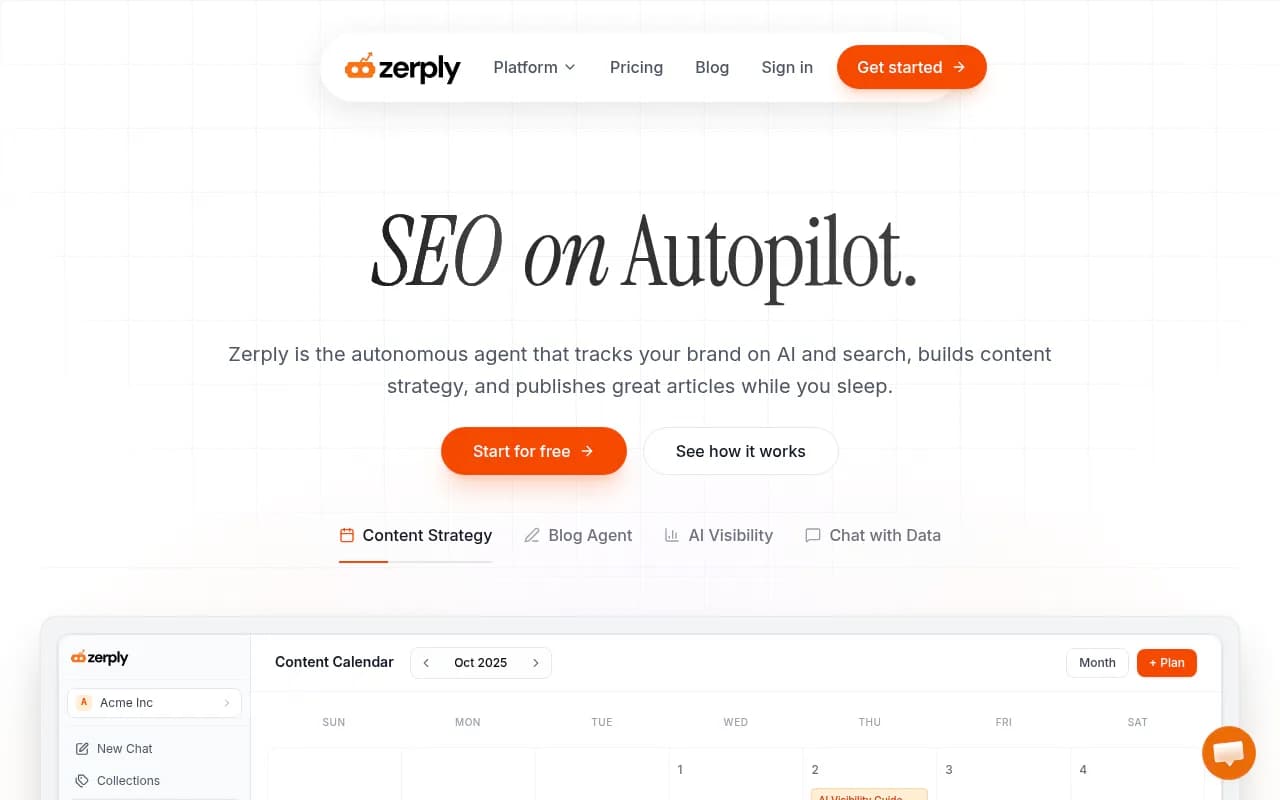
Zerply positions itself as "SEO on autopilot" -- an autonomous agent that tracks your brand across AI search engines, builds content strategy, and publishes articles while you sleep. It combines three core pillars: AI visibility tracking (monitoring how your brand appears in ChatGPT, Perplexity, Claude, Gemini), SEO research chat (conversational analytics connected to Google Search Console and your own documents), and agentic SEO (autonomous AI workers that find content gaps, plan your editorial calendar, write drafts, and publish directly to WordPress).
The platform targets small businesses, agencies, and mid-market brands who want an all-in-one solution. Pricing is transparent: free plan with 500 credits/month, paid plans from $99/mo. The value proposition is clear -- you get monitoring plus optimization in one tool, not just dashboards.
Bluefish AI: Enterprise monitoring for Fortune 500 brands
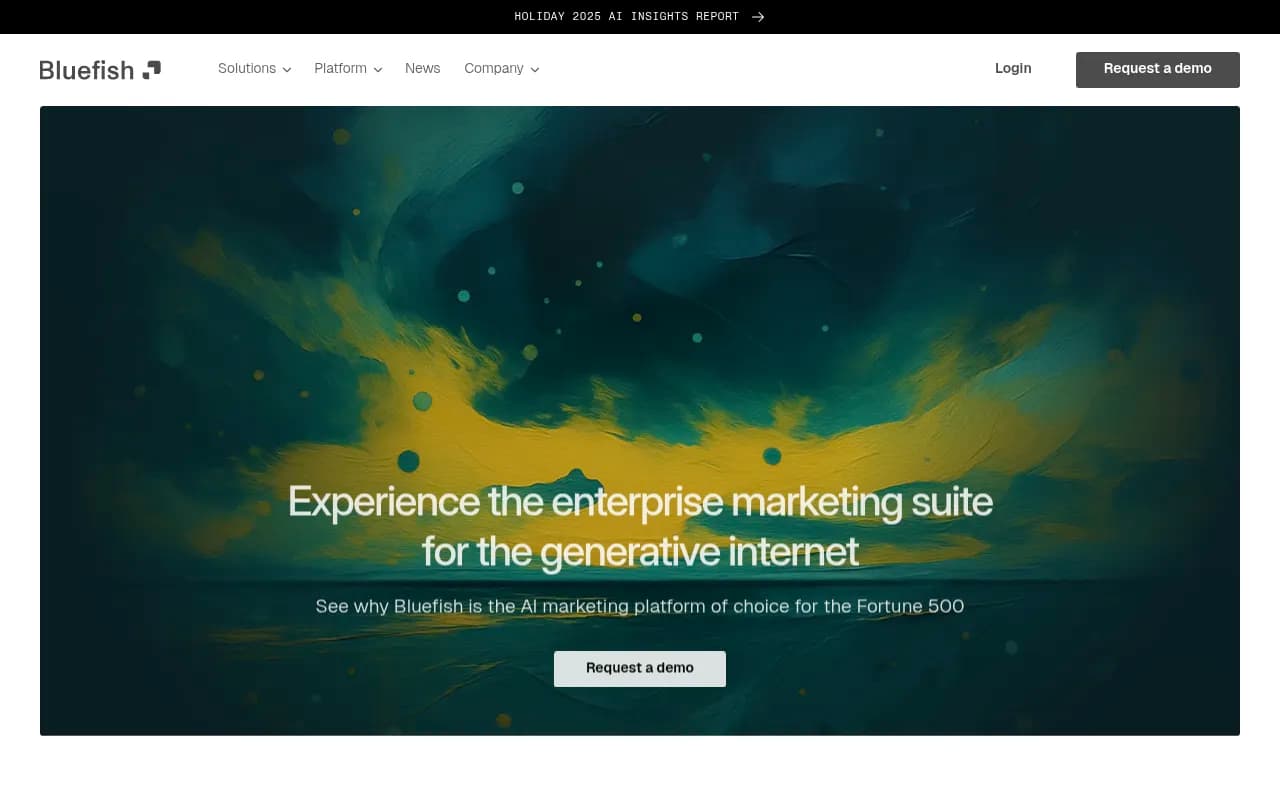
Bluefish AI describes itself as "the AI marketing platform of choice for the Fortune 500." It's built exclusively for large enterprise marketing teams who need deep visibility and control over brand presence across AI channels. The platform emphasizes custom audiences, tailored prompts, competitive differentiation, and advanced performance analytics.
Unlike Zerply, Bluefish AI is monitoring-focused. It tracks AI search (ChatGPT, Perplexity, Claude, Gemini), agentic commerce channels, and brand sentiment, but it doesn't include content generation, crawler logs, or optimization tools. Pricing is custom quote-based with no public tiers -- estimates suggest $4,000+/month for enterprise plans. There's no free trial or self-service option. You request a demo, go through enterprise sales, and get a custom contract.
The target audience is completely different. Bluefish AI is for brands with large marketing budgets who need enterprise-grade monitoring and are willing to pay for custom datasets and white-glove service.
Side-by-Side Comparison
| Feature | Zerply | Bluefish AI |
|---|---|---|
| Starting Price | Free (500 credits/mo) | Custom quote (~$4,000+/mo) |
| Paid Plans | From $99/mo | Enterprise custom pricing |
| Free Tier | Yes | No |
| Target Audience | Small businesses, agencies, mid-market | Fortune 500, large enterprises |
| AI Models Tracked | ChatGPT, Perplexity, Claude, Gemini | ChatGPT, Perplexity, Claude, Gemini + agentic commerce |
| Content Generation | Yes (autonomous AI agents) | No |
| WordPress Publishing | Yes (direct integration) | No |
| Content Gap Analysis | Yes | No |
| SEO Research Chat | Yes (GSC integration, document upload) | No |
| Crawler Logs | Not mentioned | No |
| Custom Audiences | Standard | Yes (enterprise-level) |
| Tailored Prompts | Standard | Yes (competitive analysis) |
| Sentiment Analysis | Yes | Yes |
| Share of Voice | Yes | Yes |
| Citation Tracking | Yes | Yes |
| Editorial Calendar | Yes (auto-scheduled by agents) | No |
| Self-Service Signup | Yes | No (demo required) |
| Transparent Pricing | Yes | No |
Pricing: $99/mo vs $4,000+/mo
Zerply pricing
Zerply uses a transparent credit-based model:
| Plan | Price | Credits/Month | Best For |
|---|---|---|---|
| Free | $0 | 500 credits | Testing, small sites |
| Starter | $99/mo (estimated) | TBD | Small businesses, solo marketers |
| Pro | Custom | Custom | Agencies, mid-market brands |
Credits are used for AI visibility checks, content generation, and agent tasks. The free tier gives you 500 credits to experiment. Paid plans scale up from $99/mo -- exact tiers aren't fully detailed on the site, but the entry point is clear and accessible.
Bluefish AI pricing
Bluefish AI has no public pricing. You request a demo, go through enterprise sales, and receive a custom quote. Based on industry estimates and the Fortune 500 positioning, expect:
| Plan | Estimated Price | What You Get |
|---|---|---|
| Enterprise | ~$4,000-$10,000+/mo | Custom audiences, tailored prompts, dedicated support, advanced analytics |
There's no free trial, no self-service tier, no transparent pricing. This is standard for enterprise platforms targeting large marketing teams with big budgets.
Verdict
If you're a small business, agency, or mid-market brand, Zerply's pricing is accessible and transparent. If you're a Fortune 500 company with a six-figure marketing budget, Bluefish AI's custom enterprise model makes sense. The price gap is massive -- Zerply starts at free, Bluefish AI starts around $4,000/mo.
Feature comparison: Monitoring vs optimization
AI visibility tracking
Zerply: Tracks how your brand appears in ChatGPT, Perplexity, Claude, and Gemini. Shows share of voice, sentiment analysis, recent mentions, and citation frequency. The interface displays AI share of voice as a percentage and lists recent mentions with snippets from each model.
Bluefish AI: Similar tracking across major AI models plus agentic commerce channels. Emphasizes custom audiences (you can define specific customer segments) and tailored prompts (competitive prompts designed for your market). The platform is built for deep competitive analysis -- you're not just tracking your brand, you're tracking how you compare to competitors across custom datasets.
Winner: Bluefish AI for enterprise competitive analysis with custom audiences. Zerply for straightforward visibility tracking with actionable optimization.
Content generation and optimization
Zerply: This is where Zerply separates itself. The platform includes autonomous AI agents that:
- Monitor your site 24/7 and find content gaps
- Detect opportunities based on AI search trends
- Auto-schedule content in your editorial calendar
- Draft articles using AI
- Publish directly to WordPress
You can see your entire month's content plan in a visual calendar. Agents fill gaps automatically. The SEO research chat lets you upload documents, connect Google Search Console, and ask complex questions -- "Which pages dropped traffic in the last 30 days?" The system queries GSC and gives you a conversational answer with specific pages and percentage drops.
Bluefish AI: No content generation. No content gap analysis. No publishing tools. Bluefish AI is monitoring and analytics only. It tells you how you're performing, but it doesn't help you create or optimize content.
Winner: Zerply by a mile. If you need content creation and optimization, Bluefish AI doesn't compete here.
Analytics and reporting
Zerply: Share of voice, sentiment analysis, recent mentions, citation tracking. The SEO research chat provides conversational analytics connected to GSC and uploaded documents. Multi-step reasoning engine for complex queries.
Bluefish AI: Advanced performance analytics, custom segmentation, deep competitive analysis. The platform is built for enterprise data teams who need granular control over metrics and custom reporting frameworks. Bluefish emphasizes "actionability" -- automating optimization workflows and tailoring measurement frameworks so teams focus on metrics that matter.
Winner: Bluefish AI for enterprise-level analytics depth. Zerply for accessible, actionable insights.
Integrations and publishing
Zerply: Direct WordPress publishing. Google Search Console integration for SEO research chat. Document upload for custom data analysis.
Bluefish AI: No publishing integrations mentioned. The platform is monitoring-focused, so it doesn't need to connect to CMS or publishing tools.
Winner: Zerply. If you want to publish content directly from the platform, only Zerply offers it.
Enterprise features
Zerply: Standard audiences and prompts. Built for small to mid-market teams.
Bluefish AI: Custom audiences, tailored prompts, enterprise-scale data segmentation, white-glove support, passes infosec reviews consistently. Built specifically for Fortune 500 marketing teams.
Winner: Bluefish AI. If you need enterprise-grade customization and support, Bluefish AI is designed for that.
User experience and workflow
Zerply workflow
- Connect your site and Google Search Console
- AI agents monitor your site 24/7 and find content gaps
- Agents auto-schedule content in your editorial calendar
- Review and approve AI-generated drafts
- Publish directly to WordPress
- Track AI visibility and see how your brand appears in ChatGPT, Perplexity, Claude, Gemini
- Use SEO research chat to ask questions about your data
The workflow is autonomous. You set it up once, and agents handle the heavy lifting. The interface shows a visual content calendar with planned articles. You can chat with your data conversationally instead of exporting CSVs and building pivot tables.
Bluefish AI workflow
- Request a demo and go through enterprise sales
- Define custom audiences and tailored prompts for your market
- Monitor AI visibility, share of voice, sentiment, and citations
- Analyze competitive performance across custom datasets
- Use advanced analytics to segment and optimize metrics
- Report findings to your marketing team
The workflow is monitoring and analysis. You're not creating content or publishing -- you're tracking performance and making strategic decisions based on data. The platform is built for large marketing teams with dedicated analysts.
Verdict
Zerply is hands-off and autonomous. Bluefish AI is hands-on and analytical. Pick based on whether you want automation or deep manual control.
Who should pick which tool
Pick Zerply if you:
- Run a small business, agency, or mid-market brand
- Want AI visibility tracking plus content generation in one platform
- Need autonomous agents to find gaps, plan content, and publish to WordPress
- Have a limited budget (free tier or $99/mo entry point)
- Want transparent pricing and self-service signup
- Prefer an all-in-one solution over stitching together multiple tools
- Need conversational analytics connected to Google Search Console
Pick Bluefish AI if you:
- Work at a Fortune 500 company with a large marketing budget
- Need enterprise-grade monitoring with custom audiences and tailored prompts
- Want deep competitive analysis across custom datasets
- Have a dedicated data team that can leverage advanced analytics
- Require white-glove support and enterprise-level customization
- Don't need content generation or publishing tools (you have a separate content team)
- Are willing to go through enterprise sales and custom quotes
Consider Promptwatch if you:

If you're comparing Zerply and Bluefish AI, you might also want to look at Promptwatch -- the market-leading GEO platform used by 6,700+ brands including Booking.com and Center Parcs. Unlike monitoring-only tools, Promptwatch shows you exactly which prompts competitors rank for but you don't (Answer Gap Analysis), then helps you create content that gets cited by AI models with a built-in AI writing agent grounded in 880M+ citations. You also get AI crawler logs (see which AI engines are reading your site and fix indexing issues), Reddit/YouTube insights, ChatGPT Shopping tracking, and page-level visibility tracking with traffic attribution. Plans start at $99/mo (Essential) with a free trial available.
Promptwatch sits between Zerply and Bluefish AI in positioning -- more comprehensive than Zerply's agentic SEO focus, more accessible than Bluefish AI's enterprise-only model. If you want the action loop (find gaps, create content, track results) without the Fortune 500 price tag, it's worth a look.
Pros and cons
Zerply pros
- Free tier with 500 credits/month
- Transparent pricing from $99/mo
- Autonomous content generation and publishing
- Direct WordPress integration
- SEO research chat with GSC integration
- Visual editorial calendar with auto-scheduling
- All-in-one platform (monitoring + optimization)
- Self-service signup, no demo required
Zerply cons
- Newer platform, less proven at enterprise scale
- Standard audiences and prompts (not custom)
- No mention of crawler logs or advanced indexing tools
- Limited details on credit usage and plan tiers
- May lack depth for Fortune 500 competitive analysis
Bluefish AI pros
- Built specifically for Fortune 500 brands
- Custom audiences and tailored prompts
- Deep competitive analysis across custom datasets
- Advanced performance analytics and segmentation
- Enterprise-grade support and infosec compliance
- Proven with large marketing teams
- Tracks agentic commerce channels
Bluefish AI cons
- No content generation or optimization tools
- No free tier or trial
- Custom pricing only (estimated $4,000+/mo)
- No self-service signup (demo required)
- Monitoring-only -- doesn't help you create content
- No crawler logs or indexing insights
- Overkill for small businesses and agencies
Final verdict
Zerply and Bluefish AI solve different problems for different audiences. Zerply is an agentic SEO platform that combines AI visibility tracking with autonomous content generation and publishing. It's built for small businesses, agencies, and mid-market brands who want an all-in-one solution on a reasonable budget. You get monitoring, optimization, and automation in one tool.
Bluefish AI is an enterprise monitoring platform for Fortune 500 marketing teams who need deep competitive analysis with custom audiences and tailored prompts. It's monitoring-only -- no content generation, no publishing, no optimization tools. You pay for enterprise-grade analytics and white-glove support.
The decision is straightforward: If you're a small to mid-market brand looking for AI visibility tracking plus content automation, pick Zerply. The free tier and $99/mo entry point make it accessible, and the autonomous agents handle the heavy lifting. If you're a Fortune 500 company with a large marketing budget and a dedicated data team, pick Bluefish AI. The custom audiences and deep analytics justify the enterprise price tag.
Don't try to force Bluefish AI into a small business budget, and don't expect Zerply to handle Fortune 500-level competitive analysis. Pick the tool that matches your team size, budget, and workflow. For most readers, Zerply's combination of monitoring and optimization at $99/mo is the clear winner. For enterprise teams with $50,000+/year marketing budgets, Bluefish AI's custom approach makes sense.