Key Takeaways
- Zerply is an autonomous content engine with AI agents that plan, write, and publish articles while you sleep. GetMint is a monitoring and optimization platform that shows you what to fix but leaves content creation to you.
- Pricing gap: Zerply starts free (500 credits/month) then $99/month. GetMint starts at €229/month (~$250) with no free tier, making Zerply more accessible for solo marketers and small teams.
- Agency fit: GetMint's unlimited seats and project-based scaling work better for agencies managing multiple clients. Zerply's per-account pricing doesn't explicitly support multi-client workflows.
- Content creation: Zerply's AI agents write and publish content automatically. GetMint identifies gaps and provides recommendations but doesn't generate content for you.
- Tracking breadth: GetMint monitors a wider range of AI engines and provides deeper citation analysis. Zerply integrates tracking into its content workflow but with less granular source data.
- Use case split: Pick Zerply if you want hands-off automation and are comfortable letting AI agents handle content. Pick GetMint if you want detailed insights to inform your own content strategy.
Overview: Two approaches to AI visibility
Zerply: The autonomous content agent
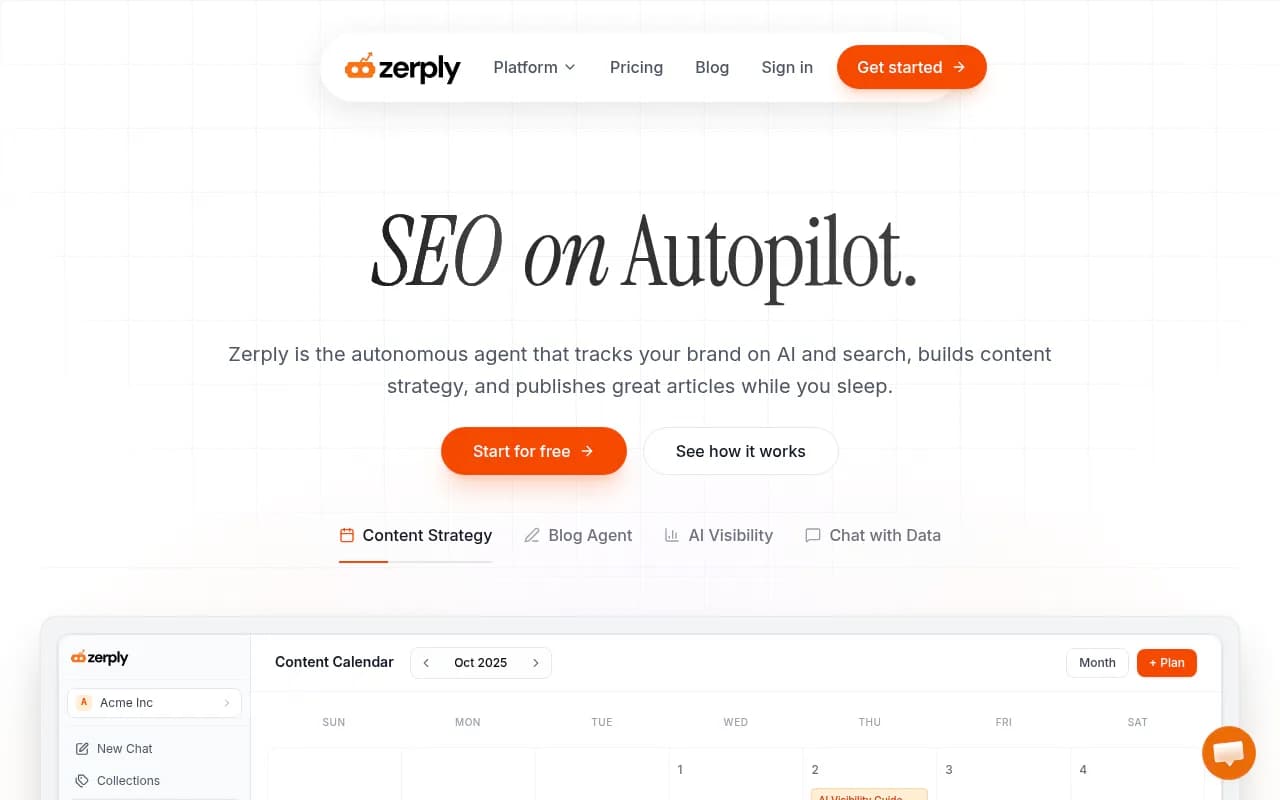
Zerply positions itself as an "agentic AI SEO platform" that runs on autopilot. The core pitch: specialized AI workers monitor your site, find content gaps, plan your editorial calendar, draft articles, and publish them to WordPress without human intervention. It's designed for marketers who want to set it and forget it.
The platform combines three pillars: AI agents for content automation, a research chat interface for querying your data, and AI visibility tracking to see how your brand appears in ChatGPT, Perplexity, Claude, and Gemini. The emphasis is on reducing manual work -- Zerply claims the average marketing team spends 47+ hours weekly on data tasks, and its agents are meant to reverse that.
Pricing starts with a free plan (500 credits per month) and paid plans from $99/month. The platform integrates with Google Search Console and WordPress.
GetMint: The GEO monitoring and optimization platform
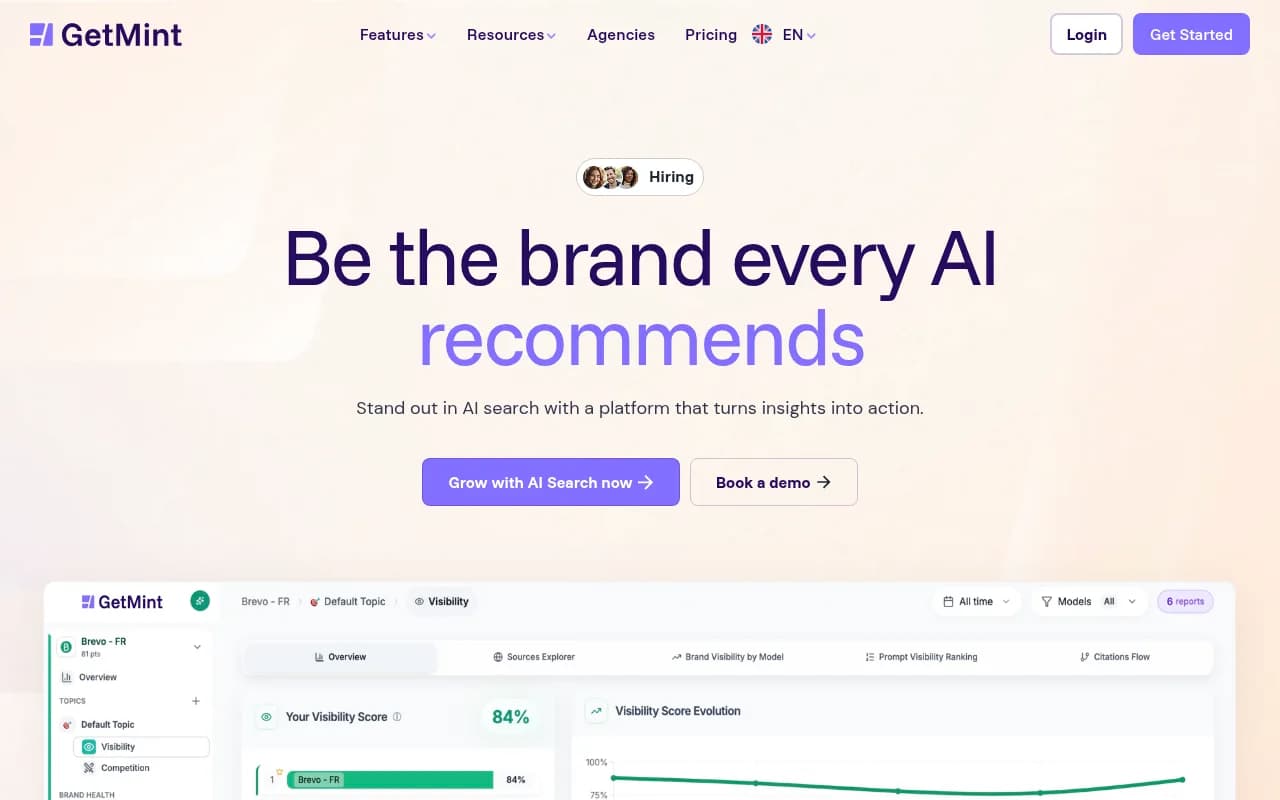
GetMint calls itself "the first platform for Generative Engine Optimization (GEO)" and focuses on helping brands monitor, analyze, and improve visibility across AI-powered search engines. It's trusted by 200+ brands and agencies and emphasizes real-time tracking with actionable recommendations.
Unlike Zerply's autonomous approach, GetMint is a hands-on platform. It shows you where you're visible (or invisible) in AI responses, which competitors are winning, what sources AI models are citing, and what content gaps exist. You get the data and strategy; you create the content.
Pricing starts at €229/month for the Growth plan and €499/month for Pro, with unlimited seats and project-based scaling. No free tier, but a free trial is available.
Side-by-Side Comparison
| Feature | Zerply | GetMint |
|---|---|---|
| Starting price | Free (500 credits/mo), then $99/mo | €229/mo (~$250), no free tier |
| Free trial | Yes (free plan) | Yes |
| AI engines tracked | ChatGPT, Perplexity, Claude, Gemini | ChatGPT, Perplexity, Claude, Gemini, + broader LLM coverage |
| Content creation | Built-in AI agents write and publish | No automated content generation |
| WordPress integration | Yes (auto-publish) | Not mentioned |
| Google Search Console | Yes | Yes |
| Sentiment analysis | Yes | Yes |
| Citation tracking | Basic | Detailed source and citation analytics |
| Competitor analysis | Gap detection | Share of voice, detailed benchmarking |
| Multi-client/agency support | Not explicitly designed for it | Unlimited seats, project-based pricing |
| Autonomous agents | Core feature (monitor, plan, write, publish) | Not available |
| Research chat interface | Yes (query your data conversationally) | Not mentioned |
| Content calendar | Auto-generated by agents | Not mentioned |
Pricing Comparison
| Plan | Zerply | GetMint |
|---|---|---|
| Free tier | 500 credits/month | None |
| Entry plan | $99/month | €229/month (~$250) |
| Mid-tier | Not specified | €499/month (Pro, unlimited seats) |
| Seats included | Per account | Unlimited (Growth and Pro) |
| Trial | Free plan available | Free trial available |
Zerply's pricing is more accessible for small teams and solo marketers. GetMint's unlimited seats make it cost-effective for agencies once you're managing multiple clients, but the entry price is more than double Zerply's paid starting point.
Head-to-head feature deep-dive
Content creation and automation
This is where the two platforms diverge most sharply.
Zerply is built around autonomous AI agents. These agents monitor your site 24/7, detect content gaps, plan your editorial calendar, draft articles, and publish them directly to WordPress. The promise is "SEO on autopilot" -- you wake up to new content already live on your site. The agents use leading models (OpenAI, Claude, Gemini) and are designed to produce "human-quality" drafts.
The workflow: agents analyze your site and competitors, identify opportunities, schedule posts on a visual content calendar, write the articles, and push them to WordPress. You can intervene if you want, but the default mode is hands-off.
GetMint doesn't generate content. It identifies what content you should create by showing you where competitors are visible and you're not, which prompts are driving AI recommendations, and what sources AI models prefer. You get strategic direction and gap analysis, but you (or your team, or your writers) create the actual content.
Verdict: If you want automation and are comfortable with AI-generated content going live without heavy editing, Zerply wins. If you want control over content quality and strategy, GetMint's approach fits better.
AI visibility tracking and monitoring
Both platforms track how your brand appears in AI-generated responses, but with different depth.
Zerply tracks ChatGPT, Perplexity, Claude, and Gemini. It shows "AI Share of Voice" (your market share vs competitors), recent mentions with sentiment, and citation frequency. The tracking is integrated into the content workflow -- agents use visibility data to decide what to write next.
GetMint also tracks the major AI engines and goes deeper on citation analysis. It shows which specific sources (pages, Reddit threads, YouTube videos, domains) AI models are citing, competitor benchmarking with share of voice, and real-time sentiment analysis. The platform is designed for brands that want granular data to inform manual optimization.
Both platforms offer competitor gap analysis, but GetMint's focus on source-level data gives you more actionable intel on where to publish and what to optimize.
Verdict: GetMint provides richer monitoring data. Zerply's tracking is solid but secondary to its content automation focus.
Research and data analysis
Zerply includes a conversational research chat interface. You can upload documents, connect Google Search Console, and ask complex questions like "Which pages dropped traffic in the last 30 days?" The platform queries your connected sources and returns insights without manual exports or pivot tables. It's designed to replace the tedious data work most marketers do in spreadsheets.
GetMint doesn't emphasize a chat interface. It provides dashboards and reports, but the interaction model is more traditional -- you navigate to the data you want rather than asking questions conversationally.
Verdict: Zerply's chat interface is a differentiator if you want to query your data in natural language. GetMint sticks to standard dashboards.
Integration and workflow
Zerply integrates with Google Search Console and WordPress. The WordPress connection is critical for its auto-publish feature. The platform is designed to slot into an existing WordPress-based content workflow and take over the creation and publishing steps.
GetMint integrates with Google Search Console and emphasizes connecting to your existing tools. It's built for teams that already have a content creation process and want to layer AI visibility tracking on top.
Neither platform mentions deep integrations with project management tools, CRMs, or other marketing platforms beyond the basics.
Verdict: Zerply's WordPress integration is more advanced (auto-publish). GetMint's integrations are standard for a monitoring platform.
Agency and multi-client support
Zerply doesn't explicitly mention agency or multi-client features. The pricing appears to be per-account, which could get expensive if you're managing multiple clients.
GetMint is designed for agencies. Both the Growth and Pro plans include unlimited seats, and pricing scales by project rather than per-user. This makes it cost-effective once you're managing multiple clients -- you pay for the platform once and add as many team members as needed.
Verdict: GetMint is the clear winner for agencies. Zerply's pricing model doesn't support multi-client workflows well.
Ease of use and learning curve
Zerply is designed to be hands-off. You set up the agents, connect your WordPress site, and let them run. The learning curve is low because the platform does most of the work. The trade-off: less control.
GetMint requires more active engagement. You need to interpret the data, decide on strategy, and execute. The learning curve is steeper because you're using the platform to inform decisions rather than automate them.
Verdict: Zerply is easier if you want automation. GetMint requires more expertise but gives you more control.
Pros and cons
Zerply pros
- Free plan available (500 credits/month)
- Autonomous AI agents handle content creation end-to-end
- Auto-publish to WordPress
- Conversational research chat for querying data
- Lower starting price ($99/month vs €229/month)
- Visual content calendar auto-generated by agents
Zerply cons
- Less detailed citation and source analysis than GetMint
- Not designed for agencies managing multiple clients
- Content quality depends on trusting AI agents
- Narrower AI engine coverage
- No mention of advanced competitor benchmarking
GetMint pros
- Detailed citation and source analytics
- Unlimited seats on Growth and Pro plans (great for agencies)
- Project-based pricing scales well for multi-client work
- Trusted by 200+ brands and agencies
- Broader AI engine coverage
- Real-time sentiment analysis
- Hands-on control over content strategy
GetMint cons
- No free tier (€229/month minimum)
- No automated content generation
- Requires more manual work to act on insights
- Higher entry price than Zerply
- No conversational data query interface
Who should pick which tool
Pick Zerply if you:
- Want hands-off content automation
- Are a solo marketer or small team with limited time
- Use WordPress and want auto-publishing
- Prefer a lower entry price or need a free tier to test
- Are comfortable with AI-generated content going live with minimal editing
- Want a conversational interface for querying your data
- Don't need deep citation-level analytics
Pick GetMint if you:
- Run an agency managing multiple clients
- Want detailed source and citation data to inform strategy
- Prefer hands-on control over content creation
- Need unlimited seats for your team
- Are willing to pay more for deeper monitoring and optimization insights
- Want to track a broader range of AI engines
- Already have a content creation process and just need visibility tracking
If you're also looking to track how your brand shows up in AI search results with a platform that combines monitoring and content optimization, Promptwatch offers a middle ground -- it shows you content gaps and helps you fix them with built-in AI content generation, plus features like crawler logs and Reddit/YouTube tracking that neither Zerply nor GetMint emphasize.

Final verdict
Zerply and GetMint solve different problems. Zerply is for marketers who want to automate content creation and are willing to let AI agents handle the heavy lifting. GetMint is for teams and agencies that want deep visibility data to inform their own content strategy.
If you're a small team with limited resources and you trust AI to create content, Zerply's autonomous approach and lower price make it the better pick. If you're an agency managing multiple clients or a brand that wants granular data and control, GetMint's unlimited seats and detailed analytics justify the higher cost.
The choice comes down to this: do you want the platform to do the work (Zerply), or do you want the platform to tell you what work to do (GetMint)?