Key takeaways
- Zerply is an agentic platform that tracks AI visibility AND automates content creation, while GeoGen focuses purely on monitoring and recommendations
- GeoGen starts cheaper (€20/mo vs Zerply's $99/mo paid tier), but Zerply includes a free plan with 500 credits and bundles content automation
- Both platforms cover major AI search engines (ChatGPT, Perplexity, Gemini, Claude), with similar breadth of coverage
- Zerply integrates directly with WordPress for automated publishing; GeoGen requires manual content execution
- If you want a monitoring dashboard with manual control, GeoGen is simpler. If you want an autonomous system that finds gaps and fills them, Zerply is the better fit
- For brands also tracking traditional SEO alongside AI visibility, tools like Promptwatch offer deeper citation analysis and crawler log insights that complement either platform
Overview: Two approaches to AI visibility
Zerply: The autonomous agent

Zerply positions itself as an "agentic AI SEO platform" -- it doesn't just show you where you're invisible in AI search results, it actively works to fix the problem. The platform combines AI visibility tracking with specialized AI agents that monitor your site 24/7, identify content gaps, plan your editorial calendar, draft articles using GPT-4/Claude/Gemini, and publish directly to WordPress. It's built for marketers who want automation, not just dashboards.
The core pitch: stop spending 47+ hours weekly on manual SEO work. Let AI agents handle the research, planning, and drafting while you focus on strategy and refinement.
GeoGen: The monitoring specialist
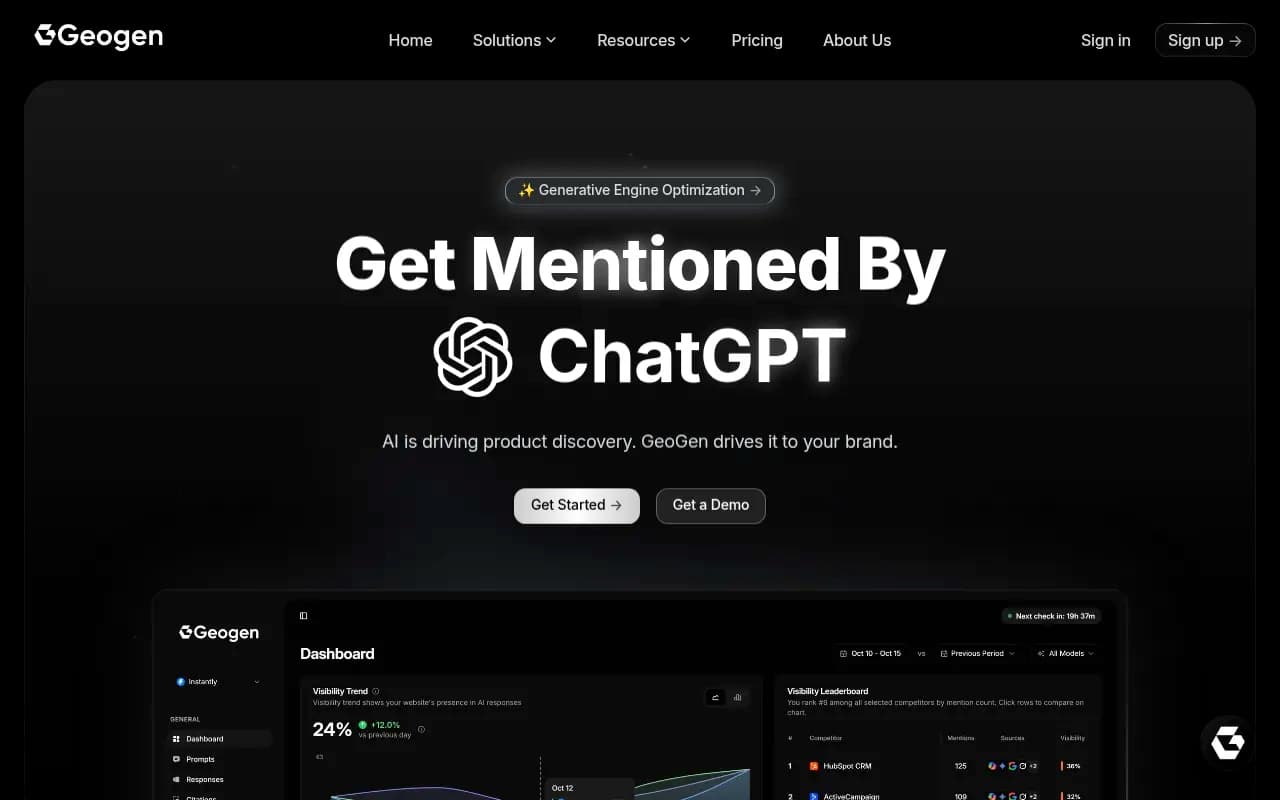
GeoGen takes a more traditional approach to Generative Engine Optimization (GEO). It's a dedicated monitoring platform that tracks how your brand appears across ChatGPT, Perplexity, Gemini, Grok, and Microsoft Copilot. You get visibility analytics, competitor rankings, sentiment analysis, and recommendations for improvement -- but the actual content creation and optimization work happens outside the platform.
The target audience is small to mid-sized brands that want clear visibility into AI search performance without the complexity (or cost) of a full automation suite.
Side-by-side comparison
| Feature | Zerply | GeoGen |
|---|---|---|
| Starting price | Free (500 credits/mo) or $99/mo paid | €20/mo (Micro plan) |
| AI engines tracked | ChatGPT, Perplexity, Gemini, Claude, Grok | ChatGPT, Perplexity, Gemini, Grok, Copilot |
| Content automation | Yes -- AI agents draft and publish | No -- monitoring only |
| WordPress integration | Direct publishing | Not available |
| Competitor analysis | Share of Voice, gap analysis | Competitor rankings |
| Sentiment tracking | Yes | Yes |
| Google Search Console integration | Yes (chat with GSC data) | Not mentioned |
| Content calendar | Auto-generated by agents | Not available |
| Citation analysis | Basic mention tracking | Basic mention tracking |
| Annual discount | Not specified | 20% off |
| Free tier | Yes (500 credits/mo) | No |
| Best for | Brands wanting automation | Brands wanting monitoring |
Pricing breakdown
| Plan | Zerply | GeoGen |
|---|---|---|
| Free/Entry | Free: 500 credits/mo | Micro: €20/mo (~$22) |
| Mid-tier | $99/mo (paid plan) | Standard: €99/mo (~$108) |
| High-tier | Not publicly listed | Pro: €399/mo (~$435) |
| Enterprise | Custom pricing | Custom pricing |
| Annual discount | Not specified | 20% off |
GeoGen is more transparent about its pricing tiers. Zerply's website emphasizes the free plan and a $99/mo tier but doesn't detail what's included at each level or whether higher tiers exist. For budget-conscious teams, GeoGen's €20/mo entry point is hard to beat. But Zerply's free tier with 500 credits offers a genuine try-before-you-buy option that GeoGen lacks.
Core philosophy: Automation vs control
The fundamental difference isn't features -- it's philosophy.
Zerply believes the future of SEO is agentic. You shouldn't be manually researching keywords, drafting briefs, writing articles, and scheduling posts. AI agents should handle the grunt work while you steer strategy. The platform is built around this vision: agents that run 24/7, analyze your site, spot opportunities, generate content, and publish it. You review and approve, but the heavy lifting is automated.
GeoGen believes in giving you visibility and letting you decide what to do with it. It tracks your brand mentions across AI engines, shows you where competitors are winning, and surfaces recommendations. But it stops there. You take the insights back to your team, your writers, your CMS. The platform doesn't try to replace your workflow -- it informs it.
Neither approach is wrong. It depends whether you want a co-pilot or a dashboard.
AI visibility tracking: How they compare
Both platforms cover the major AI search engines that matter in 2026: ChatGPT, Perplexity, Gemini, Claude. GeoGen explicitly lists Microsoft Copilot; Zerply lists Grok. The coverage is roughly equivalent.
Both track:
- Brand mentions in AI-generated responses
- Sentiment (positive, neutral, negative)
- Competitor rankings
- Share of Voice metrics
Zerply's AI visibility dashboard shows recent mentions with snippets from each AI engine, a Share of Voice percentage, and a count of total mentions. GeoGen's interface (based on screenshots) appears similar -- a dashboard view with mention tracking and competitor comparisons.
The tracking capabilities are table stakes at this point. Where they diverge is what happens after you see the data.
Zerply feeds visibility insights directly into its content agents. If ChatGPT isn't mentioning you for a relevant query, the agent identifies the gap, drafts content to fill it, and queues it for publishing. The loop closes automatically.
GeoGen gives you the same visibility data but leaves the response up to you. You see the gap, you decide whether to act, you assign it to a writer, you create the content manually. More control, more work.
For brands also looking to understand the deeper mechanics of how AI engines discover and cite content, Promptwatch offers crawler log analysis and citation source breakdowns that go beyond what either Zerply or GeoGen provide.

Content automation: Zerply's differentiator
This is where Zerply separates itself.
The platform includes AI agents that:
- Monitor your site 24/7 -- analyzing existing content, traffic patterns, and performance
- Find gaps -- identifying topics and queries where competitors rank but you don't
- Plan your calendar -- auto-scheduling content based on opportunity and priority
- Draft articles -- using GPT-4, Claude, or Gemini to write human-quality content
- Publish to WordPress -- pushing finished drafts live or queuing them for review
The content calendar view shows a month-at-a-glance grid with planned articles. Agents fill gaps automatically. You can intervene, edit, or approve, but the default mode is autonomous.
GeoGen has none of this. It's a monitoring tool. If you want content, you write it yourself or hire someone.
The question is whether Zerply's automation produces content worth publishing. The platform uses leading models and integrates with your existing data (Search Console, uploaded docs), so it's not generating blind. But AI-drafted content still needs human review. Expect solid first drafts, not publish-ready perfection. If you're comfortable editing AI output, Zerply saves hours. If you're a purist who writes every word manually, the automation won't appeal.
SEO research chat: Zerply's hidden gem
Zerply includes a conversational interface where you can upload documents, connect Google Search Console, and ask complex questions. "Which pages dropped traffic in the last 30 days?" "What keywords are competitors ranking for that we're not?" The system queries your connected data sources and returns answers with citations.
This isn't directly related to AI visibility tracking, but it's a useful bonus for teams managing both traditional SEO and AI search optimization. You get a single interface for all your search data.
GeoGen doesn't offer anything comparable. It's focused solely on AI search visibility.
User experience and interface
Both platforms have modern, dashboard-style interfaces. Zerply's screenshots show a sidebar nav with sections for Content Strategy, Blog Agent, AI Visibility, and Chat. The content calendar is visual and easy to scan. The AI visibility dashboard shows recent mentions with model icons (ChatGPT, Perplexity, Claude) and snippet previews.
GeoGen's interface (based on website screenshots) looks clean and straightforward. The focus is on visibility metrics, competitor comparisons, and mention tracking. It's simpler because it does less.
Zerply has more surface area -- more features means more screens to navigate. If you just want to check your AI visibility and leave, GeoGen is faster. If you want to live in the platform and let it run your content operation, Zerply's complexity is justified.
Integration and workflow
Zerply integrates with:
- WordPress (direct publishing)
- Google Search Console (data import and chat queries)
- Document uploads (PDFs, CSVs for research chat)
GeoGen's integrations aren't detailed on the website. It appears to be a standalone monitoring platform without deep CMS or analytics integrations.
For teams already using WordPress, Zerply's direct publishing is a major workflow advantage. You can review drafts in the platform and push them live without copy-pasting into your CMS.
GeoGen fits into workflows where you're already using separate tools for content creation, SEO research, and publishing. It adds AI visibility tracking without disrupting your existing stack.
Pros and cons
Zerply pros:
- Free tier with 500 credits/mo for testing
- End-to-end automation from gap analysis to publishing
- WordPress integration for seamless content deployment
- SEO research chat for querying Search Console and uploaded data
- Uses leading AI models (GPT-4, Claude, Gemini) for content generation
- Content calendar with auto-scheduling
Zerply cons:
- Higher starting price for paid plans ($99/mo vs GeoGen's €20/mo)
- Complexity may overwhelm teams that just want monitoring
- AI-generated content still requires human review and editing
- Pricing tiers and limits not fully transparent on website
- Newer platform with less established track record
GeoGen pros:
- Lower entry price (€20/mo Micro plan)
- Simple, focused interface for AI visibility monitoring
- 20% discount on annual billing
- Covers Microsoft Copilot explicitly
- No learning curve -- straightforward monitoring dashboard
- Better for teams that prefer manual control over content
GeoGen cons:
- No free tier for testing
- Monitoring only -- no content creation or automation
- No CMS integrations or publishing workflows
- Limited details on what's included at each pricing tier
- Doesn't help you act on insights, just shows them
Who should choose which platform
Choose Zerply if:
- You want automation, not just dashboards
- You're comfortable editing AI-generated content
- You use WordPress and want direct publishing
- You need both AI visibility tracking and traditional SEO research in one place
- You have the budget for a $99/mo tool (or can work within the free tier's limits)
- You're a solo marketer or small team drowning in manual content work
Choose GeoGen if:
- You just want to monitor AI search visibility without automation
- You prefer full manual control over content creation
- You're on a tight budget and need the €20/mo entry point
- You already have a content workflow and just need visibility data to inform it
- You don't use WordPress or don't want CMS integration
- You're a small to mid-sized brand focused on tracking, not scaling content production
Final verdict
Zerply and GeoGen solve different problems.
GeoGen is a monitoring tool. It tells you where you stand in AI search results, how competitors are performing, and what's being said about your brand. If you want visibility into the AI search landscape without changing your workflow, GeoGen delivers at a reasonable price.
Zerply is an automation platform. It tracks AI visibility but doesn't stop there -- it identifies gaps, generates content to fill them, and publishes it to your site. If you want a system that actively works to improve your AI search presence while you sleep, Zerply is built for that.
The choice comes down to control vs automation. GeoGen gives you data and lets you decide. Zerply gives you data and acts on it.
For most teams in 2026, the bottleneck isn't knowing what content to create -- it's having the time and resources to create it. Zerply addresses that bottleneck directly. GeoGen assumes you've already solved it.