Key Takeaways
- Zerply is an agentic SEO platform that tracks AI visibility AND autonomously creates content, while Ceyo is a pure monitoring tool focused on prompt analytics and sentiment tracking
- Ceyo costs less upfront ($49/mo vs $99/mo starting price), but Zerply includes a free plan with 500 credits/month and adds content generation capabilities that Ceyo lacks entirely
- Zerply integrates traditional SEO data (Google Search Console) with AI visibility, whereas Ceyo focuses exclusively on LLM monitoring across ChatGPT, Claude, Perplexity, and Gemini
- Ceyo excels at granular prompt analytics with detailed tables showing visibility %, sentiment, average position, and competitive brand mentions per prompt -- Zerply's strength is the autonomous agent workflow
- If you need content creation automation, Zerply is the only option here. If you want pure AI visibility monitoring with deep prompt-level insights, Ceyo delivers that at a lower price point.
- Neither platform is a complete GEO solution -- tools like Promptwatch offer more comprehensive AI visibility tracking with crawler logs, citation analysis, Reddit/YouTube insights, and content gap analysis that both Zerply and Ceyo lack
Overview
Zerply: Agentic SEO meets AI visibility
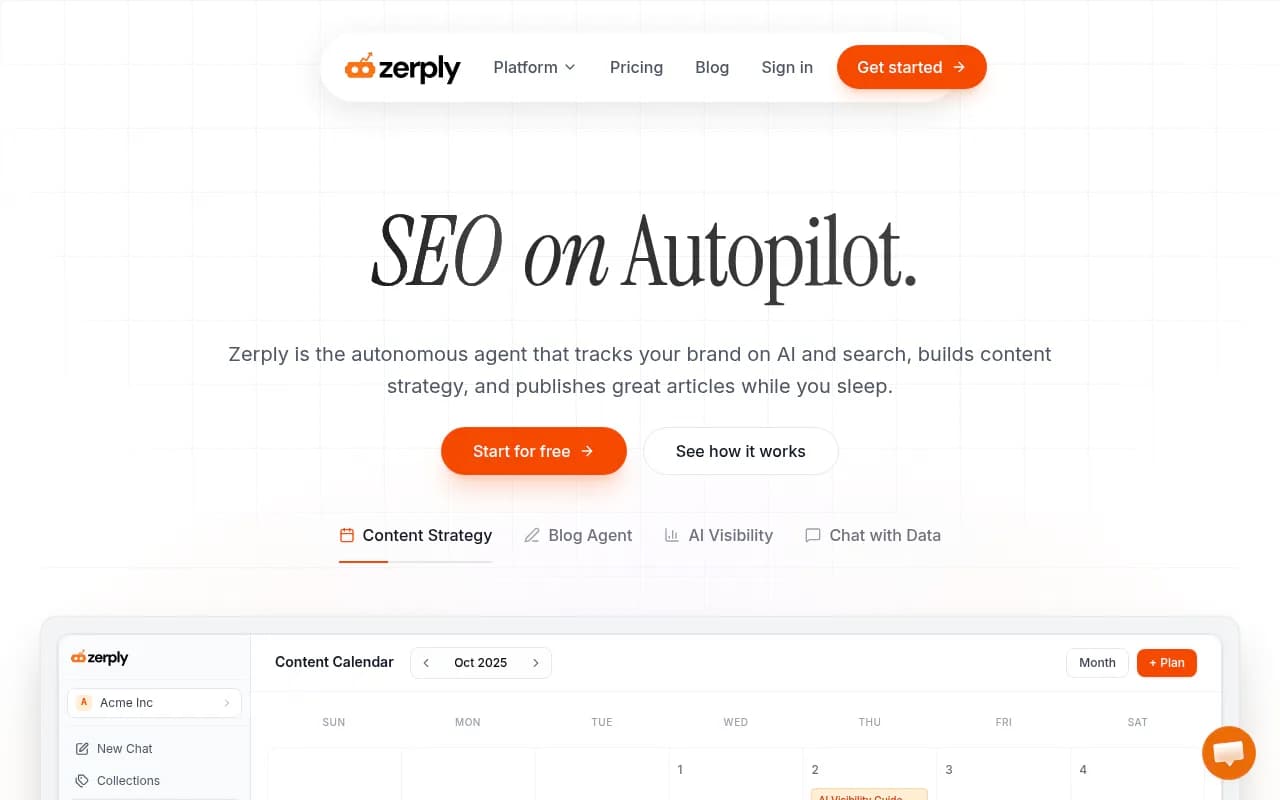
Zerply positions itself as an "autonomous agent" for SEO -- it tracks your brand's visibility in AI-generated responses, but the real differentiator is what happens next. The platform uses specialized AI workers to monitor your site, identify content gaps, plan a publishing calendar, write articles, and push them live to WordPress while you sleep. It's part AI visibility tracker, part content factory.
The pitch: stop gluing tools together. Zerply combines AI visibility monitoring, SEO research chat (connected to Google Search Console), and agentic content production in one platform. You get a content calendar view, autonomous drafting agents, and real-time sentiment analysis across ChatGPT, Perplexity, Claude, and Gemini.
Pricing starts with a free plan (500 credits/month) and paid plans from $99/mo.
Ceyo: Pure-play AI visibility monitoring
Ceyo
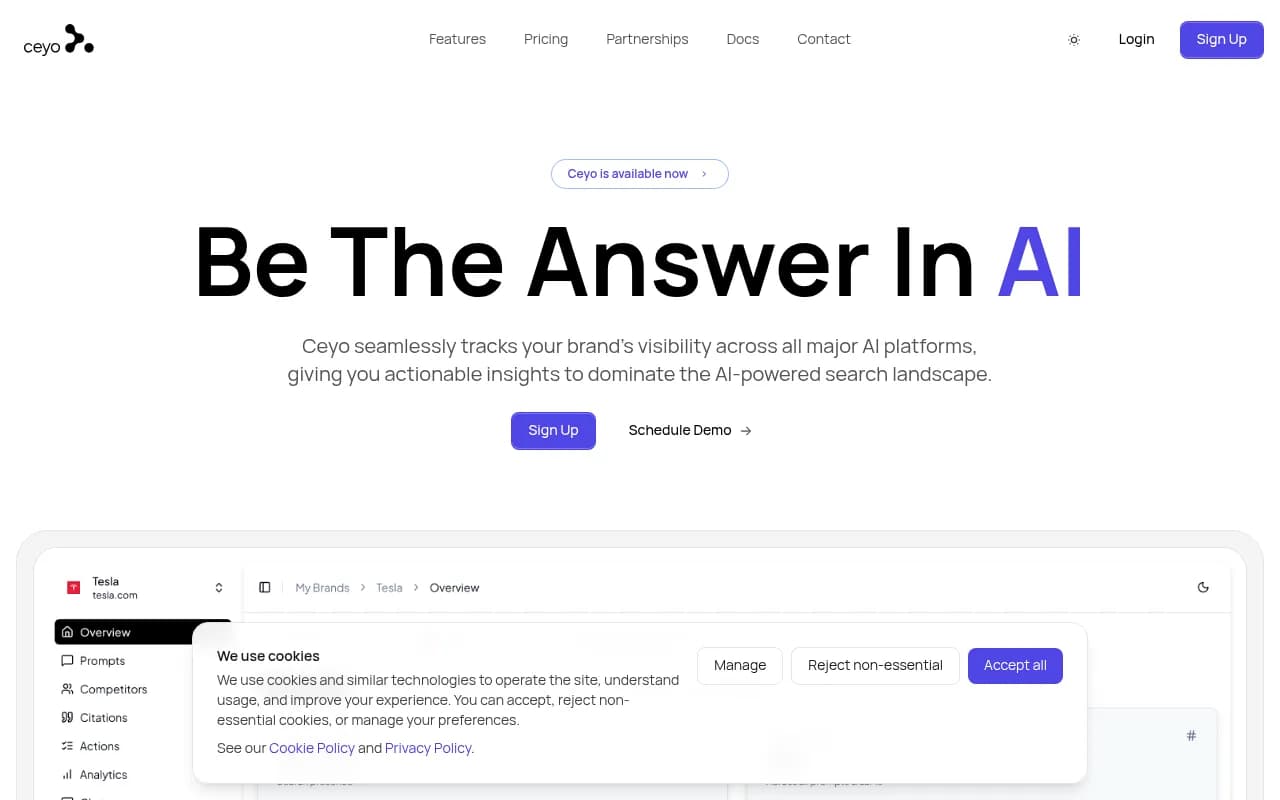
Ceyo takes a focused approach: track how your brand appears in AI responses, period. No content generation, no WordPress publishing, no autonomous agents. What you get instead is comprehensive prompt analytics -- visibility percentages, sentiment scores, average position, competitive brand mentions, and geographic tracking across thousands of prompts.
The platform monitors ChatGPT, Gemini, Claude, and Perplexity with daily updates. You see which queries drive your brand's presence, how sentiment shifts over time, and where competitors are winning. Ceyo is built for agencies, SEO teams, and brand managers who need AI visibility data without the complexity of an all-in-one platform.
Pricing starts at $49/mo for the Core plan (1 brand), with Pro plans at $89-199/mo and custom Enterprise pricing.
Side-by-Side Comparison
| Feature | Zerply | Ceyo |
|---|---|---|
| Starting price | Free plan (500 credits), paid from $99/mo | $49/mo (Core, 1 brand) |
| Free tier | Yes (500 credits/month) | No |
| AI models tracked | ChatGPT, Perplexity, Claude, Gemini | ChatGPT, Gemini, Claude, Perplexity |
| Content generation | ✓ Autonomous Blog Agent, auto-publishing to WordPress | ✗ Monitoring only |
| Prompt analytics | Basic visibility and sentiment tracking | ✓ Detailed tables with visibility %, sentiment, avg position, impact, brands |
| Google Search Console integration | ✓ Yes, for SEO chat intelligence | ✗ No mention |
| Content calendar | ✓ Visual monthly planner with agent auto-fill | ✗ Not applicable |
| Sentiment analysis | ✓ Real-time sentiment tracking | ✓ Per-prompt sentiment scores |
| Competitor tracking | Share of Voice, gap analysis | ✓ Competitive brand mentions per prompt |
| Geographic tracking | Not specified | ✓ Per-prompt GEO flags (US, UK, DE, etc.) |
| Multi-brand support | Not clearly specified | ✓ Pro/Enterprise plans for agencies |
| WordPress publishing | ✓ Direct integration | ✗ No |
| Citation analysis | Basic mention tracking | Not specified |
| API access | Not specified | Not specified |
Head-to-head feature deep-dive
Core value proposition
Zerply sells you on autonomy. The platform doesn't just tell you where you're invisible in AI search -- it fixes the problem by generating content that fills the gaps. The "agentic SEO" angle means you set goals, and AI workers handle the execution: monitoring, planning, writing, publishing. It's a workflow replacement, not just a dashboard.
Ceyo sells you on clarity. You get granular, actionable data about every prompt that matters to your brand. The prompt analytics table shows exactly which queries you're winning, which ones you're losing, and how sentiment breaks down. No fluff, no autonomous agents -- just the numbers you need to make decisions.
Verdict: If you're a lean team that needs content production bundled with visibility tracking, Zerply's agentic approach saves time. If you have writers in-house and just need visibility data to guide them, Ceyo's focused monitoring is cleaner.
AI visibility tracking depth
Zerply tracks mentions, sentiment, and Share of Voice across the big four LLMs (ChatGPT, Perplexity, Claude, Gemini). You see recent mentions with snippets of what each model said about your brand. The interface shows a pie chart of market share and a feed of citations. It's functional but not granular.
Ceyo goes deeper on the prompt level. Each row in the analytics table shows visibility percentage, sentiment (positive/neutral/negative), average position, impact score, competing brands mentioned, category, and geographic origin. You can drill into thousands of prompts and see exactly where you rank for each one. This is the core product -- prompt-level intelligence.
Verdict: Ceyo wins on analytical depth. If you need to understand which specific prompts drive visibility and how you stack up against competitors per query, Ceyo's table-driven approach is superior. Zerply's tracking is more surface-level.
Content creation and automation
Zerply's Blog Agent is the headline feature. It monitors your site 24/7, detects content gaps, schedules articles on a visual calendar, drafts them using AI (powered by OpenAI, Claude, Gemini, Perplexity models), and publishes directly to WordPress. You can review drafts or let the agent run autonomously. The content calendar shows the entire month's plan with agents filling gaps automatically.
Ceyo has zero content creation features. It's a monitoring tool. You take the insights and create content elsewhere.
Verdict: Zerply is the only option if you want content automation. Ceyo doesn't compete here.
SEO and traditional search integration
Zerply integrates Google Search Console into its "SEO Research Chat" feature. You can ask questions like "Which pages dropped traffic in the last 30 days?" and get answers pulled from GSC data. It's a conversational interface over your traditional SEO metrics, combined with AI visibility tracking. The idea: unify traditional search and AI search in one platform.
Ceyo focuses exclusively on AI visibility. No GSC integration, no traditional SEO data. If you want to correlate AI mentions with organic traffic, you're doing that manually.
Verdict: Zerply wins if you want a unified view of traditional SEO and AI visibility. Ceyo is laser-focused on LLMs only.
Competitor analysis
Zerply shows Share of Voice (your brand vs Competitor A vs Others) and mentions across LLMs. You see which models are citing competitors and can identify gaps. The gap analysis feeds into the content agent's planning.
Ceyo's prompt analytics table lists competing brands mentioned in each prompt response. You see exactly which brands are being recommended alongside yours (or instead of yours) for every query. This is more granular than Zerply's Share of Voice pie chart.
Verdict: Ceyo gives you more actionable competitive intelligence at the prompt level. Zerply's competitor view is higher-level.
Pricing and value
| Plan | Zerply | Ceyo |
|---|---|---|
| Free tier | 500 credits/month | None |
| Entry paid plan | $99/mo (details not specified) | $49/mo (Core, 1 brand) |
| Mid-tier | Not specified | $89-199/mo (Pro plans) |
| Enterprise | Not specified | Custom pricing |
Zerply's free plan is a meaningful differentiator -- 500 credits/month lets you test the platform without paying. The $99/mo entry point is higher than Ceyo's $49/mo, but you're getting content generation and WordPress publishing on top of visibility tracking.
Ceyo's $49/mo Core plan is cheaper upfront and works for solo brands or small teams that just need monitoring. The Pro plans ($89-199/mo) suggest multi-brand support for agencies, though specifics aren't detailed. Enterprise pricing is custom.
Verdict: Ceyo is cheaper if you only need monitoring. Zerply's higher price includes content automation, which justifies the cost if you use it. The free tier makes Zerply easier to trial.
User experience and interface
Zerply's interface centers on the content calendar -- a visual monthly grid showing planned articles, with agents auto-filling gaps. The SEO chat is conversational (ask questions, get answers from GSC data). The AI visibility dashboard shows Share of Voice and recent mentions. It's designed for workflow automation, not deep data exploration.
Ceyo's interface is table-driven. The prompt analytics table is the main view -- sortable, filterable, with columns for every metric. It's built for analysts who want to slice data by visibility, sentiment, category, geography, etc. Less visual, more functional.
Verdict: Zerply feels like a productivity tool (calendars, agents, automation). Ceyo feels like an analytics platform (tables, metrics, filters). Pick based on whether you want automation or analysis.
Pros and cons
Zerply pros
- Free plan with 500 credits/month for testing
- Autonomous content generation and WordPress publishing
- Google Search Console integration for unified SEO + AI visibility
- Content calendar with visual planning and agent auto-fill
- Multi-model content generation (OpenAI, Claude, Gemini, Perplexity)
Zerply cons
- Higher starting price ($99/mo vs $49/mo)
- AI visibility tracking is less granular than Ceyo's prompt-level analytics
- Agentic approach may feel like overkill if you just need monitoring
- Pricing tiers and multi-brand support not clearly detailed
- No mention of API access or advanced integrations
Ceyo pros
- Lower entry price ($49/mo for Core plan)
- Extremely granular prompt-level analytics (visibility %, sentiment, avg position, competing brands)
- Geographic tracking per prompt (useful for localized brands)
- Built for agencies with Pro/Enterprise tiers
- Focused product -- does one thing (monitoring) well
Ceyo cons
- No free tier or trial mentioned
- Zero content creation features -- monitoring only
- No Google Search Console or traditional SEO integration
- Less automation -- you manually act on insights
- Pricing details for Pro/Enterprise plans not transparent
Who should pick which tool
Pick Zerply if:
- You're a lean team (1-3 people) that needs content production bundled with AI visibility tracking
- You want autonomous agents to handle the full workflow: gap detection → content planning → writing → publishing
- You use WordPress and want direct publishing integration
- You want to unify traditional SEO data (Google Search Console) with AI visibility in one platform
- You're willing to pay $99/mo for an all-in-one solution instead of stitching together separate tools
- You want to test with a free plan before committing
Pick Ceyo if:
- You have in-house writers and just need AI visibility data to guide their work
- You want granular, prompt-level analytics with visibility %, sentiment, and competitive brand mentions
- You're an agency managing multiple client brands and need scalable monitoring (Pro/Enterprise plans)
- You prefer a focused tool that does monitoring exceptionally well over an all-in-one platform
- You're budget-conscious and want the lowest entry price ($49/mo)
- You need geographic tracking to understand how AI responses vary by region
Consider Promptwatch if:
- You need more comprehensive AI visibility tracking than either Zerply or Ceyo offers -- crawler logs showing exactly when ChatGPT/Claude/Perplexity crawl your site, citation analysis across 880M+ data points, Reddit/YouTube insights that influence AI recommendations, and content gap analysis that shows which prompts competitors rank for but you don't
- You want the action loop: find gaps → generate optimized content → track results, with built-in AI writing agents grounded in real citation data
- You need page-level tracking to see which specific pages get cited by which models, plus traffic attribution to connect AI visibility to revenue

Final verdict
Zerply and Ceyo serve different needs. Zerply is an agentic SEO platform that happens to include AI visibility tracking -- the real value is autonomous content production. Ceyo is a pure-play AI visibility monitor with exceptional prompt-level analytics.
If you're a small team that needs content automation and can't afford separate tools for monitoring + writing + publishing, Zerply's $99/mo all-in-one approach makes sense. The free tier is a low-risk way to test the agentic workflow.
If you have content production handled and just need detailed AI visibility data to inform your strategy, Ceyo's $49/mo entry price and granular prompt analytics deliver better ROI. The geographic tracking and competitive brand mentions per prompt are genuinely useful.
Neither platform is a complete GEO solution. Zerply's AI visibility tracking is surface-level (Share of Voice and mention feeds), and Ceyo lacks content creation entirely. For teams serious about dominating AI search, a platform like Promptwatch that combines deep visibility tracking (crawler logs, citation analysis, Reddit/YouTube insights) with content gap analysis and AI-powered content generation closes the loop that both Zerply and Ceyo leave open.
Bottom line: Zerply if you need automation, Ceyo if you need analytics, Promptwatch if you need both plus the data infrastructure to actually win in AI search.