Key Takeaways
- Zerply is 3x cheaper: Starts at $99/mo with a free plan (500 credits/mo), while Cognizo starts at $300/mo with no free tier
- Zerply is autonomous, Cognizo is monitoring-focused: Zerply uses AI agents to automatically plan, write, and publish content. Cognizo tracks visibility and creates briefs but requires manual execution
- Cognizo has deeper analytics: Processes millions of daily data points with detailed citation tracking and sentiment analysis. Zerply offers Share of Voice and mention tracking but emphasizes the full content workflow
- Zerply integrates traditional SEO: Connects Google Search Console, tracks organic search alongside AI visibility, and manages your entire content calendar. Cognizo is laser-focused on AI answer engines
- Different target audiences: Zerply suits individual sites and small teams wanting automation. Cognizo targets marketing teams and agencies needing granular AI visibility insights across multiple brands
- Both track the same AI engines: ChatGPT, Perplexity, Claude, Gemini, and Google AI Overviews are covered by both platforms
Overview
Two platforms tackling the same problem -- how do you show up when people ask ChatGPT or Perplexity about your industry? -- but with completely different philosophies.
Zerply: The autonomous agent approach
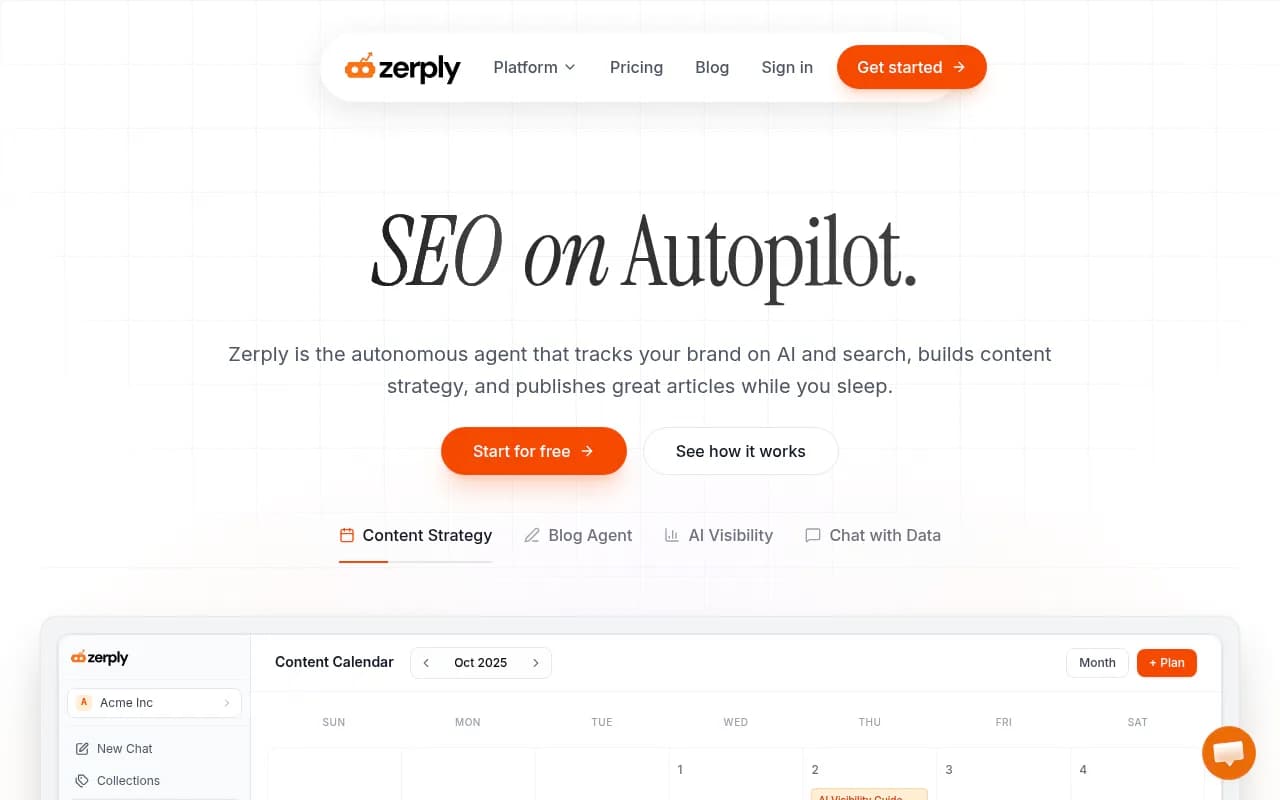
Zerply positions itself as "SEO on Autopilot" -- an agentic platform where AI workers monitor your site, identify content gaps, plan your editorial calendar, write articles, and publish them to WordPress without human intervention. It's tracking AI visibility, yes, but that's just one pillar. The real pitch is a self-running content machine that optimizes for both traditional search and AI answer engines.
The platform combines three core capabilities: AI visibility tracking (monitoring how your brand appears in ChatGPT, Perplexity, Claude, Gemini), SEO research chat (conversational interface to query your Google Search Console data and uploaded documents), and autonomous blog agents that fill your content calendar while you sleep.
Pricing starts at $99/mo with a free plan offering 500 credits monthly. The emphasis is on automation and integration -- connecting your existing tools (WordPress, GSC) and letting agents handle the grunt work.
Cognizo: The monitoring and optimization specialist
Cognizo
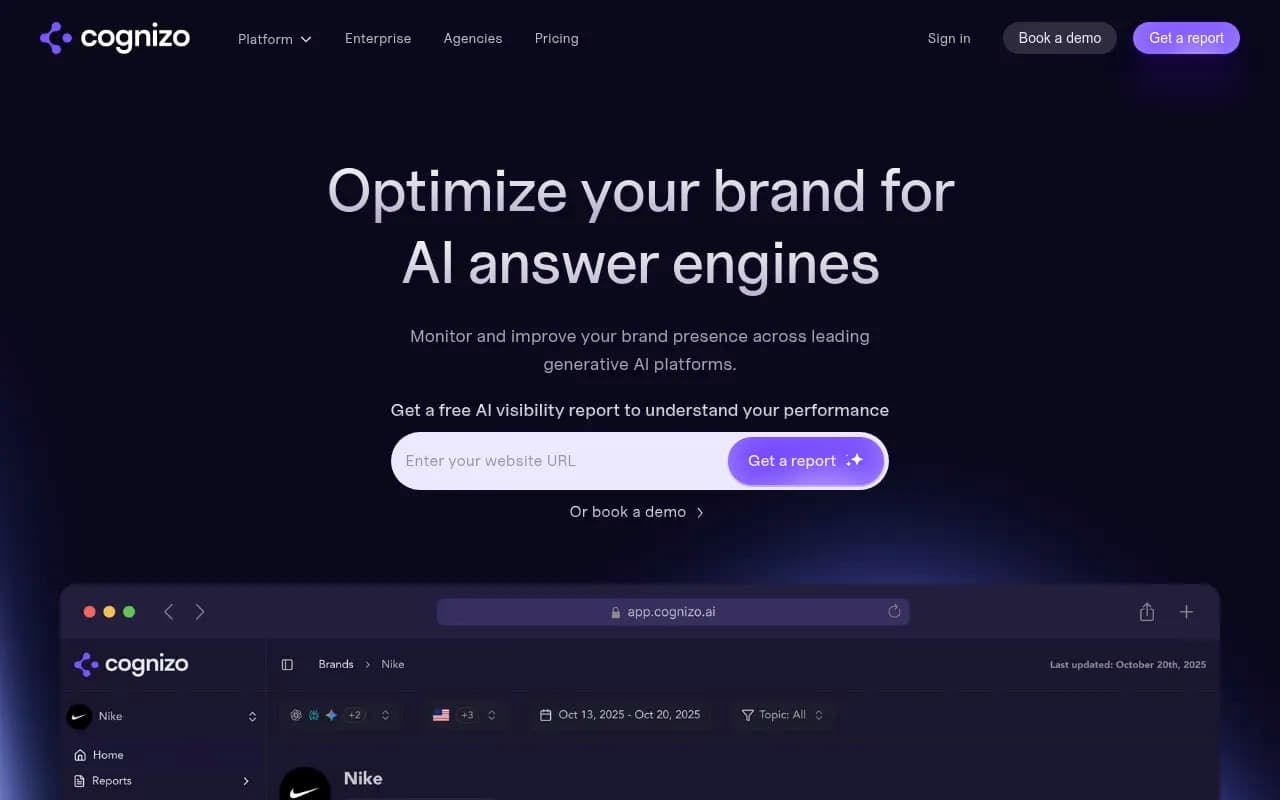
Cognizo is a dedicated Answer Engine Optimization (AEO) platform. It doesn't try to be your entire marketing department -- it does one thing deeply: help you understand and improve how your brand shows up in AI-generated answers.
The platform analyzes millions of data points daily across ChatGPT, Perplexity, Gemini, and Google AI Overviews. You get real-time mention tracking, citation analysis, sentiment monitoring, competitor gap analysis, and AI-driven traffic measurement. Cognizo also generates content briefs and drafts optimized for AI visibility, but the human is still in the loop for review and publishing.
Pricing starts at $300/mo for the Starter plan with 350 prompts and basic monitoring. No free tier. The target audience is marketing teams and agencies managing brand visibility at scale.
Side-by-Side Comparison
| Feature | Zerply | Cognizo |
|---|---|---|
| Starting price | $99/mo | $300/mo |
| Free plan | Yes (500 credits/mo) | No (free trial only) |
| AI engines tracked | ChatGPT, Perplexity, Claude, Gemini, Google AI Overviews | ChatGPT, Perplexity, Gemini, Google AI Overviews, Claude |
| Autonomous content creation | Yes (AI agents write & publish) | No (generates briefs, requires manual publishing) |
| WordPress integration | Yes (direct publishing) | Not mentioned |
| Google Search Console integration | Yes | Not prominently featured |
| Citation tracking | Basic mention tracking | Deep citation and source analysis |
| Sentiment analysis | Yes (Share of Voice metrics) | Yes (real-time sentiment monitoring) |
| Content calendar | Automated planning and scheduling | Manual planning with insights |
| Competitor analysis | Gap detection | Detailed competitor visibility comparison |
| AI-driven traffic measurement | Not prominently featured | Yes (tracks AI crawler activity and human traffic) |
| Target audience | Individual sites, small teams | Marketing teams, agencies |
Pricing comparison
| Plan | Zerply | Cognizo |
|---|---|---|
| Free tier | 500 credits/mo | None |
| Starter/Entry | $99/mo | $300/mo (350 prompts) |
| Mid-tier | Not detailed | Not detailed |
| Enterprise | Custom | Custom |
| Free trial | Yes (via free plan) | Yes |
Zerply's pricing advantage is clear: you can start for free and upgrade to $99/mo when you need more. Cognizo requires $300/mo minimum commitment, which makes sense given its enterprise positioning but creates a barrier for smaller teams testing the waters.
Head-to-head feature deep-dive
AI visibility tracking
Both platforms monitor the same core AI engines: ChatGPT, Perplexity, Claude, Gemini, and Google AI Overviews. The difference is depth vs breadth.
Cognizo processes millions of data points daily and gives you granular citation tracking -- which specific sources AI models are pulling from, how often you're mentioned, sentiment breakdowns, and competitor positioning. You see exactly where you're invisible and why. The analytics are built for teams that need to report on AI visibility as a standalone channel.
Zerply tracks AI Share of Voice and recent mentions with sentiment, but the interface feels lighter. You get a dashboard showing your market share percentage and a feed of recent mentions across AI engines. It's enough to know if you're showing up, but not as forensic as Cognizo's approach.
Verdict: Cognizo wins on tracking depth. If your job is to report AI visibility metrics to stakeholders, you want Cognizo's analytics. If you just need to know "are we visible?" before moving to content creation, Zerply's tracking is sufficient.
Content creation and automation
This is where the platforms diverge completely.
Zerply is built around autonomous agents. You connect your site, the agents analyze gaps, plan a content calendar, draft articles, and publish directly to WordPress. The pitch is "while you sleep" -- set it up once and let it run. The content calendar view shows a month at a glance with agents filling gaps automatically. You can intervene and edit, but the default mode is hands-off.
Cognizo generates content briefs and AI-optimized drafts based on visibility insights. You see what topics to cover, what angles to take, and get a draft to work from. But you're still manually reviewing, editing, and publishing. It's content assistance, not content automation.
Verdict: Zerply wins if you want automation. Cognizo wins if you want control. The autonomous agent approach is polarizing -- either you love the idea of a self-running content machine or you're skeptical about quality and brand voice consistency.
Traditional SEO integration
Zerply connects Google Search Console and lets you query your organic search data conversationally. You can ask "which pages dropped traffic in the last 30 days?" and get answers pulled from GSC. It's positioning itself as a unified platform for both traditional SEO and AI visibility.
Cognizo is laser-focused on AI answer engines. It tracks AI-driven traffic (how AI crawlers interact with your site and how that drives human visits), but it's not trying to replace your existing SEO stack.
Verdict: Zerply if you want one platform for everything. Cognizo if you already have SEO tools and just need AI visibility covered.
Competitor analysis
Both platforms offer competitor gap analysis, but with different approaches.
Cognizo shows detailed competitor visibility comparisons -- who's getting mentioned for which prompts, citation frequency, sentiment differences. You can see exactly where competitors are beating you in AI conversations.
Zerply identifies content gaps by comparing your site to competitors, but the emphasis is on feeding those gaps to the autonomous agents for content creation rather than deep competitive intelligence.
Verdict: Cognizo for competitive intelligence. Zerply for turning gaps into action.
User interface and workflow
Zerply's interface centers on the content calendar and conversational chat. You're either looking at your month's content plan (with agents filling slots) or asking questions about your data. It feels like a command center for a content operation.
Cognizo's interface is analytics-heavy. Dashboards showing visibility trends, citation breakdowns, sentiment over time, competitor positioning. It's built for marketers who need to understand the "why" behind their AI visibility.
Verdict: Depends on your role. Content managers will prefer Zerply's calendar-centric view. Marketing analysts will prefer Cognizo's data-rich dashboards.
AI-driven traffic measurement
Cognizo explicitly tracks how AI crawlers interact with your site and measures AI-driven traffic -- visits that originated from someone seeing your brand in an AI answer. This closes the loop from visibility to actual traffic.
Zerply doesn't prominently feature AI traffic attribution. The focus is on creating content that gets you visible, not measuring downstream traffic effects.
Verdict: Cognizo if you need to prove ROI from AI visibility. Zerply if you're focused on the content creation side.
Multi-site and agency capabilities
Cognizo is explicitly positioned for marketing teams and agencies managing multiple brands. The Starter plan includes 350 prompts, which suggests room for tracking multiple clients or product lines.
Zerply's pricing and feature set aren't clearly detailed for multi-site or agency use. The autonomous agent model seems geared toward individual sites rather than managing a portfolio.
Verdict: Cognizo for agencies. Zerply for individual sites or small in-house teams.
Pros and cons
Zerply pros
- 3x cheaper than Cognizo with a functional free plan
- Autonomous content creation and publishing (if you trust the agents)
- Integrates traditional SEO and AI visibility in one platform
- Google Search Console integration for unified data
- Content calendar automation saves hours of manual planning
- WordPress publishing eliminates the manual upload step
Zerply cons
- AI visibility tracking is less detailed than Cognizo's
- Autonomous agents are a trust issue -- quality and brand voice consistency unclear
- Multi-site and agency capabilities not clearly defined
- No explicit AI-driven traffic attribution
- Lighter on competitive intelligence depth
Cognizo pros
- Deep citation and sentiment analysis across AI engines
- Millions of daily data points for granular insights
- AI-driven traffic measurement closes the visibility-to-revenue loop
- Strong competitor gap analysis
- Built for marketing teams and agencies managing multiple brands
- Content briefs based on real visibility data
Cognizo cons
- 3x more expensive with no free tier
- No autonomous content creation -- you're still manually publishing
- Doesn't integrate traditional SEO tools like GSC
- Requires more manual workflow from insight to action
- Overkill if you just want basic AI visibility tracking
Who should pick which tool
Pick Zerply if:
- You're a solo marketer or small team drowning in content creation work
- You want one platform for both traditional SEO and AI visibility
- You're comfortable letting AI agents draft and publish content autonomously
- Budget is tight and you need to start with a free plan
- You use WordPress and want direct publishing integration
- You value automation over granular analytics
Pick Cognizo if:
- You're a marketing team or agency managing brand visibility at scale
- You need detailed analytics to report AI visibility as a standalone channel
- You want control over content creation and publishing
- You have budget for a $300/mo+ tool and need enterprise-grade monitoring
- AI-driven traffic attribution matters for proving ROI
- You already have SEO tools and just need AI visibility covered
Consider Promptwatch if:
- You want the action loop that most monitoring tools miss: find gaps, generate content, track results
- You need crawler logs showing exactly how AI engines interact with your site
- You're tracking AI visibility across 10+ models including ChatGPT Shopping, Reddit, and YouTube
- You want prompt intelligence (volume estimates, difficulty scores, query fan-outs) to prioritize winnable prompts
- You need page-level tracking with traffic attribution to connect visibility to revenue

Final verdict
Zerply and Cognizo solve different problems despite both living in the "AI visibility" category.
Cognizo is the better pure monitoring platform. If your job is to understand and report on how your brand shows up in AI conversations, Cognizo's depth of analytics justifies the $300/mo price. You get millions of data points, detailed citation tracking, sentiment analysis, competitor intelligence, and AI-driven traffic measurement. It's built for teams that need AI visibility as a standalone reporting channel.
Zerply is the better automation platform. If you're drowning in content creation work and want a system that monitors AI visibility, identifies gaps, plans your calendar, writes articles, and publishes them autonomously, Zerply's $99/mo price (or free plan) is a steal. The trade-off is less granular analytics and trusting AI agents with your content.
The decision comes down to this: Do you need deep insights to inform human-driven content strategy (Cognizo), or do you want an autonomous system that handles the entire workflow from gap detection to publishing (Zerply)?
For most small teams and individual sites, Zerply's automation and price point win. For marketing teams and agencies managing multiple brands with budget to spend, Cognizo's analytics depth is worth the premium.