Key Takeaways
- Zerply is a content automation machine -- autonomous agents plan your calendar, write articles, and publish to WordPress without human intervention. Atomic AGI doesn't auto-generate content; it automates research, audits, and workflows instead.
- Atomic AGI is the analytics powerhouse -- it combines traditional Google SEO tracking with AI search monitoring, technical site audits, and deep data analysis. Zerply focuses on AI visibility and content execution, not technical SEO.
- Both start at $99/mo, but the value proposition differs: Zerply bundles content creation (agents write for you), while Atomic AGI bundles analytics depth (multi-engine tracking, technical audits, GSC integration).
- Zerply wins on content velocity -- if your bottleneck is publishing enough articles, Zerply's blog agents are unmatched. Atomic AGI wins on diagnostic depth -- if you need to understand why rankings dropped or where technical issues live, it's the stronger choice.
- Atomic AGI tracks both Google and AI search in one platform. Zerply is AI-search-first with less emphasis on traditional Google SEO metrics.
- Neither is a full replacement for the other -- they solve different problems. Zerply = content production at scale. Atomic AGI = SEO intelligence and technical optimization.
Overview: Two AI-native platforms, two philosophies
Zerply: The autonomous content engine
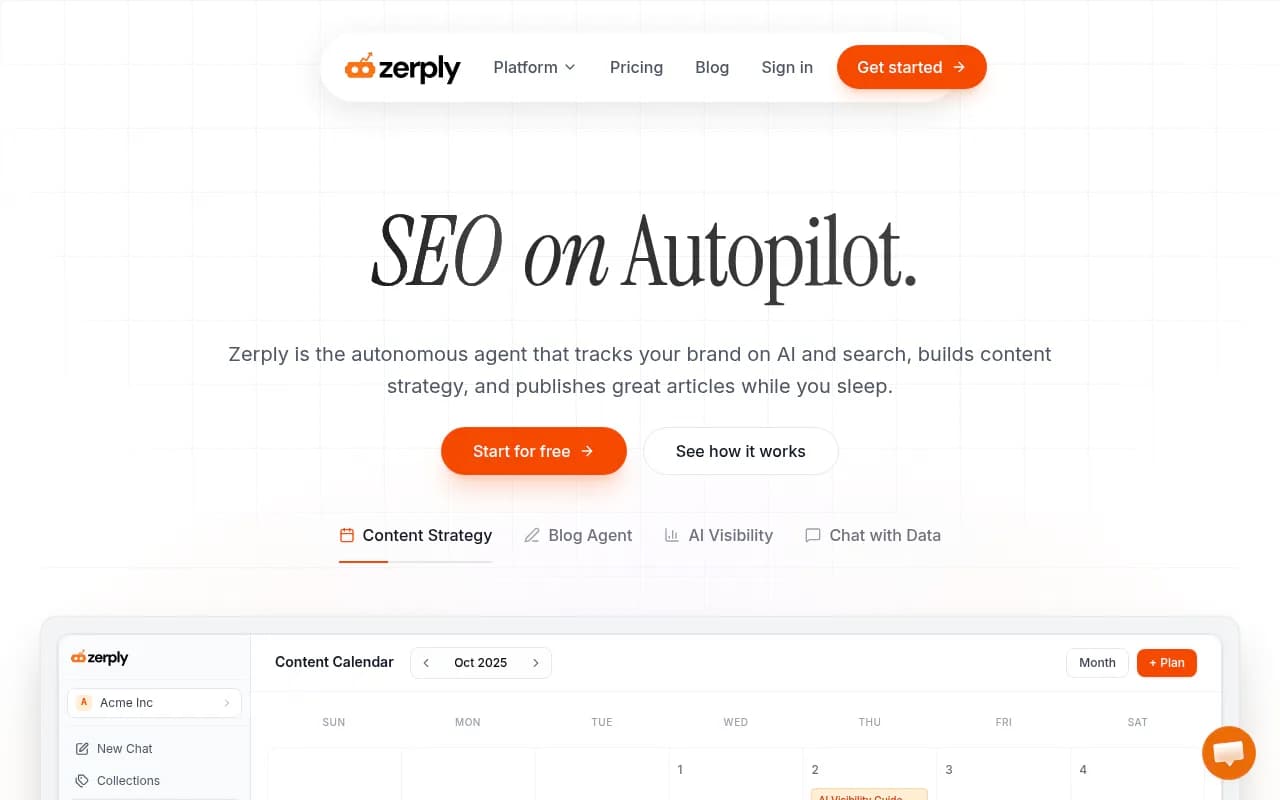
Zerply positions itself as "SEO on autopilot" -- a platform where AI agents monitor your site, identify content gaps, plan your editorial calendar, write articles, and publish them to WordPress while you sleep. The pitch is simple: stop spending 47+ hours weekly on manual content work. Let specialized AI workers handle the entire content pipeline.
The platform has three core pillars: Agentic SEO (autonomous content agents), SEO Research Chat (conversational data analysis with GSC integration), and AI Visibility Tracking (monitoring how your brand appears in ChatGPT, Perplexity, Claude). Zerply is built for teams who want content velocity without hiring more writers.
Pricing starts with a free plan (500 credits/mo) and paid plans from $99/mo. The focus is clearly on content execution -- agents that draft, schedule, and publish.
Atomic AGI: The SEO operating system
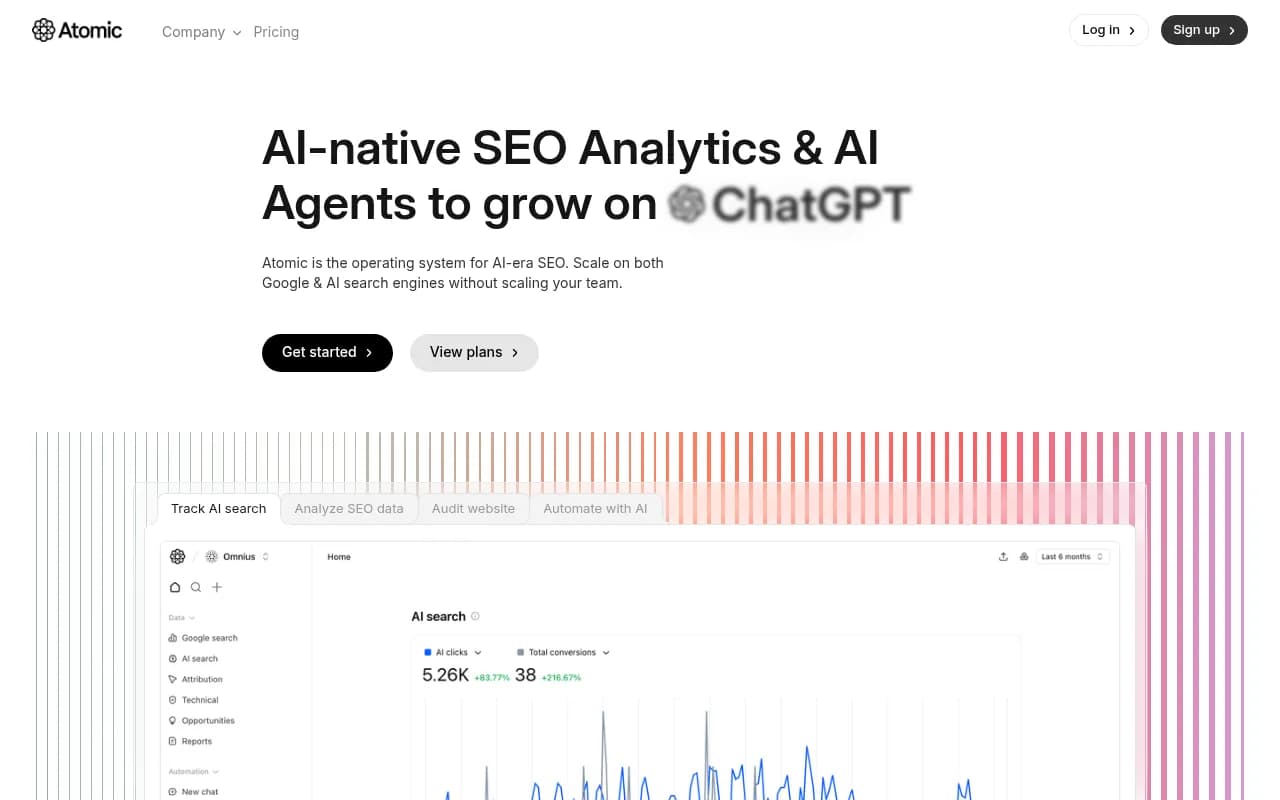
Atomic AGI calls itself the "operating system for AI-era SEO" -- a platform that tracks both traditional Google search and AI search engines (ChatGPT, Perplexity, Gemini, Claude) in one unified dashboard. The value prop: scale organic growth without scaling headcount by combining deep analytics, technical audits, and AI agents for workflow automation.
Atomic AGI has four pillars: AI Search Tracking (multi-engine visibility monitoring), SEO Data Analysis (GSC integration, rank tracking, traffic analysis), Technical Audits (site health, crawl errors, performance), and AI Agents (workflow automation for repetitive tasks). It's built for marketing teams who need diagnostic depth and technical optimization, not just content output.
Pricing is $99/mo per domain with a free plan available. Clients include Booking.com, Accenture, Samsung, MIT -- brands that need enterprise-grade analytics.
Side-by-Side Comparison
| Feature | Zerply | Atomic AGI |
|---|---|---|
| Primary focus | Autonomous content creation | Analytics + technical SEO |
| AI search engines tracked | ChatGPT, Perplexity, Claude (mentioned) | ChatGPT, Perplexity, Gemini, Claude, Google |
| Google SEO tracking | Limited (not emphasized) | Full (GSC integration, rank tracking) |
| Content generation | ✓ Autonomous blog agents write & publish | ✗ No content generation |
| Technical audits | ✗ Not mentioned | ✓ Full site audits, crawl analysis |
| WordPress integration | ✓ Direct publishing | ✗ Not mentioned |
| GSC integration | ✓ (for chat analysis) | ✓ (for rank tracking & analysis) |
| AI agents | Content planning, writing, publishing | Workflow automation, research, audits |
| Sentiment analysis | ✓ (AI mentions) | ✗ Not mentioned |
| Free plan | ✓ 500 credits/mo | ✓ Available |
| Starting price | $99/mo | $99/mo per domain |
| Target user | Content teams, solo marketers | SEO teams, agencies, technical marketers |
Head-to-head feature breakdown
AI search visibility tracking
Both platforms monitor how your brand appears in AI-generated responses, but with different depth.
Zerply tracks mentions across ChatGPT, Perplexity, and Claude. You see your "AI Share of Voice" (what percentage of relevant queries mention you vs competitors), recent mentions with sentiment analysis, and citation frequency. The dashboard shows which AI engines are recommending you and whether the sentiment is positive or negative. This is solid for brand monitoring.
Atomic AGI tracks ChatGPT, Perplexity, Gemini, Claude, and traditional Google search in one unified view. You can compare your visibility across engines, see which queries trigger mentions, and analyze citation sources. The platform doesn't emphasize sentiment analysis as heavily as Zerply, but it gives you more engines and tighter integration with Google data.
Verdict: Atomic AGI wins on breadth (more engines, Google integration). Zerply wins on sentiment depth. If you care about how you're being mentioned (positive vs negative), Zerply is stronger. If you want comprehensive cross-engine coverage, Atomic AGI.
Content automation and execution
This is where the platforms diverge completely.
Zerply is built around autonomous content agents. Here's the workflow: agents monitor your site 24/7, detect content gaps, auto-schedule articles on your calendar, draft human-quality content, and publish directly to WordPress. You can wake up to new articles live on your site. The "Content Calendar" view shows your entire month planned out, with agents filling gaps automatically. This is genuine automation -- not just suggestions, but execution.
Atomic AGI does not generate or publish content. Its AI agents automate research and workflows (e.g. running audits, analyzing data, identifying opportunities), but you still write and publish manually. The platform helps you work faster, but it doesn't write for you.
Verdict: Zerply wins decisively if content velocity is your goal. Atomic AGI isn't competing in this category.
Technical SEO and site audits
Zerply doesn't emphasize technical SEO. The site mentions monitoring and gap detection, but there's no mention of crawl analysis, Core Web Vitals, schema markup, or technical audits. It's focused on content, not infrastructure.
Atomic AGI has a full technical audit suite. You get site health scores, crawl error reports, performance analysis, and actionable recommendations. This is critical for diagnosing why pages aren't ranking or why traffic dropped. The platform positions itself as an "operating system" for SEO, which means it covers the technical foundation, not just content.
Verdict: Atomic AGI wins. If you need to fix technical issues (broken links, slow pages, indexing problems), Atomic AGI is the only option here.
Data analysis and insights
Zerply offers "SEO Research Chat" -- a conversational interface where you upload documents, connect GSC, and ask questions like "Which pages dropped traffic in the last 30 days?" The AI queries your data and answers in plain language. This is useful for quick insights without manual exports or pivot tables. The chat interface uses multi-step reasoning to answer complex questions.
Atomic AGI integrates GSC, rank tracking, and traffic analysis into a unified dashboard. You get traditional SEO metrics (rankings, traffic, CTR) alongside AI search data. The platform is built for teams who need to slice data by segment, compare time periods, and drill into page-level performance. It's less conversational, more dashboard-driven.
Verdict: Zerply wins on ease of use (chat is faster than dashboards for quick questions). Atomic AGI wins on depth (more metrics, more segmentation). Pick based on whether you prefer conversational queries or traditional analytics.
Workflow automation
Both platforms use AI agents, but for different tasks.
Zerply's agents are content-focused: they plan calendars, write drafts, and publish. The automation is end-to-end for content production.
Atomic AGI's agents automate repetitive SEO tasks: running audits, analyzing competitor gaps, generating reports, identifying optimization opportunities. The goal is to eliminate manual busywork so your team can focus on strategy.
Verdict: Different use cases. Zerply automates content creation. Atomic AGI automates SEO operations. Both save time, but in different ways.
Integrations and ecosystem
Zerply integrates with WordPress (for publishing) and Google Search Console (for data analysis). The focus is tight integration with the tools content teams already use.
Atomic AGI integrates with GSC and emphasizes multi-domain tracking for agencies. The platform is built to handle multiple clients or brands in one account.
Verdict: Atomic AGI is better for agencies managing multiple domains. Zerply is better for single-brand content teams.
Pricing comparison
| Plan | Zerply | Atomic AGI |
|---|---|---|
| Free tier | 500 credits/mo | Free plan available (limits not specified) |
| Starter | $99/mo (details not public) | $99/mo per domain |
| What's included | Content agents, AI visibility, chat analysis | AI search tracking, GSC integration, audits, agents |
| Billing | Monthly or annual (likely) | Monthly or annual (likely) |
Both platforms start at the same price point, but the value differs. Zerply bundles content generation -- agents that write and publish for you. Atomic AGI bundles analytics depth -- multi-engine tracking, technical audits, and workflow automation. You're paying for different things.
If you're currently paying freelance writers $500-1000/mo for 4-8 articles, Zerply's $99/mo is a bargain. If you're paying for multiple SEO tools (rank tracker, audit tool, AI monitoring), Atomic AGI consolidates them.
Pros and cons
Zerply pros
- Autonomous content agents actually write and publish articles
- WordPress integration for seamless publishing
- AI visibility tracking with sentiment analysis
- Conversational data analysis (chat interface)
- Content calendar view shows your entire month planned
- Free plan with 500 credits/mo
Zerply cons
- Limited technical SEO capabilities (no audits mentioned)
- Less emphasis on traditional Google SEO metrics
- Fewer AI engines tracked compared to Atomic AGI
- Agent-generated content quality is a question mark (you're trusting AI to publish)
- Not ideal for agencies managing multiple clients
Atomic AGI pros
- Tracks 5 AI engines plus Google in one platform
- Full technical SEO audits and site health monitoring
- GSC integration for traditional rank tracking
- Built for agencies (multi-domain support)
- Trusted by enterprise clients (Booking.com, Samsung, MIT)
- AI agents automate workflows without auto-publishing content
Atomic AGI cons
- No content generation (you still write manually)
- No WordPress publishing integration
- Less emphasis on sentiment analysis for AI mentions
- Pricing is per domain (can get expensive for agencies)
- Steeper learning curve (more features = more complexity)
Who should pick which tool?
Pick Zerply if:
- Your bottleneck is content production, not technical SEO
- You want AI agents to write and publish articles automatically
- You're a solo marketer or small team without dedicated writers
- You prioritize AI search visibility over traditional Google metrics
- You want a conversational interface for data analysis
- You publish primarily to WordPress
Pick Atomic AGI if:
- You need deep technical SEO audits and site health monitoring
- You manage multiple domains or clients
- You want unified tracking across Google and AI search engines
- Your team can handle content creation but needs better data and automation
- You prioritize analytics depth over content velocity
- You're an agency or enterprise with complex SEO needs
Consider both if:
- You have budget for specialized tools and want best-in-class for each function
- Your team is large enough to use Zerply for content and Atomic AGI for analytics
- You need both content velocity and technical optimization
If you're also looking to track how your brand shows up in AI search results with a focus on optimization (not just monitoring), Promptwatch is worth exploring -- it goes beyond tracking to help you fix content gaps and improve AI visibility through citation analysis and content generation.

Final verdict
Zerply and Atomic AGI are both AI-native SEO platforms, but they solve fundamentally different problems. Zerply is a content automation engine -- agents plan, write, and publish articles while you sleep. Atomic AGI is an SEO operating system -- it tracks both Google and AI search, runs technical audits, and automates workflows without auto-publishing content.
If your team is drowning in content backlogs and you trust AI to draft and publish, Zerply is the faster path to content velocity. If you need diagnostic depth, technical optimization, and cross-engine analytics, Atomic AGI is the stronger foundation.
Most teams will eventually need both capabilities -- content production and technical optimization. The question is which bottleneck you solve first. Start with the one that's costing you the most traffic today.