Key Takeaways
- Zerply is 50-85% cheaper and includes autonomous content generation agents that plan, write, and publish articles. Brandlight.ai is monitoring-focused with no built-in content creation.
- Brandlight.ai raised $30M Series A and targets Fortune 500 enterprises with white-glove service and multi-brand deployments. Zerply serves SMBs, agencies, and solo marketers with a freemium model.
- Both track major AI engines (ChatGPT, Perplexity, Claude, Gemini), but Zerply integrates content workflow end-to-end while Brandlight.ai emphasizes competitive benchmarking and "AI-trusted rivals" analysis.
- Zerply offers a free plan (500 credits/mo) so you can test before paying. Brandlight.ai requires a demo and starts at $199/mo with no free tier.
- If you need action, not just dashboards, Zerply's agentic SEO approach (monitor → find gaps → plan → write → publish) closes the loop. Brandlight.ai gives you insights and recommendations but leaves execution to you.
- Enterprise buyers with complex org structures, multi-brand portfolios, and compliance requirements will find Brandlight.ai's positioning and support model more aligned. Scrappy teams that want to move fast should pick Zerply.
Overview: Two platforms, two philosophies
Zerply: Agentic SEO meets AI visibility
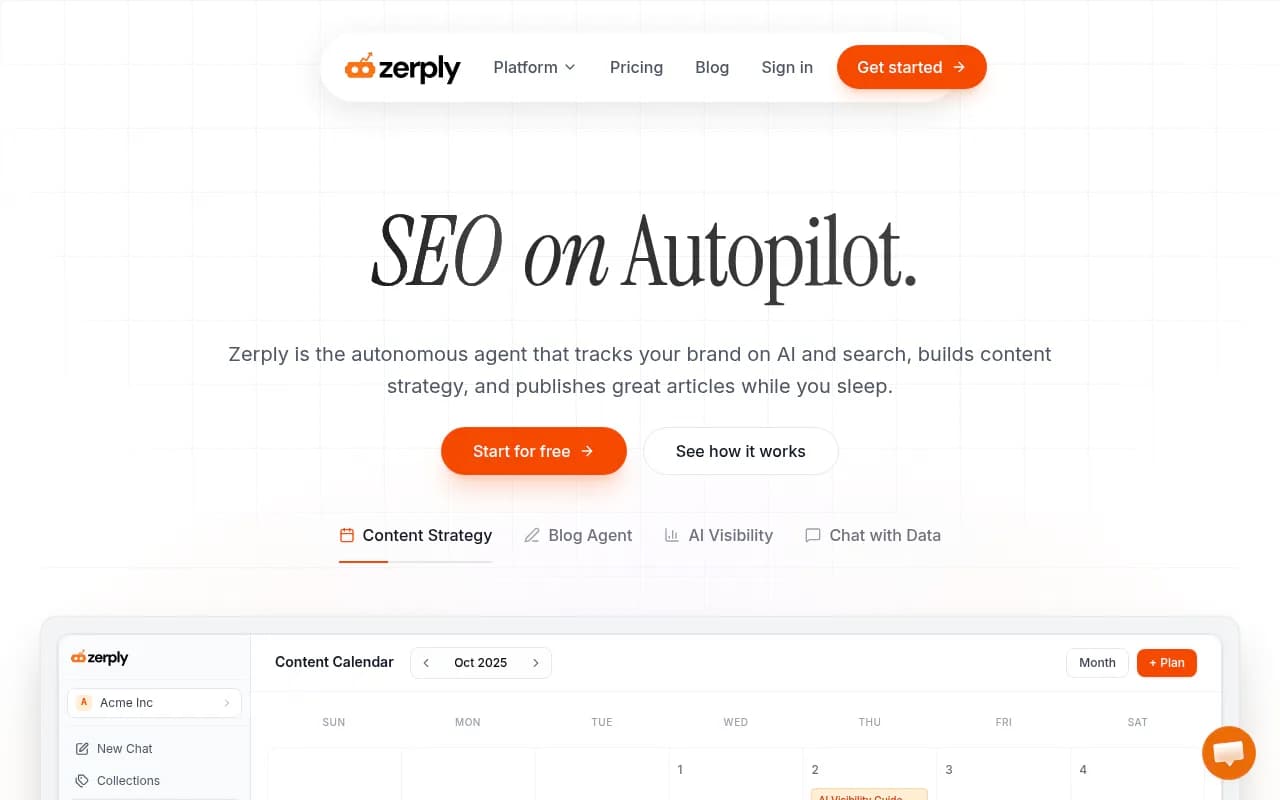
Zerply positions itself as an "autonomous agent" platform -- it doesn't just track how your brand shows up in AI search results, it actively builds content strategy, writes articles, and publishes them while you sleep. The core pitch: stop gluing tools together and let AI workers handle the entire SEO workflow. You get AI visibility tracking (Share of Voice, sentiment analysis, citation frequency across ChatGPT, Perplexity, Claude, Gemini) plus a content calendar, SEO research chat interface, and agents that draft and publish to WordPress. It's freemium with a 500-credit free tier and paid plans starting at $99/mo. Target audience: marketing teams, agencies, solo operators who want automation and affordability.
Brandlight.ai: Enterprise AI visibility at scale
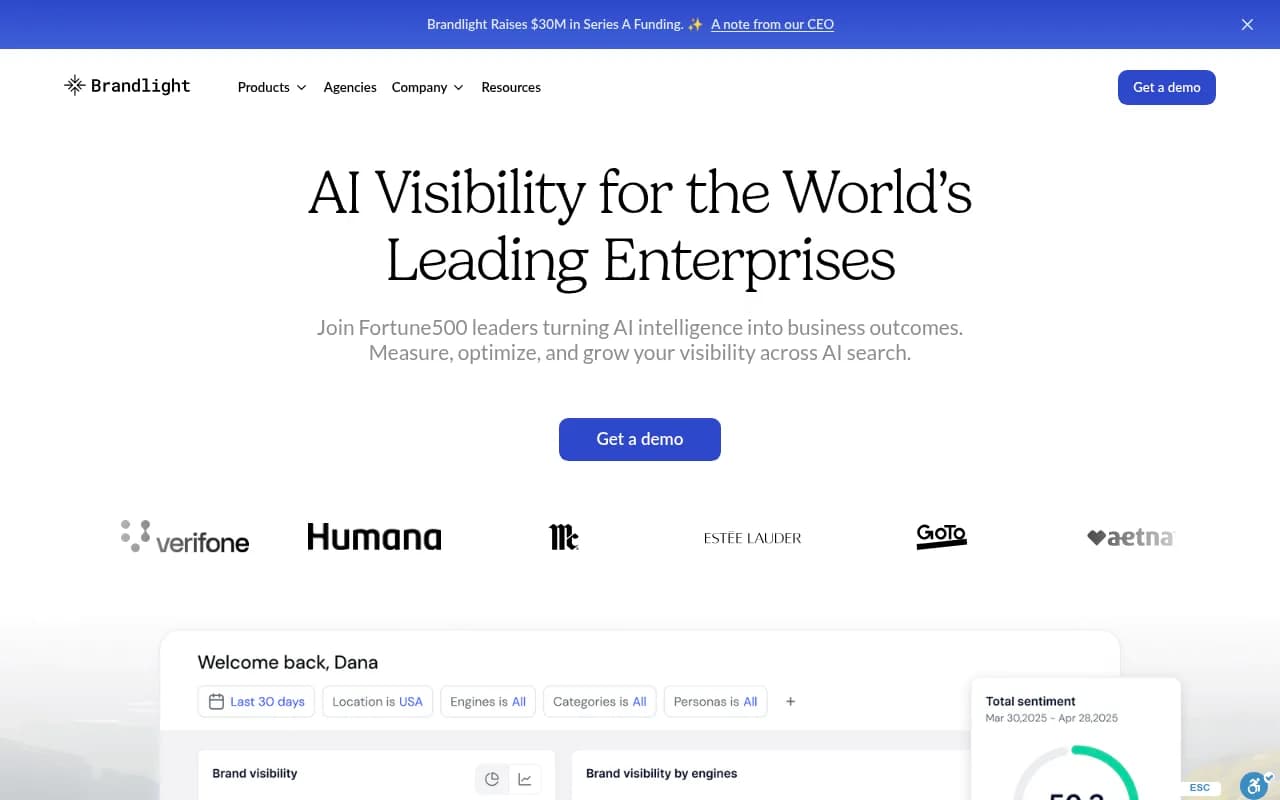
Brandlight.ai just raised $30M Series A and explicitly targets Fortune 500 companies. It monitors brand mentions, sentiment, citations, and competitive positioning across 11 AI search engines (ChatGPT, Perplexity, Claude, Gemini, and others). The platform emphasizes "AI-trusted rivals" analysis -- showing which competitor domains AI engines cite most often -- and provides optimization recommendations to improve visibility. No content generation built in; it's pure monitoring and intelligence. Pricing starts at $199/mo for basic monitoring, $750/mo for the activation plan, and custom enterprise pricing for multi-brand deployments. Target audience: enterprise marketing teams, Fortune 500 brands, agencies managing large portfolios.
Side-by-Side Comparison
| Feature | Zerply | Brandlight.ai |
|---|---|---|
| Starting price | Free (500 credits/mo), then $99/mo | $199/mo (basic), $750/mo (activation) |
| Free tier | Yes | No (demo required) |
| AI models tracked | ChatGPT, Perplexity, Claude, Gemini | 11 AI search engines (ChatGPT, Perplexity, Claude, Gemini + others) |
| Content generation | Yes -- autonomous agents write and publish | No |
| WordPress integration | Yes (direct publishing) | No |
| Sentiment analysis | Yes | Yes |
| Share of Voice | Yes | Yes |
| Competitive analysis | Gap analysis, Share of Voice | "AI-trusted rivals" domain analysis |
| SEO research chat | Yes (upload docs, connect Search Console) | Not mentioned |
| Content calendar | Yes (auto-scheduled by agents) | No |
| Target audience | SMBs, agencies, solo marketers | Fortune 500 enterprises |
| Enterprise features | Not emphasized | Multi-brand, custom deployments, white-glove support |
| Funding/backing | Not disclosed | $30M Series A |
Pricing: Zerply undercuts Brandlight.ai by a wide margin
| Plan | Zerply | Brandlight.ai |
|---|---|---|
| Free tier | 500 credits/mo | None |
| Entry tier | $99/mo | $199/mo (basic monitoring) |
| Mid tier | Not disclosed (likely $200-400 range) | $750/mo (activation plan) |
| Enterprise | Custom | Custom (multi-brand deployments) |
Zerply's free plan is a real differentiator -- you can test AI visibility tracking and even generate some content without paying. Brandlight.ai requires a demo to get started and has no free tier. If you're a small team or agency, Zerply's pricing is 50-85% lower depending on tier. If you're a Fortune 500 brand with budget to spare, Brandlight.ai's pricing reflects enterprise positioning and likely includes dedicated support, compliance features, and multi-brand management that Zerply doesn't emphasize.
Content generation: Zerply's killer feature vs Brandlight.ai's gap
Zerply: Autonomous agents that write and publish
Zerply's standout capability is its "agentic SEO" workflow. The platform doesn't just tell you where you're invisible in AI search -- it helps you fix it:
- Monitor: 24/7 site analysis and AI visibility tracking
- Find Gaps: Opportunity detection (which prompts competitors rank for but you don't)
- Plan: Auto-scheduling content calendar
- Write: AI agents draft articles
- Publish: Direct publishing to WordPress
This is a complete loop. You wake up to published content optimized for AI search. The agents use leading models (OpenAI, Claude, Perplexity, Gemini) to generate drafts, and the platform claims "human-quality" output. Whether that's true depends on your standards, but the automation is real.
Brandlight.ai: Insights without execution
Brandlight.ai gives you visibility data, sentiment analysis, and optimization recommendations. It tells you what to fix. But it doesn't write content for you. You still need a separate content team, SEO tool, or agency to act on the insights. For enterprise teams with dedicated writers and workflows, that's fine. For smaller teams, it's a gap.
Verdict: If you want a platform that closes the loop from insight to published content, Zerply wins. If you have a content team and just need intelligence, Brandlight.ai's monitoring is sufficient.
AI visibility tracking: Both cover the bases, different emphasis
Models and engines covered
Both platforms track the major AI search engines:
- ChatGPT (OpenAI)
- Perplexity
- Claude (Anthropic)
- Gemini (Google)
Brandlight.ai claims 11 AI search engines total but doesn't list them all publicly. Zerply emphasizes integration with "leading models" for content generation but doesn't publish a complete tracking list either. Assume both cover the big four; ask during demos for specifics on niche engines (Grok, DeepSeek, Meta AI, etc.).
Metrics and insights
Both platforms offer:
- Share of Voice: Your brand's visibility vs competitors
- Sentiment analysis: Positive, neutral, negative mentions
- Citation tracking: Which sources AI engines cite when mentioning you
- Mention frequency: How often you appear in AI responses
Brandlight.ai adds "AI-trusted rivals" analysis -- showing which competitor domains AI engines cite most often. This is useful for understanding who you're really competing against in AI search (spoiler: it's often not your traditional SEO competitors). Zerply offers gap analysis showing which prompts competitors rank for but you don't, which feeds directly into content planning.
Verdict: Brandlight.ai has a slight edge on competitive intelligence depth. Zerply ties visibility tracking more tightly to content strategy.
SEO research and data integration: Zerply's chat interface vs Brandlight.ai's enterprise focus
Zerply: Conversational data analysis
Zerply includes an "SEO Research Chat" interface where you can upload documents, connect Google Search Console, and ask complex questions in natural language. Examples from their site:
- "Which pages dropped traffic in the last 30 days?"
- "What are the top opportunities in my niche?"
- "Show me competitor content gaps"
The platform queries your connected data sources (Search Console, uploaded CSVs, etc.) and returns conversational answers with citations. It's like ChatGPT for your SEO data. This is a huge time-saver if you're tired of manual exports and pivot tables.
Brandlight.ai: Enterprise dashboards and reporting
Brandlight.ai doesn't emphasize a chat interface. Instead, it provides dashboards, reports, and "optimization recommendations" in a traditional enterprise BI format. For Fortune 500 teams that need to present data to executives or run multi-brand comparisons, this structure works. For solo marketers who just want quick answers, it's overkill.
Verdict: Zerply's chat interface is more accessible and faster for day-to-day questions. Brandlight.ai's dashboards are better for formal reporting and executive presentations.
Competitive analysis: Different approaches to the same problem
Zerply: Gap analysis and Share of Voice
Zerply shows you:
- Which prompts competitors rank for but you don't (gap analysis)
- Your Share of Voice vs competitors in AI search
- Recent mentions across AI engines with sentiment
The gap analysis feeds directly into content planning -- the platform suggests topics to cover based on what's working for competitors.
Brandlight.ai: AI-trusted rivals and domain authority
Brandlight.ai emphasizes "AI-trusted rivals" -- identifying which competitor domains AI engines cite most frequently. This is a different angle: instead of just tracking mentions, it shows you which sources AI models trust as authoritative. If a competitor's blog is cited 10x more often than yours, that's a signal to improve content quality, not just volume.
Brandlight.ai also provides competitive positioning dashboards showing how you stack up across multiple dimensions (mentions, sentiment, citation frequency, etc.).
Verdict: Brandlight.ai's "AI-trusted rivals" analysis is more sophisticated for understanding authority and trust. Zerply's gap analysis is more actionable for content planning.
Ease of use: Freemium accessibility vs enterprise onboarding
Zerply: Self-serve and fast
Zerply offers a free plan with 500 credits/month. You can sign up, connect your site, and start tracking AI visibility in minutes. The interface is modern and chat-driven -- less intimidating than traditional SEO dashboards. For solo marketers or small teams, this is a huge advantage.
Brandlight.ai: Demo-gated and enterprise-oriented
Brandlight.ai requires a demo to get started. No free tier, no self-serve trial. This is standard for enterprise software but a barrier for smaller teams. Once onboarded, the platform is built for multi-user teams with role-based access, multi-brand management, and formal reporting workflows.
Verdict: Zerply is easier to start with. Brandlight.ai is easier to scale across a large organization.
Integration and workflow: Zerply's WordPress focus vs Brandlight.ai's enterprise stack
Zerply integrations
- WordPress: Direct publishing from the platform
- Google Search Console: Connect for traffic and keyword data
- Document uploads: CSV, PDF for custom analysis
- Leading AI models: OpenAI, Claude, Perplexity, Gemini for content generation
Zerply is built around a WordPress-centric workflow. If your blog is on WordPress, the integration is seamless. If you use a different CMS (Webflow, HubSpot, custom), you'll need to copy-paste content manually.
Brandlight.ai integrations
Brandlight.ai doesn't publish a detailed integration list, but enterprise platforms typically support:
- API access for custom integrations
- Data exports for BI tools (Tableau, Looker, etc.)
- Multi-brand dashboards for agencies and holding companies
No mention of direct CMS publishing -- Brandlight.ai is monitoring-focused, not workflow-focused.
Verdict: Zerply's WordPress integration is a game-changer for WordPress users. Brandlight.ai's enterprise integrations are better for large orgs with custom tech stacks.
Support and onboarding: Self-serve vs white-glove
Zerply
Freemium model suggests self-serve support with documentation, tutorials, and possibly email/chat support for paid plans. No mention of dedicated account managers or white-glove onboarding.
Brandlight.ai
Enterprise positioning and $30M Series A funding suggest dedicated account managers, custom onboarding, and white-glove support for high-tier customers. This is standard for Fortune 500 sales but overkill (and unavailable) for small teams.
Verdict: If you need hand-holding, Brandlight.ai delivers. If you prefer to figure it out yourself, Zerply's self-serve model is faster.
Pros and cons
Zerply pros
- Free plan with 500 credits/month -- test before you buy
- Autonomous content generation agents that write and publish
- WordPress integration for seamless publishing
- SEO research chat interface for conversational data analysis
- 50-85% cheaper than Brandlight.ai
- Modern, accessible UI for solo marketers and small teams
Zerply cons
- Less emphasis on enterprise features (multi-brand, compliance, white-glove support)
- WordPress-centric workflow may not fit non-WordPress users
- Newer platform with less enterprise credibility than a $30M-funded competitor
- No public customer logos or case studies (yet)
Brandlight.ai pros
- $30M Series A funding and Fortune 500 customer base (credibility)
- "AI-trusted rivals" analysis for deep competitive intelligence
- Enterprise features: multi-brand, custom deployments, white-glove support
- 11 AI search engines tracked (broader coverage claimed)
- Built for large orgs with complex workflows and compliance needs
Brandlight.ai cons
- No free tier -- demo-gated, enterprise sales cycle
- 2-7x more expensive than Zerply depending on tier
- No built-in content generation -- monitoring only
- Overkill for small teams and solo marketers
- Less transparent pricing (custom quotes)
Who should pick which tool?
Pick Zerply if you:
- Run a small marketing team, agency, or solo operation
- Want to test AI visibility tracking for free before committing
- Need content generation, not just monitoring
- Use WordPress and want seamless publishing
- Prefer self-serve tools over enterprise sales cycles
- Have a budget under $500/mo for AI visibility
- Value automation and want agents to handle repetitive work
Pick Brandlight.ai if you:
- Work at a Fortune 500 company or large enterprise
- Manage multiple brands or a portfolio of clients
- Need white-glove support and dedicated account management
- Have compliance, security, or multi-user access requirements
- Want deep competitive intelligence ("AI-trusted rivals" analysis)
- Already have a content team and just need visibility data
- Budget isn't a constraint ($750+/mo is fine)
Consider alternatives if:
- You want both monitoring and content optimization with more enterprise credibility than Zerply but lower cost than Brandlight.ai. Tools like Promptwatch offer a middle ground -- they track AI visibility across 10 models, provide content gap analysis and AI-generated articles, plus crawler logs and traffic attribution, starting at $99/mo. Worth comparing if you want action-oriented features without enterprise pricing.

Final verdict: Different tools for different teams
Zerply and Brandlight.ai both track AI visibility, but they serve different markets. Zerply is a scrappy, affordable, automation-first platform for small teams that want to move fast. Brandlight.ai is a well-funded, enterprise-grade monitoring platform for Fortune 500 brands that need credibility, compliance, and white-glove support.
If you're a solo marketer or small team, Zerply's free plan and $99/mo entry tier make it a no-brainer. The autonomous content agents are a huge differentiator -- you get action, not just dashboards. If you're a Fortune 500 brand with budget and complex requirements, Brandlight.ai's enterprise positioning and $30M backing make it the safer bet.
The real question: do you need monitoring or optimization? Brandlight.ai tells you what's wrong. Zerply fixes it. Pick accordingly.