Key takeaways
- Promptwatch is purpose-built for AI search visibility with the deepest feature set in the category -- 10 AI models monitored, real-time crawler logs, 880M+ citations analyzed, and prompt-level traffic attribution. Zerply covers AI visibility but treats it as one pillar of a broader agentic SEO platform.
- Zerply has a free plan; Promptwatch does not. If budget is tight or you want to test AI visibility tracking at zero cost, Zerply is the easier starting point.
- For content generation, the tools take different approaches: Zerply's Blog Agent autonomously schedules and publishes articles to WordPress. Promptwatch's AI writing agent generates content engineered specifically to get cited by LLMs, grounded in real citation data and prompt volumes.
- Promptwatch covers 10 AI models including DeepSeek, Grok, Mistral, and Copilot. Zerply's AI visibility tracking focuses on ChatGPT, Perplexity, Claude, and Gemini -- a narrower set.
- Promptwatch includes features Zerply doesn't: AI crawler logs, ChatGPT Shopping tracking, Reddit and YouTube citation insights, query fan-outs, and page-level AI traffic attribution connected to actual revenue.
- Zerply's agentic automation (auto-scheduling, auto-publishing, GSC chat) makes it a stronger pick for teams that want to reduce manual SEO work broadly. Promptwatch wins if AI search visibility is your primary focus and you need data depth to back up decisions.
Overview
Promptwatch

Promptwatch is an end-to-end AI Search Visibility platform used by 7,000+ brands and agencies. The core idea is an action loop: find which prompts your competitors rank for but you don't, generate content designed to get cited by LLMs, then track whether your visibility actually improves. It monitors 10 AI models -- ChatGPT, Claude, Gemini, Perplexity, Grok, DeepSeek, Copilot, Mistral, Meta AI, and Google AI Overviews -- and has processed over 1.1 billion citations and prompts. Customers include Booking.com, Center Parcs, ABN AMRO, and Typeform.
Zerply
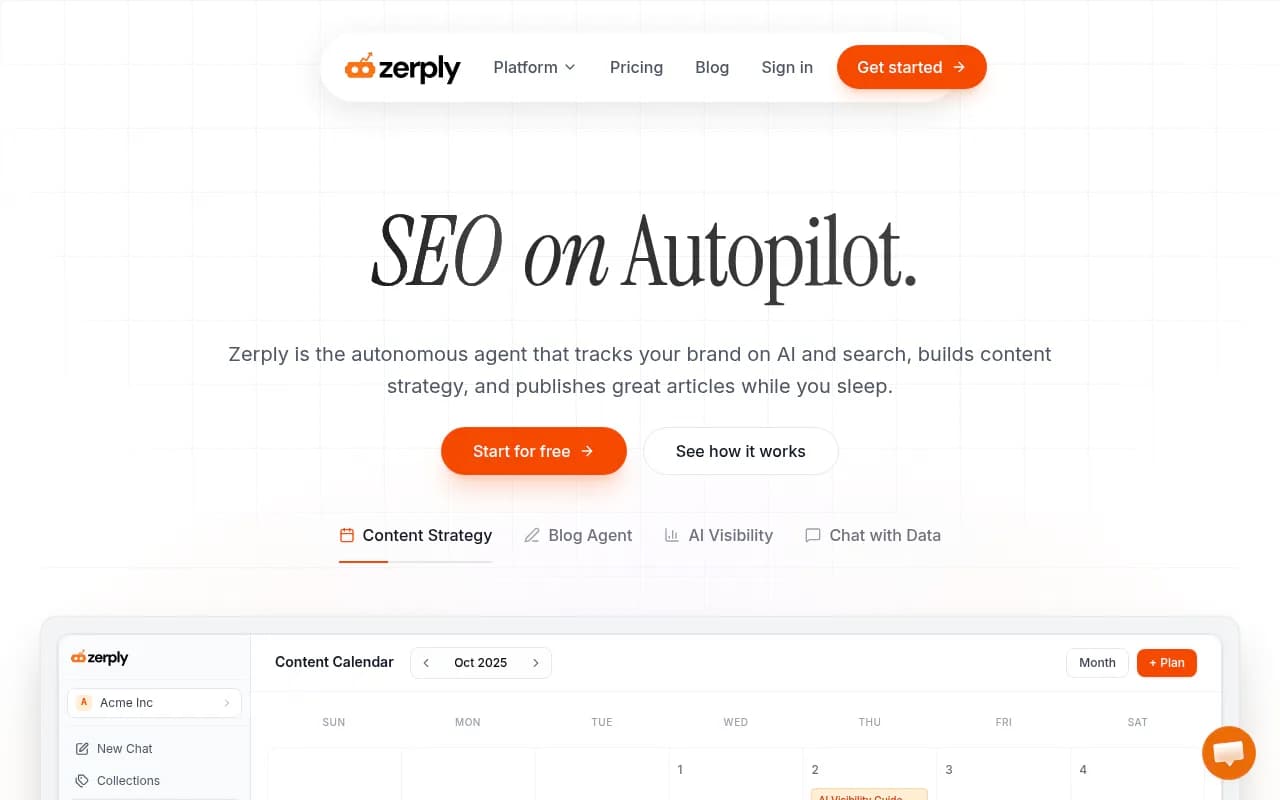
Zerply calls itself an "agentic AI SEO platform." The pitch is that it replaces the stack of disconnected tools a marketing team typically uses -- rank tracker, content calendar, brief generator, publishing tool -- with a single autonomous agent that monitors your site, finds content gaps, schedules articles, and publishes them to WordPress while you sleep. AI visibility tracking (brand mentions in ChatGPT, Perplexity, Claude) is one of three main pillars, alongside agentic SEO and an SEO research chat interface. It's a newer, leaner product with a free tier.
Side-by-side comparison
| Feature | Promptwatch | Zerply |
|---|---|---|
| Primary focus | AI search visibility & GEO | Agentic SEO + AI visibility |
| Free plan | No (7-day trial) | Yes (500 credits/mo) |
| Starting price | $99/mo | $99/mo (paid tier) |
| AI models monitored | 10 (ChatGPT, Claude, Gemini, Perplexity, Grok, DeepSeek, Copilot, Mistral, Meta AI, Google AIO) | 4 (ChatGPT, Claude, Perplexity, Gemini) |
| AI crawler logs | Yes | No |
| Prompt volume & difficulty scores | Yes | No |
| Query fan-outs | Yes | No |
| Citation & source analysis | Yes (880M+ citations) | Basic (sentiment + frequency) |
| Reddit & YouTube insights | Yes | No |
| ChatGPT Shopping tracking | Yes | No |
| AI content generation | Yes (citation-grounded) | Yes (Blog Agent, auto-publish) |
| WordPress auto-publishing | No | Yes |
| Content calendar | No | Yes |
| GSC chat / data Q&A | No | Yes |
| Page-level AI traffic attribution | Yes (GSC, snippet, server logs) | No |
| Multi-language / multi-region | Yes | Not specified |
| Agency / white-label features | Yes | Not specified |
| Looker Studio integration | Yes | No |
| API access | Yes | Not specified |
| G2 rating | 4.7/5 | Not yet rated |
| Customer base | 7,000+ brands | Early-stage |
Head-to-head feature deep-dive
AI model coverage
Promptwatch monitors 10 AI platforms. That matters because the AI search landscape isn't just ChatGPT -- Grok, DeepSeek, and Copilot are all sending meaningful traffic in certain verticals, and Google AI Overviews is still the highest-volume AI surface for most brands. Zerply covers four models (ChatGPT, Claude, Perplexity, Gemini), which covers the majority of AI search volume but misses the long tail.
Verdict: Promptwatch wins on breadth. If you care about Grok, DeepSeek, or Copilot, Zerply isn't an option.
Prompt intelligence and gap analysis
Promptwatch's Answer Gap Analysis shows exactly which prompts competitors appear in that you don't. Each prompt comes with volume estimates and a difficulty score, so you can prioritize the gaps that are actually worth closing. Query fan-outs show how a single prompt branches into related sub-queries -- useful for understanding the full content surface you need to cover.
Zerply has a "Competitor Gap Analysis" feature listed under AI visibility, but it doesn't publish the same level of prompt-level data. There's no mention of volume estimates, difficulty scoring, or fan-out analysis.
Verdict: Promptwatch is meaningfully deeper here. The prompt intelligence layer is what separates it from most monitoring tools.
Content generation
This is where the comparison gets interesting because both tools generate content, but with different philosophies.
Zerply's Blog Agent is built around automation and publishing velocity. It drafts articles, slots them into a content calendar, and can publish directly to WordPress. The appeal is obvious: less manual work, more output. It's closer to an AI writing assistant with scheduling built in.
Promptwatch's AI writing agent generates articles, listicles, and comparison pages grounded in real citation data. The idea is that content generated this way is more likely to actually get cited by LLMs, because it's built around the topics and angles AI models are already pulling from. It doesn't auto-publish to WordPress -- you get the content, then decide what to do with it.
| Dimension | Promptwatch | Zerply |
|---|---|---|
| Content types | Articles, listicles, comparisons | Articles (blog-focused) |
| Grounded in citation data | Yes | Not specified |
| Auto-publish to CMS | No | Yes (WordPress) |
| Content calendar | No | Yes |
| Persona targeting | Yes | Not specified |
| Articles per month (base plan) | 5 (Essential), 15 (Professional), 30 (Business) | Depends on credits |
Verdict: Depends on what you need. If you want to publish more content faster with less manual work, Zerply's Blog Agent is genuinely useful. If you want content specifically engineered to rank in AI search, Promptwatch's approach is more rigorous.
AI crawler logs
Promptwatch shows real-time logs of AI crawlers (ChatGPT, Claude, Perplexity, etc.) hitting your website -- which pages they read, errors they encounter, how often they return. This is a diagnostic tool that most platforms don't have at all. If an AI model is ignoring your most important pages, you'll see it here and can fix it.
Zerply has no equivalent feature.
Verdict: Promptwatch only. This is a meaningful gap if you're serious about AI search optimization.
Traffic attribution and revenue connection
Promptwatch connects AI visibility to actual website traffic and conversions through three methods: a JavaScript snippet, Google Search Console integration, or server log analysis. You can see which AI-cited pages are driving visits and tie that back to revenue.
Zerply's SEO research chat connects to GSC and can answer questions about traffic drops, but there's no equivalent AI-specific traffic attribution layer.
Verdict: Promptwatch wins. Connecting visibility to revenue is the whole point, and Zerply doesn't close that loop.
Agentic automation and ease of use
This is Zerply's strongest angle. The platform is designed around the idea that most marketing teams spend too much time on manual data work. The agentic layer -- 24/7 site monitoring, auto-scheduling, auto-drafting, auto-publishing -- reduces that overhead. The GSC chat interface is also genuinely useful: ask "which pages dropped traffic in the last 30 days?" and get an answer without exporting CSVs.
Promptwatch is a more manual tool in this sense. You set up your prompts, review the data, use the writing agent, and act on recommendations. It's not trying to run autonomously.
Verdict: Zerply wins on automation. If your team is stretched thin and you want the platform to do more of the work, Zerply's agentic approach is appealing.
Reddit, YouTube, and third-party citation sources
Promptwatch surfaces Reddit discussions and YouTube content that directly influence AI recommendations -- a channel most tools ignore. Since LLMs frequently cite Reddit threads and YouTube transcripts, knowing which discussions are shaping AI responses about your brand (or your competitors) is genuinely useful intelligence.
Zerply doesn't mention Reddit or YouTube tracking.
Verdict: Promptwatch only.
Pricing comparison
| Plan | Promptwatch | Zerply |
|---|---|---|
| Free | No (7-day trial) | Yes (500 credits/mo) |
| Entry paid | $99/mo (Essential: 1 site, 50 prompts, 5 articles) | $99/mo (paid tier) |
| Mid tier | $249/mo (Professional: 2 sites, 150 prompts, 15 articles, crawler logs) | Not publicly detailed |
| Upper tier | $579/mo (Business: 5 sites, 350 prompts, 30 articles) | Not publicly detailed |
| Agency / Enterprise | Custom pricing | Not specified |
| Annual discount | Yes | Not specified |
Zerply's credit-based pricing on the free tier (500 credits/month) makes it easy to test without a card. Promptwatch's 7-day trial gives you access to the full feature set but requires commitment after that. For teams that want to run a proper evaluation before paying anything, Zerply has the lower barrier to entry.
Pros and cons
Promptwatch
Pros:
- Widest AI model coverage in the category (10 models)
- Real-time AI crawler logs -- a feature most competitors lack entirely
- Prompt volume and difficulty scoring lets you prioritize intelligently
- Citation analysis grounded in 880M+ data points
- Reddit and YouTube tracking for third-party citation intelligence
- ChatGPT Shopping tracking
- Page-level AI traffic attribution connected to revenue
- Strong agency features: multi-site, Looker Studio, API, white-label
- 7,000+ customer base with enterprise names (Booking.com, Center Parcs, ABN AMRO)
- 4.7/5 on G2
Cons:
- No free plan -- 7-day trial only
- No auto-publishing to CMS
- No content calendar
- Higher price ceiling ($579/mo for Business tier)
- Can feel data-heavy; requires time to get full value
Zerply
Pros:
- Free plan available (500 credits/month)
- Agentic automation reduces manual work significantly
- Blog Agent auto-publishes to WordPress
- Content calendar with auto-scheduling
- GSC chat interface is genuinely useful for quick data questions
- Broader SEO scope (not just AI visibility)
- Lower barrier to entry for testing
Cons:
- Only 4 AI models monitored (no Grok, DeepSeek, Copilot, Mistral)
- No AI crawler logs
- No prompt volume or difficulty scoring
- No Reddit or YouTube citation tracking
- No ChatGPT Shopping tracking
- No page-level AI traffic attribution
- Newer platform -- smaller customer base, less proven at scale
- Credit-based pricing can be opaque for high-volume users
Who should pick which tool
Pick Promptwatch if:
- AI search visibility is a core business priority, not a side project
- You need to monitor more than 4 AI models (especially Grok, DeepSeek, or Copilot)
- You want to understand why AI models are or aren't citing your pages (crawler logs, citation analysis)
- You're an agency managing multiple clients and need white-label reporting and multi-site management
- You want to connect AI visibility to actual revenue, not just track mentions
- You need prompt-level intelligence (volume, difficulty, fan-outs) to prioritize your content roadmap
Pick Zerply if:
- You want to test AI visibility tracking without spending anything
- Your team is time-constrained and wants more automation -- auto-drafting, auto-scheduling, auto-publishing
- You're running a content-heavy SEO operation and want one tool that handles strategy, writing, and publishing
- You primarily care about ChatGPT, Perplexity, Claude, and Gemini (the four biggest platforms)
- You want a conversational interface to query your GSC and analytics data
Final verdict
These tools are solving related but different problems. Zerply is trying to be a full agentic SEO platform that happens to include AI visibility tracking. Promptwatch is a dedicated AI search visibility platform that happens to include content generation.
If AI visibility is your primary objective -- understanding exactly where you appear, why, and how to improve it -- Promptwatch is the more complete tool by a significant margin. The crawler logs, prompt intelligence, citation depth, Reddit/YouTube tracking, and traffic attribution are features Zerply simply doesn't have yet.
If you want to reduce the manual overhead of running an SEO operation and AI visibility is one of several things you're trying to automate, Zerply's agentic approach is genuinely interesting -- and the free tier means you can test it without risk.
The honest summary: Promptwatch is the specialist, Zerply is the generalist. Specialists win when the problem is specific enough to justify the focus.