Key Takeaways
- Price gap is massive: Zerply starts at $99/mo with a free tier; Botify requires $10k-$50k+/month annual contracts -- a 100x+ difference that immediately narrows your choice based on budget
- Zerply = autonomous content engine: AI agents that plan, write, and publish blog posts automatically. Botify = enterprise technical SEO powerhouse with deep crawling, log analysis, and site-wide optimization at scale
- Both track AI visibility: Zerply and Botify monitor ChatGPT, Perplexity, Claude, and Google AI Overviews, but Zerply emphasizes share of voice and sentiment while Botify integrates GEO/AEO into broader technical workflows
- Target audience couldn't be more different: Zerply suits SMBs, agencies, and content marketers who need affordable AI search tracking plus content automation. Botify is built for enterprise brands (Fortune 500, major retailers) with millions of pages and dedicated SEO teams
- Integration depth: Botify connects to enterprise analytics stacks, data warehouses, and complex CMS environments. Zerply focuses on WordPress publishing, Google Search Console, and conversational data chat
- If you're choosing between them, budget decides: Under $1k/mo budget? Zerply is your only option. Enterprise budget with complex technical SEO needs? Botify. There's almost no overlap in their ideal customer profiles
Overview: Two platforms solving different problems
Zerply: Agentic SEO for the rest of us
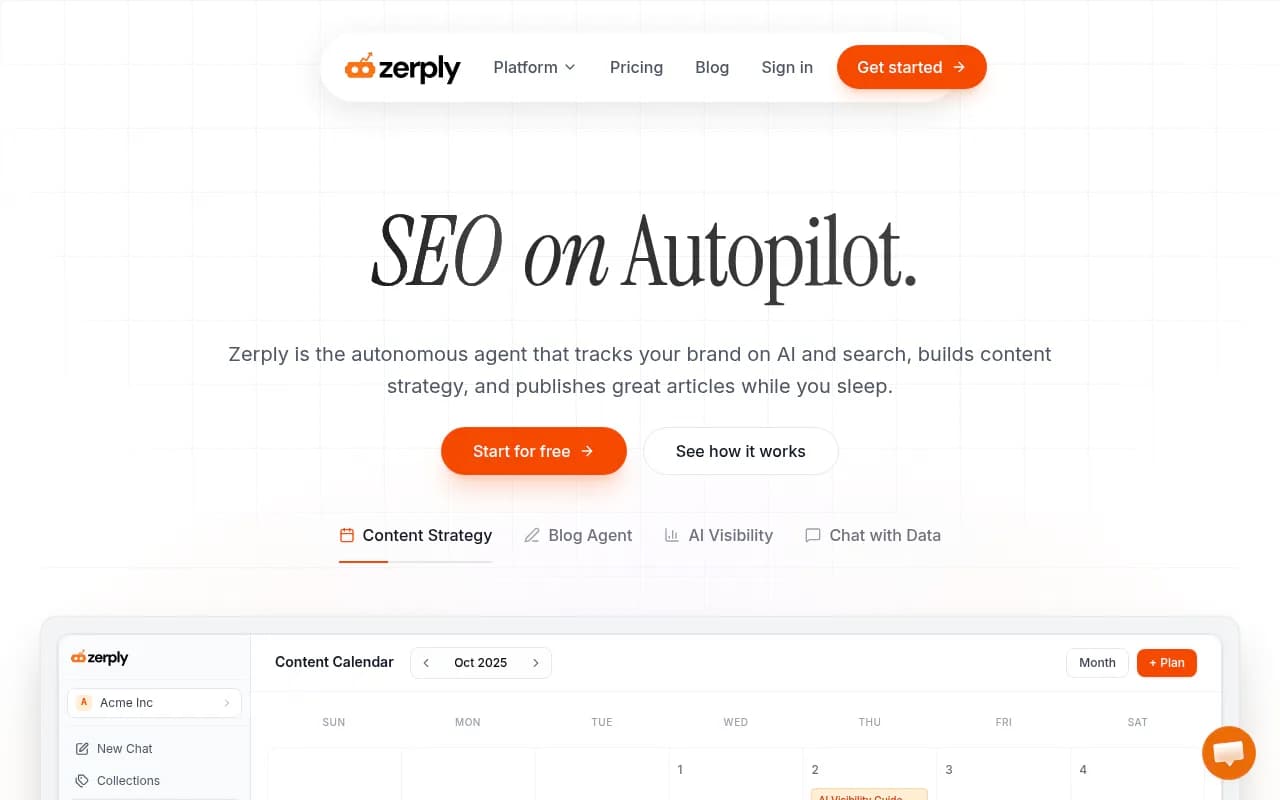
Zerply positions itself as "SEO on autopilot" -- an autonomous agent that tracks your brand across AI search engines, builds content strategy, and publishes articles while you sleep. It's a freemium platform with a free tier (500 credits/month) and paid plans starting at $99/mo.
The pitch: stop gluing tools together. Zerply combines AI visibility tracking (how you show up in ChatGPT, Perplexity, Claude), SEO research chat (ask questions about your Search Console data), and autonomous content agents (plan calendar, write drafts, publish to WordPress) in one interface. It's aimed at marketing teams tired of spending 47+ hours weekly on manual data work.
Core capabilities: content calendar planning, blog agent that writes and publishes, AI visibility tracking with sentiment analysis and share of voice metrics, conversational chat interface for SEO data, integration with Google Search Console and WordPress.
Botify: Enterprise AI search optimization at scale
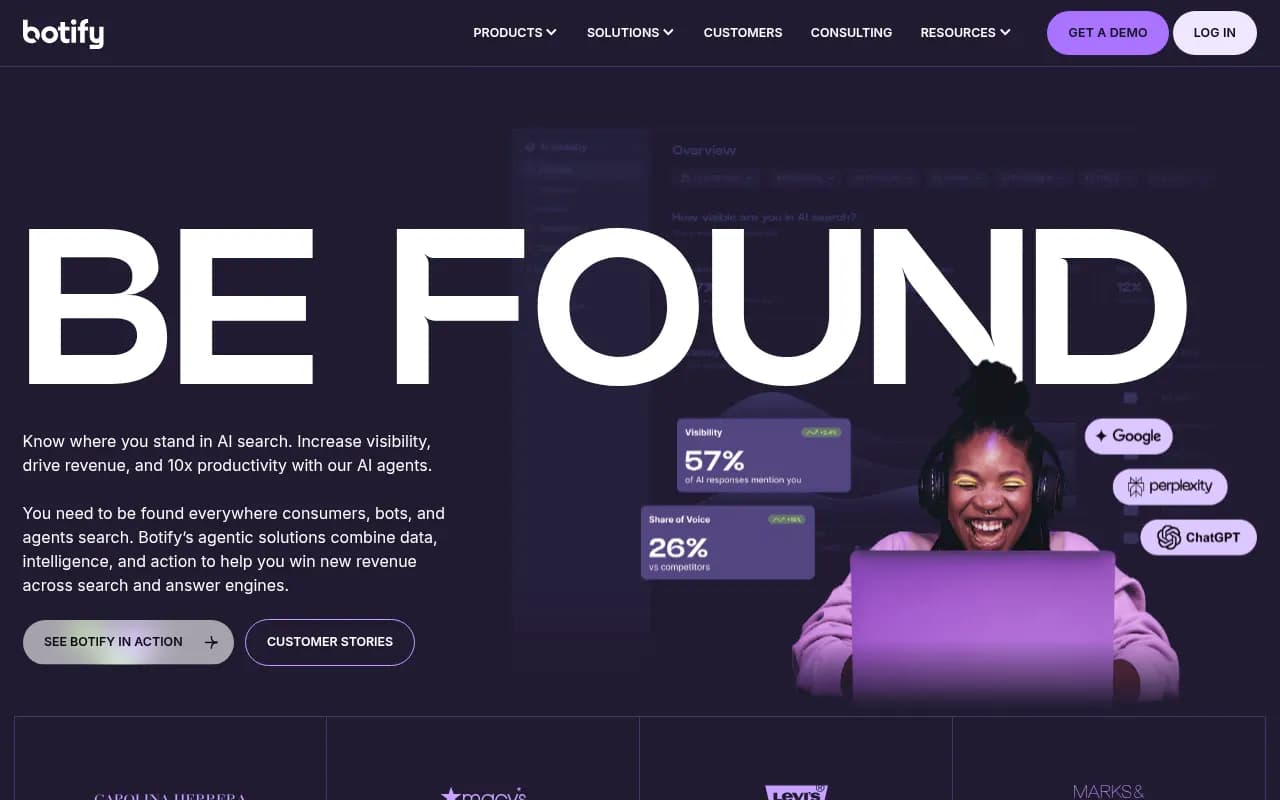
Botify is an enterprise-grade platform that helps large brands control visibility across traditional search engines and AI answer engines (ChatGPT, Perplexity, Google AI Overviews). It combines deep technical SEO analytics, AI-powered automation, and agentic workflows.
The enterprise story: Botify serves Fortune 500 brands and major retailers with millions of pages. Think Carolina Herrera, Ralph Lauren, and other household names dealing with complex site architectures, international markets, and technical SEO challenges at scale. Named a Strong Performer in The Forrester Wave 2025 for SEO platforms.
Core capabilities: technical SEO crawling and log file analysis, AI search visibility tracking (GEO/AEO), agentic automation for SEO tasks, enterprise integrations with analytics and data warehouses, 30-day time-to-value with claimed 5x ROI within 3 years. Custom pricing starting around $10k-$50k+/month on annual contracts.
Side-by-Side Comparison
| Feature | Zerply | Botify |
|---|---|---|
| Starting Price | Free tier (500 credits/mo), paid from $99/mo | Custom enterprise pricing, typically $10k-$50k+/month |
| Contract Terms | Monthly or annual billing | Annual contracts standard |
| Free Tier | Yes -- 500 credits/month | No |
| Target Audience | SMBs, agencies, content marketers | Enterprise brands, Fortune 500, major retailers |
| AI Visibility Tracking | ChatGPT, Perplexity, Claude, Gemini -- sentiment, share of voice, citations | ChatGPT, Perplexity, Google AI Overviews, other answer engines -- integrated with technical SEO |
| Content Automation | Autonomous agents: plan calendar, write drafts, publish to WordPress | AI-powered recommendations and task automation, not end-to-end content generation |
| Technical SEO Depth | Basic -- focuses on content and AI visibility | Deep crawling, log file analysis, site architecture optimization for millions of pages |
| Integrations | Google Search Console, WordPress, document uploads | Enterprise analytics, data warehouses, complex CMS environments |
| SEO Research Interface | Conversational chat -- ask questions about your data | Traditional dashboards and reports with AI-powered insights |
| Ideal Site Size | Small to mid-size sites (under 100k pages) | Large enterprise sites (millions of pages) |
| Setup Complexity | Self-service signup, quick onboarding | Sales process, implementation team, 30-day time-to-value |
| Support Model | Standard support tiers | Dedicated account management, enterprise support |
Pricing: The 100x gap
Zerply pricing
Zerply uses a freemium model with credits:
| Plan | Price | What You Get |
|---|---|---|
| Free | $0/mo | 500 credits/month -- enough to test AI visibility tracking and basic features |
| Paid Plans | From $99/mo | More credits, advanced features, higher usage limits (exact tiers not publicly detailed) |
No credit card required for the free tier. Monthly or annual billing available. This is accessible pricing for individual marketers, small teams, and agencies managing multiple clients.
Botify pricing
Botify does not publish pricing. Based on industry reports and competitor analysis:
| Tier | Estimated Price | What You Get |
|---|---|---|
| Enterprise | $10,000 - $50,000+/month | Custom based on site size, page count, features needed |
| Contract | Annual contracts standard | 30-day time-to-value, dedicated implementation, account management |
| ROI Claim | 5x ROI within 3 years | Botify's internal benchmarking for enterprise customers |
You need to request a demo and go through a sales process. Pricing scales with the complexity of your site and the depth of features you need. This is enterprise software budgeting -- expect six-figure annual commitments for large deployments.
The reality: If your annual SEO budget is under $50k, Botify isn't an option. If you're a Fortune 500 brand spending $500k+/year on SEO, Zerply won't handle your technical complexity.
AI visibility tracking: Both monitor, different emphasis
Zerply's AI visibility approach
Zerply tracks how your brand appears in ChatGPT, Perplexity, Claude, and Gemini. The interface shows:
- AI Share of Voice: percentage of mentions vs competitors in a visual pie chart
- Recent Mentions: specific quotes from each AI engine with sentiment indicators
- Citation frequency: how often you're cited vs ignored
- Sentiment analysis: positive, neutral, or negative tone in AI responses
The goal: see where you're winning the AI conversation and where competitors dominate. Fix negative mentions, increase citation frequency, own the narrative.
Zerply's AI visibility is tightly integrated with its content agents -- the platform identifies gaps, then helps you create content to fill them.
Botify's GEO/AEO integration
Botify monitors AI answer engines (ChatGPT, Perplexity, Google AI Overviews) as part of a broader search optimization strategy. Key difference: Botify connects AI visibility to technical SEO fundamentals.
Their angle: AI platforms need your content to recommend you. Traffic from AI bots and agents grew 5.6x (Botify's data). Can they find your pages? Botify shows:
- Which pages AI crawlers are accessing (or failing to access)
- How your content is being cited in AI responses
- Competitor gap analysis for AI visibility
- Technical barriers preventing AI engines from discovering your content
Botify's agentic workflows automate fixes -- if AI crawlers can't reach a section of your site, the platform flags it and suggests (or automates) the solution.
The enterprise advantage: Botify handles AI visibility at scale across millions of pages, multiple markets, and complex site architectures. Zerply's AI tracking is more manual and content-focused.
Content automation: Zerply's killer feature vs Botify's recommendations
Zerply's autonomous content agents
This is where Zerply differentiates hard. The platform includes AI agents that:
- Monitor your site 24/7 for content gaps and opportunities
- Find gaps using opportunity detection algorithms
- Plan your calendar with auto-scheduling across weeks and months
- Write drafts using AI (powered by OpenAI, Claude, Gemini, Perplexity models)
- Publish live directly to WordPress without human intervention
The content calendar view shows a month-at-a-glance grid with planned articles. Agents fill gaps automatically based on keyword research, competitor analysis, and AI visibility data.
Example workflow: Zerply detects that competitors rank for "AI visibility guide" but you don't. It schedules an article, drafts it using citation data and SEO best practices, and publishes it to your WordPress site on the planned date. You review and approve (or let it run fully autonomous).
This is agentic SEO -- the platform acts on your behalf, not just reports data.
Botify's AI-powered recommendations
Botify uses AI to surface insights and automate technical SEO tasks, but it doesn't write and publish blog posts for you. Instead:
- AI agents identify technical issues (crawl errors, indexing problems, site speed bottlenecks)
- The platform recommends fixes with priority scoring
- Automation workflows can implement certain changes (e.g. updating XML sitemaps, fixing canonical tags)
- Integration with enterprise CMS systems allows some automated publishing of technical changes
Botify's "agentic" label refers to task automation and intelligent recommendations, not end-to-end content creation. If you need a platform that writes articles, Botify isn't built for that. If you need a platform that fixes technical SEO at scale, Botify excels.
Verdict: Zerply wins on content automation. Botify wins on technical automation. They're solving different problems.
SEO research and data intelligence
Zerply's conversational chat interface
Zerply lets you upload documents, connect Google Search Console, and ask questions in natural language:
- "Which pages dropped traffic in the last 30 days?"
- "Show me keyword opportunities where competitors rank but we don't"
- "What's our AI share of voice vs [competitor]?"
The platform queries your connected data sources (GSC, uploaded CSVs, internal analytics) and returns answers with citations. It's like ChatGPT for your SEO data -- no more manual exports or pivot tables.
Multi-step reasoning: you can ask follow-up questions and the system maintains context. Example: "Why did those pages drop?" after seeing the traffic decline list.
This is a huge time-saver for marketers who hate spreadsheets. The interface is conversational, not dashboard-heavy.
Botify's enterprise analytics depth
Botify provides traditional dashboards and reports with enterprise-grade data:
- Log file analysis: see exactly which search engine and AI bots are crawling your site, how often, which pages they access
- Crawl data: Botify's own crawler analyzes your entire site architecture, finds orphan pages, broken links, indexing issues
- Performance metrics: page speed, Core Web Vitals, mobile usability at scale
- Custom segmentation: slice data by page type, category, market, language
- Data warehouse integration: export to BigQuery, Snowflake, or other enterprise analytics platforms
Botify's analytics are built for SEO teams that need granular control and deep technical insights. The learning curve is steeper, but the depth is unmatched.
Verdict: Zerply is easier and faster for everyday questions. Botify is more powerful for complex technical analysis and enterprise reporting.
Technical SEO capabilities
Zerply's technical SEO coverage
Zerply focuses on content and AI visibility, not deep technical SEO. It connects to Google Search Console for basic performance data and can identify content gaps, but it doesn't:
- Crawl your entire site architecture
- Analyze log files to see bot behavior
- Diagnose complex indexing issues
- Optimize site speed or Core Web Vitals
- Handle enterprise-scale technical challenges
For a small to mid-size site with straightforward technical SEO needs, this is fine. For a large e-commerce site with millions of product pages, it's insufficient.
Botify's technical SEO depth
Botify is a technical SEO powerhouse:
- Site crawling: Botify's crawler analyzes millions of pages, maps site architecture, identifies orphan pages and broken links
- Log file analysis: see which bots (Google, Bing, ChatGPT, Perplexity) are crawling your site, how often, which pages they access or ignore
- Indexing optimization: diagnose why pages aren't indexed, fix crawl budget waste, improve discoverability
- Performance monitoring: track Core Web Vitals, page speed, mobile usability across your entire site
- International SEO: manage hreflang, multi-language sites, regional targeting at scale
- JavaScript rendering: analyze how search engines render your JavaScript-heavy pages
Botify handles the technical complexity that enterprise sites face -- pagination issues, faceted navigation, dynamic URLs, massive product catalogs.
Verdict: If technical SEO is a priority, Botify is in a different league. Zerply isn't trying to compete here.
Integration ecosystems
Zerply integrations
Zerply integrates with:
- Google Search Console: pull performance data for conversational analysis
- WordPress: publish content directly from the platform
- Document uploads: CSV, PDF, and other files for data analysis
- AI models: powered by OpenAI, Claude, Gemini, Perplexity for content generation
The integration list is short because Zerply is designed as an all-in-one platform. You're not meant to connect it to a dozen other tools -- it replaces them.
Botify integrations
Botify connects to enterprise analytics and martech stacks:
- Analytics platforms: Google Analytics, Adobe Analytics, custom data warehouses (BigQuery, Snowflake)
- CMS systems: enterprise CMS platforms for automated publishing of technical changes
- SEO tools: can complement (not replace) tools like Semrush or Ahrefs for keyword data
- Data visualization: export to Looker, Tableau, or other BI tools
- APIs: extensive API for custom integrations and workflows
Botify is built to fit into an existing enterprise tech stack, not replace it.
Verdict: Zerply is simpler and more self-contained. Botify is more flexible for complex enterprise environments.
Who should pick Zerply?
- Budget-conscious teams: If you can't afford $10k+/month, Zerply is your only option between these two
- Content-driven marketers: You want AI agents that plan, write, and publish blog posts automatically
- SMBs and agencies: Managing 1-10 sites with under 100k pages each, focused on content marketing and AI visibility
- WordPress users: Direct publishing integration makes content automation seamless
- Teams tired of tool sprawl: You want one platform for AI visibility tracking, content planning, SEO research, and publishing
- Conversational data fans: You prefer asking questions in natural language vs building dashboards
Zerply is the affordable, autonomous content engine for teams that don't have enterprise budgets or technical SEO complexity.
Who should pick Botify?
- Enterprise brands: Fortune 500 companies, major retailers, large publishers with millions of pages
- Technical SEO teams: You need deep crawling, log file analysis, and site architecture optimization at scale
- International operations: Managing multi-language sites, regional targeting, complex hreflang setups
- Complex site architectures: E-commerce with massive product catalogs, faceted navigation, JavaScript rendering challenges
- Data-driven organizations: You need enterprise analytics integrations, custom reporting, and data warehouse connections
- Teams with dedicated SEO budgets: You're spending $500k+/year on SEO and need a platform that scales with that investment
Botify is the enterprise technical SEO and AI search optimization platform for brands that need industrial-strength capabilities.
What about Promptwatch?
If you're evaluating AI visibility tracking but neither Zerply nor Botify quite fits, Promptwatch is worth a look. It's the market-leading Generative Engine Optimization (GEO) platform used by 6,700+ brands including Booking.com and Center Parcs.

Promptwatch sits between Zerply and Botify in positioning: more robust than Zerply's AI visibility module (880M+ citations analyzed, crawler logs, Reddit/YouTube tracking, ChatGPT Shopping monitoring), but more affordable than Botify's enterprise pricing (plans from $99/mo to $579/mo). The core difference: Promptwatch doesn't just show you where you're invisible -- it helps you fix it with Answer Gap Analysis, AI content generation, and page-level optimization tools. If AI search visibility is your primary focus (not full-stack SEO automation or enterprise technical SEO), Promptwatch is purpose-built for that.
Pros and cons
Zerply pros
- Free tier lets you test before committing
- Dramatically cheaper than enterprise alternatives ($99/mo vs $10k+/mo)
- Autonomous content agents actually write and publish articles for you
- Conversational chat interface makes SEO data accessible to non-technical users
- All-in-one platform reduces tool sprawl
- Fast setup -- self-service signup, no sales process
Zerply cons
- Limited technical SEO depth -- no site crawling or log file analysis
- Not built for enterprise scale (millions of pages, complex architectures)
- Newer platform with less enterprise track record than Botify
- AI visibility tracking is less granular than specialized GEO platforms
- WordPress-centric publishing may not fit all CMS environments
Botify pros
- Enterprise-grade technical SEO at scale (millions of pages)
- Deep crawling and log file analysis unmatched by cheaper tools
- Named a Strong Performer in Forrester Wave 2025
- Proven ROI with major brands (5x ROI claim within 3 years)
- Comprehensive AI search visibility integrated with technical SEO
- Extensive enterprise integrations and API
- Dedicated account management and support
Botify cons
- Pricing is prohibitively expensive for SMBs and most agencies ($10k-$50k+/month)
- Requires annual contracts -- no month-to-month flexibility
- No free tier or trial -- you need to go through a sales process
- Steeper learning curve than simpler platforms
- Overkill for small sites or content-focused teams
- Doesn't offer end-to-end content generation like Zerply
Final verdict
Zerply and Botify barely compete -- they serve completely different markets.
Pick Zerply if: You're a small to mid-size team with a limited budget ($100-$500/mo) who wants autonomous content creation, AI visibility tracking, and an all-in-one platform that's easy to use. You care more about publishing great content and tracking AI mentions than deep technical SEO.
Pick Botify if: You're an enterprise brand with a six-figure SEO budget, millions of pages, and complex technical challenges. You need industrial-strength crawling, log analysis, and AI search optimization at scale. You have a dedicated SEO team that can leverage Botify's depth.
The honest take: Most readers choosing between these two will pick Zerply by default -- Botify's pricing puts it out of reach for 95% of businesses. The real question is whether Zerply's feature set (content automation + AI visibility tracking) matches your needs, or whether you need a more specialized tool. For pure AI visibility optimization with deeper citation analysis and content gap tools, platforms like Promptwatch offer a middle ground between Zerply's simplicity and Botify's enterprise complexity.
If you're an enterprise evaluating Botify, you're likely also looking at Conductor, BrightEdge, and Semrush Enterprise -- not Zerply. If you're evaluating Zerply, you're probably comparing it to Surfer SEO, Clearscope, or other content-focused SEO tools -- not Botify.
Know your budget, know your use case, and the choice becomes obvious.