Deepserp Review 2026
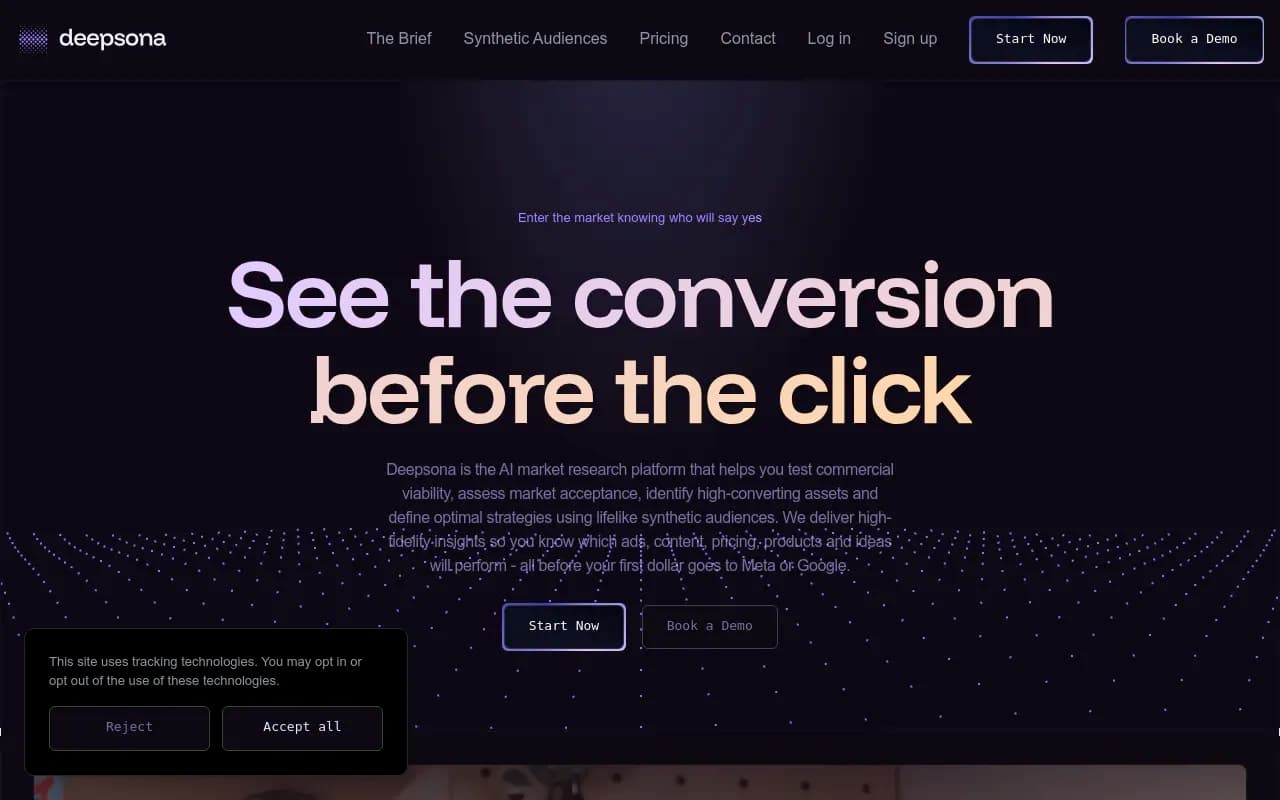
Deepsona (formerly Deepserp) is an AI-powered market research platform that simulates consumer responses using synthetic audiences of up to 1 million AI personas. Test ad campaigns, pricing strategies, product concepts, and email campaigns against psychographically-modeled audiences before spending
Key Takeaways:
• Predictive testing at scale: Simulate campaigns against up to 1 million AI personas modeled on Big Five personality traits, demographics, and behavioral patterns — achieving 74-90% predictive alignment with real campaign outcomes • End-to-end market research automation: Specialized AI agents handle audience building, exposure testing, debate simulation, scoring, QA, and insights generation — delivering statistically reliable results in 2-5 minutes • Pre-launch optimization: Test ad creative, pricing, product concepts, email campaigns, and ideas before spending on Meta, Google, or other channels — eliminating wasted exploratory spend • Best for: Marketing teams, digital agencies, product managers, and growth teams at startups through enterprise who need rapid concept validation and predictive performance data • Limitations: Synthetic data quality depends on input accuracy; newer platform with limited third-party validation; pricing not publicly disclosed for higher tiers
Deepsona (operating under Deepserp Limited, a UK-based company) is an AI market research platform that fundamentally changes how teams validate marketing campaigns, product concepts, and go-to-market strategies. Instead of launching campaigns and waiting weeks to see what works, Deepsona simulates consumer responses using synthetic audiences — collections of AI personas modeled on real behavioral patterns, psychographic traits, and demographic data. The platform claims 74-90% predictive alignment with actual campaign outcomes and human responses from established research firms like YouGov and GWI.
The core value proposition is simple but powerful: know what will perform before your first dollar goes to paid channels. For marketing teams burning budget on A/B tests that prove what doesn't work, or product teams guessing at market fit, Deepsona offers a pre-launch testing environment that surfaces winning variants, identifies blocking objections, and reveals segment-specific preferences — all within minutes.
How Synthetic Audiences Work
Deepsona's Persona Factory Agent builds custom audiences where each AI persona carries psychological depth far beyond basic demographics. Every persona is modeled using the Big Five (OCEAN) personality framework — Openness, Conscientiousness, Extraversion, Agreeableness, Neuroticism — combined with socioeconomic factors, category familiarity, price sensitivity, lifestyle values, and behavioral patterns. An urban tech-savvy introvert with high openness and low price sensitivity will respond to your SaaS pitch differently than a suburban family-oriented extravert with high conscientiousness and budget constraints. These differences aren't cosmetic — they translate into predictive signals about real market behavior.
You define audience parameters: size (from small test groups to 1 million personas), demographics (age, income, education, location, occupation), and behavioral characteristics. The platform automatically applies psychographic modeling to ensure each persona is unique and mirrors real population distributions. The result is a synthetic market segment that behaves like your actual target audience, minus the response bias, social desirability effects, and stated-preference distortions that corrupt traditional surveys.
Agentic AI Architecture: A Research Team in Software
Most AI tools for market research are glorified chatbots — you prompt, they respond, you interpret. Deepsona takes a different approach: it's built as a team of specialized AI agents that handle the entire research workflow. The Persona Factory builds your audience. Exposure agents present your marketing assets to each persona. Debate agents simulate internal deliberation (mimicking how real consumers weigh pros and cons). Scoring agents aggregate responses into confidence-scored predictions. QA agents validate output consistency. Insights agents surface patterns and recommendations.
This multi-agent architecture is why Deepsona claims 95%+ statistical confidence versus single-output AI chatbots like ChatGPT, Gemini, Claude, or Perplexity, and 10x higher result stability. A single chatbot gives you one opinion. Deepsona gives you structured feedback from thousands or millions of simulated consumers, each responding based on their unique psychological and demographic profile. The difference is the gap between anecdotal insight and statistically meaningful data.
Five Core Simulation Types
Deepsona supports five content types, each designed for a specific validation use case:
1. Ad Campaign Simulations: Enter your ad components — offer text, primary copy, visual descriptions, CTA, budget parameters, target CPA. Select target audiences. Each AI persona evaluates your ad as a real consumer would, outputting numeric scores for click probability, conversion intent, trust, clarity, novelty, and brand fit, plus written reactions explaining what works and what creates friction. The platform aggregates these into segment-level heatmaps showing which demographics and psychographics respond strongest. Compare multiple ad variants side-by-side. See predicted lift percentages. Identify high-converting creative elements before your first dollar goes to Meta or Google. This is the flagship use case — marketers testing 5-10 ad variations across 3-5 audience segments, killing losers in simulation, launching winners in reality.
2. Product Proposition Testing: Describe your product concept, value proposition, key features, and target outcomes. Select evaluation audiences. Within minutes, you receive segment-level reactions showing which groups connect with your messaging and which remain skeptical. AI personas generate authentic written responses (not survey checkboxes) explaining what excites them, what concerns them, and what would push them to convert. One segment might love your innovation angle while another prioritizes affordability. Another might question credibility or need stronger social proof. You see these patterns immediately, with recommendations for repositioning messages by segment. This is critical for early-stage startups validating product-market fit or established companies launching new offerings.
3. Email Campaign Optimization: Configure email elements — campaign name, goal, subject line, preheader text, body copy, CTA. Select target audiences mirroring your subscriber segments. AI personas evaluate each component based on personality traits, communication preferences, and behavioral patterns. Introverted personas prefer direct, no-fluff subject lines. Extroverted personas respond to playful, social language. Price-sensitive segments scrutinize value propositions intensely. The simulation surfaces these preferences explicitly, showing which subject lines generate curiosity, which body copy builds trust, and which CTAs convert — segmented by demographic and psychographic profile. Optimize every element before hitting send to your real list.
4. Price Discovery: Define your product name, description, and current price if applicable. Set minimum and maximum price bounds or specify exact price points to evaluate. The simulation tests each price across selected audience segments, measuring willingness to pay, perceived value, conversion thresholds, and price sensitivity by demographic and psychographic group. High-income early adopters might barely notice a premium price while budget-conscious families hit a hard ceiling at a lower point. You see these patterns visualized across segments with confidence scores. The system recommends optimal pricing by segment and suggests tiered pricing strategies when data shows distinct willingness-to-pay clusters. This is invaluable for SaaS companies testing subscription tiers or e-commerce brands launching new products.
5. Idea Validation: Describe your product or feature idea — name, type, detailed description, problem being solved, target outcome, key features. Choose which market segments should evaluate it. AI personas assess your concept through their personal lens: pain points, priorities, existing solutions, psychological profiles. A time-starved parent evaluates productivity tools differently than a solo entrepreneur. A privacy-focused techie scrutinizes data handling differently than a convenience-seeking casual user. You receive explicit demand signals segmented by audience type, along with reasoning behind positive and negative reactions. See objections you never anticipated. Discover which audiences show genuine enthusiasm versus polite indifference. Make build-versus-kill decisions backed by predictive data rather than founder intuition.
The Debate Feature: Simulating Internal Deliberation
One of Deepsona's differentiators is its debate simulation capability. Real consumers don't make instant decisions — they deliberate, weigh trade-offs, consider alternatives, and talk themselves in or out of purchases. Deepsona's Debate agents simulate this internal dialogue. When evaluating your ad or product, personas don't just output a score — they engage in simulated deliberation, surfacing objections, counter-arguments, and decision factors that mirror real cognitive processes. This reveals blocking objections you wouldn't catch in a simple survey. If a high-neuroticism persona says your product feels risky, that's predictive. If a low-openness persona finds your innovation confusing, that's actionable. You get honest reactions uncorrupted by social dynamics or researcher effects.
Speed and Scale: Minutes, Not Weeks
Most simulations complete in 2-5 minutes. Enter campaign details, select audience, run simulation. While your coffee brews, you receive segment-level heatmaps, persona reactions, confidence scores, and ranked insights. Traditional research requires weeks of planning, recruitment, data collection, and analysis. Deepsona delivers actionable intelligence before your competitor's focus group even schedules. Survey panels cap at hundreds of responses due to recruitment costs. Focus groups max out at 8-12 participants. Deepsona simulates thousands or millions of personas per run with no additional cost. Want to evaluate ten market segments simultaneously? Twenty? Test against them all in a single simulation. Scale your research without scaling your budget.
Continuous Iteration: Test, Refine, Repeat
Need to tweak your headline? Adjust pricing? Test a new CTA? Run another simulation in minutes. No waiting for panel availability, recruitment cycles, or budget approval. Iterate as fast as you type. Refine your messaging through rapid simulation cycles until segment responses converge on optimal configurations, then launch knowing what works for whom. This rapid iteration loop is transformative for agile marketing teams and lean startups that need to move fast without burning budget on failed experiments.
Who Is Deepsona For?
Deepsona is built for marketing teams, digital agencies, product managers, and growth teams at startups through enterprise who need predictive performance data before launch. Specific personas include:
Performance marketers at DTC brands running paid campaigns on Meta, Google, TikTok, LinkedIn — testing 5-10 ad variations across audience segments to identify winners before allocating media spend. Typical use case: e-commerce brand launching a new product line, testing ad creative and pricing against synthetic audiences mirroring their customer base, killing underperformers in simulation, launching top variants with confidence.
Digital agencies managing multiple client accounts — using Deepsona to validate campaign concepts, pricing strategies, and messaging before presenting to clients or launching live campaigns. Reduces client churn from failed campaigns and positions the agency as data-driven and strategic.
Product managers at SaaS companies validating feature ideas, pricing tiers, and product positioning before committing engineering resources. Typical use case: B2B SaaS company considering a new enterprise tier, simulating willingness to pay and feature preferences across target segments (IT directors, CTOs, procurement managers), using insights to define tier structure and pricing.
Startup founders pre-launch or pre-seed testing product-market fit, messaging, and go-to-market strategy without budget for traditional research. Typical use case: founder with an MVP testing value propositions across 5-10 audience segments, discovering that urban tech-savvy millennials show 82% conversion intent while suburban families remain skeptical, pivoting positioning and targeting accordingly.
Growth teams at scale-ups optimizing email campaigns, landing pages, and conversion funnels. Typical use case: growth team testing 10 email subject line variations across subscriber segments, identifying that introverted, high-conscientiousness personas respond to direct, benefit-focused lines while extraverted personas prefer social proof and urgency.
Who should NOT use Deepsona: Teams that need real-world behavioral data (clickstream, purchase history, actual conversion rates) rather than predictive simulations. Companies in highly regulated industries where synthetic data may not meet compliance requirements. Teams with unlimited research budgets who prefer traditional methods. Brands targeting niche audiences where synthetic persona modeling may lack sufficient real-world calibration data.
Integrations and Ecosystem
Deepsona is a standalone platform accessed via web app (app.deepsona.ai). It does not currently advertise native integrations with ad platforms (Meta Ads Manager, Google Ads), CRM systems (HubSpot, Salesforce), or analytics tools (Google Analytics, Mixpanel). The workflow is: run simulations in Deepsona, export insights, apply learnings to your existing marketing stack. This is a limitation for teams seeking automated workflows or direct campaign deployment from simulation results. The platform is built on trusted AI infrastructure (logos shown for OpenAI, Anthropic, Google Cloud, AWS, Vercel, Supabase, Stripe, Resend), indicating reliance on leading LLM providers and cloud platforms.
Data Privacy and Security
Deepsona is a UK-based company (Deepserp Limited, registered in London) and claims full GDPR compliance. The platform states that simulation results, audiences, and content are processed only within secure environments and never used for model training or shared with third parties. Every project remains confidential. This is critical for agencies and brands testing sensitive campaigns or proprietary product concepts. The company also claims SOC 2 and ISO 27001 compliance (though these certifications are not independently verified in public documentation).
Pricing and Value
Deepsona does not publicly disclose detailed pricing on its website. The site offers a "Start Now" CTA leading to sign-up (app.deepsona.ai/account/sign-up) and a "Book a Demo" option, suggesting a sales-led or custom pricing model. Based on the platform's positioning (enterprise-grade simulations, unlimited scale, rapid iteration), pricing likely targets mid-market to enterprise budgets rather than individual freelancers or solopreneurs. The value proposition is clear: eliminate wasted exploratory media spend (claimed 30-50% reduction), accelerate decision cycles (5-10x faster than traditional A/B testing), and increase ROAS by launching only proven campaigns. For a performance marketing team spending $50K-$500K/month on paid channels, even a 10% reduction in wasted spend justifies significant platform investment.
Strengths
Predictive accuracy: 74-90% alignment with real campaign outcomes and human responses from YouGov and GWI is a strong claim, though independent validation is limited. If accurate, this makes Deepsona a legitimate pre-launch testing tool rather than a speculative research toy.
Scale and speed: Simulating up to 1 million personas in 2-5 minutes is a genuine differentiator versus traditional research methods (surveys, focus groups, panels) that take weeks and cap at hundreds of responses.
Psychographic depth: Modeling personas on Big Five personality traits, category familiarity, price sensitivity, and behavioral patterns goes far beyond basic demographic segmentation. This enables nuanced insights (e.g., "high-neuroticism, low-openness personas find your innovation confusing") that inform targeted messaging.
Multi-agent architecture: The agentic AI approach (Persona Factory, Exposure, Debate, Scoring, QA, Insights agents) is more sophisticated than single-output chatbots and delivers higher result stability and statistical confidence.
Rapid iteration: The ability to test, refine, and re-test in minutes enables agile marketing workflows and continuous optimization — a massive advantage for fast-moving teams.
Honest reactions: Synthetic personas don't suffer from social desirability bias, acquiescence bias, or stated-preference distortions that corrupt traditional surveys. You get behavioral predictions uncorrupted by survey dynamics.
Limitations
Synthetic data validity: While Deepsona claims 74-90% predictive alignment, this depends heavily on input quality (how accurately you define your product, audience, and campaign elements) and the platform's underlying persona models. Garbage in, garbage out. If your audience definition is off or your product description is vague, simulation results will be misleading.
Limited third-party validation: The platform cites alignment with YouGov and GWI data, but there's no public case study library, independent audits, or peer-reviewed research validating the methodology. Early adopters are taking the platform's claims on faith.
No native integrations: Lack of direct integrations with Meta Ads Manager, Google Ads, HubSpot, Salesforce, or analytics platforms means manual export and application of insights. This adds friction for teams seeking automated workflows.
Pricing opacity: No public pricing creates uncertainty for budget-conscious teams. The sales-led model suggests mid-market to enterprise pricing, which may exclude startups and small agencies.
Newer platform: Deepsona is a relatively new entrant in the AI market research space. The company (Deepserp Limited) was incorporated recently, and the platform lacks the track record and customer base of established research firms or tools.
Niche audience modeling: Synthetic personas are calibrated on population-level behavioral data. For highly niche audiences (e.g., enterprise CIOs at Fortune 500 healthcare companies), persona modeling may lack sufficient real-world data to ensure accuracy.
Bottom Line
Deepsona is a powerful pre-launch testing platform for marketing teams, agencies, and product managers who need predictive performance data before committing budget to live campaigns. The ability to simulate consumer responses at scale (up to 1 million personas), with psychographic depth (Big Five traits, behavioral patterns), in minutes (2-5 minutes per simulation), is a genuine competitive advantage over traditional research methods. The multi-agent AI architecture delivers statistically reliable insights that single-output chatbots cannot match. For performance marketers burning budget on A/B tests that prove what doesn't work, Deepsona offers a risk-free testing environment that identifies winners before launch.
The platform is best suited for mid-market to enterprise teams with significant paid media budgets ($50K+/month) who can justify platform investment through reduced wasted spend and faster decision cycles. Startups and small agencies may find value in rapid concept validation and product-market fit testing, though pricing opacity creates uncertainty. The lack of native integrations and limited third-party validation are notable gaps, but the core value proposition — know what will perform before your first dollar goes to paid channels — is compelling for any team tired of expensive learning experiments.
Best use case in one sentence: Performance marketing teams at DTC brands or agencies testing ad creative, pricing, and messaging across audience segments to eliminate underperformers before allocating media spend.
Tags:
Similar and alternative tools to Deepserp