Key takeaways
- Peec AI is a capable monitoring tool, but most teams hit its limits quickly: rising costs at scale, limited multi-engine coverage, and no path from "you're invisible here" to "here's how to fix it."
- The best alternatives in 2026 don't just track — they help you act on what they find, whether that's content gap analysis, AI-optimized writing, or crawler log diagnostics.
- Promptwatch is the only platform in this comparison rated as a "Leader" across all GEO categories, covering 10 AI models with built-in content generation and traffic attribution.
- If you're a smaller team or agency just getting started, tools like Otterly.AI or LLM Pulse offer lower-friction entry points before you need the full stack.
- The right tool depends on whether you need monitoring, optimization, or both — this guide breaks down exactly where each option fits.
There's a specific frustration that comes with AI visibility tools. You set one up, you get a dashboard full of data, and then you sit there wondering: okay, now what?
Peec AI is a good example of this. When it launched in 2025, it filled a real gap — tracking brand presence in ChatGPT, Perplexity, and Google AI Overviews at a time when almost nothing else did. Teams used it to understand which prompts triggered their brand, how often they appeared, and where competitors were showing up instead.
But as AI search has matured, the bar has moved. Monitoring alone isn't enough. You can rank #1 organically and still be invisible in ChatGPT's response. The question isn't just "where am I missing?" — it's "what do I do about it?"
That's the gap most Peec AI alternatives are trying to fill in 2026. Some do it better than others.

Why teams are looking beyond Peec AI
Before getting into the alternatives, it's worth being specific about what's actually pushing teams to look elsewhere. Based on community feedback from r/SEO, TrafficThinkTank, and LinkedIn, three issues come up repeatedly:
- Cost scales badly. As you add more prompts and keywords, Peec AI's pricing climbs faster than the value it returns.
- Coverage gaps. Teams tracking visibility across Claude, Grok, DeepSeek, or Meta AI find Peec AI's engine coverage limited.
- No optimization path. The platform tells you where you're invisible. It doesn't tell you what to write, what to fix, or how to close the gap.
That third point is the biggest one. According to Similarweb's 2025 Generative AI Report, AI platforms generated over 1.1 billion referral visits in June 2025 — up 357% year-over-year. The stakes are real. Teams need tools that help them act, not just observe.
The 5 best Peec AI alternatives in 2026
1. Promptwatch — best for teams that want to monitor and optimize
Promptwatch is the most complete option on this list. Where most tools stop at showing you where you're not appearing, Promptwatch is built around a full loop: find the gaps, create content to fill them, then track whether it worked.

The Answer Gap Analysis feature is the clearest differentiator. It shows you exactly which prompts your competitors are visible for that you're not — not just a vague "you're missing here" signal, but the specific topics and questions AI models want answered that your site doesn't address. From there, the built-in AI writing agent generates content grounded in real citation data (880M+ citations analyzed) rather than generic SEO filler.
On the tracking side, Promptwatch monitors 10 AI models: ChatGPT, Perplexity, Claude, Gemini, Google AI Overviews, Google AI Mode, Grok, DeepSeek, Copilot, and Meta AI. It also logs real-time AI crawler activity — which pages ChatGPT or Perplexity's bots are reading, how often they return, and what errors they're hitting. Most competitors don't have this at all.
Traffic attribution closes the loop. You can connect AI visibility to actual revenue through a code snippet, Google Search Console integration, or server log analysis. That's the thing most monitoring dashboards can't do: prove the business case.
Pricing starts at $99/month (Essential: 1 site, 50 prompts, 5 articles), with Professional at $249/month and Business at $579/month. A free trial is available.
In a 2026 comparison of 12 GEO platforms, Promptwatch was the only tool rated as a "Leader" across all categories — the core reason being that it's an optimization platform, not just a tracker.
Best for: Marketing and SEO teams that need to improve AI visibility, not just measure it.
2. Profound — best for enterprise-grade AI Overview tracking
Profound

Profound has built a strong reputation for precise AI Overview tracking, entity extraction, and attribution mapping. If your primary concern is Google AI Overviews and you want deep entity-level analysis — understanding which named entities trigger your brand's appearance — Profound does this better than most.
It covers 9+ AI search engines and has solid competitor presence monitoring. The interface is clean and the data is reliable. Where it falls short relative to Promptwatch is on the optimization side: Profound is primarily a monitoring and analysis tool. There's no built-in content generation, no AI crawler logs, and no Reddit or YouTube citation tracking.
Pricing starts at $99/month, which makes it competitive at the entry level. For enterprise teams with dedicated SEO analysts who can act on the data themselves, Profound is a strong choice.
Best for: Enterprise teams focused on Google AI Overviews with in-house content resources to act on findings.
3. Otterly.AI — best for straightforward monitoring without complexity
Otterly.AI

Otterly.AI is the most accessible option on this list. It tracks brand mentions across ChatGPT, Perplexity, and Google AI Overviews with a clean interface that doesn't require a steep learning curve. For teams that are just starting to think about AI visibility and want to understand the basics before committing to a more complex platform, it's a reasonable starting point.
The honest limitation: Otterly.AI is a monitoring dashboard and nothing more. There's no content generation, no crawler logs, no traffic attribution, and no answer gap analysis. You'll see where you're not appearing, but the tool won't help you figure out why or what to do about it.
It's also worth noting that engine coverage is narrower than Promptwatch or Profound. If you're tracking visibility across Claude, Grok, or DeepSeek, Otterly.AI isn't the right fit.
Best for: Small teams or individuals who want a low-cost, low-complexity way to start monitoring AI visibility.
4. AthenaHQ — best for multi-engine competitive analysis

AthenaHQ covers Google AI Overviews, Perplexity, ChatGPT, and Claude with a focus on competitive intelligence. Its competitor heatmaps and share-of-voice analysis across engines are genuinely useful for teams that need to understand not just their own visibility but how they stack up against specific competitors across different AI platforms.
The platform is monitoring-focused, which means it shares the same fundamental limitation as Otterly.AI and Peec AI: it shows you the problem but doesn't help you solve it. There's no content optimization tooling, no AI writing assistance, and no crawler log data. At $295/month, it's also priced higher than Promptwatch's entry tier while offering fewer capabilities.
Where AthenaHQ earns its place is in competitive intelligence workflows. If your primary job is to report on competitive AI visibility to leadership — rather than to actively improve your own — it's a solid choice.
Best for: Competitive intelligence teams and analysts tracking multi-engine share of voice.
5. LLM Pulse — best budget option for brand monitoring
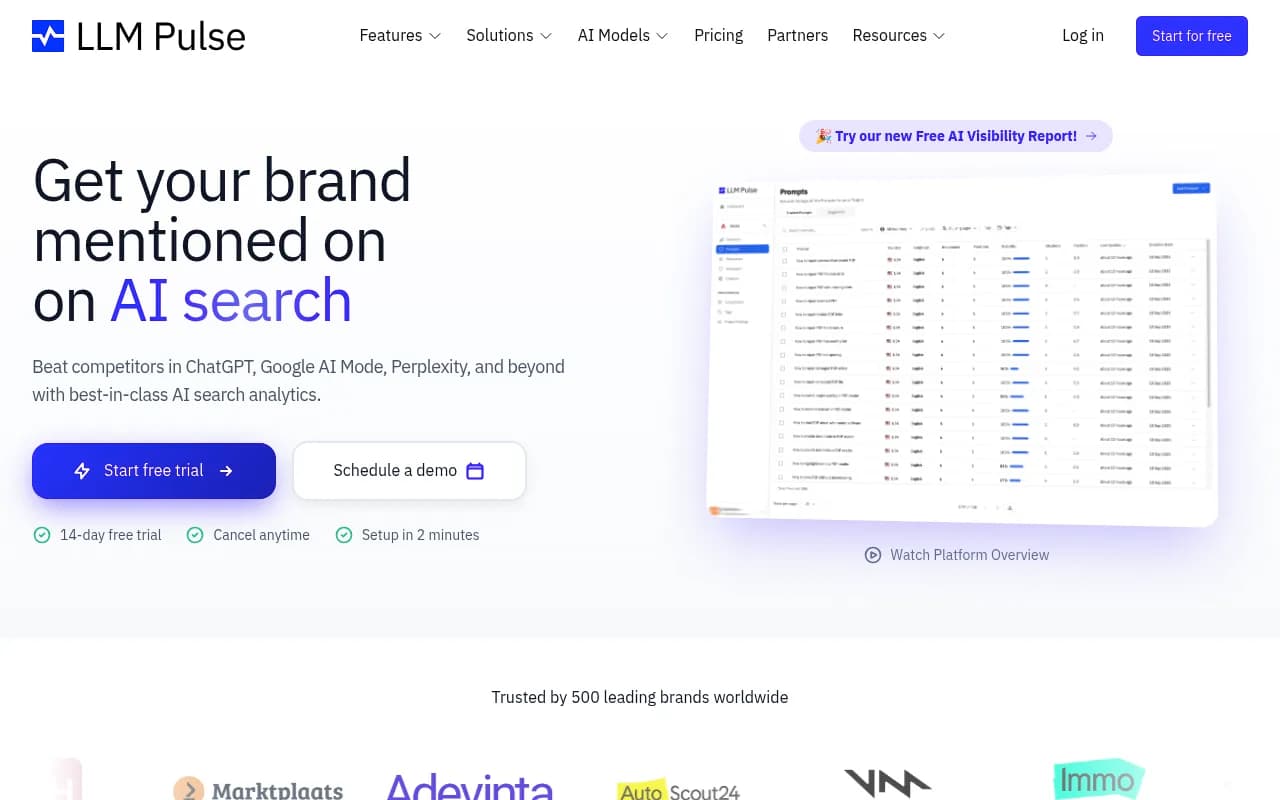
LLM Pulse is a lightweight tool for tracking brand presence across ChatGPT, Perplexity, and a handful of other AI engines. It's positioned as an affordable entry point for brands that want basic AI visibility monitoring without the complexity or cost of enterprise platforms.
The feature set is intentionally limited. You get brand mention tracking, basic prompt analytics, and some competitor comparison. What you don't get is content generation, crawler logs, traffic attribution, or deep citation analysis. It's a step up from manually checking AI responses yourself, but not much more than that.
For very small teams or solo marketers who want to keep an eye on AI mentions without a significant budget commitment, LLM Pulse is worth considering. For anyone who needs to actually improve their AI visibility, it's a starting point rather than a solution.
Best for: Solo marketers and small businesses wanting basic AI brand monitoring on a tight budget.
How these tools compare
Here's a direct comparison across the features that matter most for teams trying to improve AI visibility in 2026:
| Feature | Promptwatch | Profound | Otterly.AI | AthenaHQ | LLM Pulse |
|---|---|---|---|---|---|
| AI engines covered | 10 | 9+ | 3 | 4 | 3-4 |
| Answer gap analysis | Yes | Partial | No | No | No |
| Built-in content generation | Yes | No | No | No | No |
| AI crawler logs | Yes | No | No | No | No |
| Traffic attribution | Yes | No | No | No | No |
| Reddit/YouTube citation tracking | Yes | No | No | No | No |
| ChatGPT Shopping tracking | Yes | No | No | No | No |
| Competitor heatmaps | Yes | Yes | Basic | Yes | No |
| Starting price | $99/mo | $99/mo | Lower | $295/mo | Lower |
| Free trial | Yes | Yes | Yes | Yes | Varies |
The pattern is clear: most tools in this space are monitoring dashboards. Promptwatch is the only one here that covers the full cycle from gap identification to content creation to traffic attribution.
What to look for when choosing a Peec AI alternative
Monitoring vs. optimization
The most important question to ask is whether you need a tool that monitors or one that helps you optimize. If you have a dedicated SEO team that can take data and act on it independently, a monitoring-focused tool like Profound or AthenaHQ might be enough. If you need the tool to help you figure out what to do and how to do it, you need something closer to Promptwatch.
Engine coverage
AI search is not just ChatGPT and Google. Claude, Grok, DeepSeek, Perplexity, and Copilot are all sending meaningful traffic in 2026. A tool that only monitors three or four engines is going to give you an incomplete picture. Check the engine list carefully before committing.
Prompt volume and difficulty data
Not all prompts are worth chasing. A good AI visibility platform should tell you not just which prompts you're missing, but which ones have enough volume to be worth targeting and which ones are realistically winnable given your current authority. Promptwatch's prompt intelligence feature does this with volume estimates and difficulty scores — most competitors don't offer this at all.
Traffic attribution
This is the feature that separates tools that help you prove ROI from tools that just generate reports. Can you connect AI citations to actual website visits and conversions? Without this, you're flying blind on whether your AI visibility efforts are actually driving business results.
Crawler log access
Understanding how AI bots interact with your site — which pages they read, how often they return, what errors they hit — is a distinct capability that most tools don't offer. If you're serious about technical GEO, crawler log access is worth prioritizing.
The bottom line
Peec AI was a useful tool when AI visibility tracking was a new discipline. In 2026, the bar is higher. Teams need platforms that don't just show them where they're invisible — they need tools that help them fix it.
If you're looking for the most complete option, Promptwatch covers the full loop: gap analysis, content generation, multi-engine tracking, crawler logs, and traffic attribution. It's the only platform in this space that's been rated a "Leader" across all GEO categories, and the pricing is competitive with tools that offer significantly less.
If you're just starting out and want to understand the basics before committing, Otterly.AI or LLM Pulse are lower-risk entry points. For enterprise teams focused specifically on Google AI Overviews, Profound is worth a look. And if competitive intelligence is your primary use case, AthenaHQ does that well.
The right choice depends on where you are in your AI visibility journey — but if you're serious about improving how AI engines cite your brand, monitoring alone won't get you there.