Key Takeaways
- Most AI visibility tools are monitoring-only dashboards that track brand mentions across ChatGPT, Perplexity, Claude, and other LLMs—but leave you stuck figuring out what to do next
- Action-oriented platforms close the loop by showing content gaps, generating optimized articles grounded in citation data, and tracking results—turning visibility insights into revenue
- The core difference: tracking tools answer "where am I invisible?" while content-generation platforms answer "what content do I need to fix it?"
- Pricing varies wildly: monitoring-only tools start around $99/month, while platforms with built-in content generation and optimization range from $249-$579/month for professional tiers
- Enterprise brands need both capabilities: visibility tracking to diagnose the problem, content generation to solve it, and attribution tools to prove ROI
Your brand's reputation now lives inside AI search engines. When someone asks ChatGPT "best project management tools for remote teams" or prompts Perplexity "alternatives to Salesforce," the answer determines whether you exist in their consideration set. One hallucinated fact, one competitor-favoring response, and the trust—and revenue—vanishes.
With ChatGPT usage soaring and Google's AI Overviews appearing in nearly half of all searches, the stakes have never been higher. But here's the problem: most AI visibility tools are monitoring-only dashboards. They show you the data—where you're invisible, which competitors are winning, how often AI models cite your content—but they don't help you fix it.
This guide breaks down the fundamental difference between tracking-only platforms and action-oriented tools that actually help you generate content, optimize for AI search, and close visibility gaps.
What AI Visibility Tools Actually Do
Before we compare tracking vs generation capabilities, let's establish what these platforms monitor:
Core Tracking Capabilities
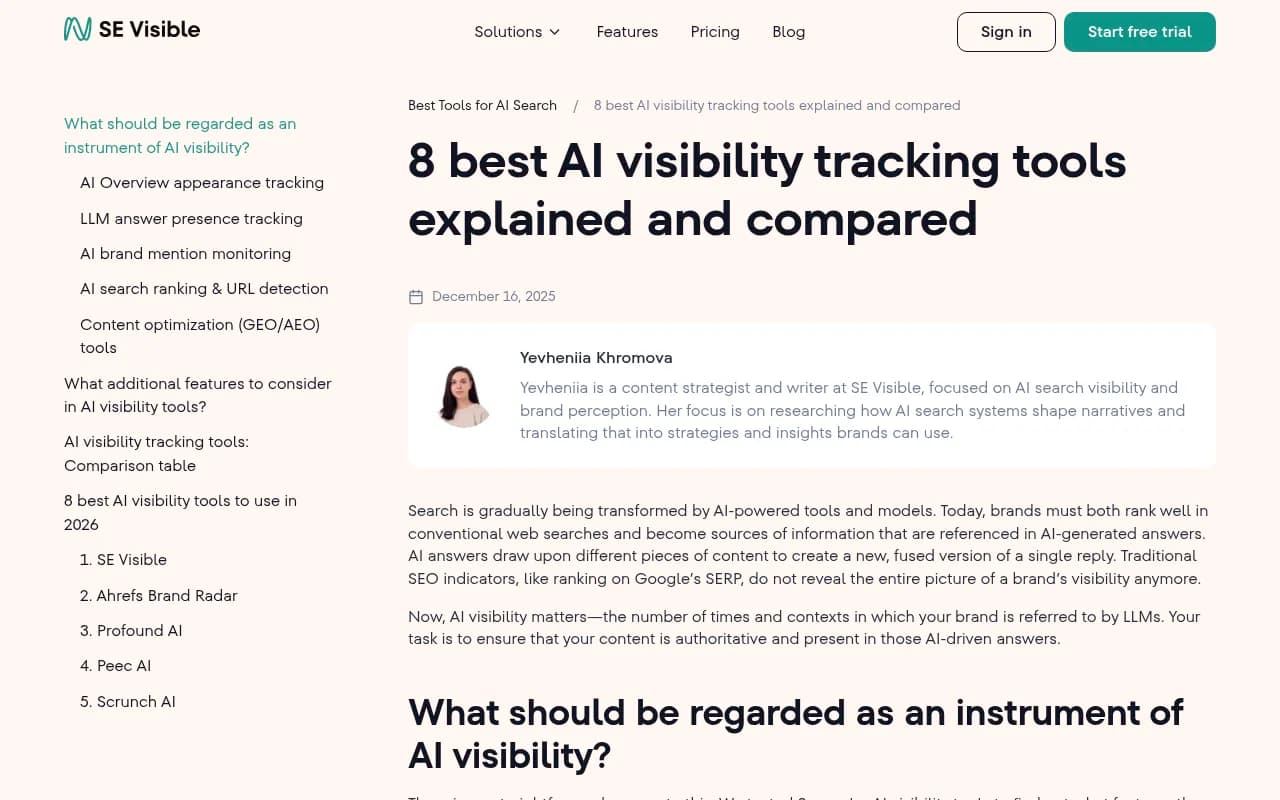
AI Overview Appearance Tracking: Monitors how your brand appears in Google AI Overviews and Bing Chat. These tools track which URLs surface in AI-generated search results and how often.
LLM Answer Presence Tracking: Runs queries on ChatGPT, Claude, Gemini, Perplexity, DeepSeek, Grok, and other language models. Records when and how your brand is mentioned in conversational AI responses.
Brand Mention Monitoring: Tracks sentiment, context, and positioning of brand mentions across generative answer outputs. Alerts you when competitors are cited instead of you.
AI Search Ranking & URL Detection: Creates an "AI visibility score" by measuring citation frequency, position in responses, and which specific pages AI models reference.
These capabilities are table stakes. Every serious AI visibility platform offers them. The real differentiation comes in what happens next.
The Tracking-Only Approach: What You Get (and Don't Get)
Most AI visibility tools stop at monitoring. They answer the question "where am I invisible?" but leave you to figure out the rest.
What Tracking-Only Tools Provide
Visibility Dashboards: See at a glance how often your brand appears across 8-14 different AI models. Track trends over time, compare against competitors, and identify which prompts you're losing.
Citation Analysis: Understand which pages, Reddit threads, YouTube videos, and domains AI models cite when answering queries related to your space. See the exact sources influencing AI recommendations.
Competitor Benchmarking: Compare your AI visibility against competitors. Identify which prompts they dominate and where you have opportunities to steal share of voice.
Prompt Intelligence: Volume estimates and difficulty scores for each prompt. Some tools show query fan-outs—how one prompt branches into sub-queries.
Evidence Logs & Screenshots: Raw AI responses and screenshots proving visibility (or lack thereof). Essential for audits and client reporting.
What's Missing from Tracking-Only Platforms
No Content Gap Analysis: You see that competitors rank for certain prompts, but you don't know what content your website is missing. Which topics? Which angles? Which questions do AI models want answers to but can't find on your site?
No Content Generation: You're left to create optimized content manually. No AI writing agent. No citation-grounded articles. No automated listicles or comparisons engineered to get cited by ChatGPT and Claude.
No Optimization Workflow: You can't fix indexing issues, optimize existing pages for AI search, or track which changes actually improve visibility. The loop never closes.
No Traffic Attribution: You don't know if AI visibility translates to actual revenue. Most tracking tools lack code snippets, GSC integration, or server log analysis to connect citations to conversions.
Popular Tracking-Only Platforms
Otterly.AI



These tools excel at diagnosis. They tell you what's broken. But they don't help you fix it.
The Action-Oriented Approach: Tracking + Content Generation + Optimization
A smaller subset of platforms go beyond monitoring. They close the action loop: find gaps → generate content → track results.
The Complete Workflow
1. Find the Gaps (Answer Gap Analysis)
These platforms show exactly which prompts competitors are visible for but you're not. More importantly, they reveal the specific content your website is missing—the topics, angles, and questions AI models want answers to but can't find on your site.
Example: Your competitor ranks for "best CRM for real estate agents" but you don't. Answer Gap Analysis shows you're missing:
- A dedicated page targeting real estate use cases
- Comparison content (your CRM vs Salesforce for real estate)
- Customer testimonials from real estate clients
- Integration guides for MLS systems
2. Create Content That Ranks in AI (AI Writing Agent)
The built-in AI writing agent generates articles, listicles, and comparisons grounded in:
- Real citation data (880M+ citations analyzed)
- Prompt volume estimates and difficulty scores
- Persona targeting (how your actual customers prompt)
- Competitor analysis (what's working for them)
This isn't generic SEO filler. It's content engineered to get cited by ChatGPT, Claude, Perplexity, and other AI models.
3. Track the Results (Visibility Improvement + Attribution)
See your visibility scores improve as AI models start citing your new content. Page-level tracking shows exactly which pages are being cited, how often, and by which models.
Close the loop with traffic attribution:
- Code snippet for tracking AI referral traffic
- GSC integration to see AI Overview impressions and clicks
- Server log analysis to identify AI crawler activity
Connect visibility to actual revenue. Prove ROI.
Additional Capabilities That Support the Action Loop
AI Crawler Logs: Real-time logs of AI crawlers (ChatGPT, Claude, Perplexity) hitting your website. See which pages they read, errors they encounter, how often they return. Fix indexing issues before they hurt visibility.
Reddit & YouTube Insights: Surface discussions that directly influence AI recommendations. Most competitors ignore this channel entirely, but Reddit threads and YouTube videos are heavily cited by LLMs.
ChatGPT Shopping Tracking: Monitor when your brand appears in ChatGPT's product recommendations and shopping carousels. Critical for e-commerce brands.
Multi-language & Multi-region: Monitor AI responses in any language, from any country, with customizable personas that match how your actual customers prompt.
Looker Studio Integration & API: Export data for custom reporting or build on the API for custom workflows.
The Leading Action-Oriented Platform

Promptwatch is the only platform rated as a "Leader" across all categories in a 2026 comparison of 12 GEO platforms. The core difference: most competitors are monitoring-only dashboards that show you data but leave you stuck. Promptwatch is built around taking action.
It monitors 10 AI models (ChatGPT, Perplexity, Google AI Overviews, Claude, Gemini, Meta AI, DeepSeek, Grok, Mistral, Copilot), tracks 880M+ citations, and includes the full action loop: Answer Gap Analysis, AI content generation, crawler logs, Reddit/YouTube tracking, ChatGPT Shopping, and traffic attribution.
Pricing: Essential $99/mo (1 site, 50 prompts, 5 articles), Professional $249/mo (2 sites, 150 prompts, 15 articles, crawler logs), Business $579/mo (5 sites, 350 prompts, 30 articles). Free trial available.
Side-by-Side Comparison: Tracking-Only vs Action-Oriented
| Capability | Tracking-Only Tools | Action-Oriented Platforms |
|---|---|---|
| AI Model Coverage | 8-14 models (ChatGPT, Perplexity, Claude, Gemini, etc.) | 10+ models including ChatGPT Shopping, Reddit, YouTube |
| Brand Mention Monitoring | ✅ Yes | ✅ Yes |
| Competitor Benchmarking | ✅ Yes | ✅ Yes |
| Citation & Source Analysis | ✅ Yes | ✅ Yes (880M+ citations) |
| Prompt Volume & Difficulty | ⚠️ Limited | ✅ Yes with query fan-outs |
| Answer Gap Analysis | ❌ No | ✅ Yes—shows missing content |
| AI Content Generation | ❌ No | ✅ Yes—grounded in citation data |
| AI Crawler Logs | ❌ No | ✅ Yes—real-time indexing insights |
| Reddit/YouTube Tracking | ❌ No | ✅ Yes—surfaces cited discussions |
| ChatGPT Shopping | ❌ No | ✅ Yes—product recommendation tracking |
| Traffic Attribution | ❌ No | ✅ Yes—code snippet, GSC, server logs |
| Page-Level Optimization | ❌ No | ✅ Yes—fix what's not working |
| API & Data Export | ⚠️ Limited | ✅ Yes—Looker Studio, custom workflows |
| Pricing (Professional Tier) | $99-$199/mo | $249-$579/mo |
When to Choose Tracking-Only Tools
Tracking-only platforms make sense in specific scenarios:
You Already Have a Content Engine: If you have a dedicated content team, SEO writers, and a proven workflow for creating optimized content, you just need visibility data to inform strategy.
Budget Constraints: Monitoring-only tools start around $99/month. If you're testing AI visibility tracking for the first time or have limited budget, these are accessible entry points.
Agency Reporting: If you're an agency tracking AI visibility for multiple clients and handling content creation separately, tracking-only tools provide clean dashboards and white-label reporting.
Research & Competitive Intelligence: If your primary goal is understanding the AI search landscape—what competitors are doing, which prompts matter, how the market is evolving—tracking tools provide the data you need.
Best Tracking-Only Options
Otterly.AI: Affordable monitoring across ChatGPT, Perplexity, and Google AI Overviews. Clean interface, basic reporting. Lacks crawler logs and content generation.
Peec AI: Smart suggestions for prompt targeting. Good competitor analysis. No content creation tools.
AthenaHQ: Solid monitoring features, multi-model coverage. Focused on tracking, not optimization.
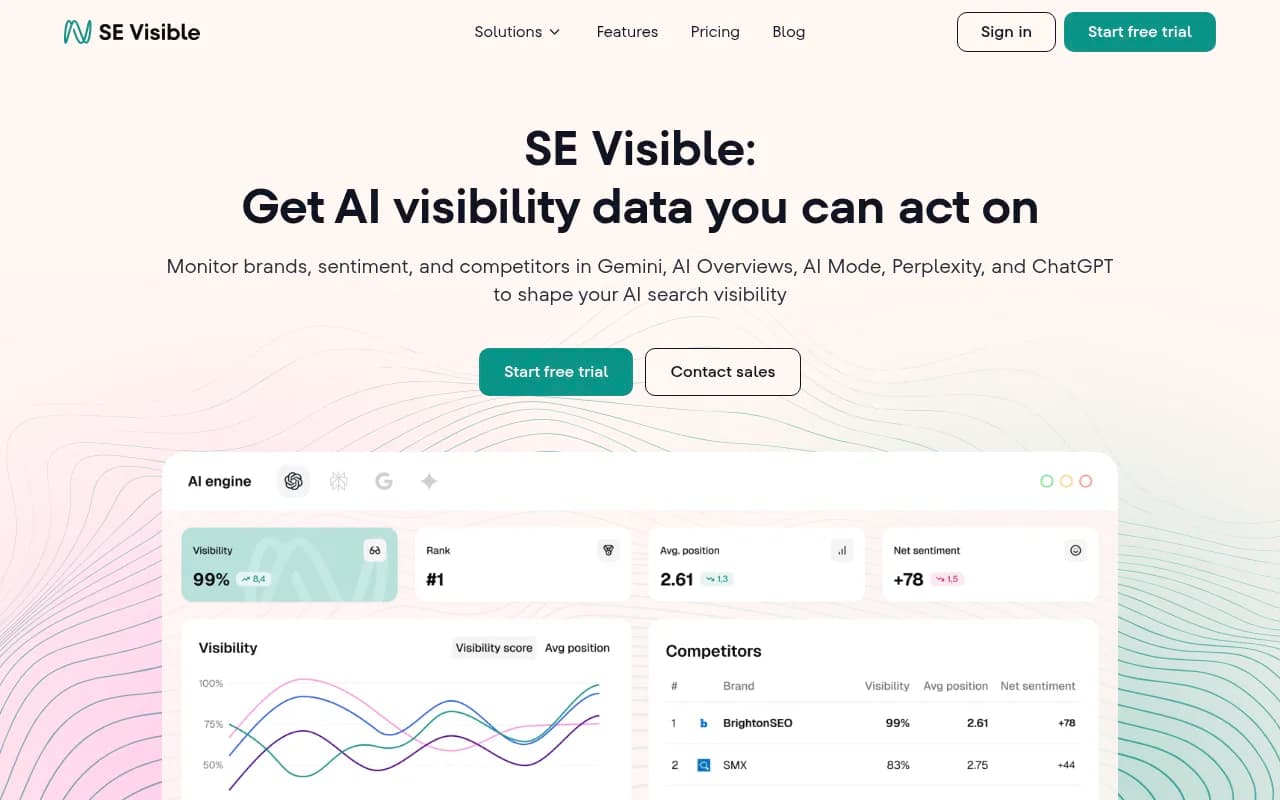
SE Visible: Brand mention tracking without the tools to fix visibility gaps. Good for diagnosis, not treatment.
When to Choose Action-Oriented Platforms
Action-oriented platforms are essential when:
You Need to Scale Content Creation: If you're trying to close dozens or hundreds of content gaps, manual writing doesn't scale. AI-generated articles grounded in citation data accelerate production without sacrificing quality.
You Want to Prove ROI: If you need to connect AI visibility to actual revenue—impressions, clicks, conversions—you need traffic attribution tools. Tracking-only platforms can't close this loop.
You're Competing in Crowded Markets: If competitors are already dominating AI search in your category, you need more than monitoring. You need Answer Gap Analysis to find winnable prompts and content generation to execute fast.
You Have Limited SEO Resources: If you don't have a dedicated content team or SEO specialists, an action-oriented platform becomes your content engine. It shows you what to create and generates it for you.
You're Managing Multiple Sites: If you're tracking AI visibility across multiple brands, domains, or clients, you need workflow automation. Page-level tracking, crawler logs, and API access make multi-site management feasible.
The Clear Leader
Promptwatch is the only platform that delivers the complete action loop. It's not just a tracker—it's an optimization engine. You see the gaps, generate content to fill them, and track results in one unified workflow.
Compared to competitors:
- vs Profound/Scrunch: Strong feature sets but higher price points, no Reddit tracking, no ChatGPT Shopping
- vs Otterly.AI/Peec.ai: Basic monitoring only—no crawler logs, no visitor analytics, no content generation
- vs AthenaHQ: Monitoring-focused, lacks content optimization and generation capabilities
- vs Semrush/Ahrefs: Traditional SEO tools that don't support AI search monitoring in depth; fixed prompts, no AI traffic attribution
Hybrid Approach: Traditional SEO Tools Adding AI Tracking
Some established SEO platforms are adding AI visibility features to their existing toolsets.
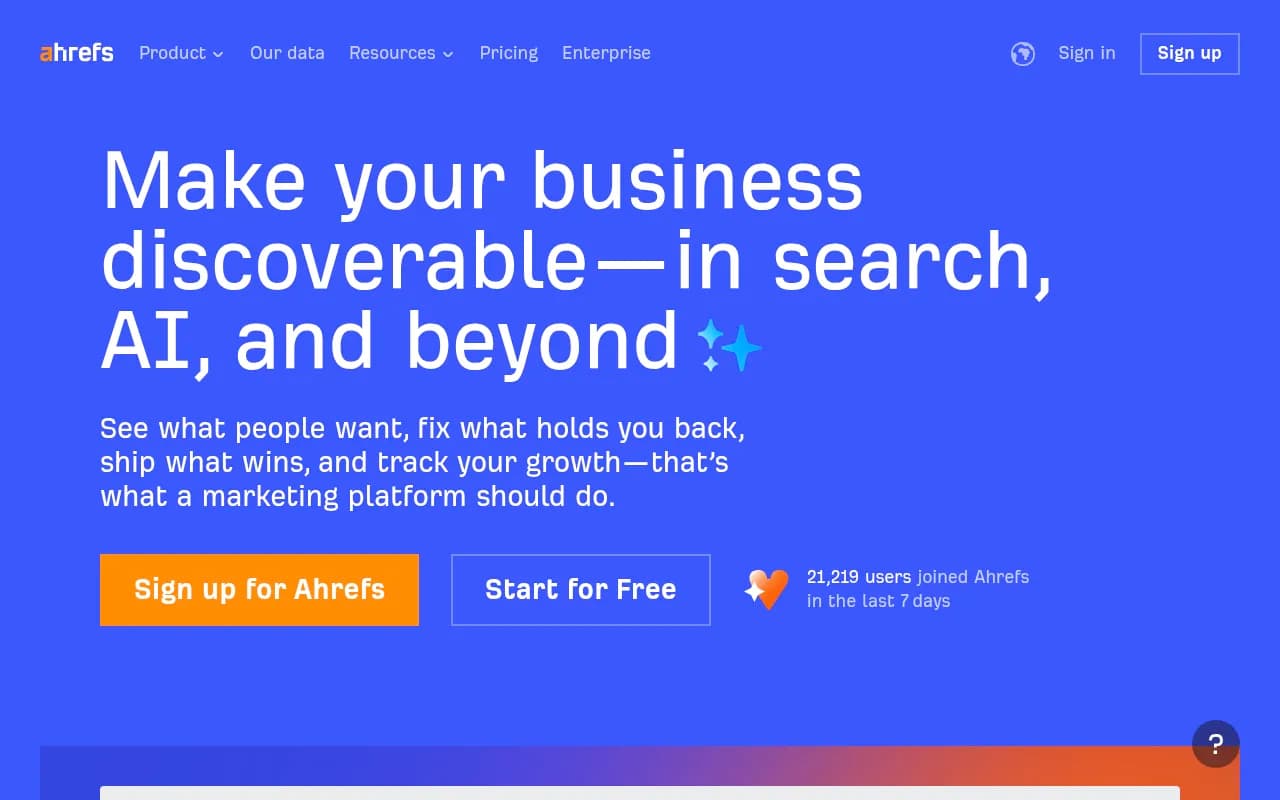
These tools offer side-by-side SEO and GEO tracking. If you're already a Semrush or Ahrefs customer, their AI visibility modules provide basic monitoring without switching platforms.
Limitations: Fixed prompt sets (you can't customize queries), no content generation, limited AI-specific optimization features. They're built for traditional SEO first, AI search second.
Best for: Teams that want to monitor AI visibility alongside traditional rankings without adding another tool to the stack.
The Future: AI Visibility Becomes Table Stakes
In 2026, tracking AI visibility is no longer optional. But the market is splitting into two camps:
Monitoring Dashboards: Clean interfaces, competitive pricing, solid reporting. They tell you what's happening but don't help you change it.
Optimization Engines: Higher price points, steeper learning curves, but they close the action loop. They show you what's missing, help you create it, and prove ROI.
The question isn't "should I track AI visibility?" It's "do I just want to see the data, or do I want to fix the problem?"
For most brands, the answer is clear: visibility without action is just expensive reporting. The platforms that win in 2026 are the ones that help you generate content, optimize for AI search, and connect visibility to revenue.
How to Choose the Right Platform for Your Needs
Start with Your Primary Goal
Goal: Understand the AI search landscape → Choose a tracking-only tool like Otterly.AI or Peec AI
Goal: Close content gaps and improve visibility → Choose an action-oriented platform like Promptwatch
Goal: Monitor AI alongside traditional SEO → Choose Semrush or Ahrefs if you're already a customer
Evaluate Based on Your Resources
Limited budget, no content team → Action-oriented platform pays for itself by generating content
Dedicated content team, need data to inform strategy → Tracking-only tool provides the insights your team needs
Agency managing multiple clients → Look for white-label reporting, API access, multi-site management
Test Before Committing
Most platforms offer free trials. Run a 30-day test:
- Set up tracking for your top 20-30 prompts
- Identify 3-5 content gaps where competitors are visible but you're not
- If the platform has content generation, create 2-3 articles and publish them
- Track visibility changes over 2-4 weeks
- Measure whether AI referral traffic increases
If you see measurable improvement in visibility and traffic, the platform is working. If you just see dashboards and reports with no clear path to action, you're paying for monitoring—not optimization.
Conclusion: The Action Loop Wins
The AI visibility market is maturing fast. In 2026, the winners aren't the tools with the most AI models or the prettiest dashboards. They're the platforms that help you take action.
Tracking-only tools answer "where am I invisible?" Action-oriented platforms answer "what content do I need to fix it?" and then help you create it.
For most brands, the choice is clear: you don't need another monitoring dashboard. You need an optimization engine that shows you the gaps, generates content to fill them, and proves ROI by connecting visibility to revenue.
That's the difference between tracking and optimization. That's the difference between seeing the problem and solving it.