Key takeaways
- AirOps is primarily a content workflow automation platform that includes some AI visibility tracking (up to 4 models); Promptwatch is a dedicated GEO platform tracking 10+ AI models with a full optimization loop built in.
- If your team's main bottleneck is publishing volume and CMS automation, AirOps solves that well. If your goal is to actually improve where you show up in ChatGPT, Perplexity, Claude, and Google AI Overviews, you need a platform built around that problem.
- Promptwatch's Answer Gap Analysis, AI writing agent, and crawler logs give content teams a closed loop: find what's missing, create content that fixes it, track whether it worked.
- AirOps doesn't offer crawler log monitoring, Reddit/YouTube citation tracking, ChatGPT Shopping tracking, or prompt volume/difficulty scoring.
- Pricing starts at $99/mo for Promptwatch and free tier for AirOps, but the comparison gets more complex once you factor in what each platform actually does.
Two tools, two very different jobs. That's the honest summary of AirOps vs Promptwatch in 2026. Both show up in conversations about AI search visibility, and both have content creation components. But spending time with each one makes the difference obvious pretty quickly.
AirOps grew out of content operations. It's built for teams that need to produce a lot of content, push it to a CMS, and track some basic AI visibility signals along the way. Promptwatch is built around a different question: why aren't you appearing in AI search results, and what do you do about it?
This guide breaks down both platforms across the dimensions that actually matter for content teams: AI model coverage, gap analysis, content generation, traffic attribution, crawler intelligence, and pricing.
What each platform is actually trying to do
Before getting into features, it's worth being clear about the design philosophy behind each tool, because that shapes everything else.
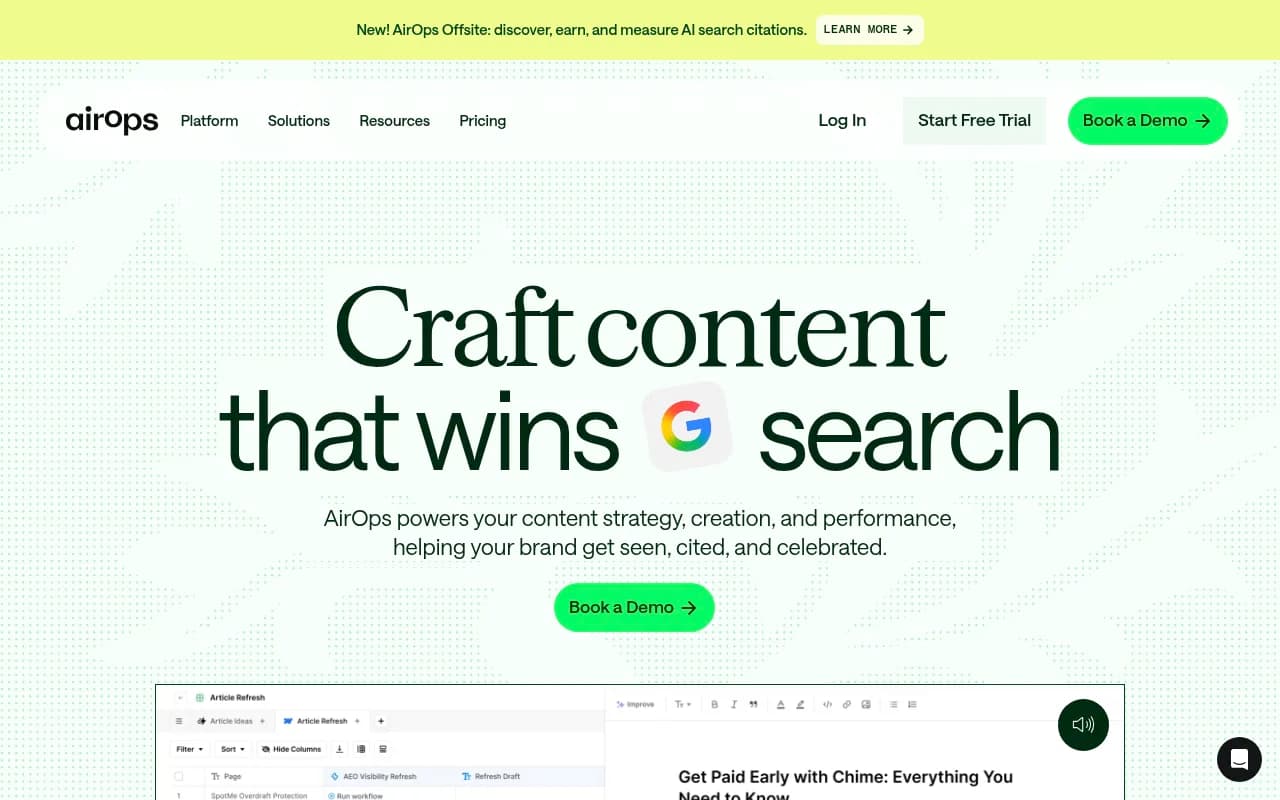
AirOps describes itself as a content engineering platform. Its core workflow connects AI visibility insights to content production and CMS publishing. The "Insights" layer helps teams identify where to create content; the automation layer helps them do it at scale. It's strongest for teams that already know they need more content and want a repeatable pipeline to produce it.
Promptwatch is built around what it calls the action loop: find the gaps in your AI visibility, generate content engineered to close those gaps, then track whether your visibility actually improved. The emphasis is on optimization, not just production. The platform monitors 10 AI models, analyzes over 1.1 billion citations, and gives teams the tools to connect AI visibility changes to real traffic and revenue.

Neither framing is wrong. They're just solving different problems. The question is which problem your team actually has.
AI model coverage
This is where the gap becomes concrete.
AirOps tracks up to 4 AI models. The exact models aren't always specified in their public documentation, but the coverage is limited compared to the full AI search landscape.
Promptwatch monitors 10 AI models: ChatGPT, Perplexity, Google AI Overviews, Google AI Mode, Claude, Gemini, Meta/Llama, DeepSeek, Grok, Mistral, and Copilot.
Why does this matter? Because different AI models cite different sources. A brand that appears consistently in ChatGPT responses might be nearly invisible in Perplexity or Claude. If you're only tracking 4 models, you have a partial picture at best. You might think your GEO strategy is working when you're actually losing ground on the models your customers use most.
| Feature | AirOps | Promptwatch |
|---|---|---|
| AI models tracked | Up to 4 | 10 (ChatGPT, Perplexity, Claude, Gemini, Grok, DeepSeek, Copilot, Meta/Llama, Google AI Overviews, Google AI Mode) |
| Google AI Overviews | Unclear | Yes |
| DeepSeek / Grok | No | Yes |
| Multi-region / multi-language | Limited | Yes |
| Custom personas | No | Yes |
Gap analysis: finding what you're missing
This is the feature that separates optimization platforms from monitoring dashboards.
AirOps has an Insights layer that helps teams identify where to create content. It surfaces AI visibility data and connects it to content opportunities. But it doesn't appear to offer the kind of prompt-level gap analysis that shows you exactly which queries your competitors are winning and you're not.
Promptwatch's Answer Gap Analysis does exactly that. You can see the specific prompts where competitors are being cited by ChatGPT or Perplexity and you're not. Not just "you're less visible than Competitor X" -- but "here are the 23 specific questions where Competitor X gets recommended and you don't appear at all."
That specificity matters because it turns a vague strategic problem ("we need better AI visibility") into an actionable content brief ("we need to write about these specific topics, framed this way, to appear in these responses").
Promptwatch also includes prompt volume estimates and difficulty scores, so you can prioritize the gaps that are worth closing first. Query fan-outs show how a single prompt branches into sub-queries, which helps content teams understand the full territory around a topic rather than optimizing for one narrow question.
Content generation
Both platforms include AI content generation, but the underlying approach is different.
AirOps is strong here. It's designed as a content pipeline, so the generation capabilities are mature and the CMS publishing integrations are a genuine advantage. Teams can build repeatable workflows that go from brief to published article with minimal manual steps. For agencies or in-house teams managing high content volume, that's real operational value.
Promptwatch's built-in AI writing agent is grounded in citation data. It generates articles, listicles, and comparisons based on 880M+ citations analyzed, prompt volumes, persona targeting, and competitor analysis. The goal isn't to produce content fast -- it's to produce content that AI models will actually cite. That's a different optimization target.
The practical difference: AirOps helps you publish more. Promptwatch helps you publish content that improves your AI search visibility. If you're already publishing a lot and not seeing visibility gains, the second approach is probably what you need.
Tracking and attribution
Knowing your visibility score went up is useful. Knowing that the article you published three weeks ago is now being cited by Perplexity and drove 340 incremental visits is much more useful.
Promptwatch offers three attribution methods: a code snippet, Google Search Console integration, and server log analysis. Page-level tracking shows which specific pages are being cited, how often, and by which AI models. This closes the loop between content investment and business results.
AirOps has a Page360 analytics layer that unifies AI citation data with Google Analytics data. It's a meaningful attempt at attribution, but the coverage is limited by the 4-model ceiling on the monitoring side.
| Feature | AirOps | Promptwatch |
|---|---|---|
| Page-level citation tracking | Yes (Page360) | Yes |
| Traffic attribution | Via GA integration | Code snippet, GSC, server logs |
| AI crawler logs | No | Yes (Professional plan+) |
| ChatGPT Shopping tracking | No | Yes |
| Reddit citation tracking | No | Yes |
| YouTube citation tracking | No | Yes |
AI crawler logs
This feature doesn't get talked about enough, and it's one of the clearest differentiators between a monitoring tool and a full GEO platform.
Promptwatch's AI Crawler Logs show you in real time which AI crawlers (ChatGPT's GPTBot, Perplexity's crawler, Claude's, etc.) are hitting your website, which pages they're reading, how often they return, and what errors they encounter. If an AI model can't crawl a key page on your site, you'll see it -- and you can fix it.
AirOps doesn't offer this. Most competitors in this category don't either. But for teams serious about GEO, crawler visibility is foundational. You can't optimize for AI citation if the AI models can't read your content in the first place.
Reddit and YouTube insights
Here's something that surprises people: AI models like ChatGPT and Perplexity frequently cite Reddit threads and YouTube videos in their responses. If you're only tracking your own website's citation rate, you're missing a significant part of the picture.
Promptwatch surfaces Reddit discussions and YouTube content that directly influence AI recommendations. This tells you where else you should be publishing or engaging to improve your AI visibility, beyond just your own site.
AirOps doesn't track Reddit or YouTube citations.
Pricing comparison
| Plan | AirOps | Promptwatch |
|---|---|---|
| Entry tier | Free tier available | $99/mo (Essential: 1 site, 50 prompts, 5 articles) |
| Mid tier | Paid plans (pricing not publicly listed) | $249/mo (Professional: 2 sites, 150 prompts, 15 articles, crawler logs) |
| Higher tier | Enterprise (custom) | $579/mo (Business: 5 sites, 350 prompts, 30 articles) |
| Agency/Enterprise | Custom | Custom |
| Free trial | Yes | Yes |
AirOps doesn't publish its paid pricing publicly, which makes direct comparison harder. The free tier is a genuine entry point for smaller teams testing the platform.
Promptwatch's pricing is transparent and scales with the number of sites, prompts, and articles. The Professional plan at $249/mo is where most serious content teams land -- it includes crawler logs and state/city-level tracking, which the Essential plan doesn't.
Who each tool is actually for
AirOps makes sense if:
- Your team's primary challenge is content production volume and CMS workflow automation
- You're already tracking AI visibility through another tool and want to layer in content execution
- You need tight integrations with your existing content stack
- You're comfortable with 4-model coverage for now
Promptwatch makes sense if:
- You want to understand why you're not appearing in AI search results and fix it
- You need full coverage across 10 AI models, including Google AI Mode, DeepSeek, and Grok
- You want to connect AI visibility changes to actual traffic and revenue
- You need crawler log monitoring to diagnose indexing issues with AI bots
- You want to track Reddit and YouTube as citation sources, not just your own site
- You're running a multi-site or agency operation that needs scalable GEO infrastructure
The honest version: AirOps is a content operations tool that added AI visibility features. Promptwatch is an AI visibility platform that added content generation. If GEO is a core priority for your team in 2026, that distinction matters.
A note on the broader competitive landscape

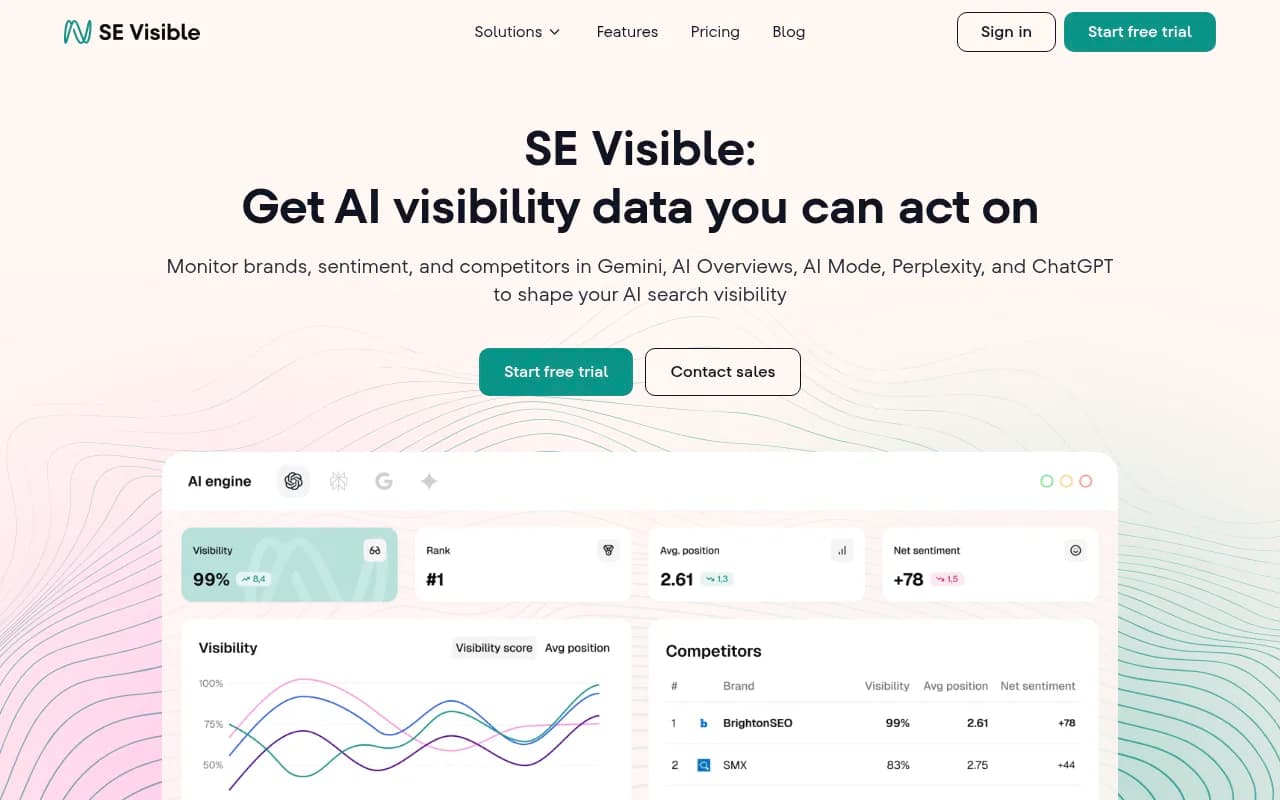
The AI visibility tool market has expanded significantly in 2025-2026. Tools like Profound, Otterly.AI, Peec AI, and SE Visible all compete in this space with varying approaches. Most of them are monitoring-only dashboards -- they show you data but leave the "what do I do about it" question unanswered.
Profound

Otterly.AI


What separates Promptwatch from most of this field isn't the monitoring layer -- it's the action layer. Finding that you're invisible in Perplexity for a set of high-volume prompts is useful information. Having a tool that then shows you exactly what content to create, generates a draft grounded in real citation data, and tracks whether that content improved your visibility -- that's a different category of value.
AirOps sits in an interesting middle position: more action-oriented than pure monitoring tools, but with narrower AI coverage and less GEO-specific infrastructure than Promptwatch.
Bottom line
If you're a content team that needs to scale production and automate publishing workflows, AirOps is worth evaluating seriously. The content pipeline capabilities are real.
If your goal is to actually improve how your brand appears in ChatGPT, Perplexity, Claude, and the rest of the AI search ecosystem -- and to measure whether your efforts are working -- Promptwatch is the more complete platform. The combination of 10-model coverage, Answer Gap Analysis, AI crawler logs, Reddit/YouTube tracking, and traffic attribution gives content teams the full picture and the tools to act on it.
Both offer free trials. The fastest way to figure out which one fits your team is to run the same set of prompts through each platform and see what each one tells you to do next.