
Key takeaways
- Bloomreach announced the acquisition of AthenaHQ on November 16, 2026. The price was not disclosed, and the team is joining Bloomreach.
- AthenaHQ's strengths are broad engine coverage, a genuinely usable free tier (300 credits), and an Action Center that turns gaps into tasks. G2 shows 4.9/5 with a Spring 2026 High Performer badge.
- The gaps are the same ones reviewers flagged before the sale: nothing between free and $295/month, credit math that is easy to get wrong, and the best features (Citation Engine, multi-country) reserved for Enterprise.
- Pricing, roadmap and standalone availability after the acquisition have not been verified. Treat every price in this guide as pre-sale until you confirm it on athenahq.ai.
- Stay if you are an enterprise or ecommerce team that wants breadth and a path into Bloomreach. Look elsewhere if you need cheap entry pricing, high prompt volume, or content that gets written and published for you.
What happened: Bloomreach buys AthenaHQ
On November 16, 2026, Bloomreach announced it was acquiring AthenaHQ, the Y Combinator-backed AI visibility platform founded by Andrew Yan (ex-Google) and Alan Yao. Forbes covered the deal the same day. No price was disclosed. A deal tracker lists it as completed with a close around November 15 and says the founder confirmed the team is moving to Bloomreach.
The strategy is stated plainly in the announcement. Bloomreach's CEO Raj De Datta says AthenaHQ's Athena Citation Engine (ACE), a model that estimates how likely a piece of content is to be cited by AI, "complements Loomi," Bloomreach's own AI. The pitch is connecting AI discovery to personalization and revenue across Bloomreach's 1,400+ brands, which include American Eagle, Sonepar and Pandora.
That tells you who the product is increasingly built for: commerce and customer-data teams already in the Bloomreach orbit. If you are one of those, this is good news. If you bought AthenaHQ as a standalone monitor, you now have questions the press release does not answer.
What we do not know yet
Be honest about the gaps before making any decision:
- Whether AthenaHQ stays on sale as a standalone product or gets folded into Loomi.
- Whether the free Essential tier, the $295 Starter price and the credit model survive unchanged.
- What the roadmap looks like for non-Bloomreach customers.
- Any commitments on data retention or migration.
Every pricing figure below comes from reviews written before the sale. Verify them on the AthenaHQ site before you budget.

What AthenaHQ does well
The reviews we read were written by competitors (all of them disclose it, which is worth noting), but they agree on the core strengths more than you would expect.
Broad engine coverage
The paid Starter plan was listed with coverage of 9 to 11 engines depending on the review and date: ChatGPT, Perplexity, Google AI Overviews, AI Mode, Gemini, Claude, Copilot, Grok, DeepSeek, Meta AI and Mistral. For teams whose buyers are spread across assistants or countries, that matters. One G2 reviewer switched from Semrush specifically because Claude and Gemini tracking did not cost extra there.
A free tier you can actually use
The Essential plan gives you 300 credits, five engines and unlimited members. One credit equals one AI response. Reviewers disagree on whether the 300 credits is a permanent allowance or a one-time grant, so check the current terms. Either way, it is enough to run a real sample and see whether the data tells you anything.
The Action Center
This is what AthenaHQ leads with. Gaps become tasks: on-page and off-page recommendations, content optimization, and on Enterprise the Citation Engine. For a CMO who does not want to learn a dashboard, that framing is easier to live with than a score to watch. Reviewers also praise the branded PDF exports for client work and same-day support.
Customer sentiment
On G2, AthenaHQ held 4.9 out of 5 across 34 to 48 reviews depending on when you read it (September 2026 saw 48). Complaints are about learning curve, UI rough edges and missing industry prompt templates. Nobody in the reviews we read names price or says the data is wrong. One agency reviewer said they had been paying nearly $6k a month for another platform their team dreaded using.
Treat vendor-reported outcomes with care. Grüns growing share of voice from 2.0% to 12.6% in 60 days and Lago reporting 50% more demos are both vendor-published and were not independently verified.
Where AthenaHQ falls short
These points were true before the acquisition. The sale does not fix them, and it may make some of them stickier.
The missing rung between free and $295
The most repeated complaint. There is nothing between the free tier and Starter at $295/month. A team that needs thirty prompts on six engines has no $80 or $99 option here. One reviewer put it in one line: the jump is steep with nothing between.
Credit math is easy to get wrong
Credits are consumed per response, and not equally. One review states that 5 credits apply to Claude, Grok, DeepSeek, Meta AI and Mistral, against 1 credit for the others. Another worked example from the same period:
- Twenty prompts on ten engines is 200 credits per run, so 3,600 credits buys about eighteen full runs a month.
- Tracked daily, Starter covers at most about 39 prompts on three engines, according to one competitor's arithmetic.
- Another estimate puts 3,600 credits at roughly 120 daily-tracked prompt-engine pairs.
Those numbers do not agree, because the assumptions differ. That is the point. Run the vendor's credit calculator on your actual prompt set before you commit.
The best features are Enterprise
Multiple reviews say the Citation Engine, multi-country tracking and the strongest optimization workflows sit behind an Enterprise contract. A $295 customer gets a strong tracker with an Action Center, not the strategy engine the marketing implies. Note the press release now presents ACE as core to the platform, so check whether that packaging has changed.
Optimization output is thin
A hands-on test by Nick Lafferty, published on Profound's blog (so a rival's), said the optimization feature recommended a few minor edits and then gave up, and called the first generated draft trite. That is one reviewer with a conflict of interest, and he tested Starter. A G2 user was gentler, asking for ways to encode product-specific guardrails into recommendations. The common thread: recommendations are not drafted fixes, and nothing re-runs the prompt to prove the change worked.
MCP and API are unclear
A September review said no MCP server was found and that API access is a paid add-on on Starter. The November press release says AthenaHQ integrates with Claude and ChatGPT via MCP, and another October review lists an MCP server that can read and write. The likely story is that this was added or documented after September. Check the docs before relying on either claim.
The category-wide caveat
One practitioner warning applies to AthenaHQ and everyone else: a visibility score is not a measurement of a fixed thing. Change the model version and the score moves. The Action Center is a better answer to that than a bare dashboard, but the warning stands.
Pricing, as last published
These figures pre-date the sale. Confirm them.
| Plan | Price | Credits | Engines | Notes |
|---|---|---|---|---|
| Essential | Free | 300 | 5 | Unlimited members |
| Starter | $295/month (about 17% off annual) | 3,600 | 9 to 11 | One country, API as paid add-on |
| Enterprise | Custom | Negotiated | 11+ | Multi-country, SSO, audit log, Citation Engine |
Should you stay, wait or move?
Stay or start if
- You are an enterprise or upper-mid-market team that wants one dashboard across many engines, including DeepSeek, Mistral and Meta AI.
- You are already a Bloomreach customer, or sell through Shopify, GA4 and Search Console, and expect the integration story to improve.
- You check prompts weekly rather than daily, so the credit model costs you little.
- You want to evaluate for free before you spend anything.
Wait and watch if
- You are between tiers: too big for 300 credits, too small to justify $295.
- You need multi-country tracking or the Citation Engine and are being quoted Enterprise.
- Your contract renews soon. Ask in writing about pricing locks, standalone availability and data export.
Move on if
- You need to track many prompts daily and publish a steady stream of content. Credits run out before you can act.
- You want the fix drafted from cited evidence, published to your CMS, and then re-measured.
- You do not sell through ecommerce and have no interest in a revenue-and-personalization pitch.
- You need crawler-level evidence of whether AI bots can read your site.
Alternatives worth a look
The useful question is who does the work after the dashboard shows a gap. Some tools go deeper on monitoring. Others go further into execution.
Promptwatch for monitoring plus execution
Promptwatch is the closest fit for teams that want the loop closed. It tracks ChatGPT, Gemini, Claude, Perplexity, Google AI Overviews, AI Mode, Copilot and others from the real interfaces, then goes past reporting: the Action Board prioritizes work, the Content Agent writes and publishes to WordPress, Webflow or Framer, and IP-verified AI crawler logs plus visitor analytics show whether the page was read, cited and clicked. It also covers Reddit, YouTube and LinkedIn citation tracking and ChatGPT Shopping. Pricing starts at $95/month (Essential) and $245/month (Professional), which fills the gap AthenaHQ leaves between free and $295. The Content Agent and faster-than-daily tracking start on Business at $579/month. There is a 7-day free trial on monthly billing, and the head-to-head with AthenaHQ lays out the differences. Check current pricing.

Peec AI for monitoring on a budget
Reviewers cite roughly $80 to $95/month for 50 prompts on three models, with a strong MCP. A reasonable pick if you only need monitoring.

Otterly for a cheap first look
Around $29/month and a fine way to watch a handful of prompts, with little execution.
Otterly.AI

Profound for enterprise depth
The usual pick for large programmes that want prompt volumes and governance, at a higher price.
Profound

AirOps for content teams
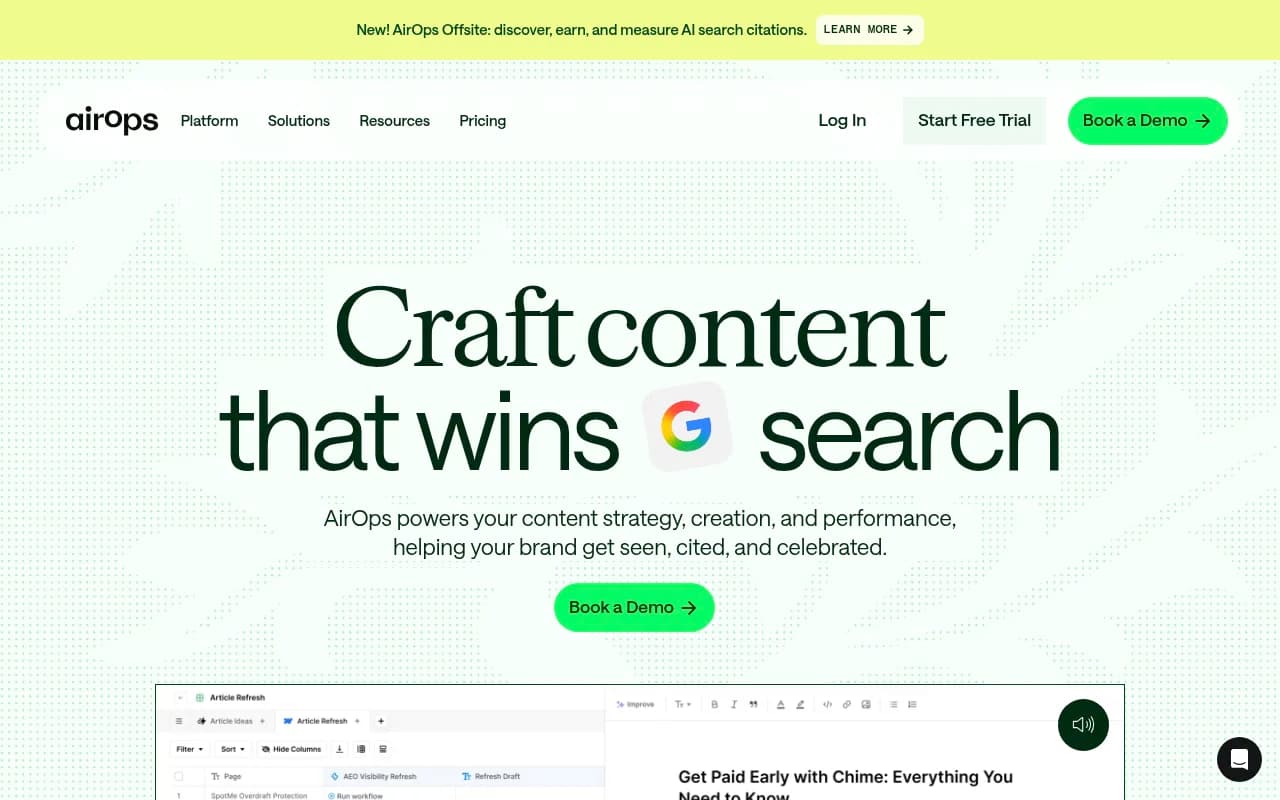
If your real bottleneck is publishing, AirOps is built around content engineering and CMS publishing rather than monitoring.
| Tool | Entry price (as reported) | Strongest at | Main limit |
|---|---|---|---|
| AthenaHQ | Free, then $295/mo | Engine breadth, Action Center | No middle tier, Enterprise-gated features, post-sale uncertainty |
| Promptwatch | $95/mo (7-day trial) | Monitor, fix, measure in one product | Content Agent starts on Business |
| Peec AI | About $80 to $95/mo | Affordable monitoring, MCP | Little execution |
| Otterly | About $29/mo | Cheap first look | Basic tracking |
| Profound | Higher, quote-based | Enterprise depth | Price, no agentic execution |
| AirOps | Varies | Content production and publishing | Not a visibility tracker first |
If you want a wider survey, the GEO software directory lists more options.
A caution about citation advice
Whatever tool you pick, judge its "citation opportunity" advice against what is actually being cited. Promptwatch Data's ChatGPT citation share report for November 2026 (Nov 1 to 25) shows how fragmented it has become. Reddit is the top popular site at only 0.23% of ChatGPT citations, down from 3.71% in June, and the top 20 popular sites together earn under 2%. Review sites such as G2, Gartner, Capterra and Trustpilot hold five of the top 10 spots. The practical takeaways are to get listed on review sites and publish answers on your own domain, not to build a ChatGPT plan around Reddit. The data reflects a random 1-in-8 sample of responses. For the longer trend, see Promptwatch's Reddit citations report.
How to decide: a ten-prompt test
Don't pick from a review, including this one. Do this during a trial:
- Write ten real buyer prompts in your market.
- Run them through AthenaHQ and two finalists.
- Compare the raw answers, not the summary scores.
- Check how many credits or responses each tool burned.
- Ask who does the work after a gap shows up, and whether anything re-measures the result.
- Ask AthenaHQ's sales team, in writing, about post-acquisition pricing, standalone availability and export rights.
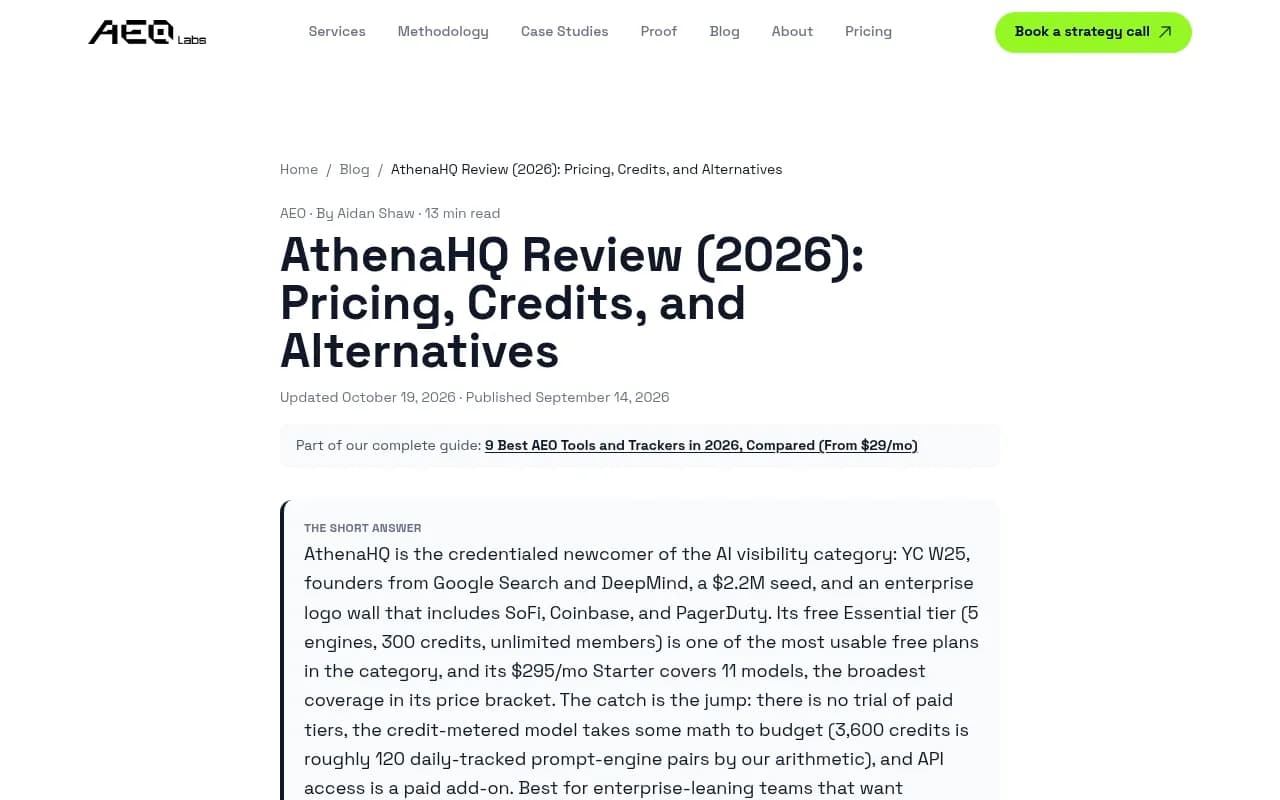
The screenshots below show how competing reviewers present the same product, which is a useful reminder that every review here has a stake in the outcome.
Verdict
AthenaHQ was a well-liked tracker with a missing pricing rung, and the sale does not change that. For commerce teams near Bloomreach it may get better. For everyone else, the next few months are a wait-and-see period, and the sensible move is to use the free tier, keep your data exportable, and run a side-by-side trial before any annual commitment.
FAQ
Who bought AthenaHQ?
Bloomreach, announced November 16, 2026. The price was not disclosed.
Is AthenaHQ still available after the acquisition?
It is not yet clear whether it will remain a standalone product. Check athenahq.ai and ask sales directly.
Is the $295 Starter price still current?
The figure comes from pre-sale reviews. Confirm it on the live pricing page.
Is the free tier still worth using?
Yes, for evaluation. Three hundred credits is enough to sample prompts, but it is a sample, not a programme.
What is the best AthenaHQ alternative?
It depends on who does the work next. Promptwatch suits teams that want monitoring, content creation and measurement in one product. Peec AI and Otterly suit budget monitoring. Profound suits large enterprise programmes.