Key takeaways
- Amazon retired the Rufus brand name on May 13, 2026, folding it into Alexa for Shopping — but most brands, sellers, and even tool vendors still say "Rufus" because that's what shoppers search for.
- Azoma is the only one of the three built specifically around Rufus/Alexa for Shopping, with ASIN-level share of voice, a Conversation Explorer that surfaces real shopper questions, and case studies (Ruroc, L'Oréal, Unilever) tied directly to Amazon's AI agent.
- Promptwatch does not track Amazon's shopping agent at all on its current pricing page — its Shopping Insights feature (Business plan, $579/month) is built around ChatGPT's shopping carousels, not Rufus. It's the stronger pick if ChatGPT, Perplexity, and Google AI Mode matter more to your brand than Amazon.
- ShopOS reads as a managed commerce agency wrapped around software rather than a dedicated AI-visibility analytics platform — useful if you want hands-on execution on Shopify and ads, less useful if you need a defensible ASIN-level Rufus dashboard.
- No single platform here covers ChatGPT Shopping and Rufus with equal depth. Most serious brands end up running Azoma (or a Rufus specialist) alongside a general GEO platform like Promptwatch for everything else.
Why this comparison even needs to exist
A year ago, "AI shopping optimization" mostly meant one thing: trying to get recommended inside Amazon Rufus. That's no longer true. ChatGPT now runs what several analysts call the largest AI-native shopping channel by user count, Walmart Sparky is baked into the Walmart app and showing up inside ChatGPT and Gemini, and Perplexity shipped agentic checkout to all US users for free. Salesforce reported that during Cyber Week 2025, AI agents and assistants influenced $67 billion in global sales, roughly a fifth of all orders worldwide, with traffic from AI agent channels tripling year over year and converting at eight times the rate of social.
So when a brand asks "which tool covers ChatGPT and Rufus best," they're really asking a harder question: can one platform handle a closed, proprietary marketplace assistant (Rufus, now Alexa for Shopping) and an open, web-crawling conversational engine (ChatGPT) with the same rigor? The honest answer, after digging into all three platforms, is no. They approach the problem from different starting points, and picking the wrong one for your business model wastes budget.
What changed with Rufus in 2026
On May 13, 2026, Amazon retired the Rufus brand and merged it with Alexa+ into a single assistant called Alexa for Shopping, available across the Amazon Shopping app, website, and voice devices. Some locales still show "Rufus" in the UI, and virtually every brand, seller forum, and tool vendor still searches and writes using the old name, because that's the term with search volume. Functionally the assistant didn't change much; Amazon's COSMO knowledge graph still powers the recommendation logic underneath it, and the Amazon-reported numbers that made Rufus worth optimizing for in the first place still hold. Rufus crossed 300 million users during 2025, was involved in 38% of Amazon shopping sessions by Black Friday, and Amazon's own Q4 2025 earnings call credited nearly $12 billion in incremental annualized sales to the feature. Andy Jassy told investors customers who use it convert 60% more often than those who don't.
That's the backdrop for why a specialist like Azoma exists at all, and why general GEO platforms built for ChatGPT, Perplexity, and Google don't automatically translate to Amazon's walled garden.
Azoma: the Rufus specialist
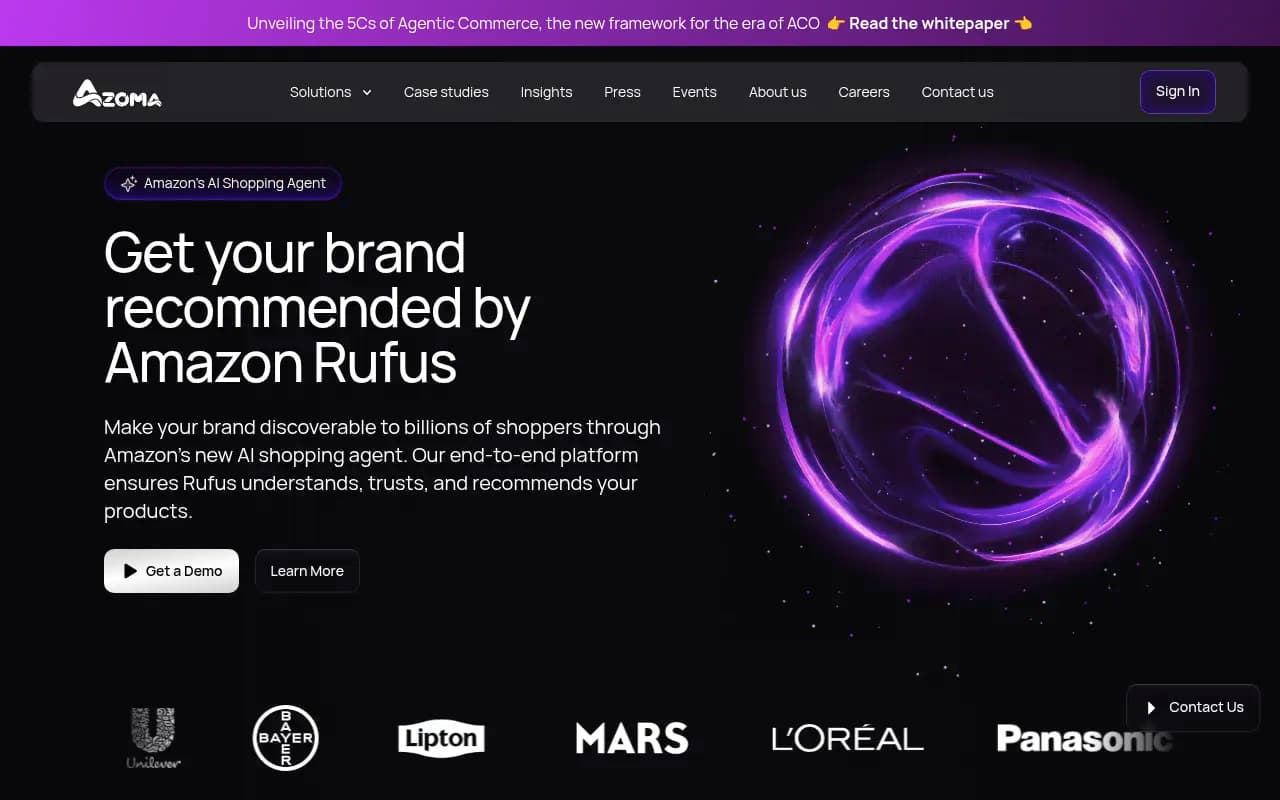
Azoma, formerly Ecomtent before its May 2025 rebrand, is an Agentic Commerce Optimisation platform founded by Max Sinclair, a six-year Amazon veteran who owned the browse and catalogue experience for Amazon's Singapore launch and the Amazon Grocery rollout. That background shows up in the product: Azoma's Rufus module tracks share of voice at the category, brand, and ASIN level, with a sample dashboard showing metrics like 46.7% SOV climbing 17 points over three months. Its Conversation Explorer surfaces the actual questions shoppers type or speak to Rufus, which is the closest thing to a keyword research tool for a conversational engine that doesn't expose a public API.
Azoma frames its whole approach around what it calls the "5 Cs of Agentic Commerce": completeness of structured product data, context (answering the questions shoppers actually ask), citations across the surfaces AI synthesizes from, correctness (catching AI hallucinations about your products at scale), and customer acquisition, turning visibility into revenue. It's a sensible framework because Rufus, unlike ChatGPT, doesn't reward keyword stuffing — Azoma's own positioning is that Rufus recommends products it can "confidently answer questions about," not products matching the most search terms.
Beyond Rufus, Azoma also tracks Walmart Sparky, Amazon's COSMO knowledge graph directly, Lazada's AI Lazzie, Target's AI shopping experiences, and the general LLM apps: ChatGPT (including its shopping carousel), Gemini, Perplexity, Claude, and Siri. It supports the emerging agentic commerce protocols too — the Agentic Commerce Protocol (ACP), Universal Commerce Protocol (UCP), and Agentic Merchant Protocol (AMP) — which matters more every quarter as checkout itself starts happening inside these assistants rather than on a brand's own site.
The catch is pricing and scale. Azoma runs fully custom pricing with no public tiers and no self-serve signup; one third-party roundup cites a starting point around $1,000/month, but that's not confirmed anywhere on Azoma's own site. Its customer list (L'Oréal, Unilever, Mars, Procter & Gamble, Colgate, HP, Zappos, Canadian Tire) reads like an enterprise and mid-market roster, not a small-seller tool. Ruroc's case study — going from obscurity to the #1 most recommended ski and snowboard helmet brand on ChatGPT, with a reported 14x increase in traffic from that channel — is the kind of result Azoma leads with, and it's a real result, but it comes with real budget attached.
Promptwatch: the general GEO platform that skips Rufus
Promptwatch approaches the problem from the opposite direction. It's not built around Amazon's marketplace at all — its own pricing page lists eight tracked models: ChatGPT, Perplexity, Google AI Overviews, Google AI Mode, Claude, Gemini, Meta Llama, DeepSeek, and Grok, plus coding-agent tracking for Claude Code and OpenCode. Amazon Alexa for Shopping doesn't appear on that list. If Rufus coverage is your top priority, that's a real gap worth knowing before you buy.

Where Promptwatch does shine for AI shopping is on ChatGPT specifically. Its Shopping Insights feature, available from the Business plan ($579/month), stores every product card ChatGPT surfaces with price, merchant, rating, review count, and carousel position, and matches those cards to your own catalog by exact product ID. The ChatGPT Shopping tracker layers in Visibility Score, Sentiment Analysis, and an Entity Tracker for brands, products, and competitors mentioned in responses — showing which brands ChatGPT recommends and how share of voice moves over time. That's meaningfully deeper than a basic "were we mentioned" check.
The data behind it is worth taking seriously because of where it comes from. Promptwatch's own research shows product pages are now the single most-cited content type in ChatGPT, at 22.4% of citations overall and 26.0% on commercial prompts specifically, ahead of landing pages and listicles, according to Promptwatch's ChatGPT citation data by content type for the week of September 28 to October 4, 2026. Promptwatch's ChatGPT Shopping usage data also shows that shopping features (product cards, price comparisons) attach to only a low single-digit percentage of responses across all prompt types, but that rate moves in visible steps — it roughly doubled overnight in late May 2026 before falling back weeks later — which tells you OpenAI is actively tuning when these features appear rather than leaving them to run organically. If your brand is trying to time a push for ChatGPT shopping visibility, that volatility matters more than any static benchmark.
Beyond shopping specifically, Promptwatch's broader value is that it does more than monitor. Crawler logs show which of your pages ChatGPTBot, ClaudeBot, PerplexityBot and 400+ other bots are actually reading; Content Agents can plan, write, and publish GEO-optimized pages straight to Webflow, Framer, or WordPress; and Unified Actions turns all of that into a prioritized to-do list rather than a dashboard you have to interpret yourself. Most monitoring-only competitors — Otterly.AI, Peec.ai, basic prompt trackers — stop at the "were we mentioned" question. Promptwatch goes further into fixing the problem, which is relevant for a brand trying to improve ChatGPT shopping visibility rather than just measure it.
ShopOS: a commerce agency wearing a software jacket
ShopOS is the hardest of the three to pin down from public materials, mostly because the company blocks automated scraping of its own site. What's visible is that it positions itself as "the deployment team brands trust," pairing AI tooling with human staff who create content, manage ad returns, build AI-search visibility, and improve a brand's Shopify store. That's a materially different product category from Azoma or Promptwatch — it reads closer to a managed commerce agency with software layered on top than a self-serve AI-visibility analytics platform.
ShopOS has reportedly raised $6.5M, with backing that includes Flipkart co-founder Binny Bansal, and offers a "Brand Audit" feature where you enter a brand name, category, and URL and get an AI Visibility Rank versus competitors within about a minute — a lightweight scoring tool similar to the free audits several GEO platforms offer, bundled inside a broader commerce-OS product rather than sold as a standalone subscription.
There's no evidence of a dedicated, named Rufus or Alexa for Shopping optimization module comparable to Azoma's. ShopOS's public messaging centers on Shopify storefronts, paid ads, and general AI-search visibility rather than Amazon-specific agent coverage. If your business runs primarily on Shopify and you want a team that executes rather than a dashboard you have to act on yourself, it might fit. If you sell meaningfully on Amazon and need defensible ASIN-level Rufus data, it's not built for that job — at least not based on anything publicly documented.
Side-by-side comparison
| Platform | Rufus / Alexa for Shopping coverage | ChatGPT Shopping coverage | Pricing model | Best for |
|---|---|---|---|---|
| Azoma | Deep — ASIN/brand/category share of voice, Conversation Explorer, correctness/hallucination checks | Included, part of broader "5 Cs" framework | Fully custom, no public tiers (reportedly from ~$1,000/mo) | Brands with meaningful Amazon revenue, mid-market to enterprise |
| Promptwatch | Not tracked — absent from current pricing page's model list | Strong — product cards with price, merchant, rating, carousel position; Shopping Insights on Business plan | Published tiers, $95-$579/mo, 7-day free trial | Brands prioritizing ChatGPT, Perplexity, Google AI Mode over Amazon, who also want content generation and crawler-level data |
| ShopOS | None publicly documented | General "AI-search visibility" claims, not Amazon-specific | Not publicly disclosed | Shopify-first DTC brands wanting a managed team, not just a dashboard |
So which one should you actually use
If a meaningful share of your revenue runs through Amazon, Azoma is the more defensible choice for Rufus specifically — it's the only one of the three that was built with Amazon's recommendation logic as the starting assumption, not an add-on. The custom pricing and lack of self-serve signup will put off smaller sellers, but the customer list (L'Oréal, Unilever, Mars) suggests it's doing real work for brands with real Amazon exposure.
If ChatGPT, Perplexity, and Google's AI surfaces matter more to your business than Amazon — which is increasingly the case for DTC and non-marketplace brands — Promptwatch is the stronger general-purpose platform, with the caveat that you'll need a separate tool or Azoma itself if Rufus coverage becomes important later. Its advantage over narrower prompt trackers isn't just coverage breadth; it's that the same platform that tells you where you're invisible also has the Content Agents and Unified Actions to go fix it.
ShopOS is worth a look mainly if you want execution help on Shopify and ads bundled with lightweight AI-visibility reporting, rather than a standalone analytics product you'll operate yourself. It's not currently a serious contender for Rufus-specific optimization based on what's public.
For most brands selling across more than one channel, the realistic setup right now is Azoma (or a Rufus specialist) for Amazon alongside a broader GEO platform for everything else — there isn't yet a single tool that does both jobs at full depth. If you want to see how the two dozen or so platforms in this space stack up more broadly, the directory of GEO software at bestgeosoftware.com and the rankings at aisearchtoolrank.com are both useful starting points before you commit budget.