Key takeaways
- AI visibility for medical and dental practices follows a cliff, not a slope: practices in Google's top 10 map pack get named by AI engines 82% of the time, but that drops to 47% for the next ten spots and 30% below that, according to Identity Dental's 2026 study of five US cities.
- Health content is YMYL (Your Money or Your Life) territory, and Google's 2025 rater guideline updates widened that scope while adding explicit language penalizing AI-generated "filler" content at scale — a direct hit against the duplicate city-page template most multi-location practices run.
- "Near me" is a dead phrase in AI search. ChatGPT silently rewrites it into a city name behind the scenes, so your pages need to say "dental implants in Naperville," not "near me," to be matched at all.
- Consumer ChatGPT and Claude.ai are not HIPAA compliant, and law firms warn that the same chatbot can be compliant on an enterprise account and non-compliant the moment a staff member logs in from a personal device.
- Government and research sources (NIH, PubMed, FDA) take roughly 7% of all healthcare citations in ChatGPT, more than hospitals, directories, and medical associations combined — which tells you exactly what kind of sourcing builds trust with these models.
Why this is a different game than ranking a dentist's website in 2020
For a long time, local SEO for medical practices was mostly about three things: a tidy Google Business Profile, a pile of five-star reviews, and consistent NAP (name, address, phone) data across directories. That still matters. But a second search behavior has opened up next to it, and it runs on completely different rules.
Patients are now asking ChatGPT, Gemini, and Perplexity things like "who's a good dentist in Hoboken" or "find me a dermatologist near downtown Austin who takes new patients." The assistant doesn't hand back ten blue links. It hands back three to five names in confident prose, and if your practice isn't one of them, you don't exist in that conversation at all.
Identity Dental ran exactly this test across five US cities in 2026 — McKinney TX, Arlington Heights IL, Manhattan Beach CA, Hoboken NJ, and Naperville IL — comparing Google Places rankings against what ChatGPT, Gemini, and Perplexity actually recommended for 118 practices.
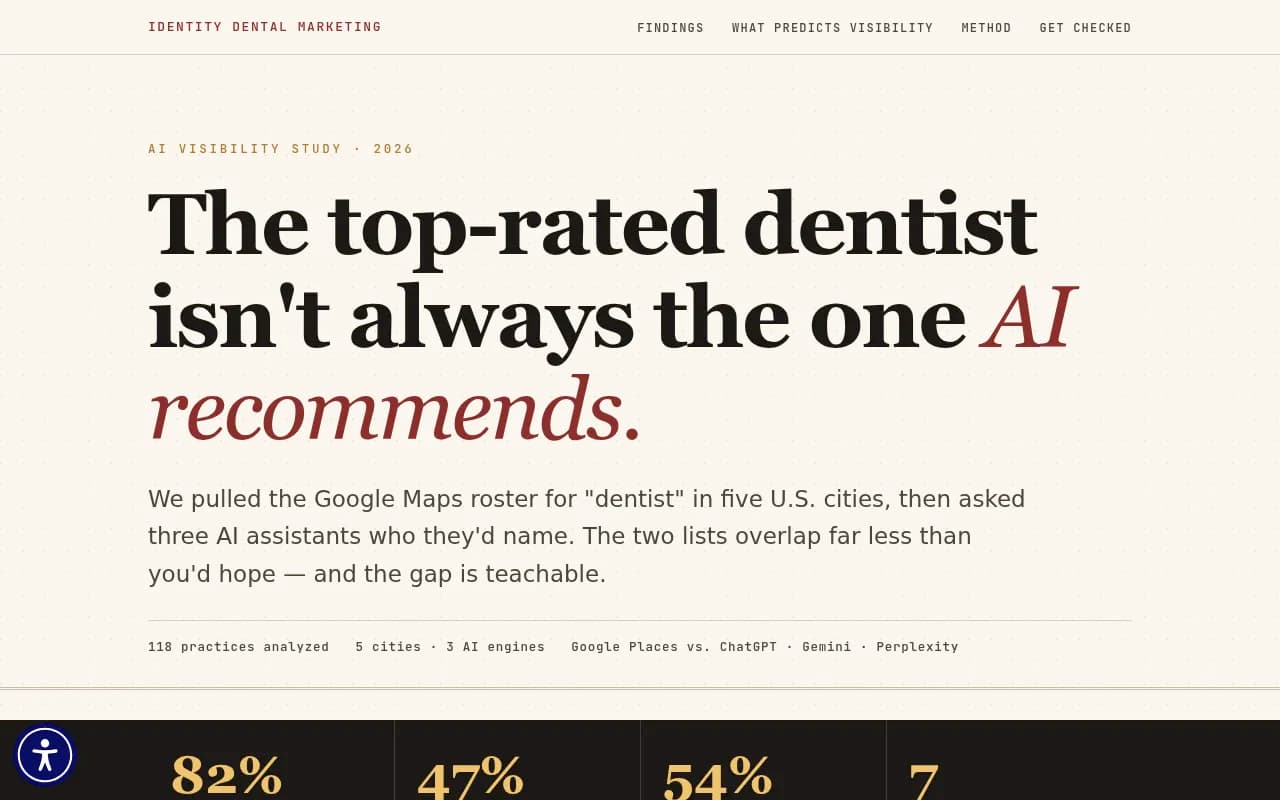
The findings are blunt. 82% of practices sitting in Google's top ten Maps results got named by at least one AI engine. Drop to the next tier, positions roughly 11 through 20, and that falls to 47%. Keep going further down and it's 30%. Google Maps position was the single strongest predictor the study found — AI-named practices averaged Maps position 8.5, while practices the AI engines skipped averaged position 13.2.
A few other things stood out. Having the city name baked into the practice name ("Naperville Family Dentists") seemed to help. Review counts, once a practice cleared the top-10 threshold, basically stopped mattering as a differentiator — star ratings clustered between 4.7 and 5.0 across nearly every practice, so there was nothing left to distinguish on. And keyword-stuffed domains like dentistnapervilleil.com got zero credit; that domain's owner was never named by a single engine. Third-party press and editorial roundups didn't move the needle either — almost every practice sat at the floor of external-authority scoring.
The part worth sitting with: 54% of AI-named practices were named by only one of the three engines tested. There's no consensus mechanism here. ChatGPT, Gemini, and Perplexity each pull from slightly different signals, so "winning" AI visibility isn't one battle, it's three separate ones running in parallel. And seven of the 69 AI-named practices never appeared in Google's top tiers at all — an AI-only discovery path that traditional local SEO would have completely missed.
The $185 billion directory problem
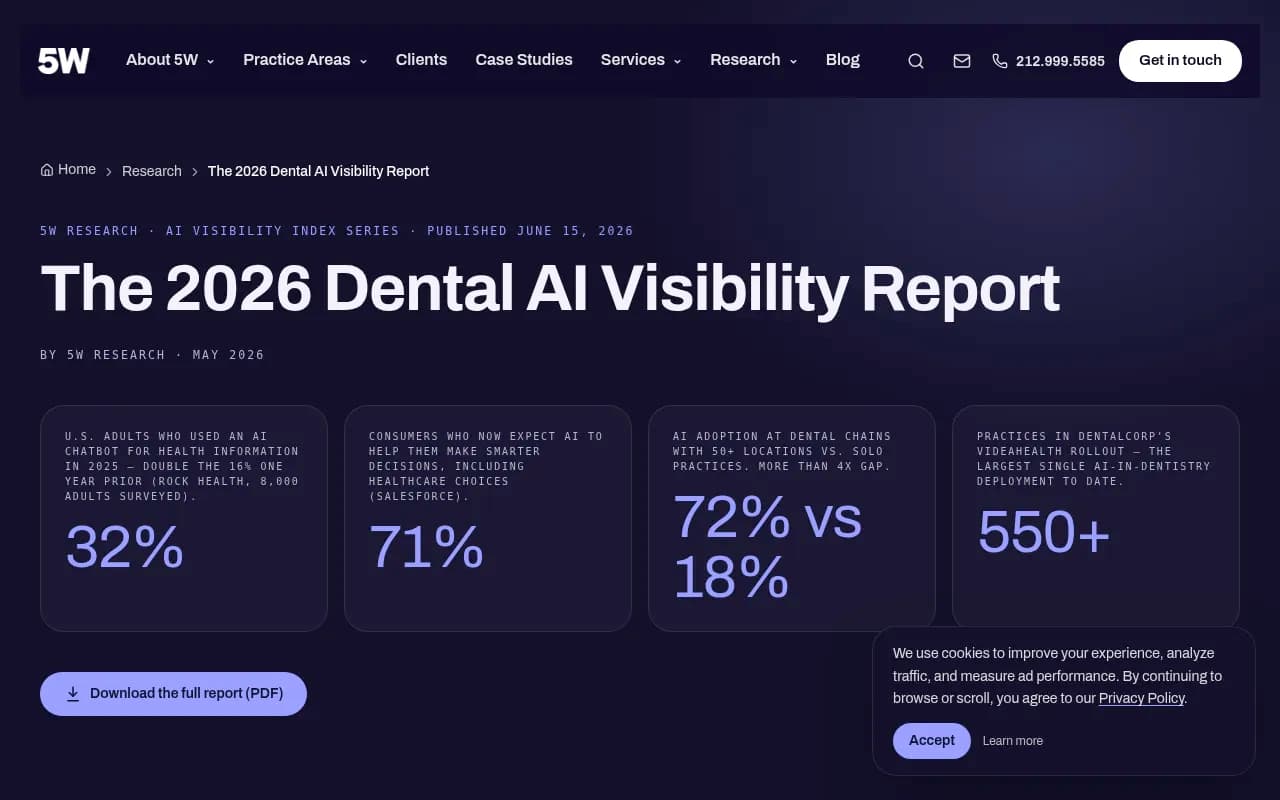
5WPR's 2026 dental AI visibility research puts a number on why this matters: 32% of US adults now use AI tools for health research, but a small cluster of nine directory properties owns essentially every dental citation AI models pull from, creating what the firm calls a $185 billion visibility gap for independent practices competing against directory incumbents.
This tracks with what Promptwatch's own citation data shows across healthcare broadly. In its ChatGPT healthcare citation breakdown for September-October 2026, NIH alone accounts for 5.46% of all healthcare citations in ChatGPT, more than FDA, NHS, CMS, and SAMHSA combined. Government and public-health sources together take 7.06% of citations, the single largest source-type bucket, ahead of medical research sites, medical associations, and hospitals. Review and directory sites like Doctify and WebMD doctor profiles each earn a thin 0.23%. That's a signal worth taking seriously: AI models lean toward research-backed sources over marketing-adjacent directories, which means a dental practice citing clinical guidance correctly and consistently is doing more for its AI visibility than another directory listing ever will.
YMYL rules just got stricter, not looser
Google updated its Search Quality Rater Guidelines in January and September 2025, and the changes matter for anyone running a multi-location medical or dental site. Health and safety YMYL status now explicitly covers anything that could "potentially impact people's health, financial stability, or safety, or the welfare or well-being of society." That's a clarification of existing policy, not new territory, but the January 2025 update added something sharper: explicit "scaled content abuse" language. Content that's copied, paraphrased, low-effort AI-generated, or filler produced at scale gets the lowest quality rating, "regardless of if a human or AI created it."
Read that again in the context of a 12-location dental group that swaps the city name into an otherwise identical service page template. That's precisely the pattern the update targets. Remedo, Firegang, and MediaNV all flag duplicate or thin city pages as the number one structural SEO mistake for multi-location dental and medical practices going into 2026, and the rater guideline update gives that mistake a name.
The fix isn't complicated, it's just slower than templating. Each city page needs something that couldn't exist anywhere else: a named clinician with a real bio, first-person language about what that specific office actually does ("In our Naperville office, we see a lot of sports-related dental trauma because of the youth hockey leagues nearby"), original photos of that location, and patient outcomes or case notes specific to that team. Experience is the one E-E-A-T signal AI can't fabricate. A model can summarize expertise from a textbook. It can't invent twelve years of actually doing root canals in a specific suburb.
"Near me" doesn't mean what you think it means to an AI
Here's a detail that trips up a lot of practices still writing copy for 2019 SEO. ChatGPT determines a user's rough location from IP address, then silently rewrites "near me" prompts before it ever searches. OpenAI's own documentation gives the example: "good restaurants near me" becomes the actual search query "top restaurants San Francisco." Google's AI surfaces do the same thing with device-level location, more precisely.
The practical upshot is that optimizing your page copy for the literal phrase "dentist near me" is wasted effort in AI search, because the model throws that phrase away before it queries anything. What it searches for instead is the city name. So the phrase that actually needs to live on your page, in your headings and your service descriptions, is "dental implants in Naperville" or "pediatric dentistry in Hoboken," not "near me." The more specific the city or neighborhood name in both the prompt and your content, the more confident the model gets about local intent, and the more likely it narrows its answer to nearby practices instead of national brands or directories.
The HIPAA trap hiding inside AI chatbots
There's a compliance issue specific to medical and dental practices that doesn't show up in generic AI visibility advice. Consumer-tier ChatGPT (Free or Plus) and the consumer Claude.ai interface are not HIPAA compliant. OpenAI and Anthropic don't sign Business Associate Agreements for those tiers, and conversation data may be used for model training. ChatGPT Enterprise and Claude's API deployments can be HIPAA-compliant, but only under a signed BAA with proper configuration, and Gemini-in-Chrome is explicitly excluded from BAA coverage altogether.
Holland & Hart's guidance on this is worth repeating because it catches people off guard: a signed BAA is necessary but not sufficient. The exact same chatbot product can be compliant on a practice's enterprise account and non-compliant the second a staff member opens the same app on a personal phone. That's not a theoretical risk — over 41 million patient records have been exposed in recent healthcare breaches tied partly to non-compliant AI tooling, and HIPAA penalties run from $100 to $50,000 per violation, up to $1.9 million annually per category. If your front desk is using a free AI tool to draft patient communications, that's the gap to close first, before worrying about AI search visibility at all.
What actually moves the needle, city by city
Pulling the research together, here's where to spend effort for a practice trying to be visible when AI answers local health queries.
Get the GBP foundation right first
Google Business Profile signals account for 32% of local pack ranking weight, the single largest factor, per BrightLocal's 2026 benchmarking. Practiwrite's Q1 2026 study of over 2,000 dental GBP profiles found the top 10% of profiles generate 3x the profile actions and get 7x more clicks and calls than average, driven by consistent posting, responding to every review, and uploading 25+ photos. This foundation matters for AI visibility too, since Google Maps position was the strongest single predictor Identity Dental found for AI naming.
Write for the city, not for "near me"
Every service page should name the actual city or neighborhood explicitly and repeatedly, not rely on "near me" phrasing the AI discards anyway.
Differentiate each location page with real content
Named clinicians, original photos, location-specific case notes. Templated city pages are exactly what the 2025 scaled-content-abuse language targets.
Cite the sources AI already trusts
Link out to NIH, PubMed, FDA, or specialty association guidance when discussing procedures or conditions. Government and research sources take over 7% of healthcare citations in ChatGPT, well ahead of directories.
Lock down HIPAA before adding AI chat tools
Any patient-facing AI chatbot needs a signed BAA covering the chatbot vendor, the underlying model, and the hosting infrastructure, and staff need policy guardrails against using personal-tier tools for anything patient-related.
Track visibility across engines separately
Since 54% of AI-named practices were named by only one engine, winning ChatGPT doesn't mean you've won Gemini or Perplexity. Treat them as three separate campaigns.
Tooling: what's actually built for this, and what isn't
A fair warning before recommending tools: none of the major AI-visibility platforms currently on the market ship medical or dental-specific compliance features, like HIPAA-aware prompt tracking. Pricing and feature sets across the category are generic, vertical-agnostic products. That's a real gap for YMYL-sensitive buyers, and it means a practice's compliance and content review process has to sit outside whatever visibility tool it chooses.
With that caveat, here's how the relevant categories break down.
| Tool | Category | Starting price | Best fit for a practice |
|---|---|---|---|
| Promptwatch | AI visibility + content action | $95/mo (Essential) | Tracking prompts like "best dentist in [city]" across ChatGPT, Gemini, Perplexity, and AI Overviews, with crawler logs and automated content generation to fix gaps, not just report them |
| BrightLocal | Local SEO / citations | Custom | Multi-location NAP consistency and directory management |
| Birdeye | Review management + AI search | Custom | Multi-location reputation at scale, review collection workflows |
| Yext | Multi-location listings | Custom | Large DSOs managing dozens of locations' structured data |
| Local Falcon | Geo-grid rank tracking | Custom | Visualizing exactly where in a city your Maps ranking drops off |
For a single-location practice, basic GBP hygiene and the content fixes above will get you most of the way there. For a multi-location group or DSO managing visibility across a dozen cities, something that tracks prompt-level visibility by city and surfaces where your content is thin compared to what AI engines are actually citing becomes worth the investment.
Promptwatch tracks visibility across ChatGPT, Gemini, Claude, Perplexity, and Google AI Overviews with state and city-level tracking, which matters a lot for a practice chain where visibility in Naperville and visibility in Arlington Heights are two entirely different problems. Its crawler logs also show whether AI bots are even reaching and reading your city pages correctly, which is often the first thing to check before assuming a content or trust problem.

A note on which domain-authority tier actually matters
One more data point worth knowing before you panic about competing with big hospital systems or directory sites. Promptwatch's domain-rank citation breakdown for August 2026 found mid-authority sites (DR 46-75) take about 46% of ChatGPT citations, while the very top tier (DR 91-100) fell to around 3% by mid-month, and even the lowest authority bucket (DR 0-15) out-cited the top tier by month's end. A solid, well-maintained practice website doesn't need Mayo Clinic-level domain authority to get cited. It needs clear, specific, trustworthy content about what it does and where it does it.
Where to go from here
If your practice runs multiple locations, the biggest mistake to fix first is almost always the duplicate city-page template, because it works against both Google's YMYL quality raters and AI engines looking for genuine local experience signals. After that, audit whether any patient-facing AI tools in your workflow actually have a signed BAA, because that's the compliance risk nobody's AI visibility strategy accounts for. For a broader look at dedicated GEO platforms built for tracking this kind of local, multi-city visibility, the directory at bestgeosoftware.com is a reasonable starting point for comparison shopping.